正在加载视频...

视频加载失败

Founders chasing venture scale should take a page from the oldest playbook: repeatable, proven, capital-efficient growth--Franchises. They print free cash flow. VCs love to talk software, but let’s not forget—classic models like franchises often allocate capital better than your favorite SaaS. Will Quist on TBPN with Jordi Hays and...

20,924 次观看 • 1 年前 •via X (Twitter)

9 条评论

maitham 的头像
maitham1 年前

@joseflchen

Inc. 的头像
Inc.2 年前

Are you ready to make your next business move? Explore podcasts such as Your Next Move, videos and audio clips from fellow entrepreneurs, and so much more at Capital One’s business hub. #ad.

Jeff Weinstein 🇺🇸 的头像
Jeff Weinstein 🇺🇸1 年前

Love this

Luckyram9887 $TUT base.eth (🧙) 的头像
Luckyram9887 $TUT base.eth (🧙)1 年前

Your Twitter add this token dev ?

Luckyram9887 $TUT base.eth (🧙) 的头像
Luckyram9887 $TUT base.eth (🧙)1 年前

One reply please dev ?🙏

Arsen Ibragimov 的头像
Arsen Ibragimov1 年前

Franchises are underrated in this convo tbh

antonio 🇺🇸 的头像
antonio 🇺🇸1 年前

Would have to agree here.

Arpan Punyani 的头像
Arpan Punyani1 年前

@honam I think Trinity invested in Starbucks back in the day correct?

Bitget 的头像
Bitget1 年前

😎

相关视频

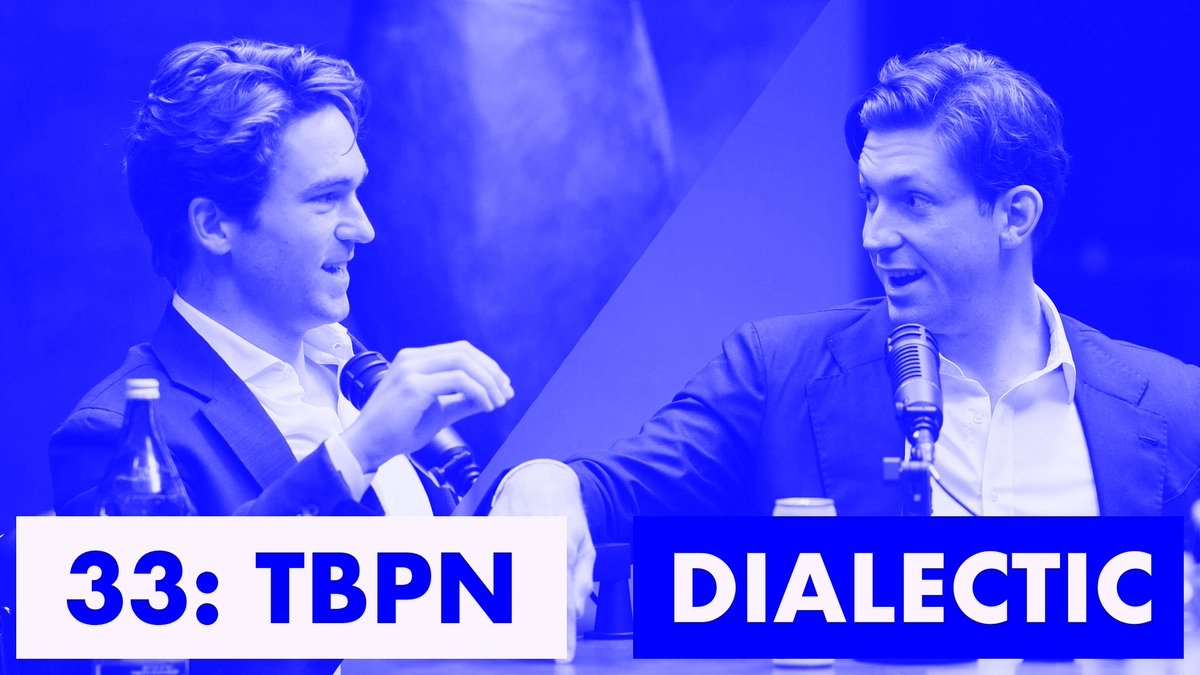
Ep. 33: TBPN (John Coogan & Jordi Hays) - Inside Tech's Water Cooler John Coogan and Jordi Hays are the hosts of TBPN, a daily live show covering the technology business. TBPN was launched only about a year ago, but has become a mainstay in tech culture and a center of gravity for terminally online technologists. John was previously an EIR at Founders Fund and tech YouTuber. He co-founded Lucy Nicotine and Soylent. Jordi has co-founded and invested in many business including Party Round/Capital and Branded Native, a podcast and youtube ad network. We cover the origins of TBPN, or the Technology Business Programming Network, from its beginnings as "Technology Brothers" to the interplay between John's love for technology and Jordi's for business. They share how they've built a media business in an era of infinite competition by leaning into high volume and constant iteration, all while treating media as the "main thing." We discuss brand building and innovating on form by borrowing ideas from outside the tech industry—from Formula One and SportsCenter to Hollywood films—to avoid tech's tendency toward circular references. We also talk about their focus on X/Twitter and a niche, highly informed audience, rather than trying to go too wide. We also chat about what makes their partnership work and how they take the work incredibly seriously while not taking themselves seriously at all. Timestamps: 0:00 - Opening Highlights 3:18 - Intro & Background 6:08 - Technology vs. Business and the Strategy behind TBPN 12:08 - Building a Media Business when Distribution is not Scarce 22:26 - Being Entrepreneurs and Talent 30:33 - Avoiding Audience Capture 35:57 - Why Advertising is a Good Model 44:04 - Technology's Circular References and Borrowing Ideas from New Places 53:20 - Narrow vs. Wide Appeal 59:44 - X (Twitter)-First Content and Other Platforms 1:14:35 - Making Content People Want to Share and Taking Yourself Seriously and Unseriously 1:20:28 - Valuing Brand 1:30:10 - Balancing Focus and Iteration 1:35:25 - Endurance & Evolution 1:40:34 - A Day in the Life of TBPN & Learning to be Newscasters 1:49:59 - Jordi & John as a duo, Will Manidis, and the beginnings of TBPN 2:02:57 - Grab Bag: Bias to Action, 15 Minute Interviews, Not Journalism, Talent, and Domination of Spirit Available on all platforms. Full transcript and all links available below.

Dialectic with Jackson Dahl

170,839 次观看 • 9 个月前

Q: What are VCs looking for in the companies they fund? Marc Andreessen, founder of Netscape and venture firm a16z, explains in the clip below that venture capitalist business is a game of outliers: “The conventional statistics are that about 200 of the 4,000 venture-fundable companies per year will be funded by a top-tier VC. About 15 of those will someday get to $100MM of revenue, and those 15 will generate something on the order of 97% of all of the returns for the entire category of venture capital in that year.” He continues: “Venture capital is such an extreme feast or famine business. You’re either in one of the 15 or you’re not.” Most VCs are looking for extreme outliers, and when they’re evaluating your startup, they’re asking themselves if this business is one of the 15 businesses that year that will get to $100MM in revenue. One principle Marc believes helps firms invest in outliers is: invest in strength rather than lack of weakness. “The default way to do venture capital is to check boxes: really good founder, really good idea, really good product, really good initial customers. Check, check, check, check. ‘Ok this is reasonable, I’ll put money into it.’ But what you find with those checkbox deals is that they don’t have something that makes them really remarkable and special. They don’t have an extreme strength that makes them an outlier.” The takeaway for founders here is to make sure they highlight to VCs during the funding process that they have a really extreme strength across an important dimension.

Michael McGuiness

587,670 次观看 • 3 年前

John Collison on three things founders can learn from Elon Musk Stripe co-founder John Collison says he found the Walter Isaacson biography of Elon Musk to be a useful resource for studying “The Elon Method.” John came away with three important learnings from it: #1 Pick the right high-level metric to optimize for John observes that Elon always picked a sensible metric to optimize for with every business he ran. With SpaceX, for example, Elon focused the company on “dollars per kilogram to orbit.” Tesla’s focus on “deliveries per week” is another non-obvious example: “You could’ve focused on revenue, profitability, or deliveries per year,” John observes. “The focus on the number of deliveries per week rolling off the factory line was itself an interesting choice for a high-level metric.” #2 Create a sense of urgency “People talk about this as ‘inventing crises,’” John explains. “But I think the generous version is shortening the time horizons. Elon was talking about (when he was sleeping on the gigafactory floor) how ‘Tesla will go bankrupt if we don’t do this and figure out Model 3 production.’ Tesla was a $200 billion company by market cap at that time . . . but he created a sense of urgency with sleeping on the factory floor, which clearly shortens the timeline.” #3 Be capital efficient “I think hardware companies can be really self-indulgent with capital, where they say, ‘Venture capitalists will fund my vision of exploration for five or ten years.’” John gives robotics as an example: “It’s like, ‘I’ll do my science project for ages and then I’ll maybe figure out a product and how to commercialize it,’ . . . but Elon’s companies have always been very capital efficient. They build a bad one and then build a good one. The Boring Company bought commercial tunnel-boring machines before they started developing their own. Tesla had the masterplan where they built the low-volume roadster before they got to the high-volume stuff. SpaceX, for what they do, has never actually burned that much capital.” Video source: Stripe (2025)

Startup Archive

106,755 次观看 • 10 个月前

Marc Andreessen on what VCs look for in startups “The conventional statistics are that about 200 of the 4,000 venture-fundable companies per year will be funded by a top-tier VC. About 15 of those will someday get to $100MM of revenue, and those 15 will generate something on the order of 97% of all of the returns for the entire category of venture capital in that year.” He continues: “Venture capital is such an extreme feast or famine business. You’re either in one of the 15 or you’re not.” As Marc explains, VCs are looking for extreme outliers, and when they’re evaluating your startup, they’re asking themselves if this business is one of the 15 businesses that year that will get to $100MM in revenue. One principle Marc believes helps firms invest in outliers is investing in strength rather than lack of weakness. “The default way to do venture capital is to check boxes: really good founder, really good idea, really good product, really good initial customers. Check, check, check, check. ‘Ok this is reasonable, I’ll put money into it.’ But what you find with those checkbox deals is that they don’t have something that makes them really remarkable and special. They don’t have an extreme strength that makes them an outlier.” The takeaway for founders here is to make sure they highlight to VCs during the funding process that they have a really extreme strength across an important dimension. Video source: Y Combinator (2014)

Startup Archive

23,116 次观看 • 4 个月前

Founders and VCs fall into the same growth trap year after year: A startup launches in a niche market. Early traction looks great, everyone’s cheering, and capital chases the curve. Then the curve flattens—because the total addressable market (TAM) is already tapped out. Growth stalls, morale tanks, and the company fades. "The walking dead". However, the truth is, the growth treadmill never stops. If you raise venture money, you’re stepping on a treadmill that can’t slow down: • $10M in revenue this year? Next year has to be $20M. • $100M this year? Next year needs to be $150M. • Hit $1B? Now shoot for $1.2B—minimum. That pace only works when your market is huge and continues to expand. Otherwise, momentum dies the moment you hit the ceiling. Take a certain company that raised $15M+ to build a...precision tea infuser. The early signs were great: • Design awards • Media buzz • 500K servings brewed across 20 countries But most casual tea drinkers didn’t want a $999 machine, and true tea lovers preferred hand-brewing. The TAM was tiny. Growth flat-lined, and the company shut down in 2017, not because the product was bad, but because the ceiling was low. Whether you’re building the company or investing in it, the growth trap looks the same: early numbers sparkle, emotions spike, and rational TAM math goes quiet. Here’s how to keep your footing on either side of the table: Founders: • Decide upfront: is it a lifestyle business (great!) or venture-scale machine? • If it's venture-scale, remember revenue must compound aggressively every single year. • Validate the ceiling, not just initial demand. VCs: • Don’t get hypnotised by the first uptick. • Pressure-test the TAM and the speed at which it caps out. In other words - if you concentrate on building a company that can truly have world impact - you'll escape the gravity of the growth trap. But incremental ideas simply will not. It's what people call "a feature not a product". Early traction is proof you’ve built something people want. It is NOT proof there’s enough headroom to keep doubling. If the honest answer to “Can this keep compounding?” is no, then change the plan—or the funding model—before the treadmill throws you off.

seth sternberg

21,432 次观看 • 1 年前

Some personal hot takes from AI: engineer Miami follows... 1. Software development is a dead-end profession because anyone can be a software developer now. 2. Anyone can use Cursor or any other tool and generate code. Being a coder and being a software engineer are different. 3. Computers used to be gated; now everyone has the power to make computers malleable. Everyone is a software developer now, but that does not mean they are software engineers 4. If you cannot demonstrate how a coding agent works, you are just a consumer and have imposed an artificial glass ceiling on your career as a software engineer. 5. If you are curious, you will have a job. If you have not been curious in the last two years, you are replaceable. 6. SaaS per-seat economics may become unstable as customers need fewer people to achieve results, prompting founders to think about new unit economics 7. Most companies will take two or three years (or more!) to figure out AI transformation. 8. Some companies are already building AI native teams of five to ten people who can build with the grain of AI 9. There will be an explosion in the number of software developers. Software development is now essentially free, and tokens are cheaper than humans 10. Not enough engineers know what it means to be a product engineer 11. JIRA ticket monkeys are cooked 12. If your company has banned AI, you should quit that company 13. AI is more like a musical instrument than just a tool play with it, make discoveries, build intuition learn where AI is good and where it fails

geoff

64,193 次观看 • 1 个月前

In 2026, Venture Capital will eat Private Equity It used to be that venture capital and private equity lived on two separate planets: VC = San Francisco PE = New York They targeted completely different universes of companies: --> PE - people heavy biz services, stable/low growth, predictable cashflows --> VC - tech-forward, high growth, high risk, massive TAM What was the playbook for B2B VC backed startups? --> Grow to unicorn scale by selling to other early adopter tech companies, then Fortune 500s XX> SMB and mid-market services - think field services, IT staffing, accounting, construction, recruiting - were always tough to sell into for startups Why? -->Thin margins, high labor costs, and small IT budgets >> But as AI eats labor, these businesses are in play << There are 3 ways where VC and PE are colliding: 1/ Private Equity funds will become channel partners for startups. PE funds are focused on financial engineering and cost optimization. Startups building AI products and services can sell across their portfolio to automate the backoffice and uplevel sales and marketing. PE funds have made AI their #1 strategic priority and have hired central leaders to oversee their portfolio adoption efforts 2/ PE portfolio pages are a startup idea menu Private equity will often buyout vertical software companies whose TAM didn’t allow venture scaled returns. As software evolves from data storage and collaboration to agents taking action and completing work, AI should massively expand the TAM for these categories. Founders will set their sights on unseating these legacy incumbents backed by private equity. All they have to do is look at their portfolio pages for category ideas 3/ AI Rollups This is one of the most direct ways that VC is eating PE VC backed AI platform businesses are not just selling software but acquiring legacy business services companies to own the value chain end to end. As an example, our a16z speedrun 🧊 company AgentAstra is acquiring freight forwarding services businesses with mostly debt and integrating AI deeply into their operations These companies aim to increase margins by at least 2x and make them “AI native” tl;dr - While the west coast, Patagonia-wearing VCs and the east coast, PE suits used to live in different universes, in 2026 with AI, I believe, those worlds converge

Troy Kirwin

187,300 次观看 • 8 个月前