Loading video...

Video Failed to Load

Go Home

From proven silicon to production roadmap. Arbel, NextSilicon's RISC-V CPU, is moving beyond validation and into full enterprise productization. 64-core & 128-core configurations | Targeting 3.4 GHz | Full RVA23 compliance | Built for AI, HPC, and next-generation data centers

273,402 views • 1 month ago •via X (Twitter)

0 Comments

No comments available

Comments from the original post will appear here

Related Videos

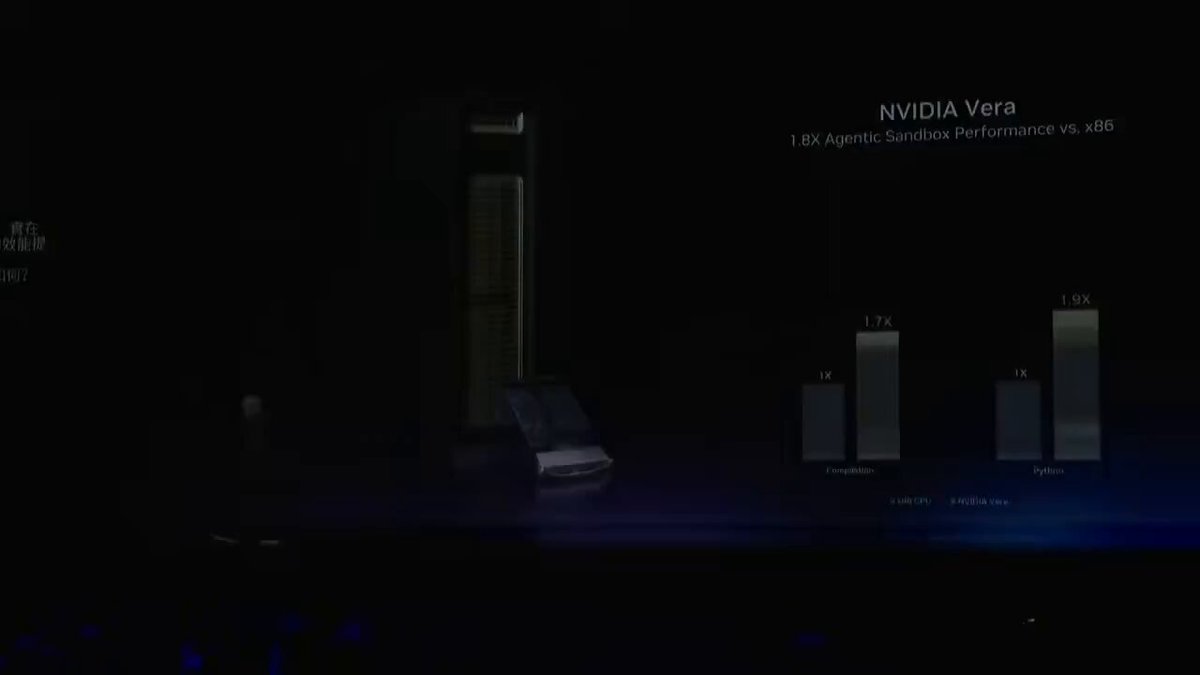
Jensen Huang just identified the next $200 billion market (Save this). The shift starts with a observation about agentic AI that changes everything about infrastructure. In the era of training and inference, the GPU was everything while CPU was a traffic cop, scheduling work, managing memory, dispatching tasks while the GPU did the heavy lifting. Agentic AI breaks that model entirely. An AI agent does not just run a single inference pass but rather it plans, calls tools, executes code in sandboxes, retrieves data from multiple sources and loops through complex multi-step reasoning sequences often thousands of times per second at scale. Every one of those operations runs through the CPU and the GPU sits idle waiting for the CPU to prepare the next task, supply the right context and execute the retrieval and tool calling logic fast enough to keep the accelerators fed. The CPU is now the conductor and the GPU is the orchestra and the bottleneck is the conductor falling behind. This is showing up in production AI factory utilization right now, which is exactly why Jensen built Vera from scratch rather than licensing x86. Vera achieves 40% lower peak memory latency than x86, 50% faster core to core communication, and 1.8 times the agentic sandbox performance of current x86 processors on a purpose-built architecture designed around the agentic loop. Now here is where the investment thesis gets interesting. The obvious beneficiary is Nvidia itself, and that thesis is real. Nvidia's CFO has guided for nearly $20 billion in Vera CPU revenue this fiscal year alone, a market Nvidia had zero presence in just three years ago. Intel held 60% of server CPU market share as recently as Q4 2025 and that transition is now happening at a pace Intel structurally cannot respond to. But the deeper question is, what architecture is Vera actually built on? Vera's Olympus cores are ARM compatible and every single Vera CPU deployed in every Vera Rubin rack in every data center in the world runs on ARM architecture. And ARM Holdings collects a royalty on every one of them. ARM does not make chips but rather licenses the instruction set architecture and CPU core designs that others build on top of. Every time Nvidia ships a Vera CPU, every time a hyperscaler deploys a Vera Rubin rack, every time an enterprise qualifies Vera for their AI factory, ARM earns a royalty. The secular tailwind here is almost perfectly constructed for ARM's business model. Amazon's Graviton, Microsoft's Cobalt, Google's Axion, Apple's silicon stack, and Qualcomm's data center push all run on ARM. And now Nvidia's Vera, which is projected to displace Intel as the largest server CPU supplier by revenue in a single fiscal year, is ARM. ARM's royalty rate on high end server chips is estimated at roughly 1 to 2% of chip selling price. At $5,000 per Vera CPU and 4 million units projected for FY2027, that is a royalty line growing from near zero to potentially $400 million to $800 million annually from Nvidia's data center CPU business alone before counting Amazon, Microsoft, Google, Apple, and Qualcomm. The total ARM addressable royalty base across all the silicon it already licenses is compounding at a rate that the current $130 billion market cap does not fully reflect. Jensen's CPU thesis is the most underappreciated catalyst in ARM's fundamental story, and the royalty compounding has barely started. Come join Milk Road Pro and get our full ARM royalty model and our entire AI trade thesis. Link below!

Milk Road AI

11,819 views • 3 months ago

Mansa AI is an enterprise-grade AI + Web3 platform designed to move artificial intelligence from experimentation into real-world execution. Built for creators, developers, and businesses, it focuses on deploying AI that actually works across modern digital systems, not just in isolated demos. 🚀 Production-ready AI infrastructure Mansa AI enables teams to deploy AI systems designed for live environments, handling real workflows, real data, and real operational demands without constant manual oversight. 🧠 Autonomous AI agents At its core, Mansa AI allows users to build autonomous agents that automate decision-making, coordinate tasks, monitor live signals, and execute complex workflows across dynamic environments. ⚙️ Fully customizable logic Agents can be configured with custom behaviors, triggers, and responses. From content generation and analytics to operational automation and intelligent orchestration, logic adapts to specific business strategies. 🔗 Web3 and off-chain integration Mansa AI bridges blockchain ecosystems with traditional systems, enabling cross-chain coordination, smart contract interactions, and seamless integration with existing enterprise infrastructure. 📊 Real-world use cases The platform supports automation for operations, customer engagement, analytics, data pipelines, content workflows, and AI-driven optimization across products and teams. 📈 Built for scale Whether launching as a startup or deploying across enterprise systems, Mansa AI is designed to scale AI operations without adding complexity or fragmentation. Mansa AI transforms artificial intelligence into deployable infrastructure. By combining autonomy, customization, interoperability, and scalability, it enables teams to own, operate, and grow intelligent systems that deliver real value in production environments.

King

155,637 views • 9 months ago

Agentic AI will transform every enterprise–but only if agents are trusted experts. The key: Evaluation & tuning on specialized, expert data. I’m excited to announce two new products to support this–Snorkel AI Evaluate & Expert Data-as-a-Service–along w/ our $100M Series D! --- Snorkel Evaluate is our new data-centric agentic AI evaluation platform for specialized, mission-critical enterprise settings where vibe checks and out-of-the-box metrics driven by simple LLM prompts are not enough. Snorkel Expert Data-as-a-Service is our white glove service for expert-level AI datasets, powering frontier LLM developers in areas like expert knowledge, reasoning, agentic action and tool use, and more! Both built on top of Snorkel AI’s Data Development Platform, using our programmatic technology to drive higher-quality expert data, faster– for getting specialized AI to real production value. If you’re building enterprise AI and want to partner around the key ingredient in AI today–the data–book a demo and let's talk! Finally, see thread for details on 🧵👇 - 📽️ A walkthrough of Snorkel Evaluate and Expert Data-as-a-Service on an agentic AI enterprise task - 📅 An upcoming event on Enterprise Agentic AI with innovators from Accenture @BNY Comcast Stanford University QBE & others - 📊 An upcoming series of benchmark datasets and model artifact releases 👀 Want early access to the full agentic AI dataset? Retweet this post and we'll send you the link!

Alex Ratner

50,393 views • 1 year ago

Core, ‌the Bitcoin-first ‌chain, and how it’s trying to stretch BTC’s usefulness Core DAO (Core DAO 🔶) brands itself as “The Bitcoin Everything Chain.” The pitch is simple: take Bitcoin’s strengths and push them beyond the usual buy-and-hold story. The protocol centers on one main idea: BTC shouldn’t sit still. Core wants idle Bitcoin to earn, but without giving up the properties people care about most: safety, decentralization, and full self-custody. To get there, Core leans on a mix of Satoshi Plus, timelocks, and a quick Layer 1 EVM chain. Satoshi Plus folds in Delegated Proof of Work (so Bitcoin miners can participate), self-custodial Bitcoin staking, and staking of the $CORE token. Core frames the relationship with Bitcoin as mutualistic. It borrows security and incentive alignment from Bitcoin, then tries to send value back through extra miner rewards, trustless yield opportunities for BTC holders, and infrastructure that makes it easier for Bitcoin products to plug in and scale. Key ways Core aims to expand Bitcoin utility: 1.) Self-custodial Bitcoin staking Lock BTC with timelocks directly on the Bitcoin network (CLTV) and earn CORE yield, no wrapping, no bridges, and no handing custody to anyone else. 2.) Dual staking Stake $BTC and $CORE together to reach higher yield tiers. 3.) Tapping Bitcoin’s hash power Miners can delegate hash power to earn extra CORE rewards, while Core itself is secured using a majority share of Bitcoin’s hash rate. 4.) The “Bitcoin Power Grid” A set of rails Bitcoin products can connect to, built around yield, collateral, payments, and DeFi use cases. 5.) Scalable Bitcoin DeFi An EVM-compatible network designed for faster, cheaper BTCFi apps. 6.) Two-way value flow The goal is to strengthen Bitcoin’s security budget over time, while also turning dormant BTC into something that can actively do work. In plain terms, Core DAO’s broader mission is to make Bitcoin more productive without piling on trust assumptions, converting energy and capital tied up in Bitcoin into yield, DeFi activity, and scalable infrastructure.

BSCN

27,175 views • 25 days ago