Загрузка видео...

Не удалось загрузить видео

На главную

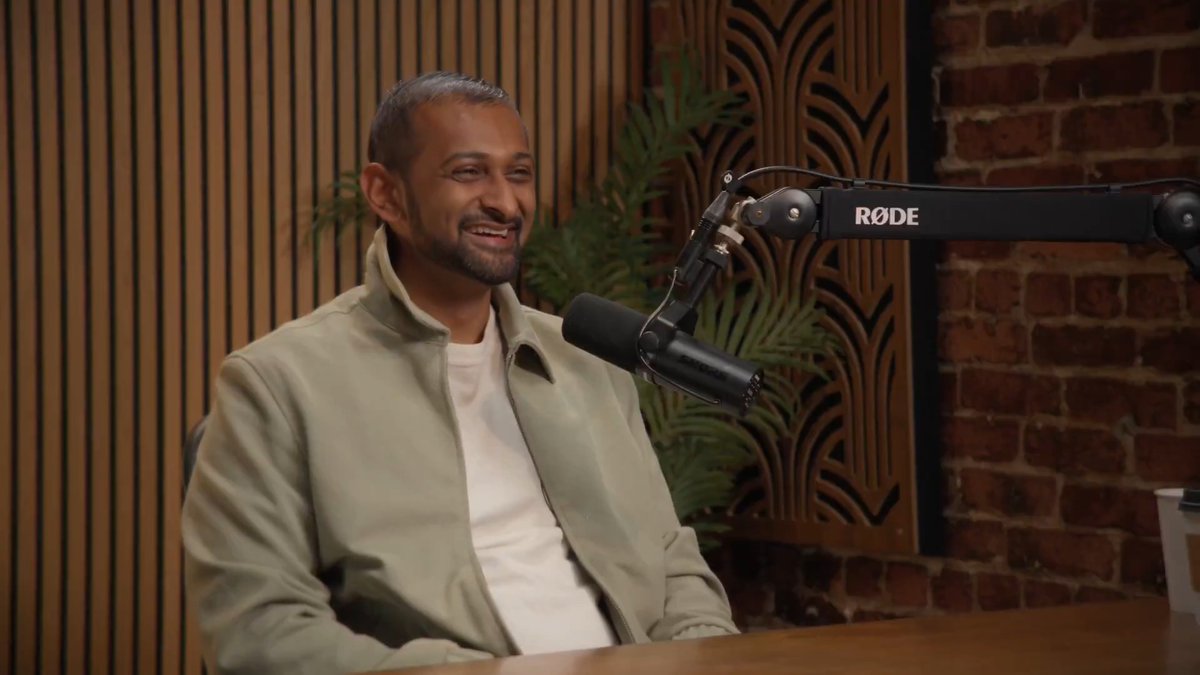
Full CludeAI $CLUDE interview w/seb Topics covered: → 2% hallucination rate vs 15% industry → Big labs are incentivized not to fix memory → ~100x token cost reduction -------------------------------- 0:00 Sovereign memory narrative 1:26 Founder background 3:28 The context window problem 9:08 Why big labs won't fix it 17:23...

13,370 просмотров • 5 месяцев назад •via X (Twitter)

Комментарии: 0

Нет доступных комментариев

Здесь появятся комментарии из оригинального поста

Похожие видео

My full interview with Roman Chernin, Co-founder & Chief Business Officer of Nebius Nebius just signed a $17 billion deal with Microsoft and a $3 billion deal with Meta. These are two of the biggest tech companies on Earth - and they're coming to Nebius for AI infrastructure. But the company does so much more than that: - Full-stack AI cloud (data centers → software → managed services) - Nebius Token Factory Nebius Token Factory for managed inference & post-training - Partners include Shopify, Higgsfield, Jetbrains My 5 takeaways with Roman Chernin below - thanks for the conversation! Full interview also available on YT ⬇️ Timestamps: 00:00 - Introduction 01:47 - Overview of Nebius $NBIS 03:23 - Roman's background and role at Nebius 04:10 - The $17B Microsoft & $3B Meta deals 05:29 - Why hyperscalers trust Nebius over building in-house 07:06 - Nebius's full-stack approach: Data centers to managed services 08:39 - Customer segmentation: Hyperscalers & Frontier AI Labs vs AI Startups vs Enterprises 14:41 - Token Factory explained: Managed inference & post-training 17:41 - When to switch from closed-source to open-source models 20:59 - Real results: Process achieves 26% cost reduction 25:05 - Why developers love building on Nebius 28:40 - AI agents and the future of infrastructure interaction 32:22 - NVIDIA's Groq acquisition: What it means for inference 35:38 - Why AI adoption will surprise us

Elliot Garreffa

29,660 просмотров • 7 месяцев назад

The new Huberman Lab episode is out: How to Improve Your Memory & Cognitive Function at Any Age | Dr. Alan Castel 0:00 Dr. Alan Castel 2:41 What Is Memory?, Reconstruction & Metacognition 4:49 Mnemonics, Remembering Names & Deeper Learning 8:22 The Penny & Apple Logo, Noticing vs Seeing, Learning Through Mistakes 10:43 Sponsors: Wealthfront & Helix 14:05 Neuroplasticity, Frustration, Curiosity & Mindset 17:42 Maintaining vs Learning New Things, Habits, Novelty & Emotional Memory 24:28 "Mental Photographs," Photo-Taking & Imagining the Future 29:28 Eyewitness Memory, the Ronald Cotton Case, Confidence vs Accuracy 35:07 Medium-Term & Prospective Memory, Hotel Fire Exits 40:28 Sponsor: AG1 41:47 When Habits Turn Lethal, Aviation & Human Error 49:01 Why Memory Changes With Age; Alzheimer's & the Nun Study 52:34 Exercise & Hippocampal Volume, Falls & Balance 57:14 SuperAgers & Athletes; Regret, Balance & Being Driven 1:12:08 Sponsor: Function 1:13:45 Age Stereotypes, Subjective Age & Positive Age Beliefs 1:20:02 Goals & Plans, Scams; Anterior Midcingulate Cortex & SuperAgers 1:26:23 Culture, Resilience, Blue Zones & COVID 1:29:18 Adversity, the Positivity Effect & Intergenerational Learning 1:36:31 Sponsor: Lingo 1:38:00 Limitations & Purpose; Time, Family & Connection 1:44:58 Deliberately Building Memories; the ABCs of Successful Aging 1:51:02 Following Your Interests; Castel's Path & Older Adults 1:57:16 Mental Simulations, Curiosity Studies & Selectivity 2:01:19 Socioemotional Selectivity Theory; Steve Jobs & Lifespan 2:07:10 The Secret to Successful Aging; State vs Trait Curiosity 2:11:04 Scams & AI Voice Cloning 2:14:31 John Wooden, Wisdom, Love & Balance 2:17:41 Learning Through Mistakes; Does the Brain Get Better With Age? 2:25:00 Conclusion, Better With Age 2:26:00 Zero-Cost Support, YouTube, Spotify & Apple Follow, Reviews & Feedback, Sponsors, Protocols Book, Social Media, Neural Network Newsletter Includes paid partnerships.

Andrew D. Huberman, Ph.D.

127,206 просмотров • 1 месяц назад

New interview: Reiner Pope, co-founder/CEO of MatX A counterintuitive throughput insight: “Low latency means small batch sizes. That is just Little’s law. Memory occupancy in HBM is proportional to batch size. So you can actually fit longer contexts than you could if the latency were larger. Low latency is not just a usability win, it improves throughput.” We get into: • The hybrid SRAM + HBM bet, and why pipeline parallelism finally works • Why sparse MoE drives MatX to “the most interconnect of any announced product” • Why frontier labs are willing to bet on an AI ASIC startup • Memory-bandwidth-efficient attention, numerics, and what MatX publishes (and what it does not) • Why 95% of model-side news is noise for chip design • The biggest challenges ahead 00:00 “We left Google one week before ChatGPT” 00:24 Intro: who is MatX 01:17 Origin story: leaving Google for LLM chips 02:21 GPT-3 and the “too expensive” problem 04:25 Why buy hardware that is not a GPU 05:52 Overcoming the CUDA moat 08:46 Early investors 09:35 The name MatX 09:59 The chip: matrix multiply + hybrid SRAM/HBM 12:11 Why pipeline parallelism finally works 14:22 Reading papers and Google going dark 15:20 Research agenda: attention and numerics 17:06 Five specs and meeting customers where they are 19:24 Why frontier labs are the natural first customer 20:32 Workloads: training, prefill, decode 22:18 Little’s law and the throughput case for low latency 24:29 Interconnect and MoE topology 26:35 Inside the team: 100 people, full stack 28:32 Agentic AI: 95% noise for hardware 30:35 KV cache sizing in an agentic world 32:11 How MatX uses AI for chip design (Verilog + BlueSpec) 34:23 Go to market: proving credibility under NDA 35:12 Porting effort for frontier labs 36:34 Biggest skepticism: manufacturing at gigawatt scale 37:32 Hiring plug Vikram Sekar

Semi Doped

19,797 просмотров • 5 месяцев назад

*Major* open source AI drop today. Can America win the Open AI race? My conversation with Nathan Lambert and Luca Soldaini 🎀 of Ai2 about the launch of Olmo 3 00:00 – Cold Open 00:39 – Welcome & today’s big announcement 01:18 – Introducing the Olmo 3 model family 02:07 – What “base models” really are (and why they matter) 05:51 – Dolma 3: the data behind Olmo 3 08:06 – Performance vs Qwen, Gemma, DeepSeek 10:28 – What true open source means (and why it’s rare) 12:51 – Intermediate checkpoints, transparency, and why AI2 publishes everything 16:37 – Why Qwen is everywhere (including U.S. startups) 18:31 – Why Chinese labs go open source (and why U.S. labs don’t) 20:28 – Inside ATOM: the U.S. response to China’s model surge 22:13 – The rise of “thinking models” and inference-time scaling 35:58 – The full Olmo pipeline, explained simply 46:52 – Pre-training: data, scale, and avoiding catastrophic spikes 50:27 – Mid-training (tail patching) and avoiding test leakage 52:06 – Why long-context training matters 55:28 – SFT: building the foundation for reasoning 1:04:53 – Preference tuning & why DPO still works 1:10:51 – The hard part: RLVR, long reasoning chains, and infrastructure pain 1:13:59 – Why RL is so technically brutal 1:18:17 – Complexity tax vs AGI hype 1:21:58 – How everyone can contribute to the future of AI 1:27:26 – Closing thoughts

Matt Turck

37,531 просмотров • 9 месяцев назад