Video wird geladen...
Video konnte nicht geladen werden
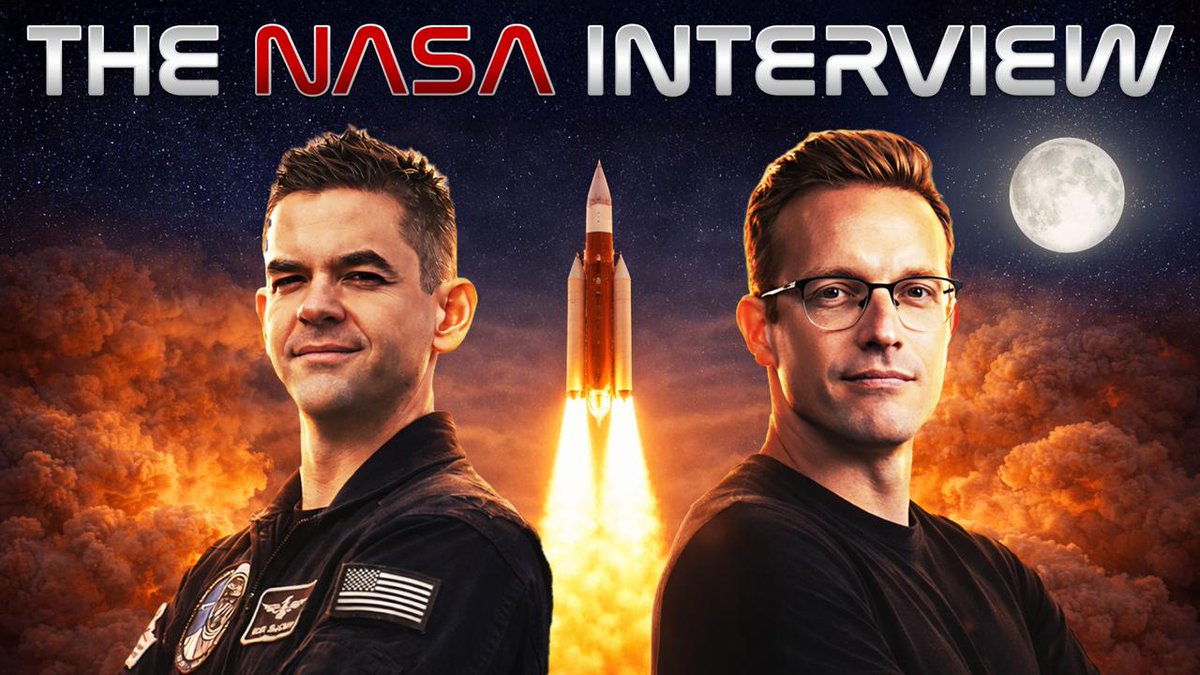
FULL INTERVIEW: Jared Isaacman says if you don't want data centers in your backyard, put them in space. The physics isn't broken, the economics are hard, and hitting pause while rivals keep building isn't a strategy. Jared Isaacman is the Administrator of NASA. He joined Theo Jaffee and sof... show more

184,472 Aufrufe • vor 10 Tagen •via X (Twitter)
22 Kommentare

@rookisaacman @NASA best interview from yesterday!

@rookisaacman @NASA :DDD

@rookisaacman @NASA Space isn't a free heatsink. There's no air to dump heat into, so you radiate or you cook. A 300K panel sheds 459 W/m2, so 100MW of waste heat needs roughly 0.11 km2 of double-sided radiator. The ISS rejects about 70 kW in total. What's the radiator mass budget?

@rookisaacman @NASA his ears are so cute :3

@rookisaacman @NASA I know it’s early but if we let Jared cook he will go down as one of the NASA goats. Up there with von Braun, Webb, Gilruth, Kraft, Roman. To the moon!

@rookisaacman @NASA damn, you guys should have asked viewers to send in questions beforehand.

@rookisaacman @NASA The most interesting part isn't putting data centers in space. It's the mindset: Don't pause because the problem is hard. Build, test the physics, solve the economics, and keep moving. That's how technological advantages are created.

@rookisaacman @NASA Forget the Dyson swarm. NASA already has the Deep Space Network sitting on the sides of this man’s head.

@rookisaacman @NASA yes.

@rookisaacman @NASA Isaacman: put the data centers in space if the backyard says no. SpaceX compute already >$1.1B a month toward $100B ARR.

@rookisaacman @NASA Yep.

@rookisaacman @NASA Our way of life depends on it. Offensive agentic activity makes easy work of the terrestrial grid. All transactions, comms, and much of infrastructure is at risk until we can secure them in this new paradigm.

@rookisaacman @NASA Awesome interview, Jared is perfect as NASA administrator

@knowerofmarkets @rookisaacman @NASA Keep kicking ass Jared!

@rookisaacman @NASA What a conversation. Space data centers and nuclear propulsion, wow

@rookisaacman @NASA worked on the gov side/ffrdc and at spacex Absolutely continues to make sense having public and private work side by side. Both has strengths and shortcomings that are fundamental.

@rookisaacman @NASA Fascinating take space data centers and NASA's future is such a big conversation

@rookisaacman @NASA Absolutely.

@rookisaacman @NASA aura is a great word for something you can't put on a NASA balance sheet

@rookisaacman @NASA Fascinating vision connecting space exploration with future infrastructure

@rookisaacman @NASA The real truth about the space race, AI and the double slit experiment. No aliens, no internet slop. The real data we all have access too.

@rookisaacman @NASA Sounds reasonable, the future of data centers is in space



![Elon Musk on how he initially got into space: “I didn't understand why NASA had nothing about people going to Mars.” “The space stuff actually came from a conversation Adeo [Ressi] and I had. Adeo asked me, what am I doing after PayPal? I said I thought maybe there'd be something philanthropic that could be done in space that would get the public more excited about space travel, in particular sending people to Mars. I said, I'm sure NASA's got that covered. So, I'll go look on the NASA website for when are we going to Mars? Because, of course, it should be on the website: We're going to Mars in this year, and this is how we're going to do it. But there was nothing. Nothing at all about people going to Mars. I was like, I just don't understand why there's nothing about people going to Mars. Because if you look at the literature in the 1970s, it was all about, we went to the moon, now we're going to go to Mars. And so, what happened? There was the Space Shuttle, and the Space Shuttle turned out to be a really big mistake. It could barely get to Low Earth Orbit. Forget about the moon or Mars or anything like that. So, I thought, maybe I can do something that's going to get the public excited about Mars, and that will generate congressional support, which will turn into funding for NASA to go do this.” Churchill Club, April 7, 2009](https://image.24vids.com/tw-1866156293481767221/ext_tw_video_thumb/1866153674789036032/pu/img/bQmCUfGsk1J8qAqL.jpg)


