Video wird geladen...

Video konnte nicht geladen werden

Zur Startseite

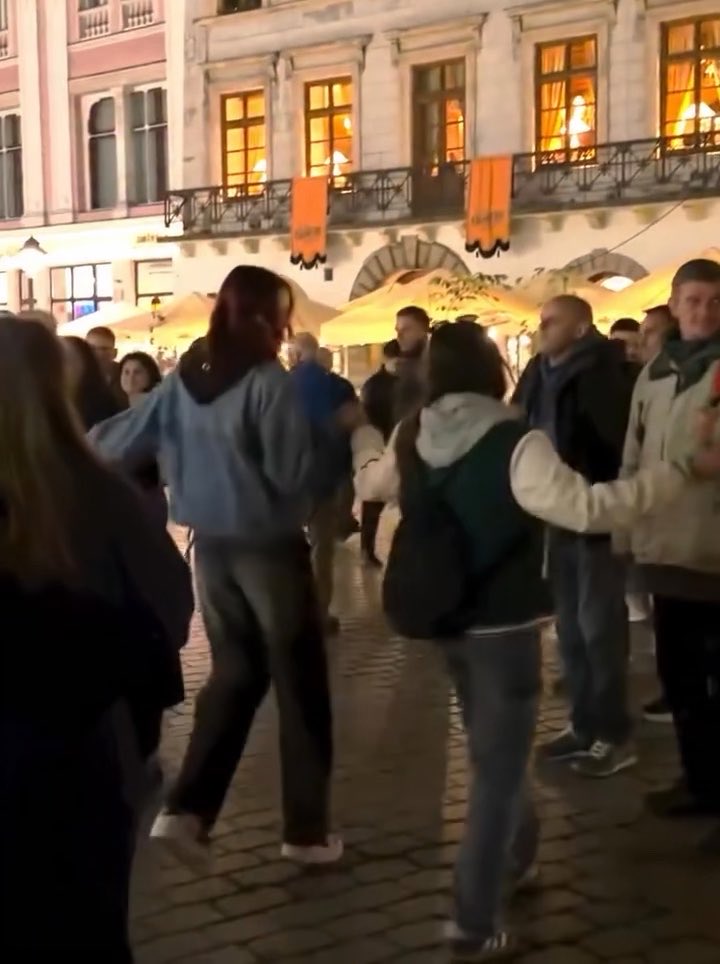
Fun Fact: Developed by John Gray, Sunriver, OR was a visionary 20-year plan aiming to “blend into the environment without insult.” It features village clusters, housing around 5,000 people. Preserving natural areas for common enjoyment, joined by 12 miles of eco-friendly paths.

12,281 Aufrufe • vor 3 Jahren •via X (Twitter)

0 Kommentare

Keine Kommentare verfügbar

Kommentare vom Original-Post werden hier angezeigt

Ähnliche Videos

🚨NO,THE GAME OF POLO WAS NOT INVENTED IN MANIPUR! 📌 The claim by Meiteis that an obscure figure named King Kangba of Kangleipak (Manipur) invented Polo (sagol kangjei) around 5140 BC or 7200 years ago is bereft of any logical foundation, historical truth or archaeological evidence. In fact, There is not a single trace of such a king in any CREDIBLE historical record, inscription or archaeological source. 🐎Even more absurdly, DNA analysis by Archeologist indicates that horse domestication began only around 2200 BC or 4200 years ago. (a full 3000 years after the fanciful legend that an obscure king of a non existing kingdom conceived a sport dependent on an animal not yet domesticated). 📍The true roots of Polo can be traced to the mounted nomads of Central Asia, who played an early form of the game which was as much a test of horsemanship & combat readiness as it was a sport. These early matches, sometimes involving up to a hundred riders per side, tested not only horsemanship but also coordination & combat readiness. 🚨By the 6th century BCE, these nomadic horsemen, ancestors of the modern Mongols & Persians had developed rudimentary forms of polo or Chovgan (čowgân), which soon spread across the vast steppes of Asia. As these tribes migrated & founded empires, they carried the sport with them into Persia, present-day Iran. There, around the 5th century BCE, polo evolved from a rugged tribal contest into a refined into a regal persuit. The Persians are rightly credited with transforming polo from a war exercise into a game of into an aristocratic team sport, eventually adopting it as their national sport. 📌 In fact, the first recorded polo tournament between the Turkomans & Persians dates back to around 600 BCE, 2600 years ago with the Turkomans emerging victorious. The term "Polo" is believed to derive from the Balti word "Pholo" or "Pulu" (Tibetan for "Willow branch"), which corrupted to "Polo" hinting at its deep cultural connections along the Silk Road. From Persia, polo's influence spread far & wide, westward to Byzantium, eastward to Tibet, China & Japan & southward into the Indian subcontinent. Each civilization not only adopted the sport but also infused it with its own traditions & values. By the 7th century CE, polo had reached as far as Japan from China. 📌 The Mughals were chiefly responsible for taking the game from Persia & reintroducing or popularizing Polo in the Indian subcontinent. It was Emperor Babur, in the 16th century who established & formalize the sport in India, where it flourished as a royal pastime. (It had already long been played in China and Japan, but had died out by the time the West came in contact with those countries). Earlier, the game's harshest incarnations even saw the use of human or animal heads in place of balls, a practice that eventually gave way to the pulu, a ball made from willow root. 📌 The British Colonial officers stumbled upon the game of Polo only in the mid 19th Century AD, when the Manipuri king, seeking British protection from Burma, threw himself upon British protection, turning his kingdom into a protectorate state under their suzerainty. Enthralled by the sport, the British carried it back to England & across Europe, dressed it in Victorian polish & gloablised it under imperial Patronage while packaging it as their latest civilised pastime. 📌 But make no mistake, The game of Polo's cradle was never Manipur's Valley & to suggest that Polo originated in Manipur is not only a distortion of history but an illusion of history. Long before Manipur's chronicles even began & thousands of years before Manipur (Kangleipak) even entered recorded time, the game of Polo had already flourished across the steppes of Central Asia for centuries, sustained by the skills of Mongolian horsemen, Persians Nobles & warriors whose bloodline predated both the British & the Meiteis by Millenia & whose ancestors knew no such name as Britain, let alone Manipur or Kangleipak.

J Shakur

14,358 Aufrufe • vor 9 Monaten

The castles of Europe are some of the most amazing things we’ve inherited from history Between 75,000 and 100,000 castles were built in Western Europe during the medieval period, with around 1,700 in England and Wales alone, and roughly 14,000 in German-speaking areas... Most of them rose between the 9th and 15th centuries after the collapse of centralized Roman authority and the rise of fragmented feudal power. As attacking armies grew more sophisticated, so did the walls meant to stop them. The cost was staggering: from 1179 to 1188, King Henry II of England spent over £6,500 on Dover Castle alone — an enormous sum given that his entire annual revenue was around £10,000. That figure was more than three times what he spent on any other building project in his reign, and more than four times what went into grand royal residences like Windsor. And then there is Malbork... Built by the Teutonic Knights in what is now Poland, Malbork is the largest castle in the world measured by land area. It covers 52 acres and once housed approximately 3,000 knights. A medieval visitor reportedly noted it seemed "more a city enclosed by walls than a single castle." In 950, Provence was home to just 12 castles. By 1000, the number had risen to 30. By 1030, it was over 100. The pace was not driven by a single empire with a plan, but by thousands of individual decisions made by lords, bishops, and kings who each decided, in their own time and place, that stone was the only reliable answer to an uncertain world... The word castle is derived from the Latin word castellum, which is a diminutive of the word castrum, meaning "fortified place". Between seventy-five thousand and a hundred thousand of these fortresses were built over six centuries as a reminder that every civilization eventually decides what it will leave behind. Europe decided on this. And the castles are still here.

James Lucas

1,921,888 Aufrufe • vor 3 Monaten

This woman was going out and decided to pull into a dark road on the side of the highway that doesn’t get much traffic. She pulls her car over and gets sets up a camera and gets out so that she could do a “fit check” to make sure her outfit looks nice. There was a man who was walking away from her, as soon as she turned her back, he turned around and started walking towards her. She should have been more aware of what was happening around her. I think the man was hoping she would stick around longer, that’s why he turned back around. Wouldn’t you pick a more busy place to do something like this instead of a remote road away from traffic. In college sometimes I was working some odd jobs to make ends meet so I didn’t have to take out a loan. That meant sometimes I was walking back to the apartment at night, most of the time it was busy and there were people still walking around in the middle of the night, getting food or trying to make it home. It was a colder night than usual, the fall goat was warning me that winter was coming. Colder nights meant less people out and about. On the way home I was going to swing by the corner store to grab something to eat so I wouldn’t have to cook. As I was walking out I saw that there were a group of people at the corner, just hanging out and having a smoke, it was dark and I couldn’t see how many there was. I turned around and went back into the store. I let the clerk know and he looked out to see what was going on and he saw them too. He said to be careful because sometimes gang members like to hang out by that corner. I couldn’t call the police because they technically weren’t doing anything but I wasn’t about to find out either. I ended up waiting until they left about 15 minutes later.c then I proceeded to walk home, but not without looking behind me to make sure I wasn’t being followed.

SonnyBoy🇺🇸

41,617 Aufrufe • vor 9 Tagen

An incredibly rare situation as Imelda and Humberto *merge* in the Northwest Atlantic – two active hurricanes combining into one larger, more powerful hurricane! On Tuesday morning, Humberto and Imelda were separated by just 476.4 miles – second place to the record for closest Atlantic hurricanes. (Two hurricanes in 1853 made it to within 428 miles of one another). When hurricanes pass within 800 or 900 miles of each other, they interact in a rare dance called the "Fujiwhara." Basically, they dance around each other. Humberto was initially a much stronger hurricane. Over the weekend, it yanked Imelda eastward. That technically means that a hurricane helped spare the U.S. a strike from another hurricane! How ironic and bizarre is that!? But now Imelda is the stronger hurricane. It has winds of 90 mph, and Humberto's winds are at 80 mph. In the next couple days, Imelda will ingest Humberto's vorticity, or spin, and the two low pressure systems will fold into one larger, more powerful low over the northwest Atlantic. It will probably retain hurricane-strength winds, and it's likely the Hurricane Center will allow Imelda to keep its name! The Fujiwhara effect has happened before – iconic examples of the Fujiwhara dance were observed with Odette and Seroja in the Indian Ocean in 2021, or Hilary and Irwin in the eastern Pacific in 2017. The Fujiwhara effect happens with atmospheric vortices of all scales. For nontropical (midlatitude) cyclones to be influenced by each other’s presence and interact, they need to be within about 1,500 to 2,000 miles. Their interaction becomes more intense once they’re within about 1,200 miles. Hurricanes are smaller, so that threshold is smaller. But even tornadoes orbit one another in Fujiwhara-like interactions! When a storm spawns multiple tornadoes simultaneously, the twisters tend to swirl around each other in a counterclockwise fashion. In fact, that happens regularly with what’s called cyclical tornadogenesis, or the process by which rotating supercells produce successive tornadoes. A dying twister is tugged ahead of its successor, then swirled left (north) into the rain and hail where it’s stretched into oblivion. As its predecessor dissipates, the new, stout tornado matures and begins tracing its large counterclockwise path. These handoffs can happen every 15 or 20 minutes in powerhouse thunderstorms. The Fujiwhara effect can even manifest within individual tornadoes. Most tornadoes contain smaller whirlwinds called subvortices. They last a few seconds each, and whip around the parent funnel. Individual subvortices can locally enhance the parent tornado’s wind field, leading to narrow swaths of extreme destruction. That’s why one home might be obliterated while a neighboring structure escapes unscathed

MyRadar Weather

90,105 Aufrufe • vor 10 Monaten