Загрузка видео...

Не удалось загрузить видео

На главную

"Getting close to a 90 degree turn there." That's not a physician. That's a device rep, on camera, first time putting a microwire through our MicroNav™ model. Nobody scripted it. He just narrated what he was feeling as the wire hit the bend. Forty seconds later: "Yeah. So pretty...

61,325 просмотров • 7 дней назад •via X (Twitter)

Комментарии: 0

Нет доступных комментариев

Здесь появятся комментарии из оригинального поста

Похожие видео

An Indian institute of technology filmed a full course on how money actually moves through a banking system and released it for nothing. The course is Economics of Banking and Finance Markets, produced at IIT Kanpur under NPTEL, India's national open courseware programme. It runs in sequence as one continuous argument rather than a set of clips. A green chalkboard, a lapel microphone, a checked shirt, one fixed camera. He opens with the only question that matters at the start. Where does surplus money sit, who needs it, and what stands between them. Then he splits the answer in 2. Direct finance, where the saver reaches the borrower through a market. Indirect finance, where a bank stands in the middle and absorbs the risk instead. Everything after that hangs off the split. Time value of money, risk, information asymmetry, why institutions exist at all, and what regulators are actually regulating. The turn is what he does with information. Banks are not warehouses for money. They exist because one side of every transaction knows things the other side does not, and the whole industry is built on charging for that gap. It matters more now. Every fintech product claims to cut out the middleman, and almost none of them remove the information problem that put him there. Free, in order, subtitled, funded by a public programme. The banking system explained from the first principle, for nothing. Lecture 1. 2 channels. It is in the video.

the lich

101,070 просмотров • 1 месяц назад

Elon Musk just spent seventeen billion dollars to make every cell tower on Earth a relic. Musk: “It will allow SpaceX to deliver high bandwidth connectivity directly from the satellites to the phones.” Not through towers. Not through cables. Not through any infrastructure on the ground. Directly from orbit to the phone in your pocket. For over a century, connectivity followed the same blueprint. Build a tower. Run a cable. Expand the network one piece of ground at a time. Coverage went where the money was. Where the population density justified the investment. Everywhere else got silence. Four billion people still don’t have reliable internet. Not because the technology doesn’t exist. Because no one could justify building a tower where they live. Connectivity was never a technology problem. It was a geography problem disguised as one. Musk: “The phones that are able to use the spectrum that was acquired probably start shipping in around two years.” Two years. Then the phone in your hand connects straight to space. No tower required. No carrier infrastructure between you and the signal. The entire telecom industry was built on one assumption. That connectivity requires ground infrastructure. Every carrier. Every contract. Every coverage map. All products of that assumption. Starlink just bypassed it from orbit. From orbit, every point on Earth is equidistant. The word “remote” only exists because connectivity was built from the ground up. From space, there is no remote. There is no coverage gap. There is no place on Earth harder to reach than any other. The ground decides who gets connected based on where they are. The sky doesn’t know the difference. Human potential was always distributed evenly across the planet. Access to information never was. The gap between those two facts is the greatest waste in human history. We spent a century deciding who deserved access to information based on where they happened to be born. Musk just made that question obsolete from 550 kilometers above the answer.

Dustin

644,726 просмотров • 2 месяцев назад

your agent reviewing its own work is not a check. it is a second opinion from the same source. this is the most common gap in agent systems and it hides in plain sight, because the step exists. there is a review. it just cannot do the thing you think it does. here is the mechanism. the model produced an output from a context. you then ask the same model, holding the same context, whether that output is correct. it answers fluently, because that is what it does. and the answer is drawn from the same distribution that produced the thing being judged. same weights, same window, same blind spots. if the reason the output is wrong is something the model does not know, the review does not know it either. if the reason is something the context does not contain, the review has the same context. the failure mode and the detector share a cause. > why it feels like it works because most of the time the output is fine, and the review says fine. agreement is not evidence of detection. a reviewer that says pass on everything agrees with reality most of the time too. what you actually want to measure is what happens on the cases that are wrong. that is the only place a check earns its name, and it is exactly the place where a self-review is weakest. there is research on this. Huang and colleagues at DeepMind showed at ICLR 2024 that intrinsic self-correction, revising without external grounding, does not reliably help and often makes things worse. > what to actually do move the check outside the model. a test that runs, a schema that validates, a file that exists or does not, an exit code from something you did not write. these are not smarter than the model. they are just not correlated with it, and that is the entire value. when the judgement genuinely needs a model, at minimum use a different family. same family means shared blind spots, and frontier judges measurably inflate scores for outputs that look like their own. and split the work by kind. anything objectively checkable goes to code. only the genuinely semantic calls go to a judge, and those get a rubric written as one line. a review inside the loop tells you the model is confident. a check outside it tells you whether the work is done. save this - then read the eval setup below

Hanako

14,325 просмотров • 1 месяц назад

Elon Musk just posted three numbers that should terrify every semiconductor company on Earth. A terawatt of chips. A terawatt of solar. Ten million tons to orbit per year. That is not a product roadmap. That is a species-level engineering ultimatum. Musk: “Build a terawatt of chips, a terawatt of solar, and 10 million tons to orbit per year.” A terawatt is roughly the entire power generation capacity of the United States. He is not asking for a bigger factory. He is asking for a second grid. The name alone tells you the scale. Terafab. Not gigafab. Tera. A thousand times the prefix. A thousand times the ambition. Every chip company on the planet currently begs TSMC for allocation. They wait in line. They negotiate quarters in advance for a fractional increase in supply. Musk looked at that line and started building the factory that makes it extinct. Vertical integration from lithography to packaging. Design to deployment. Under one roof in Texas. But the factory is not the point. The destination is. Most of this output is not staying on the ground. That is where SpaceX turns from a rocket company into the supply chain for orbital compute. You build the chips. You build the solar. You launch them into the vacuum where the Sun never sets and nothing on Earth can compete. The companies optimizing their server racks in Nevada are solving last decade’s problem with last decade’s ceiling. Musk is fusing Tesla, SpaceX, and xAI into a single organism. One builds the energy. One builds the delivery system. One builds the thing they are both feeding. Nobody has ever welded three companies together into a vertical stack like this. Because nobody has ever tried to do what he is actually attempting. Which is not building a chip factory. It is building the industrial base for a civilization that does not end at the atmosphere. And this is what separates Musk from every other CEO alive. He does not manage companies. He runs them like engineering floors where the only thing that matters is whether you can build. No committees. No twelve layers of approval. No political career tracks disguised as leadership. You either ship or you leave. That is why the most talented engineers on the planet keep walking through his doors. Not because the hours are easy. Because the mission is real and the bureaucracy is gone. Every other company on Earth makes you fight the org chart before you fight the problem. Musk deleted the org chart. Musk: “Join us on this journey.” That is the most understated recruiting pitch for the most ambitious project a human being has ever publicly committed to. And he said it the same way he says everything. Like it is already done.

Dustin

190,768 просмотров • 6 месяцев назад

Demis Hassabis confirmed every frontier AI lab is working on recursive self-improvement and in the same sentence said the safety risk of removing humans from the loop entirely keeps him up at night. That combination should stop you. The CEO of Google DeepMind just confirmed that the thing most people treat as a theoretical future risk is already the active focus of every serious lab on earth right now. He explained why it works in coding and math. The feedback loop is fast. You can verify whether an answer is correct almost instantly. You can generate synthetic training data from it. The loop closes quickly and cleanly. Then he said where it breaks down. In biology, chemistry and physics. Any domain where verifying a hypothesis requires a physical experiment in the real world. The loop does not close in seconds. It closes in weeks or months. Geoffrey Hinton said in his Nobel lecture that recursive self-improvement is the development he fears most and that once started it may not be possible to stop. Hassabis is not pushing back on that. He is describing the guardrails labs are building around a process they are already running. Every lab has to think carefully about the safety of a process where no human is in the loop. He said that as a constraint they are navigating right now. The question they are sitting with is how much of it to let run without a human watching. (Watch the full interview on YouTube at Two Minute Papers channel)

Ihtesham Ali

68,231 просмотров • 3 месяцев назад

Sam Altman just handed every startup founder a one-question autopsy. Altman: “If you’re building something on GPT-4 that a reasonable observer would say we’re going to steamroll you.” Not might. Not could. Going to. He said it with the calm of someone describing weather. Because to him it is weather. The model improves. Whatever was built on the old version’s weaknesses gets washed away. That is not strategy. That is erosion. And most founders are building on the erosion line. They find a gap in the current model. They wrap a product around it. They raise money. They hire. They scale. Then OpenAI releases the next version and the gap closes and the product has no reason to exist anymore. Altman: “When we just do our fundamental job, which is make the model better with every crank, then you get the ‘OpenAI killed my startup’ meme.” He is telling you directly. They are not hunting you. They are not even thinking about you. They are just improving the model. You happen to be standing where the improvement lands. That is the part founders refuse to hear. OpenAI does not need to compete with you. It just needs to keep doing exactly what it was already doing and your entire company disappears as a side effect. You are not a competitor. You are a temporary symptom of incomplete intelligence. The moment the intelligence completes you become nothing. Then Brad Lightcap delivered the cleanest diagnostic ever spoken in venture capital. Lightcap: “Ask if a 100x improvement in the model is something they’re excited about.” One question. The entire investment thesis reduced to a single binary. Does the next model make your company more powerful or does it make your company pointless. There is no middle ground. Lightcap: “We know the companies that come to us saying, ‘We want the next model. When is it coming out? I want to be the first to try it.’” These companies built something that feeds on intelligence. The smarter the model gets the more their product can do. They are not threatened by progress. They are starving for it. Then there are the companies Lightcap never hears from. The ones who go quiet when a new model drops. The ones who read the release notes like a death sentence. The ones privately praying the next generation takes longer because every improvement shrinks the ground beneath them. If you are hoping the model stays roughly where it is you have already told the market everything it needs to know about your company. You are not building on intelligence. You are building on the absence of it. Altman: “95% of the world should be betting on the latter category.” The latter category is simple. Assume the model keeps getting better at the pace it has been getting better. Build for that world. Not the world where GPT-4 is the ceiling. The world where GPT-4 is the floor and the ceiling has not been built yet. Then Altman told a story that should be framed on the wall of every startup in the country. A medical AI company came to him that morning. They were not complaining about the model. They were not worried about being replaced. They were demanding it improve faster. Altman: “Here’s how many people are dying every day you delay.” That is what alignment with the trajectory looks like. A company so deeply built on intelligence improving that every day the model stays the same is a day someone dies who did not have to. They are not building on a flaw. They are building on a future that has not arrived fast enough. That is the difference. The wrapper startup patches what the model cannot do today. The real company builds what the model will unlock tomorrow. One is running from the train. The other is laying the track. Altman told you the train is not slowing down. Lightcap told you exactly how to know which side you are on. One question. Does a 100x smarter model make you more valuable or erase you. If you had to pause before answering you already did.

Dustin

39,652 просмотров • 5 месяцев назад

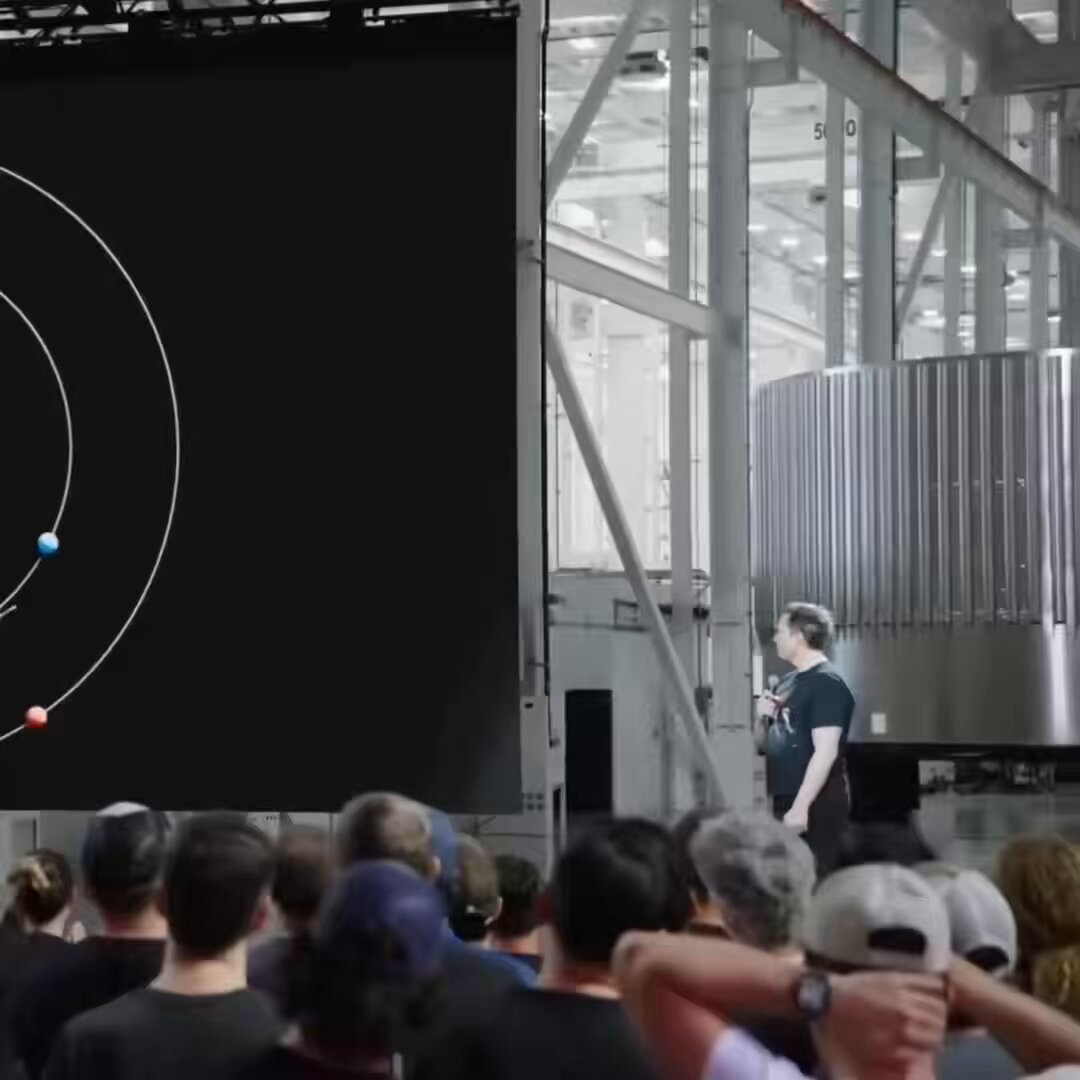
Elon Musk just told millions of Starlink customers that they have been quietly funding humanity’s road to Mars. Musk: “if you look on your Starlink Wi-Fi router, you will see this image.” The image is the transfer orbit to Mars. Earth on one side, Mars on the other, and the exact arc a ship has to fly between them. The map to another planet is printed on the router in your living room, because the two things are the same project. Musk: “you can’t just go straight to Mars, you have to create this elliptical orbit with Earth at one point and Mars at the other side at the far end of the ellipse and then time the where you are in that ellipse to intersect with Mars.” You cannot aim at where Mars is. You aim at where it will be, and you commit to that arc before you leave, because there is no correcting it once you are on it. The destination is not there when you depart. You are flying at a version of it that does not exist yet. Earth and Mars only line up for this roughly every twenty-six months. The universe hands out departure times and does not take requests. Musk: “the actual distance traveled on the arc is close to it like a thousand times further than the Moon.” A thousand times further than the farthest point any human being has ever traveled. The distance was never the hard part. Hohmann worked out this exact transfer in 1925. The math has been sitting finished for a century. What nobody could solve was money. Every previous attempt at deep space ran on government appropriations, which means it ran on election cycles. Programs that outlast a presidency are rare. Programs that outlast a generation barely exist. Musk: “Starlink internet is what’s being used to pay for humanity getting to Mars.” A rural household finally getting connected. A boat in the middle of the Pacific. A village nobody ever ran a line to. Every one of them is a payment toward a launch. Musk: “I’d just like to thank everyone out there who has bought Starlink because you are helping secure the future of civilization and helping make life multiplanetary.” That is not marketing language. That is accounting. The financing is the real breakthrough. Building something people want this month to pay for something that pays off after everyone alive is dead. Every monument in human history was built with money taken from people who were never asked. Tithes, taxes, tribute, conscription. The pyramids and the cathedrals and the moon landing were all funded by force. This is the first project at that scale that runs on people choosing it, which makes every dish on every roof a vote rather than a levy. Nobody had to be chosen for this. A working connection in a place the old providers gave up on puts you on the ledger. Every generation inherits one project large enough to be remembered by. Almost nobody alive for those ever got close enough to touch theirs. Civilizations do not get to choose whether they become permanent. They find out afterward. Every one before this looked up at the sky and wanted it. This is the first one writing the check.

Dustin

259,170 просмотров • 1 месяц назад

Your observations are almost correct, but your conclusions are not. What you see flying out, as what others thought was his ear piece, is not his ear piece. It is his chain he had around his neck, with, what I am pretty certain, a cross on it, which all Christians would wear, if they have a chain on their necks. So, what apparently happened, which seems so astronomically unlikely, is the bullet did not hit him in the neck first, but hit him in the chest, and to be more specific in that cross. So, after a hit into that cross, his chain snaps, and it is that which you see flying out backwards. When the chain snaps, and starts flying up and backwards, it also pulls up the front edge of is shirt, in less than 0.1 sec. So, that is how that anomaly is explained at the same time. What happens next, is his mic had a wire under his shirt. It kind of just laid in the back of his neck, going around his shoulder, and disappearing under his shirt on the front. That wire must have had some contact with this chain, or even being wrapped around it like may be just one turn. So, when that chain snaps and starts flying backwards, it starts pulling on his mic at the same time. Just the mic had a wire that was most certainly lose a little bit. So, that is why that responds with a few tens of a second delay. But still, the mic also, after jerking around for a few tens of a second disappears completely of his shirt. So, basically, the bullet hits his cross first, which is on his chain, would explain all of these anomalies at the same time, including the wire on the back of his neck being pulled around from the front, and thus bulging his shirt in the back a little bit. If you pay all of this is slow motion, you will see that it all gets seqeuenced correctly. And the last thing to note, is after hitting his cross, and getting deflected, the bullet now would start going up, instead of forward, and would go up into his neck from the bottom up, and disappear into his head. That would also explain at the same time why there is no exit wound. Because his skull would stop the bullet from exiting. One side note, not related to all of these anomalies, but still a necessary thing to keep in mind - that alleged high velocity bullet Mauser 30_06, could not have possibly be the weapon used, as that bullet would have taken one third of his neck out. For everything to be explained correctly, no Mauser, or any other kind of shotgun could have been used. Another, much smaller caliber weapon had to be used, like some kind of a hand gun, and from a much closer distance too, as a hand gun without the scope, from a far way roof would just not work. And so, that is how all of this happened. I know this was long. But this is one bizarre, super difficult to crack episode. So, I could not make it any shorter.

US_did_ 911

31,104 просмотров • 1 год назад

Elon Musk thinks the entire education system is built on a broken assumption. That every student should learn the same thing. At the same speed. In the same order. At the same time. Musk: “Everyone goes through from like 5th grade to 6th grade to 7th grade like it’s an assembly line. But people are not objects on an assembly line.” The model was designed for a factory economy. Standardized inputs. Predictable outputs. That economy is gone. The assembly line is gone. But the education system still runs on its logic. A student who masters algebra in two weeks sits through eight more weeks because the calendar says so. A student who struggles gets dragged forward because the schedule doesn’t wait. Neither is being served. Both are being processed. Musk: “Allow people to progress at the fastest pace that they can or are interested in, in each subject.” AI doesn’t teach a classroom. It teaches a student. One at a time. Every time. It skips what a student already knows. It finds where they’re stuck and approaches it from a different angle. It adjusts in real time. Not at the end of a semester when the damage is already done. A student obsessed with basketball learns fractions through shooting percentages. A student who builds in Minecraft learns geometry through architecture. The subject doesn’t change. The entry point does. No teacher with thirty students can do this. Not because they lack skill. Because the math doesn’t work. AI doesn’t have that constraint. Musk: “You do not need to tell your kid to play video games. They will play video games on autopilot all day. So if you can make it interactive and engaging, then you can make education far more compelling.” The brain isn’t broken. The format is. Kids learn complex systems and strategic thinking for hours voluntarily. Then walk into a classroom and can’t focus for twenty minutes. That’s not a discipline problem. That’s a design problem. Musk: “A university education is often unnecessary. You probably learn the vast majority of what you’re going to learn there in the first two years. And most of it is from your classmates.” Four years. Six figures of debt. And the real value comes from the people sitting next to you. Not the institution charging you. The degree doesn’t certify knowledge. It certifies endurance. Musk: “If the goal is to start a company, I would say no point in finishing college.” The system was built to train employees. If you’re not trying to be one, it has nothing left to offer you. Every lecture. Every textbook. Every curriculum. Now available instantly. Personalized to any learner. Adapted to any pace. The question isn’t whether the old model survives. It’s how long we keep forcing students through it while the replacement already exists.

Dustin

21,759,121 просмотров • 5 месяцев назад

Marc Andreessen explains the 3 Necessities for Start-up Success: "The general criteria for a successful high-tech startup, in my view, you see different sort of rules of thumb from different people. But the three big things you always come back to are, is there a big market? And by the way, that comes in two parts. Is there a big existing market that you think you can go after and sort of displace incumbents or do you believe there will be a new market that will be big? So big market. Is there a fundamental technology or economic change that causes you to basically justify having a new company? And that's really important. And the way I always think about that is, is there a 10X change happening in the technology landscape? Is something 10X faster or 10X cheaper or 10X better? And if it's not 10X, we as both VCs and entrepreneurs, we really have to ask ourselves like, is it really worth doing? Because it's really hard. I mean, it's really hard to start new companies. new companies generally shouldn't exist. Existing companies are usually pretty good at what they do. And so for a new company to exist, it not only has to like come in and go into business and bring a product to market, but it has to bring a product to market that's so much better than what already exists that it punches through the sort of status quo. And most customers in most markets are pretty happy buying from the current suppliers and so there has to be a real kind of edge on the thing and we look for that in either a technology change, usually a technology change or an economic change. which are often the same thing. And then the third is team. Is the team outstanding? And if you think about this as an entrepreneur, it becomes a question of the founding team. Some companies are solo founders and they can work, but generally most of us, like myself, we're human beings, we're mortal. You want to have a founding team of complementary skill sets. And so you want to have at least one super strong technologist, quite possibly more than one. Some of the best startups are actually more than one founding technologist and then it often helps to have somebody who's like a product or who's a market or sales person or has a sort of really good understanding of business on the team, certainly helps a lot. And so we sort of look at market, product, and team. And the reality is you need all three. I would say, interestingly, if you're going to compromise as an investor, if we're going to compromise on one of those, it would actually be the product. And the reason I say that is because a great market is a lot easier to make up for with iterative product execution than a poor market. Because the problem with a poor market, a small market, is even if you do a great job on the product, there just aren't that many customers. It's hard to ever get big."

Founder Mode

39,005 просмотров • 8 месяцев назад

Arsenal are yet to concede a goal this season, and there are some interesting details behind the way they are preparing their players defensively in matchday warm ups. Their training has placed a much greater emphasis on duels, but their approach to matchday preparation is equally interesting. The coaches are heavily involved, working closely with their specific units. Here is Gabriel Heinze, for example, on Monday night away at Aston Villa. What stands out is the lack of a fixed routine. There is no predetermined sequence where the ball travels from A to B, the player follows the pass, and the pattern simply continues. Arsenal approach it differently. The work is position specific and built around actions the players are likely to experience in the game, but the sequence itself is not planned in advance. The players do not know exactly what is coming next, which means they have to constantly process information, make decisions and react. That is exactly what the game will demand from. The purpose of this random and reaction based work is to switch the players on mentally before kick off. They cannot simply go through the motions or operate on autopilot, as can sometimes happen during closed passing patterns. Every action demands concentration, awareness and a response to the information in front of them. It is a small detail, but an interesting one. Arsenal are preparing the brain as much as the body, and so far, it is working.

Keepitonthedeck

243,416 просмотров • 21 дней назад

This post is at nearly 200k likes in 48 hours. Every single word is true “Welcome to America where we work to live and live to work - Where we spend hundreds of thousands on a home that we barely get to step foot in because the hours we work to pay for it keeps us away from it - Where we buy a car just to drive it to a job that barely pays enough to keep the gas tank full - Where our healthcare system will bankrupt you faster than the illness can kill you - Where getting sick is the business model and the cure is priced like a luxury - Where the food is fake, the water's tainted and the air we breathe is up for sale - Where the richest 1% own more than the bottom half combined and they still tell us to work harder - Where we chase the American dream only to find out it was designed to stay out of reach and every time we get close to the finish line they just inch it a little further back - Where school doesn't teach you how to live just how to obey, comply and clock in - Where education comes with a lifetime of debt and the diploma is nothing more than a receipt for money that you ain't never going to see again - Where we pay taxes to keep the lights on in government buildings we ain't never even allowed to enter - Where your rights are written in pencil when erased when it's inconvenient - Where justice depends on your income and the law bends to the highest bidder - Where your labor is valued but your life is disposable - Where mental health is a crisis but therapy is a luxury that most can't even afford - Where they sell you fast fashion, fast food and the fast entertainment to keep you distracted from the slow theft of your soul and your spirit - Where the news is scripted, the truth is filtered and history is rewritten to protect the guilty - Where the people who run this country don't live like the people who keep it running - Where survival is success Where we've been trained to call this living but in reality we barely breathing. Welcome to America.”

Wall Street Apes

127,598 просмотров • 1 год назад

Persi Diaconis walked into a lecture at the University of Washington, held up a coin, and told a room of physicists that Richard Feynman was fooled by it his entire life. He was right. In 2007, Diaconis proved a coin flip is not 50/50. It lands on the side it started on about 51 percent of the time. The bias comes from the physics of rotation under gravity. Every physicist since Newton had assumed 50/50 without ever testing it. Every trading model built on that assumption is running on the same lie. The lecture was on Feynman's book "The Meaning of it All." Diaconis quoted the most famous line in it: "the first principle is that you must not fool yourself, and you are the easiest person to fool." Then he pointed out that Feynman himself was fooled by every coin he ever flipped. Feynman's own rule would have killed the 50/50 assumption on day one. The market is the same setup at scale. Every model that assumes independent 50/50 outcomes at the base layer is built on a physical impossibility. Order flow, positioning, forced flows, expiries all leave biases larger than 1 percent. Your gut cannot see them. The math already knows they are there. Diaconis's rule: before you trust a random process, check it. Actually check it. Not with a simulation. With a proof or an experiment. The coin is where you start. The chart is where the same rule pays. The only random thing about markets is how thoroughly you refuse to check them.

veles

18,798 просмотров • 2 месяцев назад