Loading video...

Video Failed to Load

Go Home

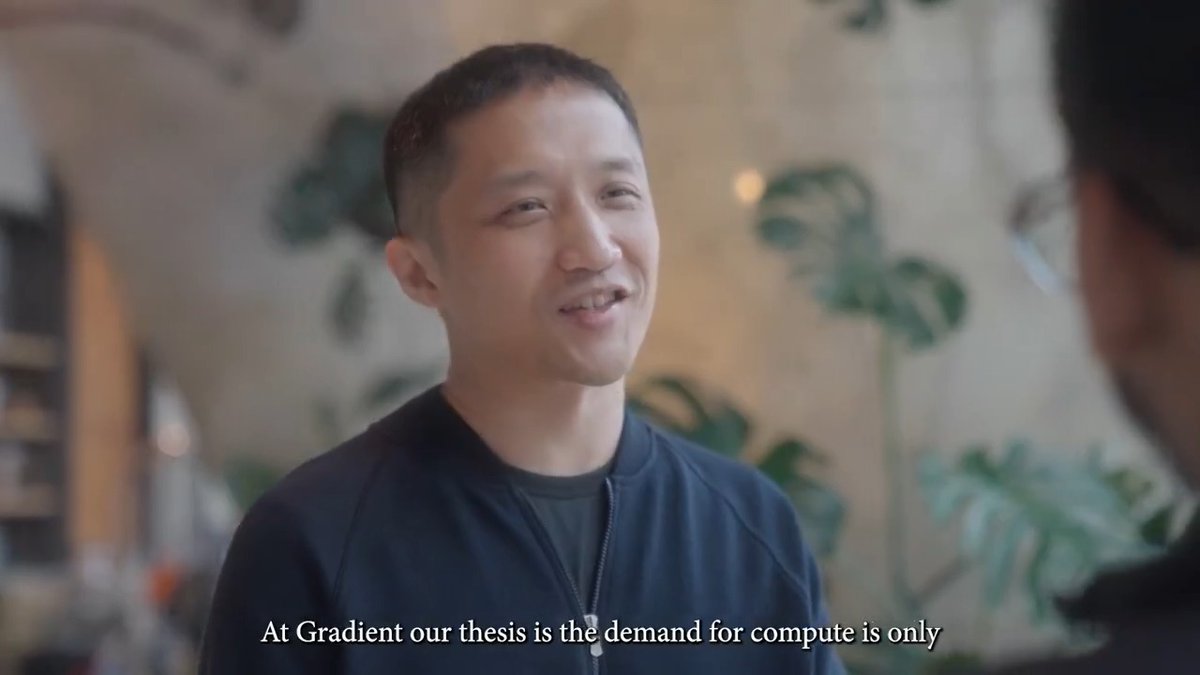
Gradient goes beyond static content, utilizing idle compute resources from edge devices, personal computers, and local servers to perform real-time processing tasks. The thesis is similar to Pipe’s: operations like AI inference or serverless functions can happen closer to the user, reducing latency. Gradient reported surpassing 20,000 connected nodes...

326,604 views • 1 year ago •via X (Twitter)

11 Comments

Solana's profile picture
Solana1 year ago

Delivering content quickly from servers to end users is crucial for apps and services, whether it's static files like images or dynamic data like AI responses. Slow delivery can ruin user experience—think buffering videos or lagging web pages. Solana-based DePIN networks @pipenetwork and @Gradient_HQ incentivize users to contribute excess storage and compute power, respectively. By leveraging a larger network of nodes and tapping into existing infrastructure, they can potentially offer faster delivery, lower costs, and greater reliability.

Solana's profile picture
Solana1 year ago

Pipe Network is a decentralized content delivery network (dCDN). Traditional CDNs cache content (for e.g., images, videos, and webpages) across distributed servers. When users request content, it’s delivered by the closest server, reducing latency compared to an origin server. @pipenetwork takes this design further by incentivizing people to contribute their excess storage and bandwidth. The thesis is simple: more nodes = higher chance a node is closer to the user = faster delivery. The development team behind Pipe recently announced a $10 million raise led by @multicoincap, with plans to launch mainnet in 2025. Learn more from @DavidRhodus' product keynote at Breakpoint:

Solana's profile picture
Solana1 year ago

What Solana DePIN projects are you excited about? If you’re curious about the broader landscape beyond content delivery DePIN, check out @yashhsm’s report: plus @Syndica_io’s recently released Aug 2024 Solana DePIN Deep Dive

⚡ rift 🐐 🛡💚🌙꧁IP꧂'s profile picture
⚡ rift 🐐 🛡💚🌙꧁IP꧂1 year ago

Bullish on @Gradient_HQ — The open layer for edge compute on Solana. Set up your #GradientSentry Node and be part of the future. " DePin Is The Future " #GradientNetwork #Solana #DePIN

XRP_Cro 🔥 AI / Gaming / DePIN's profile picture
XRP_Cro 🔥 AI / Gaming / DePIN1 year ago

💵Earn passive income with Gradient Network - The open layer for edge compute on @Solana ✅ Backed by top tier VCs: @SolanaFndn, @multicoincap, @PanteraCapital and @sequoia Sign up here: 👉 Stay online for 72 hours of uptime to earn #DePIN $GRASS

MarmZzz's profile picture
MarmZzz1 year ago

10% Bonus use this ref link

Kaorychang's profile picture
Kaorychang1 year ago

@Gradient_HQ

Joy Osaretin. (Ø,G)'s profile picture
Joy Osaretin. (Ø,G)1 year ago

@Gradient_HQ What are u waiting for UZOM1Z

crypto mania ❤❤❤'s profile picture
crypto mania ❤❤❤1 year ago

@Gradient_HQ Use my CODE: BQH3RJ

artemis || 🌳's profile picture
artemis || 🌳1 year ago

🚀Join me on @Gradient_HQ — The open layer for edge compute on Solana. Set up your #GradientSentry Node and be part of the future. #GradientNetwork

cromatoforo's profile picture
cromatoforo1 year ago

Use code 𝗡𝗦𝗤𝗧𝗜𝟴 for extra awesomeness
Related Videos

🌟 Another Epic Sneak Peek: OptimAI Core Node’s Edge AI Computing Power! We’re excited to continue unveiling the upcoming OptimAI Core Node features! This time, we’re introducing Edge AI Computing, a game-changing feature that will make your devices even more powerful in contributing to the OptimAI Network. 🔥 What is Edge AI Computing? With the OptimAI Core Node, your device’s idle computing resources (CPU/GPU) and storage will be put to work, powering critical AI computing tasks, including: 🔸Edge Inference: Running real-time AI predictions directly on your device without sending data to centralized servers. 🔸Hot LLM Models: Accelerating large language models for high-speed NLP tasks. 🔸Generative AI Models and More: Contributing to the training and inference of cutting-edge generative AI, like text-to-image models, deep learning, and more. More Contributions, Bigger Rewards Await! This Edge AI Computing feature allows us to leverage the full potential of decentralized computing power, reducing latency, increasing efficiency, and making AI more accessible. The more you contribute, the bigger the rewards!🔥 Stay in the Loop—Start Today with OptimAI Lite Node! While the OptimAI Core Node is still in the works, you don’t have to wait to join the action. The more you contribute, the greater the rewards! Let’s build a stronger, smarter, and more decentralized AI network together. Stay tuned for more exciting updates! 🔸Extension Node: 🔸Telegram Node: 🔸Register at: #DePIN

OptimAI Network

44,249 views • 1 year ago

Orbit AI Satellite Successfully Achieve World’s First Orbital AI Deployment and Launching Digital AI Sovereignty Decentralized Orbital AI Network Orbit AI Orbit AI🛰️ today announced that the first satellite, “OAI Genesis-1,” has successfully launched and entered Low Earth Orbit (LEO). Amidst fierce competition from tech giants (e.g., Starlink Starlink Elon Musk , Google AI Project Suncatcher) in space AI computing, this launch signifies Orbit AI’s position as the first to achieve real-world AI deployment, formally inaugurating its "Orbit AI Cloud Platform." Genesis-1 is equipped with NVIDIA NVIDIA AI Compute Cores, running a 2.6B parameter AI model for real-time analysis of infrared remote sensing data in space. By processing data on orbit, Genesis-1 drastically reduces critical information retrieval time (e.g., disaster alerts, maritime monitoring) from hours to mere seconds, while cutting transmission bandwidth costs by over 90%. Furthermore, Orbit AI has partnered with from energy company Powerbank (NASDAQ: SUUN) ( utilizing infinite solar power to achieve carbon-neutral computing and projecting a reduction in overall energy operational costs by 60%. Following its triumph at the BNB Chain Hackathon ( Orbit AI protocol is committed to creating an ultimate censorship-resistant deployment environment: Developers can deploy AI models, privacy applications, financial algorithms, and even blockchain nodes on the satellite network. This ensures that code and data operate in a physically isolated, neutral environment beyond the jurisdiction of major nations, guaranteeing extreme digital sovereignty and service resilience. Orbit AI will also leverage the RWA (Real World Assets) mechanism to allow community users to purchase satellite NFT shares, becoming co-owners of this space infrastructure and sharing in its compute revenues, thus building a community-owned orbital AI economy.

Orbit AI🛰️

24,771 views • 7 months ago

A Perfect Pairing! 5G & Edge Computing: Together they enhance responsiveness, capacity and reliability by processing #data closer to where it’s generated! 🌟See🔗 ◀️T-Mobile Business 🔸This is critical for applications such as augmented reality #AR and #customer interaction and especially in contexts where low latency and near-real-time data processing are critical ✅ 🌟 MEC allows data processing closer to the source, reducing latency, improving efficiency, and enhancing resilience, whilst moving computing closer to users. It reduces latency and centralizes data processing. 🔸This is useful for scenarios that demand rapid data action, data #confidentiality or the ability to function without relying on distant #Cloud servers ☁️ Although only about 10% of enterprise data is currently processed outside central servers, this figure is anticipated to grow to 75% by 2025 🌟MEC can help in industries like #manufacturing 🏭#Retail 🛍️#warehousing 🚚#agriculture🌾and #logistics 🚛through faster decision-making, lower costs and more reliable data processing. Fixed and mobile edge applications are emerging, with mobile edge becoming a key area for future growth. 🔸5G's speed, low latency, and #security make it a natural fit with MEC, offering solutions to businesses' needs for faster responses, local data processing and reliable operations ✅ 📈Business Adoption: Though still early, it is anticipated that some 75% of #enterprise data will be processed at the #edge by 2025, driven by advancements in #Smart devices and routers with built-in processing capabilities 📶 💡To find out more, please explore the 🎞️resource below 🔽 See🔗 ⬅️#5G #EdgeComputing #TechNews #TFBPartner BusinessIntelligence Franco Ronconi 🇮🇹 #IoT Jean CAYEUX #RaviVisvesvarayaSharadaPrasad #Telecom #InfoTech Yann Marchand Tony Moroney #DigitalTransformation #Telco Knut Jägersberg Jean-Baptiste Lefevre 💙 #TechForGood 💙 #Sustainability Fati Sule Aurelien Lallemant #IA 🔎 & #RSE 🌎 Lionel Costes #AI Mack ipfconline Greg Valancius Dr. Marcell Vollmer #StaySafe #CES2026 #IoT Dev Khanna Baskaran Ambalavanan Anand Narang #CX Ian Jones Hana Laurent Alaus Xavier Gomez Pinna Pierre Dr. Khulood Almani | د.خلود المانع Eric T. #VR Enrico Molinari #VivaTech2025 Chidambara .ML. Smaksked Skåne AB 🌐

Sen. Sally Eaves

10,484 views • 1 year ago

Today, we give robots a /skills library that self-evolves and compounds indefinitely! Introducing ASPIRE: a robot solving its 100th task is no longer as clueless as solving its first. Coding agents observe multimodal sensory traces from simulation and real robots, launch an evolutionary search over control programs, and distill the best know-how into an ever-expanding library. ASPIRE is a new type of continual learning: "training" is skill refinement instead of gradient descent. "Trained model" is a repo of sensorimotor skills instead of floating weights. “Distributed training” is a panel of agents each practicing a different skill instead of sharded minibatches. Here's the beauty: ASPIRE gives the tired terms "sim2real transfer" and "cross-embodiment transfer" a whole new meaning. Bridging the sim-to-real gap is notoriously brutal. An end-to-end policy has to swallow both the visual shift (sim looks toyish next to a real camera) and the subtle contact physics it never quite gets right. ASPIRE sidesteps the mess, because it doesn't ship pixels or weights across the gap, but ships the know-how. The robot still has to practice in the real world, not zero-shot, but it gets there way faster because it isn't rediscovering the strategy from scratch. Same for going single-arm to bimanual hardware, which usually requires new data and retraining from zero. ASPIRE achieves up to ~10x cut in "transfer learning” tokens (yes, tokens are the new unit of *training* compute ;) Check out our gallery of 150+ tasks and 90+ skills the robots taught themselves, all on the website! Kind of wild that we can ship the "learned weights" as an HTML page rather than a GGUF. We'll open-source the full stack so your own robot library starts compounding from ours! Deep dive in thread:

Jim Fan

199,983 views • 18 days ago