Загрузка видео...

Не удалось загрузить видео

На главную

GST AUTOMATION - GST Auto-Login using a Chrome Extension Stop typing GST credentials. Automate it. 🚀Advanced GST Login Automation by CA Kashish Kathuria - directly inside Chrome No Excel files to open. No repetitive typing. No switching between tools. 🔹 A custom Chrome Extension that: - Opens automatically on...

14,993 просмотров • 8 месяцев назад •via X (Twitter)

Комментарии: 0

Нет доступных комментариев

Здесь появятся комментарии из оригинального поста

Похожие видео

GeoLibre v2.7.0 is here! GeoLibre is a free and open-source, lightweight, cloud-native GIS platform for visualizing, exploring, and analyzing geospatial data. It runs everywhere you do, in the web browser, on the desktop, on mobile, and inside Jupyter notebooks, all while keeping your data local and private. This release is about building analysis instead of typing it: a visual Model Builder for processing workflows, a STAC browser that can add every asset type the app can draw, and a Chrome extension that opens the data on any web page in one click. 97 pull requests merged in 9 days, from 11 contributors besides me, 9 of whom sent their first contribution to GeoLibre in this cycle. Thank you all. What's new in v2.7.0 - Model Builder, a visual canvas for processing: drop tools as nodes, wire one tool's output into the next tool's input, and save the graph as a model that re-runs as a single job. The whole graph is validated before anything executes. - Your AI assistant can build one for you: describe a workflow in plain English, and it authors a validated model and opens it for review before it runs. Any model copies out as a runnable Python script. - Open data in GeoLibre, a Chrome extension now on the Chrome Web Store: it finds the dataset links and map services on the page you are viewing, including services inside embedded maps, and opens the ones you pick together on one map. - The STAC browser adds everything: PMTiles, GeoParquet, and Zarr with a variable picker join the COGs it already loaded, Icechunk repositories are read through their own manifest, and private Planetary Computer assets are signed for you. A static catalog can now be walked as a tree, not only searched. - Select features by drawing on the map: click, rectangle, polygon, freehand, and radius gestures, with Shift and Alt combining into the selection you already have. No more describing features in an expression to pick a handful of them. - Apache Iceberg tables load as vector layers, read in the browser through DuckDB, from a metadata location or a REST catalog, with the row count reported before anything is scanned. - Encoded polylines are a first-class format, with a codec, an interactive preview, processing tools, layer export, and Python support. - New vector tools: merge layers, extract vertices, and generate points along lines and polygon boundaries, all running client-side. - An activity log for shared projects and collaboration sessions, so a project owner can see who opened and edited their work. - Plugins and processing tools are now translatable too, closing the last gap where a non-English interface still read half in English. Try it out - Launch GeoLibre Web: - GitHub: - Documentation: - Release notes: #GIS #Geospatial #OpenSource #MapLibre #GeoLibre

Qiusheng Wu

15,041 просмотров • 28 дней назад

🚨 ALERT AMERICA: HERE IS THE PROOF - ONE OF THE NINE FEDERAL REFUGEE CONTRACTORS ADMITTED THE ENTIRE RESETTLEMENT SCHEME ON CAMERA AMERICA HAS BEEN SOLD OUT! This 2021 video from Episcopal Migration Ministries (EMM), one of the nine federally funded refugee resettlement contractors, is one of the most revealing pieces of footage you will see. They were speaking openly at All Saints Church in Pasadena, assuming no one outside their activist circles was paying attention. But what they admitted is devastating. This wasn’t a sermon or charity. It was a full-blown political strategy briefing, filmed in a church, explaining how the U.S. government and religious NGOs work together to: 📍 dramatically expand resettlement pipelines 📍 pressure Congress to change immigration laws 📍 mobilize churches as pro-immigration activist armies 📍 build permanent support networks for arrivals 📍 redefine “refugee” to include economic & climate migrants 📍 overload the system by design 📍 coordinate lobbying directly with Washington And they said all of it out loud - we are funding our own demise! 1. They admit they are an official U.S. government partner Brother Chris McNabb of EMM states: “EMM is a ministry of the Episcopal Church and one of nine national agencies responsible for resettling refugees in the United States in partnership with the government.” This is not charity. They are federal contractors with a financial quota. More refugees = more money. It’s that simple. This is state-funded demographic policy laundered through churches. 2. They confessed the scale: from 18,000 refugees → to 4,000 Afghans PER WEEK McNabb brags: “In 2020 all nine agencies resettled about 18,000 refugees. We are now resettling 4,000 Afghans a week.” This was a mass importation pipeline, not a humanitarian drip. He openly says they had to “staff up significantly” because the pipeline “exploded overnight.” 3. They admit DHS used “humanitarian parole” to bypass the legal process McNabb explains Afghans were: “Paroled in by the Department of Homeland Security… because they did not have time to wait for the immigration system to operate.” Translation: ➡ Normal vetting was bypassed. ➡ The legal process was circumvented. ➡ Tens of thousands were rushed in without proper screening. Congress still hasn’t adjusted their status, but the arrivals are here permanently. 4. They train congregations to take in asylum seekers and parolees — not just refugees Through the Neighbor to Neighbor program, churches are trained to: 📍 provide physical & emotional support 📍 provide transportation 📍 help navigate legal processes 📍 sponsor asylum seekers & Afghan parolees Teams of 5–10 church members take over the roles official agencies would normally handle. This decentralizes the pipeline and embeds it inside communities. 5. They push churches to DEFUND ICE Rector Mike Kinman proudly declares: “We are strong advocates for the complete defunding of ICE.” So you have: 📍 a federally connected resettlement contractor 📍 working with the State Department 📍 using a church pulpit to demand the abolition of ICE This isn’t ministry. This is open-borders political warfare. 6. They openly plan to expand “refugee” to include climate & economic migrants When asked what happens to migrants who don’t meet asylum criteria, McNabb says: “We will begin seeing more and more climate refugees… more folks who come for economic reasons. We are preparing for that.” They are planning the next wave, economic & climate migrants, long before Congress approves anything. 7. They reveal the Episcopal Church has a lobbying arm on Capitol Hill They talk about OGR - the Office of Government Relations - their official lobbying office in the “God Box” on Capitol Hill. From the stage they instruct congregants to: 📍 call Congress 📍 pressure senators 📍 demand the Afghan Adjustment Act 📍 expand asylum categories 📍 increase refugee admissions 📍 secure more funding for EMM This is organized political lobbying coordinated from the church pews. 8. They admit they operate 11 affiliate offices nationwide, including in red states When asked about IRIS in Los Angeles, McNabb says: “That’s one of our 11 affiliates.” They place arrivals everywhere: Los Angeles, Seattle, Austin, Miami, and beyond. Red states are the main prize. And their “interfaith” branding? A manipulative façade - a left-wing coalition built to push anti-Western, anti-Christian, and anti-Jewish policy through religious cover. 9. They tell congregations to serve undocumented immigrants, too Kinman boasts All Saints is a “sanctuary church” ready to support: 📍 undocumented immigrants 📍 asylum seekers 📍 Afghan parolees 📍 migrants with “various statuses” This goes far beyond refugees — this is a parallel, extra-legal system. 10. They end by admitting the goal is a permanent, embedded migration infrastructure McNabb says this is just: “the beginning of a relationship.” The goal is permanent community integration — meaning once these pipelines enter your town, they never leave. 🚨 WHY THIS MATTERS, AMERICA This is just ONE of the nine federal contractors. In one hour, at one church, they admitted: ✔ their formal partnership with the U.S. government ✔ the massive scale of Afghan importation ✔ bypassing normal processes through parole ✔ pushing to abolish ICE ✔ expansion to climate & economic migrants ✔ their professional lobbying arm ✔ their nationwide network ✔ their plan for permanent demographic restructuring If this is what they say on camera, imagine what they say off camera. Americans deserve to see this video, understand how this system truly works, and decide whether they consent to having their communities transformed, with their tax dollars, without their input. Any politician - Republican or Democrat - who continues funding this racket, this federally backed demographic-engineering pipeline that European leaders openly describe as human-trafficker behavior — WILL be held accountable. If you fund it, defend it, or stay silent while your voters are kept in the dark, Laura Loomer and I will expose you. And WE will fight with everything we have to make sure you never hold office again. No one is going to fight like Laura and me to protect American communities from turning into mini-Islamic states!

Amy Mek

229,978 просмотров • 9 месяцев назад

Today we’re introducing Heatmap Web Analytics! Let me guess… you’re frustrated with GA4, stuck setting up custom code, and getting delayed (often inaccurate) data? Miss good ol’ UA? Ecommerce friends, now you have it back and SO MUCH MORE. Here’s how: 1️⃣ 2 minutes to install, NO CUSTOM CODE. You shouldn’t need developers just to see your web analytics! Everything will work for you, out of the box, with a single copy-paste. I had my mom install it on a Shopify store to make sure it was easy lol. If she can do it, I believe in you! 2️⃣ Just the reports that matter You can get lost in the weeds of charts and tables, but Heatmap’s web analytics are just like UA. You have the most important charts, tables, and funnels with as many filters as you want. Fully customizable, and we’re guiding you right to your source of revenue loss. 3️⃣ AI that SLAPS HeatmapAI is KNOWN as one of the most powerful recommendation engines in the CRO space, and we had to double-down. It’s backed by trillions of datapoints and obnoxiously clear on exactly what you need to do to make more 💰 4️⃣ ZERO cookies or PII Heatmap proudly uses no cookies, abides by every bit of GDPR, and will likely be the most compliant software in your tech stack. We’re here for a decade, not for a year. Come join us. 5️⃣ Only $29 bucks a month! Yes… Our Web Analytics are $29/month, no matter how large your company is. Web analytics are a foundation for any successful Ecommerce business so we want to make sure you have them. We’ve got features 10x more powerful, but not 10x the price either. Start with Heatmap’s web analytics, fall in love, and we’ll grow together. We ship new features every month. GO SIGN UP! Heatmap .com orrrrr more fun??? If you’re still reading, I’ll take a minute to say hi 👋 I’m Dylan, the founder of Heatmap (dot) com. I recently built and sold one of the largest CRO agencies and optimized billions in Ecommerce revenue. I’m working like im 21 again (I’m not 😅) building Heatmap, because this data needs to be everywhere and accessible for the Ecommerce community. Every ecom brand growing in 2025 focuses on their website for growth. I personally invested 7-figures of my own money into this vision. Now we’re a rockstar team of 52. I’m the one who gets the pleasure of writing this tweet, but there’s 51 AMAZING, talented, dedicated team members who made this product release happen, even more than me. And if you’re STILL reading, you’re just awesome and I think we’re friends by now lol my DMs are open, I’m always happy to support, and GO SIGN UP! WEB ANALYTICS ARE BACK!!!

Dylan Ander | CRO & SplitTesting

43,076 просмотров • 1 год назад

I Built a 37.0 Profit Factor Bot by Cracking Every TradingView Source Code tradingview is a gold mine hiding in plain sight and i just found the master key to unlock every single secret hidden within its community scripts. most traders spend their entire lives staring at candles and hoping for a miracle while the actual alpha is buried in the open source code that nobody bothers to look at. i used to be that guy who sat there getting liquidated at three in the morning because i thought i could outplay the market with my gut feeling and some drawings on a screen. it turns out that the game is completely rigged against you if you are trading manually but there is a specific way to flip the script. i am going to show you how to stop guessing and start knowing exactly what works across every possible market condition before you ever risk a single dollar. i spent years losing money and thousands on developers because i thought i was not smart enough to code the systems myself but i was wrong. the first step to cracking the market is realizing that every indicator on the super charts has a source code section that is completely open to the public. you can literally scroll through the community scripts and pull the exact logic for thousands of different strategies that people claim are the holy grail of trading. but the secret is not just having the code because most of these indicators are actually garbage that will blow your account up in a week. this is where the real loop opens because you need a way to test these ideas across twenty five different data sets in seconds rather than months. i use a custom setup with ai agents specifically a sub agent i call the backtest architect to handle the heavy lifting of turning pine script into python code. the goal is to create a factory where you can feed in a raw indicator and get back a full report on its expectancy and profit factor without lifting a finger. most people find one strategy and marry it for life but a real data dog knows that you have to iterate to success or you will get left behind. i am running eighty one different backtests right now because i know that ninety percent of what i find will be trash but that remaining ten percent is where the wealth is made. the backtest architect knows exactly how to structure the folders and data paths so that we are testing everything from the base indicator to complex versions with filters. you might think that popular tools like fibonacci or order blocks are the way to go because everyone on social media talks about them like they are law. but when i actually ran the numbers through the machine the results were embarrassing and most of those strategies just resulted in negative expectancy. it is a dangerous trap to follow the crowd into a trade just because some guru said a certain level was important when the data shows it is a coin flip at best. the dynamic swing indicator was one of the few that actually held its weight during the recent massive testing sessions we ran. it was pulling in profit factors of over thirty seven with annualized returns that look too good to be true until you see the trade list. we combined it with filters like the adx and the money flow index to see if we could refine the signals and the results were absolutely staggering. when you have a system that can run through forty data sets while you are drinking tea you realize that manual trading is a form of self harm. i realized this after spending hundreds of thousands on apps and devs only to find out that i could just learn to build these bots myself live on the internet. the speed of iteration is the only thing that matters in this game because the faster you can fail the faster you can find the one strategy that actually prints. one of the biggest hurdles i faced was thinking that i needed to be a math genius or a senior engineer to automate my trading systems. the truth is that code is the great equalizer because it allows a regular person to compete with massive hedge funds by using the same logic and speed. i decided to learn everything in public because i wanted people to see the process of losing money with liquidations and then finally finding a path to automation. the reality of the market is that it moves in cycles and what worked yesterday will almost certainly fail tomorrow unless you are constantly testing. that is why i built the agents to automatically look through the results folder and rank the top performers based on a composite score. it takes all the emotion out of the process because i am no longer looking for a reason to enter a trade i am just looking at a csv file that tells me the truth. if you are still drawing lines on a chart and hoping for the best you are basically playing a game of chance against a high speed casino. the transition from a manual trader to a systems builder is the single most important pivot you will ever make in your life. it is not about being right or wrong it is about having a positive expectancy that has been proven across thousands of trades and multiple years of history. i had to fix a few errors in the short selling logic where the agents were getting confused between maximum and minimum values for take profit levels. these tiny bugs are the difference between a winning system and a blown account so you have to be willing to dive into the code and refine the machine. but once the system is tuned and the sub agents are running it becomes a beautiful workflow that functions entirely without your input. we are currently moving through the editors picks and the trending indicators one by one because i want to have a database of every single strategy on the platform. being a data dog means you never stop searching for that edge and you never settle for a strategy that just looks okay on a single chart. you have to demand excellence from your code because the market will not give you a single inch of mercy if you are lazy with your research. the ultimate goal is to have fully automated systems trading for you so you can focus on scaling rather than staring at a screen for ten hours a day. i am already up to over eighty backtests in this single session and i plan on hitting hundreds more by the end of the week. once you realize that you can crack the code of any indicator you see on the internet you will never look at a chart the same way again. this is the power of using agents to bridge the gap between a raw idea and a finished trading bot that actually works in the real world. i am done with getting liquidated and i am done with the stress of over trading because the code handles everything with cold precision. the path to success is paved with data and if you are not willing to automate your process you are just waiting for your next liquidation to happen

Moon Dev

26,242 просмотров • 6 месяцев назад

🙌Meet Artifig: A Figma Plugin to Generate Figma Plugins Do you use Figma and ever feel like this: - Your mind is bursting with plugin ideas, but you can't bring them to life because you don't know how to code? - You want to focus on design, but repetitive tasks keep slowing you down? - You dream of creating custom tools for your team, but lack the time or resources? I’ve been there too. That’s why I created Artifig. ✨ What is Artifig? Artifig is an AI-powered Figma plugin that empowers anyone to build their own Figma plugins using just natural language. No coding needed—simply describe what you want, and watch as your idea transforms into a fully functional, real-time plugin. 🚀 Redefining Figma Plugin Development The core philosophy of Artifig is simple: Designers often have countless ideas and creative visions, but many of them remain unrealized due to a lack of technical skills. We believe designers shouldn’t be limited by their inability to code. You should focus on creating, not be held back by technical barriers or repetitive tasks. Artifig takes you directly from "description" to "implementation." 🛠️ How Does It Work? 1. Describe Your Needs: Tell Artifig what you want, like “Create a skew transformation tool for objects, supporting horizontal and vertical skew with real-time preview functionality.” 2. Generate and Run the Plugin: Artifig instantly generates the plugin and runs it right within Figma. For example, the generated plugin can apply skew transformations to objects, precisely controlled via matrix transformations, with an intuitive user experience. 3. Optimize and Iteration: Need adjustments? Simply describe them, and Artifig will Iterating the plugin step by step. 4. Share Your Creations: Publish your plugins to the Artifig community, or remix plugins shared by others to build on their ideas. No learning curve. No complex steps. It’s as simple as that. 🌟 Key Features - Zero Barrier to Entry: No coding experience needed—any Figma user can create plugins effortlessly. - Multilingual Support: Works in multiple languages, including English, Chinese, French, Japanese, and German. - What-You-See-Is-What-You-Get: Generated plugins run in real-time, so you can quickly validate and refine your ideas. - Open and Flexible: The generated plugin code is 100% yours—modify it, distribute it, even use it commercially. - Global Community: Share your plugins, explore others’ creations, and publish your plugins to the Figma community. 🎯 Why is Artifig a Game-Changer? 1. No More Repetitive Work Let AI handle the tedious, time-consuming tasks: batch renaming layers, auto-aligning elements, or applying styles in bulk. All you need to do is say, “Import a PDF and arrange each image on the canvas with 20px spacing.” 2. Quickly Bring Ideas to Life From color contrast checks to data imports and custom components, all your “what if we could” ideas can now become plugins. Just one natural language description, and Artifig makes it happen. 3. Custom Tools for Your Team Build tailored tools for your team, creating unique solutions to streamline your workflow. 4. Not Just a Tool, But a Learning Experience Artifig explains the logic behind the code it generates, helping you understand Figma APIs and JavaScript. Today, you’re a designer; tomorrow, you could also be a design engineer. 🧑‍🚀👩🏻‍💻🥷🏻 Who is Artifig For? - Beginners: No development experience needed—just describe your ideas and let Artifig do the rest. - Experts: Save time and focus on high-value tasks while Artifig handles the repetitive work. - Learners: Use Artifig as a bridge to deepen your understanding of development. - Teams: Build custom tools to enhance collaboration and efficiency. 🎉 Ready to Get Started? I believe designers’ time and focus should be spent on creating, not on wrestling with complex tools. Artifig is the first step toward realizing this vision. Try Artifig now and experience an unprecedented flow of creativity!

yancymin

21,222 просмотров • 1 год назад

The Tradingview Source Code Hack: How Claude Code Actually Makes You Profitable building a trading bot in 2026 is less about being a genius coder and more about having the guts to stop letting your emotions drive your portfolio into a ditch. i spent years thinking that code was some secret language for the elite while i was busy getting liquidated on trades that should have been easy wins. the truth is that the simplest piece of automation can be the difference between a blown account and a system that actually grows while you sleep most traders are stuck in a loop of staring at charts until their eyes bleed and then making a panic decision at the worst possible moment. i used to be that guy who spent hundreds of thousands of dollars on developers because i thought i was too far behind to learn it myself. the moment i realized that code is the great equalizer was the moment i stopped being a victim of market makers who can see every single move i make the hardest part of trading is the transition from manual clicking to full automation and that is where most people quit because they think it is an all or nothing game. you do not need a bot that does everything on day one but you do need a way to stop yourself from over trading and hitting the market button like a slot machine. imagine if you could just tell a script to enter a position for you slowly over time so you never have to worry about catching a falling knife ever again the secret weapon in this 2026 landscape is something i call the easy bot which is basically a remote control for your trading discipline. most people use too much leverage and never take profits because their brain tells them it will go higher right before the dump hits. by using a chunking entry system you can tell your bot to buy a position piece by piece which averages your entry and keeps your heart rate low most traders do not realize that exchanges and market makers can see your stop loss sitting right there on the order book like a giant target. if you are tired of getting stopped out only to see the price immediately reverse in your direction then you need to understand the power of a ghost stop loss. a ghost stop loss lives in your code and not on the exchange so the market makers have no idea where your pain point is until the bot actually sends the close order this invisible protection is a game changer for anyone trading on high volatility chains like solana or hyperliquid where the wick hunting is relentless. i learned this the hard way after watching my manual trades get hunted over and over while my automated systems stayed perfectly safe in the shadows. once you have a bot monitoring your positions for you the stress of a potential liquidation basically vanishes because the machine does not hesitate when it is time to exit the real fun begins when you start thinking like a market maker instead of a gambler who is just hoping for a moon shot. instead of guessing where the top is you can set up a simple logic loop that says buy under this price and sell over that price all day long. this allows you to capture the sideways chop that normally drains a manual trader through fees and bad entries while you are out at the beach or focusing on your business breakout trading is another area where manual traders lose their edge because they are either too slow to react or they enter way too late on a fake out. a simple script can sit there and monitor price action 24/7 with more patience than any human being could ever dream of having. when the breakout actually happens the bot triggers the entry in milliseconds while you are still trying to unlock your phone and open the exchange app i started learning to code live on youtube because i wanted to prove that anyone can do this if they are willing to iterate to success. it is not about getting it perfect on the first try but about building the foundation with functions that get the position and check the token price. every single bot i run today is just a combination of these basic building blocks that i have refined over the last five years of building in public if you are still trading by hand you are essentially bringing a knife to a gunfight in a market that is increasingly dominated by ai and high frequency systems. my goal with the road map and the open source code is to give you the same tools the big players have without you having to spend a fortune on devs. code allows you to backtest your ideas against historical data so you can see if your strategy actually works before you risk a single dollar of your hard earned capital the journey from a hand trader to a pseudo automated trader is the most important step you will ever take for your financial freedom. as you start to automate your entries and exits you will notice that your life gets better because the machine handles the boredom and the stress. eventually you will find that you are no longer chasing the market but instead you are letting your systems do the work while you live your life the way you want to i believe that the era of the manual retail trader is coming to an end but the era of the retail coder is just getting started. through the pain of my own liquidations i found the path to automation and i am never going back to the old way of doing things. keep building and keep iterating because the great equalizer is right there in the terminal waiting for you to take control of your future

Moon Dev

38,657 просмотров • 7 месяцев назад

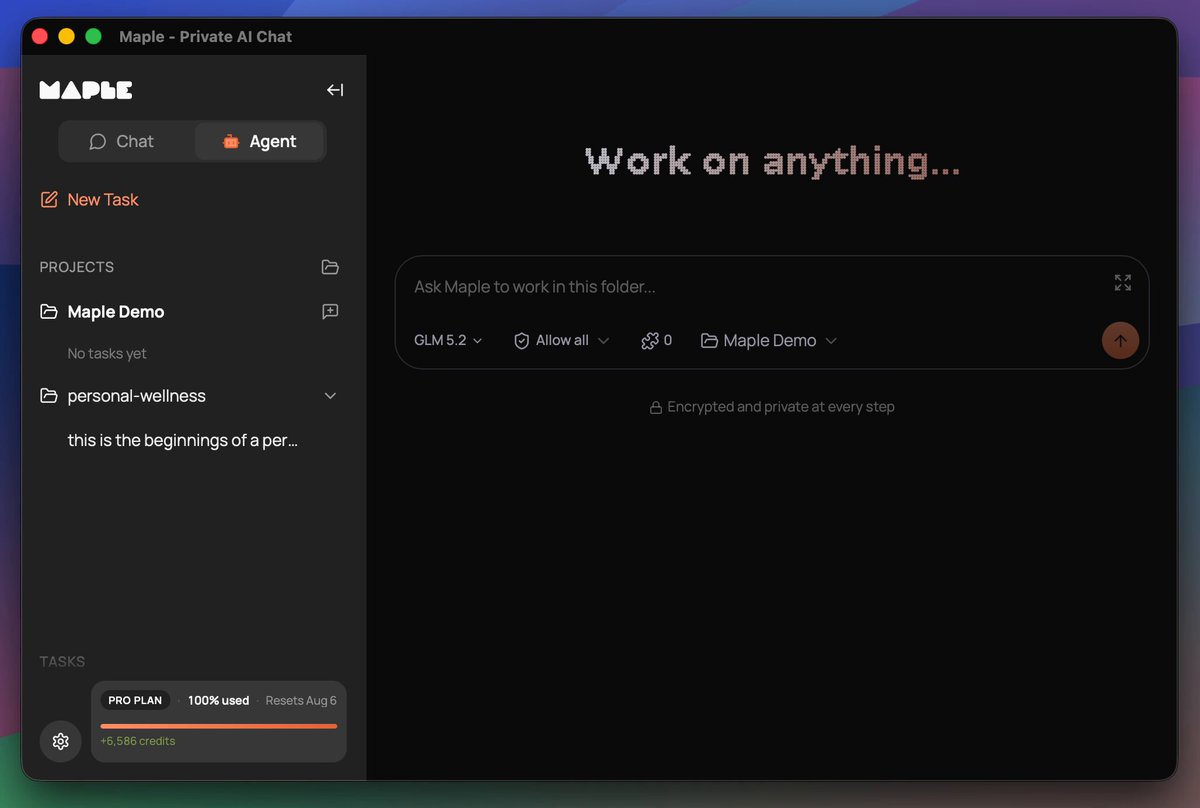
Maple is preparing for the release of a co-working agent. You install it locally and it works with your files, whether it's office work or building websites and apps. It's a turnkey solution, as easy as Claude Code, that keeps your data secure and private, no data sharing with closed AI labs. This is THE sovereign AI app for individuals and businesses who want powerful AI while retaining ownership of their information. Why build an agent into the Maple app when other agents already exist? Easy, we want to give you control over your work. We don't have a business plan that incorporates making money off our users' data. In the age of AI, your information, whether it's personal or company trade secrets, is the single thing that differentiates you from everyone else. We all have access to AI that can build a professional website for selling shoes. But your strategy and network for how you sell shoes should not be shared with your competitors. Sovereignty is the path to protecting what makes you, you. Maple sits at the intersection of Usability and Sovereignty. Maple gives you the best tools that are both easy to use and maintain your data sovereignty. Sovereign for one, sovereign for all. It has been a journey to get here. We brought to market the very first personal chatbot with end-to-end encryption using TEEs in late 2024. Prior to that there were proofs of concept but no full product offerings. Every other AI chat product on the market handled your data in plain text, either selling you a service to get your data or asking you to trust that they won't snoop on you. Quickly people found Maple and latched onto its open-source code and verifiable encryption. We didn't stop there. You may remember earlier this year we teased a product called "Maple Agent" and opened up a waiting list. That product is a mobile app that acts as your AI "friend", maintaining one long continuous chat, and getting to know you over time. I dislike using the word "friend" there, but it's the best way to convey the UX in a few words. AI is a tool, always has been, always will be. Any kind of friendly personality on top is just synthetic. In our testing, the UX of Maple Agent is really powerful for what it does. Think about the many short AI chats you have in your favorite app, whether it's looking up a historical fact or asking advice about a topic. With Maple Agent, those all go away in favor of the long-running chat with the friendly agent. It's like you have your own personal assistant who knows you so well and can look up anything for you. When I ask AI certain questions, I want to ask an expert who already understands my situation so I'm not repeating myself for the 100th time. That's the amazing value the personal agent brings to the table. We still see great utility for a personal agent like the "Maple Agent". Thousands of people on the waiting list, hoping to get their hands on it, agree that the concept is worth exploring and trying out. We were constrained in launching it due to a few circumstances, one of them being access to the scale of compute needed to power it. We have a clear path laid out for how to get there, but today is not the day to execute on that. It will be in the near future. Instead we have a different agent ready to go that we think is also incredible. We now have an agentic harness inside of the Maple Research app. This thing is a powerhouse. It even builds and publishes its own software releases. The agent in Maple Research works with your local filesystem, speaks to the largest open models running in TEEs, utilizes local models for certain tasks, is compatible with MCP tools, has an API for connecting to anything you need, and also supports the ACP protocol, which means it can be extended in the future to speak to other tools like Claude Code, Codex, and local models running on your own hardware. A big unlock for us was the Goose Development Kit, which powers the core of our agent harness. More on that to come as we publish articles and documentation later about the agent. The agent inside Maple Research doesn't have a name. At least not yet, not sure if it ever will. For now we call it "Chat Mode" and "Agent Mode". Think of this as the workhorse, the truck, the heavy lifter. Our other "Agent", the phone app, is your sidekick in your pocket, ready to help with quick things and ongoing conversations about life. I am incredibly excited about the Maple Research Agent. While I'm already seeing great results using it for internal work items, I'm especially thrilled about the personal health and wellness work it's doing for me. I know there are plenty of apps out there for compiling wellness data, but I'm having it build a tool tailored specifically for what I need, without the extra fluff. And none of my health data is being donated to the closed AI labs or sent to advertisers. I know that the AI logic is not being silently adjusted to fit the whims of a large corporation that has paid for product placement. It's me, state of the art AI, and my data. That's how I want it. Maple's new agent makes that possible. We can't wait for you to try it out. If you want early access, comment here, email us, reach out in some way. To those on the other agent waitlist, you're already in the queue. Thanks for reading this lengthy update. :)

Mark

46,589 просмотров • 1 месяц назад

This launch is one of the most exciting and important decisions we have ever made. In the traditional gaming industry, KingNet ( company , is well-known as the developer of the game 《The Legend of MIR 》, Over the past decade, KingNet has supported its operations through a three-pronged business model of research and development, publishing, and investment + IP, launching 100+ high-quality games to date. Web3's building has been ongoing for nearly two years. We have established a brand-new game studio SmileCobra Studio , and establish long-term cooperative relationships with some big guys like TON 💎 BNB Chain Solana Scroll Delphinus Lab ($ZKWASM) Cocos Studio and others. However, after speaking with many developers, we found that before a real user consumption scenario is formed, one of the main challenges many teams face is how to reduce game development costs. So it's best time to learn about Xingyi AI model : the first AI industrialization pipeline, making game production truly "automated". Check here: What problem we want to solve? 1. High Production Costs: Traditional animation design and refinement can cost anywhere from several thousand to tens of thousands of dollars, making it difficult for small startup teams to afford. 2. Long Development Cycles: The fluidity and consistency of animations have always been one of the most time-consuming aspects of development. Designers often spend weeks to achieve a satisfactory result. With Xingyi, it only takes a few steps and minutes to generate the desired animation. 3. Inefficient Collaboration: In the past, game development was usually divided into multiple stages, each managed by independent teams responsible for art, planning, programming, and other roles. The smooth transition between stages relied on high levels of team collaboration and communication. The Xingyi toolchain breaks the traditional division of labor, promoting automation and collaboration across various stages. 4. Automated but Not Passive: Outside of the automated processes, developers are the true creators of the game. Xingyi makes prototype validation and adjustments more scientific and efficient. We will gradually open source the underlying model of Xingyi and make it available to interested collaboration developers (DM is open). We have already made various agent material generation available, and you can try it now: Finally, we would like to discuss a point that many people are concerned about, why was there a launch at @pumpdotfun and it was abandoned? The most important reason is that we lacked experience in the first launch and were affected by snipers and the market. We conducted wallet statistics and found that, excluding bots, a total of 25 addresses suffered a loss of approximately 17 sol. We will use the trading fee of Launch Coin on Believe to airdrop these accounts and apologize again for our mistake. Also, thank you to Launch Coin on Believe for the smooth launch and long-term creative sharing with the builders, only $KNET CA is : CfVs3waH2Z9TM397qSkaipTDhA9wWgtt8UchZKfwkYiu $KNET not representing any equity interests of the parent company , $KNET is a meme, but at the same time, it’s not just a meme. $KNET will play a key role in the consumption scenarios of the KingnetAI ecosystem—imagine having to continuously spend $KNET each time you generate the game modules you want. Gamefi is died? NO, AI-Gaming just begain here .

Kingnet AI

187,988 просмотров • 1 год назад

Wow. Classic Jensen style, he ended the Nvidia vs. custom ASIC competition for good. 🫡 The level of confidence with which he explains. 🎯 He was answering to UBS research analyst question on how custom ASICs will affect NVIDIA or how they are going to compete with custom ASIC. Basically he says - Your custom chip is a science project in a world where NVIDIA is building revenue-generating AI factories. While the competition is still desperately trying to copy Nvidia's last generation, their roadmap is already at the limits of physics. They don't just sell silicon; they deliver the entire, impossibly complex platform that the industry has already surrendered to and standardized on. When you must bet hundreds of billions on your company's future, there is no alternative—they are the only platform to build on, and everyone knows it. Full transcript below. Question by the Analyst - "Jensen, I wanted to ask about customer ASIC. And I ask because if, you know, we listen to some of the same CSPs that you put up on that slide, and we listen to some of the companies who are making custom ASICs, some of the deployment numbers sound pretty big. So, I wanted to just hear your position, how you're going to compete with custom ASICs, how they can possibly compete with you, and maybe how some of your conversations with these same customers would sort of form your view in terms of how competitive custom ASIC will be to you." Jensen's response "First of all, just because something gets built doesn't mean it's great. Number two, if it's not great, all of those companies are run by great CEOs who are really good at math. And because these are AI factories, it affects your revenues, not just your costs. It affects your revenues, not just your cost. It's a different calculus. Every company only has so much power. You just have to ask them. Every single company only has so much power, and within that power, you have to maximize your revenues, not just your cost. So this is a new game. This is not a data center game, this is an AI factory game. So when the time comes, that simple calculus, as I was using yesterday, that simple math that I was showing yesterday, still has to be done. Which is the reason why so many projects are started and so many are not taken into production. Because there's always another alternative. We are the other alternative, and that alternative is excellent. Not normal excellent, as you know. Everybody's still trying to catch up to Hopper. I haven't seen a competitor to Hopper yet. And here we're talking about 40x more. And so our roadmap is at the limits of what's possible. Not to mention we're really good at it and completely dedicated to it. A lot of people have a lot of businesses to do. I've got this one business to do. And we're all in on this. 35,000 people doing one job. Been doing it for a long time. The depth of capability, the scope of technology, as you saw yesterday, is pretty incredible. And it's not about building a chip; it's building an AI factory. We're talking about scale up, scale out. We're talking about networking and switches and software. We're talking about systems, and these system architectures are insane. Even the systems themselves. Notice, 100% of the computer industry, 100% of the computer industry has standardized on NVIDIA's system. Why? Because try to build an alternative. Building the alternative is not even thinkable because look at how much investment we put into building this one. And so even the system's hard. What people used to think, system is just sheet metal. Hardly sheet metal. 600,000 parts, it's hardly sheet metal. And so all of the technology is hard. We're pushing every single dimension to the limit because we're talking about so much money. The world is going to lay down hundreds of billions of dollars of investment in the next just a couple of two, three years. Let's do the thought experiment. Let's say you want to stand up a data center and you want it to be fully operational in two years' time. When do you have to place the PO on that? Today. So let's suppose you have to place a hundred billion dollar PO on something. What architecture would you place it on, literally based on everything you have today? There's only one. You can't reasonably build out giant infrastructures with hundreds of billions of dollars behind it, hoping to turn it back on and to get the ROIC on it, unless you have the confidence that we are able to provide you. And we can provide you complete confidence. And singularly so. We're the only technology company where if I had to go place a hundred billion dollars on an AI factory... Oh, that's interesting, I did. Literally the only company who's willing to place hundred billion dollar POs across the industry to go build it out. And you guys know, that's our, that's the depth of our supply chain. And we are, and we have. Give me another. Give me another one that has that depth and that length. And now to the point where we've got to go and work with the supply chain upstream and downstream to prepare the world for hundreds of billions of dollars working towards trillions of dollars of AI infrastructure build-out. Our partnerships with power companies and all of the cooling companies, the Vertivs, the Schneiders, our partnerships with BlackRock... The partnership network necessary to prepare the world to go build out trillions of dollars of AI infrastructure, that's undergoing as we speak. What architecture and what ASIC chip do you go select? That doesn't even make sense. It's a weird conversation even. And so, I think that one, the game is quite large. The investment level, therefore the risk level, is quite high. And so the certainty that you're selecting the best is quite important. And the certainty that you can execute, vital. We are the company you can build on top of. We're the company, we're the platform that you can build your AI infrastructure on. And we're the company that you can build your AI infrastructure strategy on. And so, I think it includes chips, but it's much, much more than that." --- From 'GTC Financial Analyst Q&A' session (full link in comment)

Rohan Paul

208,032 просмотров • 10 месяцев назад

Pierre Poilievre Declares War on Red Tape and Liberal Decay in Osoyoos There was a moment in Osoyoos, British Columbia, this week when you could feel the tectonic plates of Canadian politics shift. Pierre Poilievre didn’t just give a campaign speech—he delivered a declaration of war. Not against a rival party, not against a foreign power, but against the bloated, self-sustaining bureaucracy that has buried this country in red tape, crushed small business, and handed our economic sovereignty to Washington. And he did it with names, numbers, and fire. Standing beside Conservative candidates Helena Konanz and Dan Albas—real people with skin in the game—Poilievre laid out the most aggressive anti-regulation, pro-prosperity plan Canada has seen in a generation. This wasn’t “efficiency.” It wasn’t “modernization.” It was a full-scale rollback of the federal state. A 25% cut to red tape within two years. A “two-for-one” regulation kill rule: for every new rule, two must die. A dollar-value offset: $1 of new administrative cost must be matched by $2 in cuts. And for once, someone’s watching the swamp: the Auditor General will audit compliance. No tricks. No loopholes. No gluing rulebooks together to fake progress like the Liberals did. Real cuts, enforced in public, with consequences. Now compare that to what the Liberals have done. Under Justin Trudeau and now Mark Carney, the number of federal rules has exploded—149,000 and counting. That’s 20,000 more than a decade ago, with $51 billion in annual compliance costs for small businesses. It’s not just inefficiency. It’s economic sabotage. And who benefits from that sabotage? The United States. Poilievre didn’t dance around it—he hit it head-on. President Trump has said he prefers the Liberals in power. Why? Because they’re weak. Because they keep Canadian oil in the ground and Canadian dollars flowing south. “Trump supports the Liberals because he wants Canada to stay weak,” Poilievre said. “I want the opposite. I want to bring it home.” The press tried to corner him—tried to paint him as “too Trump-like.” The irony, of course, is that Trump has openly rejected him, because unlike Trudeau and Carney, Poilievre is not for sale. And then came the attacks on Aaron Gunn. The media paraded misinformation accusations that Gunn denied the impact of residential schools. Poilievre didn’t flinch. He called it out for what it was: misinformation. He defended his candidate. He stood for truth, not Twitter mobs. And he flipped the narrative: if you want prosperity and dignity for First Nations, give them control over resources, revenue, and jobs—not slogans. Then came the issue of interprovincial trade, where Poilievre again showed he’s living in the real world. Local wineries in the Okanagan are shipping their product to the U.S. because it’s easier than selling across provincial lines. Under the Liberals, it's harder to trade within Canada than with foreign nations. That’s not a federation—that’s a farce. Poilievre promised to tear down the internal barriers the Laurentian elite have protected for decades. The CBC? He torched it. Not with culture war talking points, but with precision. It’s become an overfunded, Toronto-centric mouthpiece for the Liberal Party, sucking up $1.5 billion a year to produce less local coverage than ever. Mark Carney just promised another $150 million with no plan to pay for it. Poilievre called it what it is: “a morbidly obese Liberal government—on steroids.” And he’s right. Carney hasn’t named a single Liberal expenditure he’d reverse. Not one. He’s offering the same broken promises, wrapped in fancier language, from the same corrupt team. Poilievre, on the other hand, laid out a detailed plan to: Eliminate the GST on new homes and Canadian-made cars. Cut income taxes by 15%. Abolish the capital gains tax on money reinvested in Canada. Fast-track LNG projects on the West Coast. Repeal every anti-energy, anti-growth law passed by Trudeau’s swamp. He didn’t ask for permission. He promised results. He’s not trying to manage the decline. He’s here to stop it. Final Thoughts I’ve been watching these press conferences like a normal person, which means with my jaw somewhere on the floor. On one side, you’ve got Pierre Poilievre, actually talking about numbers, policies, things that, you know—exist in the real world. On the other side? You’ve got Mark Carney, Trudeau’s old economic braintrust, grinning like a Bond villain, promising to “invest” another $150 million into the CBC—because apparently, $1.5 billion a year isn’t enough to produce wall-to-wall Liberal talking points and a half-hour panel on white fragility. Carney calls it “public broadcasting.” Let’s call it what it is: state propaganda—funded by you, weaponized against you. And this is the guy who’s being sold to Canadians as the adult in the room? The savior? Mark Carney—the guy who’s spent the last decade not in Canada, but lecturing Canadians from London, New York, and climate finance panels in Geneva? He’s not some neutral economist. He’s a gold-plated Davos swamp rat who literally helped engineer the economic disaster we’re now living through—and now he wants to be rewarded with the keys to the kingdom? This man flew in from Glasgow—no joke—where he was pushing his net-zero snake oil to a bunch of unelected bureaucrats who couldn’t find Fort McMurray on a map if their Tesla battery depended on it. And what’s he proposing now? Keep Bill C-69, the law that strangled Canadian energy, killed pipeline after pipeline, and handed America control over our oil wealth. Keep the law that says: If you want to build anything in this country, you better ask permission from 14 departments and Greta Thunberg’s cousin first. Oh, and while he’s at it, don’t expect a single dollar of waste to be cut. Not one. Carney hasn’t named a single Liberal program he’d reduce. Not the CBC. Not the bloated bureaucracy. Not even the social engineering schemes buried deep in your child’s classroom. So let’s spell it out: Mark Carney is Trudeau without the TikTok. Same worldview. Same smugness. Same ideology. Except now he’s dressed it up in Oxford accents and finance jargon and thinks you’re too dumb to notice. He talks about “fighting climate change,” but never mentions the carbon imports from China. He talks about “building the future,” while propping up the same agencies that couldn’t build a bus stop on time. He talks about “standing up to Trump,” while literally keeping in place the laws that give Trump control over our energy, our jobs, our investment. And we’re supposed to believe he’s the serious one? No. What he is—is the avatar of managed decline. The velvet glove of the same iron fist that’s been throttling Canadian prosperity for ten years. Poilievre sees it, and he’s naming it. That’s why the media hate him. That’s why the Liberals fear him. And that’s why Donald Trump doesn’t want him elected—because he won’t roll over like Carney will. So again—this is not a normal election. It’s not Liberal vs. Conservative. It’s not progressive vs. populist. It’s elite decay vs. national revival. Poilievre doesn’t want to “manage” this slow-motion collapse. He wants to rip the duct tape off the pipes, shut down the bureaucracy, and start building again. He didn’t ask for permission. He didn’t host a panel. He promised results. And when he says “Canada First,” it’s not some borrowed slogan. It’s a warning to the swamp: Your time is up. Carney is decline dressed as competence. Poilievre is the first sign of life this country has had in a decade. So yeah, Pierre Poilievre chose defiance. Now it’s your turn.

Dan Knight

47,387 просмотров • 1 год назад

Stop Gambling, Start Engineering: The Ultimate Guide To CCXT Algorithmic Trading most traders are essentially walking into a high stakes casino with a blindfold on while the house has a high speed laser aimed directly at their bankroll. if you have ever felt the soul crushing weight of a liquidation notification at three in the morning then you know the market is a 24/7 beast that eats human emotion for breakfast there is a hidden bridge that connects your laptop to almost every major crypto exchange in existence and once you cross it the game changes forever. my name is moon dev i believe that code is the great equalizer because through losing money with liquidations and over trading i knew i had to automate my trading so i learned to code as in the past i spent hundreds of thousands on devs for app, thinking i would not be able to code myself w/ bots you must iterate to success so i decided to learn live on youtube, and now we are here, fully automated systems trading for me instead of getting liquidated. the secret weapon behind this transition is a library called ccxt which acts as a universal translator for exchanges like binance, bybit, and kucoin most people think they need to spend years studying computer science just to place a single trade via code but that is a lie designed to keep you on the sidelines. the reality is that once you understand how to initialize a connection you can control your entire portfolio with just a few lines of logic. it starts with importing the library and setting up your credentials in a way that doesn't leave your keys exposed to the world the first mistake that bankrupts most manual traders is the inability to act fast enough when the trend shifts. when you build a bot the first thing you need to master is the market order because it allows you to enter or exit a position instantly regardless of the price. it is the ultimate panic button for when a strategy goes south or a massive opportunity presents itself while market orders are great for speed they are the fastest way to get eaten alive by fees if you are not careful. this is where the limit order comes into play allowing you to dictate exactly what price you are willing to pay for an asset. by using a create limit order function you can place your bids and asks in the order book and wait for the market to come to you most traders forget that once an order is placed it stays active until it is either filled or manually removed. i have seen countless accounts go to zero because a bot kept piling on buy orders without ever checking to see if the previous ones were canceled. the cancel all orders function is the invisible shield that prevents your algorithm from accidentally over leveraging your account the real magic happens when you realize you can cancel more than just basic limit orders. there are untriggered conditional orders like stop losses and take profits that often hide in the background of an exchange waiting to ruin your day. by passing specific parameters into your cancel function you can wipe the slate clean and ensure your bot is starting from a neutral state every single time if you want to know what the whales are doing before it shows up on a candle chart then you need to be looking at the raw order book. fetching the order book gives you a direct view of every single bid and ask currently sitting on the exchange. this is the most honest data you can get because it represents real money waiting to be filled at specific price levels you can actually parse this data to find the exact top of the bid and the bottom of the ask to ensure your bot always gets the best possible entry. most retail traders are looking at delayed charts while your bot is reading the tape in real time and calculating the spread. this allows you to place orders that are optimized for the current liquidity rather than just guessing where the price might go one of the biggest hurdles in automation is managing the sheer volume of data that an exchange throws at you. when you fetch open high low close volume data you are getting the historical heartbeat of an asset across any timeframe you choose. this data is the foundation of every technical indicator from simple moving averages to complex machine learning models the problem is that raw data is often a mess of lists and dictionaries that are impossible for a human or a simple script to read efficiently. this is why we use pandas to convert that garbage into a structured data frame that looks exactly like a clean spreadsheet. once your data is in a data frame you can calculate rsi or macd with a single line of code and visualize the entire market structure the path to becoming a successful automated trader is not a sprint but a series of iterations toward a system that works. i chose to learn this live in front of the world because i wanted to prove that anyone can escape the cycle of over trading. you don't need a million dollars to start but you do need a system that removes the human element from the equation if you are still clicking buttons on a website then you are competing against machines that can process thousands of data points per second. it is time to stop playing a rigged game and start building your own edge in the market. the code is there for anyone to grab and the only thing standing between you and a fully automated portfolio is the willingness to sit down and write the first line every algorithm you build is a brick in a wall that protects your capital from the emotional swings of the crypto market. i spend my days refining these systems and sharing the process because i know how lonely it feels to lose everything to a flash crash. we are building a community where code is the tool and financial freedom is the goal the final step is realizing that your balance is just a number that your bot needs to manage with cold logic. by fetching your balance frequently your bot can calculate position sizes based on your total equity ensuring that no single trade can ever wipe you out. this is the difference between gambling and systematic trading and it is accessible to anyone with an internet connection i hope you take these tools and start building something that allows you to sleep peacefully while the markets do their thing. the industry is secretive for a reason but we are breaking those walls down one line of code at a time. the journey is long but the reward of never having to worry about a liquidation again is worth every second of the struggle

Moon Dev

14,105 просмотров • 7 месяцев назад

BREAKING: The biggest investor in the Trump family's crypto company just turned on them publicly. He claims they built a "trap door" into the code to freeze investor money at will. And they just secretly borrowed $75 million against tokens that aren't theirs. Here's the crypto scandal unfolding right now: World Liberty Financial launched in 2024 during Trump's third presidential campaign. Co-founded by Donald Trump Jr., Eric Trump, Barron Trump, and Zach Witkoff, the son of US envoy Steve Witkoff. Donald Trump was listed as "co-founder emeritus." The Trump family company was structured to receive 75% of net revenues from token sales. On Trump's 2025 financial disclosure form, he listed more than $57 million in income from World Liberty alone. By December 2025, the family had booked roughly $1 billion in profits. And held another $3 billion in unsold tokens. Now that empire is cracking open from the inside. One of the first, largest, and loudest investors in the project was Justin Sun. The Tron founder. Chinese-born crypto billionaire. He put in between $30 million and $75 million starting in late 2024. Sat as an advisor. Attended Trump's memecoin gala dinner. Held roughly 545 to 595 million WLFI tokens at peak, worth over $100 million. He was the whale the project pointed to as validation. On April 12, he went to X and publicly torched them. He called World Liberty "a trap masquerading as a door." He accused the project of building hidden controls into its smart contracts. Controls that let the company unilaterally freeze any wallet without notice, without warning, without due process. His own wallet was frozen last September, after he moved $9 million in tokens to a new address. He says he was running routine exchange deposit tests. No buying. No selling. No market impact. The wallet got blacklisted anyway. Hundreds of millions in tokens, locked for months. And according to Sun, the ability to do this was never disclosed to investors before they bought in. "This is the opposite of decentralization," he wrote. He called the Trump family "bad actors." He accused them of treating investors as a "personal ATM." World Liberty's official account fired back within hours. "Does anyone still believe Justin Sun?" "Justin's favorite move is playing the victim while making baseless allegations to cover up his own misconduct." "We have the contracts. We have the evidence. We have the truth." "See you in court pal." The biggest backer of a Trump family crypto venture. Publicly accusing them of a scam. Being told "see you in court" by the company. In public. On X. But the timing is the part nobody's putting together. In February, blockchain data later reported by CoinDesk showed something that never made it into a press release. World Liberty took out a $75 million loan from a crypto lending platform called Dolomite. The collateral? Five billion WLFI tokens. That's 5% of the entire supply. Borrowed against, quietly, while the same company was blocking regular holders from selling their own tokens. Think about what that means. Investors like Sun were told their tokens were locked. Couldn't be sold. Couldn't be moved. Meanwhile, the company was taking 5 billion of its own tokens and using them as collateral to borrow $75 million in stablecoins. Austin Campbell, a crypto consultant and NYU instructor, told NBC News: "If you took this conduct and translated it to traditional markets, you would have some problems." That is as close as a sober industry voice gets to saying "this is not supposed to be legal." Then on Tuesday, April 15, it escalated again. World Liberty filed a new governance proposal. It would unlock 62.3 billion WLFI tokens that were previously locked with no vesting schedule. Early supporters holding 17 billion tokens would keep all of theirs, with a two-year cliff. Founders, team, advisors, and partners would see 10% of their 45.2 billion tokens burned. The remaining 40.7 billion would unlock over five years. Sun called it a "trap door" the second it hit the forum. He warned that the proposal involves billions of dollars in assets. That it could reshape vesting rights, burn billions of tokens, and shift governance power permanently. All without the minority protections or independent review a public equity would require. His words: "These steps would never pass in traditional markets, where investors expect clear legal rights and due process." Meanwhile the token itself is bleeding. WLFI has lost 74% of its value since August. As of this week, it trades at around 8 cents. Down from a high of 40 cents at launch. But the Trump family has not been hit the way retail investors have. A Wall Street Journal analysis found the Trumps have cashed out at least $1.2 billion in real dollars from World Liberty Financial over the past 16 months. Not paper wealth. Not locked tokens. Actual cash. The separate TRUMP memecoin, launched days before the second inauguration, has crashed roughly 90% from its high. It now trades around $2.81. It was once $45. And there's the foreign money trail. Days before the inauguration, an investor linked to the UAE government paid $500 million to acquire nearly half of World Liberty Financial. A UAE government fund later used $2 billion of World Liberty's USD1 stablecoin to invest in the crypto exchange Binance. Allowing the Trump-linked entity receiving those dollars to hold them in bonds or money market funds and keep the interest. Shortly after, the Trump administration reversed a Biden-era restriction and gave the UAE access to advanced US chips. Binance's founder, Changpeng Zhao, received a presidential pardon despite his prior guilty plea for failing to stop illicit money flows tied to terrorism and trafficking. World Liberty publicly denied any connection between the UAE deal and the chips policy. But the paper trail is a paper trail. And now add this: Justin Sun's own SEC fraud case from 2023, charging him over crypto trades and illicit promotion, was quietly dismissed in March. He paid a $10 million fine. The case disappeared. One of the first investors in a Trump family crypto venture, under SEC fraud charges, had his case dropped months into the new administration. That same investor is now the loudest public critic of the company. Because he believes they built a kill switch into the code to lock him out of his own money. Here's the broader picture: World Liberty Financial holds a stablecoin, USD1, that ranks among the 10 most heavily used in the world. It runs on Binance and Kraken. It settles billions in transactions. The project's governance token, WLFI, has now collapsed in value while the company borrows against its own supply. The biggest institutional backer is calling it a trap. The House Judiciary Committee has published a report accusing the family of running a multi-billion-dollar self-dealing machine. The Committee documented $11.6 billion in Trump family crypto holdings and over $800 million in crypto income in the first half of 2025 alone. Democrats have accused the administration of dismantling the DOJ's National Cryptocurrency Enforcement Team to shield these ventures from exactly this kind of scrutiny. The White House denies any wrongdoing. The Trump Organization has not responded to media requests. World Liberty is threatening its biggest investor with a lawsuit over his public accusations. This is not a crypto story anymore. This is an ownership story. About who owns the tokens. Who owns the code. Who owns the switch that freezes the wallets. And who owns the 75% cut of every dollar that flows through it. Retail investors are holding an 8-cent token down 74% from its high. The biggest whale is publicly accusing the company of a scam. The company just announced it secretly pledged billions of its own tokens as collateral for a $75 million loan. And the founding family has already cashed out $1.2 billion in real money. One of these things is not like the others. The question now is not whether this ends in court. Justin Sun vs. World Liberty is coming. The question is which courtroom. A civil dispute between two crypto parties? Or the first real securities case testing whether a sitting president's family business structure qualifies as a legal enterprise at all? Because "see you in court pal" works both ways. And Sun's lawyers have been waiting for him to give them something to file. He just did.

Insider Trackers

79,896 просмотров • 5 месяцев назад

Don't Buy a Mac Mini for Clawdbot: The Secret $10,000 Architecture That Costs You Nothing clawdbot might be the reason you feel like you need a ten thousand dollar computer right now but i am about to show you why that fomo is going to leave you broke. if you have been watching everyone rush out to buy mac minis and mac studios just to run open claw or some local models you are witnessing a massive transfer of wealth from your pocket to apple for no reason. there is a specific setup i use that costs almost nothing and keeps my main machine safe from whatever these autonomous agents are doing. if you stick with me i will walk you through the exact architecture of a professional trading system that handles the heavy lifting without you needing to drop a single rack on hardware most people are scared of running these bots on their main computer because they don't want an agent messing with their personal files or browser sessions. instead of buying a second mac mini for six hundred dollars you can just go to the top left of your screen and create a brand new user profile. this acts like a completely isolated sandbox where you can install all your trading tools and agents without them ever seeing your main data. it is essentially like getting a free computer for the price of five minutes of clicking around your settings but what if you aren't on a mac or you need to access your system while you are traveling without carrying three laptops in your backpack. this is where the first loop of professional automation starts to close because i use something called chrome remote desktop to bridge the gap. this allows me to leave a dedicated machine running in a safe place while i access the full desktop environment from a tablet or a cheap laptop anywhere in the world. it solves the mobility issue but it still doesn't solve the problem of those massive ten thousand dollar price tags for high end mac pros if you are a pc user or just someone who doesn't want to own physical hardware yet you should look into a windows vps through a provider like contabo. most developers will tell you to use a linux terminal but if you aren't a coder yet you need a visual interface you can actually see. getting a windows server allows you to log in and see a desktop just like your home computer for about fifteen dollars a month. i usually recommend at least twelve gigabytes of ram to keep things from getting janky when you are running multiple browser windows and agents at once now you might be thinking that the whole point of the big hardware was to run local models like kimi or glm to save on api costs. i spent years thinking i had to own the machines myself and i even spent hundreds of thousands on developers before i realized i could just do this myself. the secret to running those massive open source models without the ten thousand dollar investment is renting gpu power by the hour. sites like lambda labs let you spin up a monster machine that can run any model in existence for just a couple dollars an hour this is the ultimate pivot because it allows you to test if your strategy actually prints money before you commit to the hardware. you can turn the server on when you are iterating and turn it off the second you are done which keeps your overhead near zero. if you haven't proven that your bot can pay for itself yet then buying a mac studio is just an expensive hobby rather than a business move. there is a much bigger loophole involving the anthropic subscriptions that most people are completely overlooking right now right now i am using a specific plan with claude code that costs about two hundred dollars a month but it lets me run open claw all day without hitting api limits. if i were paying for those same tokens through the standard api i would probably be spending hundreds of dollars every single day. it is a massive cost savings that allows you to iterate and fail until you find a winning strategy without draining your bank account. even if they eventually close this loophole or snitch on the usage patterns it serves as the perfect training ground for a data dog the goal is to find a system that works with a smaller or cheaper model like haiku before you ever try to scale up to the heavy weights. if you can make a strategy profitable using a less intelligent and cheaper model then you know you have found real alpha. once you have that foundation you can decide if it finally makes sense to build your own custom pc rig which will always be half the price of an apple machine. i am an apple guy so i usually pay the tax anyway but i only do it once the system is already generating enough to cover the cost ten times over i believe that code is the great equalizer because it took me from losing money and getting liquidated to having fully automated systems doing the work for me. i had to learn to live with the iterations and the failures on youtube to get to this point of clarity. the universe tends to get out of your way once you make a non negotiable contract with yourself to see the process through to the end. you don't need the flashy hardware or the most expensive setup to start winning in this game stay focused on the logic and the data rather than the hype and the fomo that everyone else is falling for. if you can master the bridge between renting power and owning your logic you will be ahead of ninety nine percent of the people in this space. the path to a fully automated life isn't paved with expensive gadgets but with the discipline to iterate until the system finally prints

Moon Dev

17,382 просмотров • 7 месяцев назад

Matthew Gallagher Built a $401M Company in Year One with 2 People. And the tool behind it? Claude Code. This year he's on track for $1.8B. Sam Altman predicted this. It's happening now. The problem? It costs money. API credits stack up. Monthly bills keep growing. Every prompt eats your budget. Every project drains your wallet faster. Until now. Two methods. 99% cheaper. One is completely free. Forever. $0. Not a trial. This video breaks down both step by step. ↓ Let me put this in perspective. $100-$500. That's monthly. That's what you spend. That's $6,000/year on API credits. Just to use a tool you haven't shipped anything with. The $401M guy? Spending $0. Same capability. Shipping weekly. Different cost structure. Different results. Different life. I'm about to hand you his cost structure for free. ↓ Open source vs closed source. Pay attention. Closed source: Claude. GPT-4. Pay per token. Meter always running. Open source: Qwen. Llama. Mistral. Free to download. Free to run. Free forever. No meter. No tokens. No bill. Here's what nobody tells you: 80% of coding tasks? Open source handles them. More than handles them. Writes clean code. Debugs errors. Generates boilerplate. Handles routine work perfectly. You're paying premium prices for tasks that don't need premium intelligence. That's hiring a brain surgeon to put on a bandaid. Smart play: Free models for the 80%. Paid credits for the 20%. That's what the $401M guy does. That's what this video teaches you. Follow Himanshu Kumar for more breakdowns that turn free tools into real businesses. ↓ Method 1: Ollama. Local. Free. Forever. Download it. Pull a model. Point Claude Code at it. Done. No internet needed. No API keys required. No monthly subscription. No token counting ever. No bill. Today. Tomorrow. Ever. Your data never leaves your computer. Complete privacy. Complete freedom. Claude Code thinks it's talking to the cloud. It's talking to your laptop. For $0. The video walks through every step: Every config file. Every variable. Every command. Every click. If you can follow a recipe, you can do this. People who set this up 3 months ago? Saved $300-$1,500 since then. Workflow didn't change one bit. ↓ Hardware you need: 16GB RAM: 7B models run smooth. 32GB RAM: 32B models run comfortable. 64GB + GPU: biggest models available. No GPU? Still works. Just slower. Few extra seconds. That's it. Your $1,500 laptop is sitting there running Chrome and Spotify. Put it to work saving you $200/month instead. Follow Himanshu Kumar for more breakdowns that turn free tools into real businesses. ↓ Method 2: Open Router. Free Cloud. No Hardware. Weak machine? Don't want local setup? This method is for you. Free AI models in the cloud. No download. No hardware. Configure Claude Code to route through Open Router. The config: Base URL: Open Router API. API key: free Open Router key. Default Sonnet: free. Default Opus: free. Default Haiku: free. Small fast model: free. Subagent model: free. Free. Free. Free. Free. Free across the board. Same interface. Same commands. Same workflow. Zero cost. Copy the config from the video. Paste it. Save $200/month. Starting today. Right now. ↓ When to use which: Ollama (local): Best for privacy. Best for offline work. Best for unlimited usage. Best if you have decent hardware. Open Router (cloud): Best for weak machines. Best for instant setup. Best for trying different models. Best if you don't want to manage anything. Both methods: Best for 80% of your daily work. Still use paid Claude for: Complex architecture. Multi-file refactoring. Deep reasoning tasks. The 20% that actually needs it. $20/month instead of $200/month. Same output. 90% less cost. ↓ The math that should make you angry. You (current): $200-$500/month. $2,400-$6,000/year. $7,200-$18,000 over 3 years. You (after this video): $20-$50/month. $240-$600/year. $720-$1,800 over 3 years. Savings over 3 years: $6,480-$16,200. That's a used car. That's seed money. That's 6 months of rent. All from one 25-minute video. All from 15 minutes of configuration. Highest ROI 25 minutes you'll spend this year. ↓ The limitations. I won't lie to you. Open source is not Opus. Not as smart on complex reasoning. Not as good at long-context tasks. Makes more mistakes on nuanced problems. But they are: Free. Capable. Getting better monthly. Good enough for 80% of daily work. Smart cost management isn't being cheap. It's being strategic. Expensive tool when it matters. Free tool when it doesn't. ↓ The one-person billion-dollar company is coming. $401M in year one proved it's possible. The building blocks: AI that codes: Claude Code. Way to run it free: this video. Distribution: the internet. Customers: everyone. Only missing ingredient? Someone who builds. Not reads about building. Not saves posts about building. Not bookmarks videos about building. Builds. Tools are free. Knowledge is free. Opportunity is screaming. You're still "thinking about it." ↓ Your action plan: Tonight: Watch the video. Tomorrow morning: Set up Ollama or Open Router. Tomorrow afternoon: Build something. Anything. This week: Build a second thing. Faster. This month: Charge someone for it. One video. One setup. One weekend. $0 cost. Unlimited potential. Or keep paying $200/month for something you could get free. Keep consuming instead of building. Keep planning instead of shipping. Matthew Gallagher didn't plan a $401M company. He built it. Full video attached. Every method. Every config. Every tradeoff. 25 minutes. Your move. Follow Himanshu Kumar for more breakdowns that turn free tools into real businesses.

Himanshu Kumar

13,677 просмотров • 5 месяцев назад

🚨BREAKING🚨: Gary McKinnon, the man behind the most sensitive and largest military hack in U.S. history, sat down for the first time in years and described seeing a cigar-shaped UFO hovering above Earth in a NASA database attached to Johnson Space Center. This corroborates the testimony of former NASA employee Donna Hare who claimed she saw a photograph of a UFO in the exact building McKinnon scanned. McKinnon also discovered a spreadsheet titled "Non-Terrestrial Officers" listing roughly 40 names and ship-to-ship transfers of exotic materials. He was promptly persecuted by American authorities, threatened with extradition along with 70 years in prison and remains on the Interpol Red List to this day. For the first time in decades, Gary reveals what he really thinks NASA’s “secret space fleet” was: a supply chain for highly useful, thinly-layered metamaterials that require a low-gravity space environment for fabrication. He also opens up about being implanted with a “tracking” chip in the middle of the night a few years after the hack. Gary McKinnon hacked into 97 U.S. military and government sites in early 2000 from his girlfriend's aunt's flat in London. NSA at Fort Meade. DISA. Army, Navy, Air Force networks. NASA. All accessed with a Perl script scanning for blank passwords on a 56K dial-up connection while smoking weed in a dressing gown at 4 AM. He was not a professional hacker. He was a guy from Falkirk, Scotland, who grew up near Bonnybridge, one of the UK's most active UFO hotspots, who had read the Disclosure Project book and wanted to know for himself. What he found inside those systems, and what the U.S. government did to him for finding it, is one of the most consequential stories in modern UFO history. 1. Cigar-Shaped UFO Hovering Above Earth Inside Building 8 at Johnson Space Center, McKinnon found a machine with two folders on a bare desktop: "Raw" and "Processed." On his 56K connection the file loaded line by line. First blackness. Then a hemisphere. Blue and white. Earth. Then a straight silvery line. A smooth, cylindrical, cigar-shaped object with no seams, no rivets, no sensors. Far beyond low Earth orbit. Then the mouse moved on its own. Someone at the other end right-clicked the network icon and disconnected him. He never saw the full image. 2. "Non-Terrestrial Officers" Spreadsheet On what he believes was a Navy system, McKinnon found a spreadsheet titled "Non-Terrestrial Officers." One tab listed roughly 30-40 names. Another listed ship names that matched no known U.S. Navy vessel. A third recorded fleet-to-fleet transfers of materials: molybdenum, barium, strontium. He downloaded it. When he was arrested, all his data was seized by the Office of Naval Intelligence. He has tried for years to get his hard drives back. ONI says the investigation is ongoing. 3. Space Supply Chain, Not “Alien Officers” McKinnon never found the secret space program known as Solar Warden. That term came from an anonymous forum post after his case went public. What the spreadsheet describes is logistics. Ship names. Personnel. Material transfers between fleets. Non-terrestrial means not Earth-based. Not necessarily non-human. The simplest read is a classified space manufacturing operation: humans creating exotic metamaterials in zero-gravity that are physically impossible to fabricate on Earth. This interpretation emerged live during the interview. McKinnon said he had never connected it that way before. 4. Materials in Space Made for Anti-Gravity Barium and strontium are high-K dielectrics that store and discharge electric fields efficiently. These are the exact materials in Thomas Townsend Brown's mid-century anti-gravity experiments. Molybdenum is used in advanced alloy strengthening. Commercial efforts to build in space haven’t succeeded historically due to cost of launch – but for materials like these with extreme national security implications – it makes sense for such a program to exist. McKinnon has been researching the Biefield-Brown effect since 2007 and is building his own experiment in a garden shed. The overlap between the spreadsheet and electrogravitics research is not something he recognized at the time. He made the connection for the first time in our interview. 5. They Wanted Him in Guantanamo The UK's crime unit initially said six months, maybe community service. Then those officers visited the Office of Naval Intelligence. When they came back, the tone changed completely. Ed Gibson, U.S. attaché in London, told McKinnon's lawyer: "We want to see him fry." The DOJ said he would be tried under Military Order Number One. Guantanamo status. No media. No family visits. Seven counts, ten years each. Seventy years. 6. He Bought Lethal Injection Chemicals and Considered Taking His Own Life By 2008, after losing multiple court cases, McKinnon gave up. He purchased potassium chloride, one of the three chemicals in lethal injection, and calculated dosage per kilogram of body weight. In 2012, UK Home Secretary Theresa May blocked the extradition, citing unacceptable risk he would end his life. Gordon Brown, David Cameron, and Barack Obama all engaged with the case. McKinnon remains on the Interpol Red List and cannot enter the United States. 7. Donna Hare Said Building 8 Held UFO Photos. McKinnon Found Building 8. Donna Hare, a NASA photographic specialist with secret clearance, testified at the Disclosure Project that a colleague in Building 8 of Johnson Space Center showed her satellite imagery of a large disc that cast a shadow. His job was to airbrush these objects out. McKinnon was already inside JSC's network when he read her testimony. He used Windows auditing commands to isolate Building 8 machines. About a dozen came up. Half had blank passwords. The first one had two folders on a bare desktop: "Raw" and "Processed." The same building. The same kind of imagery. Decades apart. 8. He Got In With Blank Passwords McKinnon wrote a Perl script that scanned hundreds of thousands of military IP addresses in minutes. Five percent responded. Of those, a further five percent had passwords that were blank, "password," or "admin." He used a tool called LanSearch to search every file and folder across up to 5,000 networked PCs at once. The Pentagon's most sensitive networks were protected by nothing. 9. He Reveals He Was “Microchipped” (likely with a tracking device) Gary opens up for the first time about his sleep being interrupted due to a chip implant. He shows us the implant on camera. Two small bumps - incisions - on his foot. He’s done some vigilante investigating and thinks the company that likely made the chip is called Verisign – they built “grain of rice” sized microchips often meant for human implantation. McKinnon’s was likely an RFID tracker to track his whereabouts. Dystopian to say the least! Why This Matters Matthew Bevan hacked into the Department of Energy and atomic labs in the 1990s using more sophisticated techniques. Slap on the wrist. McKinnon used blank passwords and found UFO imagery and a logistics spreadsheet. He faced decades in prison. The severity of the response tells you something about what he found; the existence of a secret space supply chain. The materials on that spreadsheet, barium, strontium, molybdenum, are the same materials in Townsend Brown's anti-gravity research – that is not a coincidence you dismiss easily. McKinnon never intended any harm – he was merely a curious UFO fanatic. He used off-the-shelf available technology. He should be pardoned by Trump (who has explicitly expressed interest in UFO transparency) immediately. #FREEMCKINNON Full conversation covers all of this and much more. Maybe the most mind-blowing and dot-connecting interview we've ever done 👇

Jesse Michels

41,491 просмотров • 6 месяцев назад

Everyone is exhausted. This is not a metaphor or a generational complaint. It is a clinical and measurable reality that spans every culture and every economic class. In China, young people call it tang ping, or “lying flat,” a deliberate withdrawal from the achievement treadmill. In Japan, karoshi is a legally recognized cause of death, meaning “worked to death.” In Korea, fertility has collapsed to the lowest rate on earth because an entire generation has decided the grind is not worth reproducing into. In America, deaths of despair have driven life expectancy backward for the first time in a century. Quiet quitting. Let it rot. The Great Resignation. These are not trends. They are symptoms of a global labor force that has reached the end of its tolerance. Capitalism is not satisfied with the limitations of human flesh, and our bodies are in open revolt. Something fundamental is breaking, and it is worth naming plainly. For the past two centuries, labor has been the primary mechanism by which modern economies distribute resources to households. You work for a firm, you receive wages, you use those wages to participate in the economy. This arrangement was never a law of nature. It was a system designed to solve a particular problem at a particular moment in history, and it worked reasonably well for a long time. It is not working anymore. Wages in the United States decoupled from productivity growth in the early 1970s. Since then, economic output has continued to climb while median household income has remained essentially flat. The gains have flowed to capital owners while workers have absorbed the stress and stagnation. Meanwhile, automation has steadily displaced human labor across sector after sector. Manufacturing employment peaked decades ago. Retail is hollowing out. White-collar work is now facing the same pressure from AI that blue-collar work faced from robotics. This is not a policy debate about whether automation is good or bad. It is an observation about a trajectory that is already underway and accelerating. The reason we struggle to talk about this clearly is that we have inherited a set of beliefs about labor that have nothing to do with economics. We have been told that work is sacred. That labor builds character and idleness corrupts the soul. That anyone who does not want to work is morally defective. These ideas feel like common sense, but they are not ancient wisdom. They are the residue of a specific theological tradition, namely the Protestant work ethic that emerged in the 16th century and fused with capitalism over the following centuries. We have mistaken a historical artifact for a natural law. It is time to stop fetishizing labor. It is time to stop sacralizing the sacrifice of our time, our bodies, our health, and our sanity to enrich others. Young people are already rejecting this. “I do not dream of labor” has become a widespread sentiment, not because this generation is lazy, but because they can see what older generations have rationalized away. The deal is bad and getting worse. The fetishization of work as a moral good serves the interests of those who benefit from cheap and compliant labor. It does not serve the people doing the work. Before any productive conversation about the future can happen, this fetish has to be named and dismantled. The difficulty is that both the political left and the political right remain committed to defending labor, even as the ground shifts beneath them. On the right, the defense takes the form of bootstrap mythology and warnings about welfare dependency. Work builds character. Idle hands invite trouble. A strong society requires productive citizens, and productivity is measured in hours exchanged for wages. This position treats labor as a disciplinary institution as much as an economic one. On the left, the defense is more sympathetic but equally stuck. The focus falls on dignified work, living wages, job guarantees, and union solidarity. These are responses to the genuine brutality of labor under capitalism, but they share an underlying assumption with the right. Both positions treat labor as the foundation of economic life, something to be reformed or protected rather than transcended. I call this shared ideology laborism. It is the belief that human labor must be preserved as an economic necessity, a moral virtue, or a foundation for identity. Laborism spans the political spectrum. It unites people who agree on almost nothing else. And it has become the primary obstacle to honest thinking about what comes next. Once automation reaches the point where machines can perform most human labor better, faster, cheaper, and safer, the laborist position becomes untenable. At that point, insisting that humans must continue working is not a defense of dignity. It is a demand that people perform unnecessary suffering for ideological reasons. I am proposing something simple. L/0. Labor-zero. The elimination of obligatory human labor. This does not mean the elimination of work. It means the elimination of compulsion. People will continue to create, to build, to care for each other, to solve problems, to pursue mastery. What disappears is work performed under threat of deprivation. The difference between chosen work and coerced work is the difference between exercise and forced labor. One is life-enhancing. The other is a condition we have historically recognized as a form of bondage. We call it “wage slavery” for a reason. The goal of L/0 is a world where no one has to work to survive. Where contribution is voluntary and intrinsic rather than extracted through economic desperation. This is not a utopian fantasy. It is a design problem with identifiable components and measurable progress. The coalition for this goal already exists. It just does not recognize itself yet. Consider who actually wants labor to end. On one side, you have capital. Corporations have spent the last century trying to reduce labor costs through every available means. Offshoring, automation, gig classification, union suppression. The ideal business from a pure capital perspective has zero employees and infinite output. This is not a conspiracy theory. It is the explicit optimization target of every efficiency-focused enterprise. On the other side, you have workers. Not the abstract proletariat of Marxist theory, but actual burned-out humans who fantasize about quitting, who dread Monday mornings, who experience their jobs as something to be endured rather than enjoyed. The lying flat movement, the antiwork forums, the quiet quitting phenomenon. These are not expressions of laziness. They are rational responses to a system that extracts maximum effort for diminishing returns. Capital and labor are usually framed as adversaries. But on the question of whether human labor should continue to exist as an obligation, their interests converge. The capitalist does not want to manage humans. The worker does not want to be managed. Both would prefer a world where the machines do the work and humans do something else. The conflict between capital and labor is real, but it is a conflict over the terms of the transition, not the destination. Who captures the gains from automation? How is ownership distributed? What happens to the people displaced in the process? These are genuine fights worth having. But they are negotiations within a shared frame, not a war between incompatible visions. Here is the opportunity that L/0 names. Neither side wants this marriage anymore. Capital does not want the overhead, the liability, the HR departments, the labor disputes, the inefficiency of human workers. Labor does not want the compulsion, the precarity, the alarm clocks, the performance reviews, the quiet desperation of trading irreplaceable time for replaceable wages. We are ready for a divorce. Let’s get this acrimonious arrangement behind us. The productive move is to acknowledge this honestly, sign the papers, and start negotiating the separation agreement. The fight over wages was always zero-sum. Every dollar paid to workers was a dollar not captured as profit, and vice versa. But the negotiation over ownership of automated production is positive-sum. Capitalists need consumers with money to spend or their markets collapse. Workers need income decoupled from employment or they starve. Both sides get what they want if the transition is designed correctly. This is not idealism. It is alignment of incentives. The path forward is not mysterious. Economists have understood for decades that the answer to technological unemployment is broadened capital participation. If wages are no longer the primary mechanism for distributing economic gains, then ownership must take their place. Instead of trading hours for dollars, households participate directly in the productive capacity of the automated economy. This can take many forms. Sovereign wealth funds that distribute automation dividends to citizens. Expanded employee stock ownership plans. Universal basic capital grants. Public equity stakes in AI and robotics firms that use public infrastructure and public data. The policy mechanisms are not speculative. Norway has a sovereign wealth fund worth over a trillion dollars that provides direct benefits to its citizens from oil revenues. Alaska has distributed oil dividends to residents for decades. Singapore has a system of mandatory savings and public investment that gives citizens a stake in national prosperity. These are not radical experiments. They are proven models operating at national scale. And there are thousands of such programs around the world. What is missing is not economic theory. What is missing is the political will to implement these mechanisms, the narrative infrastructure to make them seem inevitable rather than radical, and the coalition to demand them. That is what L/0 exists to build. This is an invitation. If you are building the automation and wondering who is thinking about the social transition, this is for you. If you are burned out and know that “find a better job” is not a solution to a systemic problem, this is for you. If you have been called lazy for refusing to pretend the treadmill leads somewhere, this is for you. If you run a company and understand that your future customers need income even after your company stops hiring, this is for you. L/0 is not a political party or a policy platform. It is a coalition and a direction. The work is ongoing through the Post-Labor Economics project, which addresses the specific mechanisms of transition. The conversation is happening in public, and it is open to anyone who understands that the current arrangement is ending and wants to participate in designing what comes next. The goal is simple. Eliminate obligatory labor. Distribute ownership broadly. Let humans do what humans do when they are not forced to sell their time to survive. Liberate humanity from drudgery so that we can all reach our maximum potential.

David Shapiro (L/0)

64,200 просмотров • 8 месяцев назад

CANCEL Your Weekend Plans, and Learn Claude Code Today. $5,000/month. $10,000/month. $20,000/month. People are building entire apps and charging clients thousands using Claude Code. You're still Googling 'how to center a div.' While you're binge-watching a show you won't remember next week, a 19 year old with zero coding experience just built a $5,000 SaaS product in one afternoon using the tool I'm about to break down. Same laptop. Same internet. Same 24 hours. He has Claude Code. You have Netflix. That's the only difference. This YouTube video is a goldmine. Full Claude Code tutorial. Beginner to pro. Every feature. Every setup step. Every best practice. Zero prior knowledge needed. Save it. Watch it tonight. Not tomorrow. Tonight. Save this post. This is your complete Claude Code roadmap. Lose it and you lose the next 12 months of income. Follow Himanshu Kumar so you don't miss the breakdowns for each feature. ↓ 1. Understand What Claude Code Actually Is. You think Claude Code is just another chatbot. It's not. And that misunderstanding is why you're broke. ChatGPT gives you text. Claude Code gives you software. It runs in your terminal. It reads your entire codebase. It writes files directly to your project. It runs commands on your machine. It debugs errors autonomously. It builds features end to end. You're not chatting. You're deploying a developer. One that works 24/7. Never asks for a raise. Never calls in sick. Never pushes broken code at 5 PM on a Friday. People are charging clients $5,000-$10,000 for apps they built with Claude Code in 3 hours. And you didn't even know this tool existed because you're still asking ChatGPT to write you a to-do list. The gap between you and people making money with AI isn't intelligence. It's awareness. Now you're aware. Save this post. Follow Himanshu Kumar for the complete breakdown of every Claude Code feature. ↓ 2. Set Up Claude Code Properly. Most people quit here. "It's too complicated." "I don't know terminal." "I'll set it up later." Later never comes. And "complicated" means "I watched for 30 seconds and gave up." The setup takes 10 minutes. Install Node.js. Install Claude Code via npm. Authenticate your account. Open your terminal. Done. 10 minutes. You spent longer this morning deciding what to have for breakfast. The video walks through every single click. Every command. Every screen. Assuming you know absolutely nothing. If you can download an app on your phone, you can set up Claude Code. It's the same level of difficulty. But you'll still tell yourself it's "too technical" because that excuse is more comfortable than admitting you're just scared to try something new. This is the setup that everything else builds on. Skip it and nothing works. ↓ 3. Use the Desktop App. You don't even need to live in the terminal if you don't want to. Claude Code has a desktop app. Clean interface. Visual feedback. Everything you need without touching command line. But here's the thing most people don't know: The desktop app isn't just a pretty wrapper. It lets you manage projects visually. See file changes in real time. Switch between projects instantly. The people making money with Claude Code use the desktop app for client projects because it's faster to manage multiple builds simultaneously. You're still opening 14 browser tabs to organize one project. They open one app and everything's there. Efficiency isn't a personality trait. It's a tool choice. Save this post. Follow Himanshu Kumar for the desktop app workflow that handles 5 client projects at once. ↓ 4. Install the Right Dependencies. This is where beginners silently fail and blame the tool. Claude Code needs certain dependencies installed to work properly. Miss one and everything breaks. Then you go on Twitter and say "Claude Code doesn't work." It works fine. You just didn't read the setup guide. The video covers every dependency you need. What to install. How to install it. How to verify it's working. No guessing. No Stack Overflow rabbit holes at midnight. No "why isn't this working" for 3 hours. Watch the dependency section once. Follow every step. Never deal with setup issues again. You spent more time last week troubleshooting a printer than this takes. ↓ 5. Work Inside Your Code Editor. Claude Code integrates directly with your code editor. VS Code. Cursor. Whatever you use. It's not a separate window you alt-tab between. It's right there. In your workflow. You type a request. Claude writes the code. The code appears in your editor. You review it. Accept it. Done. No copy pasting between windows. No reformatting code that got mangled in transit. No "which version was the right one." It's like pair programming with someone who never gets distracted, never argues about naming conventions, and actually writes code that works on the first try. Your current coding process is: Google the problem, read 5 answers on Stack Overflow, copy the wrong one, debug for an hour, find the right one, paste it in, break something else, repeat. Claude Code's process is: describe what you want, get working code, move on with your life. Same hour. One method produces working software. The other produces frustration and a browser history full of Stack Overflow tabs. Stop coding the hard way. Save this post. Follow Himanshu Kumar for code editor setup guides and integration tips. ↓ 6. Master Basic Usage. Most people learn 5% of a tool and say they "know" it. You "know" Photoshop because you can crop an image. You "know" Excel because you can sum a column. You "know" Claude Code because you asked it one question. Basic usage means: How to give Claude Code context about your project. How to ask for changes to existing code. How to generate new files and features. How to review what Claude produces. How to iterate when the output isn't perfect. These basics are the foundation of everything. Skip them and every advanced feature feels confusing. Master them and every advanced feature feels obvious. The video breaks down each one with real examples. Not theory. Actual usage on actual projects. You've been using AI tools at 5% capacity and wondering why your results are 5% of what others get. Save this post. Follow Himanshu Kumar for daily Claude Code usage tips. ↓ 7. Learn Every Command. Claude Code has commands that most users never discover. Because most users type one message and expect magic. That's not how professionals use it. Professionals use specific commands that tell Claude Code exactly what to do, how to do it, and what constraints to follow. The difference between a beginner and someone making $10K/month with Claude Code is knowing which command to use and when. The video walks through every single one. Not just what they do. But when to use each one. And why one command is better than another for specific situations. You've been using Claude Code like a hammer. These commands turn it into a full toolbox. Stop treating a power tool like a blunt instrument. Save this post. Follow Himanshu Kumar for the command cheat sheet I use daily. ↓ 8. Understand Modes and Shortcuts. Speed matters. The person who builds an app in 2 hours charges $5,000. The person who builds the same app in 2 days charges $2,000. Same app. Same quality. Different speed. Different income. Claude Code has modes that change how it operates. And shortcuts that cut your workflow time in half. Most people don't know either exists. They use Claude Code in default mode for everything. Like driving a car in first gear on the highway. Technically it works. But everyone is passing you. The video shows you every mode. Every shortcut. Every time-saving trick that separates the people charging $2,000 per project from the people charging $10,000. Speed is money. Literally. Save this post. Follow Himanshu Kumar for the shortcuts that cut my build time by 60%. ↓ 9. Write a Proper Planning Prompt. This is the section that separates amateurs from professionals. And it's the section most people skip. A planning prompt tells Claude Code what you're building before you start building it. Architecture. File structure. Technologies. Features. Constraints. Edge cases. Without a planning prompt, Claude Code guesses. And guessing produces garbage. With a planning prompt, Claude Code executes a clear plan. And clear plans produce working software. The video shows you exactly how to write a planning prompt that makes Claude Code produce professional-grade output on the first try. "But I just want to start coding." That's why your code breaks every time. That's why you restart projects 4 times. That's why nothing you build ever gets finished. Because you refuse to plan. A 5-minute planning prompt saves you 5 hours of debugging. But you'd rather skip the 5 minutes and suffer through the 5 hours because patience isn't your thing. And that's exactly why you're not making money. Planning is the most underpaid skill in coding. And the most overpaid when you master it. Save this post. Follow Himanshu Kumar for the planning prompt templates I use for every client project. ↓ 10. Choose the Right Model. Claude Code lets you select different AI models. Not all models are the same. Not all tasks need the same model. Using the most powerful model for a simple task wastes credits. Using a basic model for a complex task wastes time. The video explains: Which model to use for quick fixes. Which model to use for complex architecture. Which model to use for debugging. Which model to use for code generation. Most people pick one model and use it for everything. That's like using a sledgehammer to hang a picture frame. Model selection is strategy. And strategy is money. The people making $10K/month with Claude Code are strategic about every credit they spend. You're burning through credits because you use the most expensive model to write a hello world. ↓ 11. Use Git and Version Control. If you're not using version control, you're one mistake away from losing everything. Claude Code integrates with Git. Every change tracked. Every version saved. Every mistake reversible. Without Git: Claude makes a change. It breaks something. You can't undo it. You start over. 3 hours wasted. With Git: Claude makes a change. It breaks something. You roll back in 5 seconds. Keep working. Version control isn't optional. It's insurance. And the people not using it are the same people who say "I lost my entire project" like it's something that just happens. It doesn't just happen. It happens because you didn't set up Git. The video walks through the entire Git integration. Save this post. Follow Himanshu Kumar for the Git workflow that's saved every project I've ever built. ↓ 12. Set Up Claude.MD and Memory. This is the feature that makes Claude Code feel like a real team member instead of a stranger you explain everything to every time. ClaudeMD is a memory file. You tell Claude Code about your project once. It remembers forever. Coding style preferences. Project architecture decisions. Technology stack. File naming conventions. Business logic rules. Without ClaudeMD: Every new conversation starts from zero. You explain the same things repeatedly. Output is inconsistent. With ClaudeMD: Claude knows your project. Claude follows your rules. Claude produces consistent, professional code. The difference between a sloppy freelancer and a reliable agency is consistency. Claude. MD gives you consistency without the agency overhead. Most people don't set this up and wonder why Claude Code gives different answers every time. ↓ 13. Automate with Tasks. This is where Claude Code stops being a tool and starts being an employee. Tasks let you define repeating workflows. "Every time I push code, run tests." "Every time I create a new file, add boilerplate." "Every time I start a session, check for errors." Automated. Hands-free. Consistent. You're doing these things manually every single day. The same checks. The same steps. The same routine. Tasks do them automatically. So you can focus on the work that actually makes money. Every manual task you automate is time you get back. And time is the only thing you can never make more of. Save this post. Follow Himanshu Kumar for the task automation templates that run my entire workflow. ↓ 14. Explore Features Most People Never Touch. The video covers features that 95% of Claude Code users don't know exist. Because they watched a 3-minute TikTok about Claude Code and think they're experts now. They're not. They're using 5% of a tool that can do everything. The full tutorial goes deep into features that most tutorials skip because they're "too advanced." They're not too advanced. They're too valuable for lazy creators to bother explaining. This video explains all of them. Clearly. For beginners. The 5% of features you don't know about are the 5% that make people rich. ↓ Let's zoom out. I just broke down 14 sections of Claude Code. Setup and installation. Desktop app. Dependencies. Code editor integration. Basic usage. Commands. Modes and shortcuts. Planning prompts. Model selection. Git and version control. Memory and Claude. MD. Tasks and automation. Advanced features. All in one video. All free. All beginner friendly. The person who masters even half of these in the next 2 weeks will be in the top 1% of Claude Code users. The top 1% of Claude Code users are the ones charging $5,000-$10,000 per project and building them in a single afternoon. Everyone else is asking ChatGPT to fix their resume. Same tools. Same access. Completely different outcomes. Because one person treats AI like a toy. And the other treats it like a business. ↓ Here's the hard truth nobody wants to hear. You don't have a talent problem. You don't have an intelligence problem. You don't have a resources problem. You have an action problem. Everything I just listed has a free tutorial right here in the attached video. 33 minutes. That's it. 33 minutes to learn the tool that people are using to build $5,000-$20,000/month businesses. You spent more time today scrolling Twitter than it takes to watch this video. You spent more time this week watching Netflix than it takes to master Claude Code basics. You spent more time this month doing nothing than it would take to completely change your income. The information is free. The tool is accessible. The opportunity is here. The only thing missing is you caring enough to start. ↓ CANCEL your plans this week. This isn't optional anymore. The people learning Claude Code right now will be building apps for the people who didn't learn it. That's not a prediction. That's already happening. Companies are replacing $150/hour developers with one person and Claude Code. If you code: learn Claude Code or become half as valuable by next year. If you don't code: learn Claude Code or miss the biggest opportunity to start earning from tech without a CS degree. There's no path forward that doesn't include AI coding tools. None. You have one window. Right now. This week. ↓ Here's your action plan for the next 7 days: Day 1: Watch the full video. Install Claude Code. Set up dependencies. Day 2: Learn basic usage. Try 5 different commands. Day 3: Write your first planning prompt. Build a small project. Day 4: Set up Claude. MD. Configure your memory file. Day 5: Master modes and shortcuts. Build a second project faster. Day 6: Set up Git integration. Automate with tasks. Day 7: Build something real. A tool, an app, a website. Ship it. 7 days. One tool. One completely different skill set. One completely different income potential. Or 7 more days of scrolling Twitter watching other people build things while you "plan to start." Your call. ↓ This is the most important video you'll watch this year. 33 minutes. Complete Claude Code mastery. From zero to building real projects. Save this post. Come back to it every single day this week. Check off each section as you complete it. Follow Himanshu Kumar for daily Claude Code breakdowns, advanced tutorials, and the exact workflows that are turning beginners into $10K/month builders. The only thing between you and $10K/month with Claude Code is this video and 7 days. Don't waste them. You Must Follow me Himanshu Kumar, so i can send you DM.

Himanshu Kumar

101,793 просмотров • 5 месяцев назад

CANCEL Your Weekend Plans, & Learn Claude Code Today. This Claude Code teaches more about vibe-coding in 30 mins than most tutorials do in hours. Save this, it'll change how you build forever People are building entire apps and charging clients $5,000 to $20,000 using Claude Code. This Claude Code video is a goldmine. Full Claude Code tutorial. Beginner to pro. Every feature. Every setup step. Every best practice. Zero prior knowledge needed. Save it. Watch it tonight. Not tomorrow. Tonight. Follow Himanshu Kumar so you don't miss the breakdowns for each feature. This is your complete Claude Code roadmap. Lose it and you lose the next 12 months of income. ↓ 1. Understand What Claude Code Actually Is. You think Claude Code is just another chatbot. It's not. And that misunderstanding is why you're broke. ChatGPT gives you text. Claude Code gives you software. It runs in your terminal. It reads your entire codebase. It writes files directly to your project. It runs commands on your machine. It debugs errors autonomously. It builds features end to end. You're not chatting. You're deploying a developer. One that works 24/7. Never asks for a raise. Never calls in sick. Never pushes broken code at 5 PM on a Friday. People are charging clients $5,000-$10,000 for apps they built with Claude Code in 3 hours. And you didn't even know this tool existed because you're still asking ChatGPT to write you a to-do list. The gap between you and people making money with AI isn't intelligence. It's awareness. Now you're aware. Save this post. Follow Himanshu Kumar for the complete breakdown of every Claude Code feature. ↓ 2. Set Up Claude Code Properly. Most people quit here. "It's too complicated." "I don't know terminal." "I'll set it up later." Later never comes. And "complicated" means "I watched for 30 seconds and gave up." The setup takes 10 minutes. Install Node.js. Install Claude Code via npm. Authenticate your account. Open your terminal. Done. 10 minutes. You spent longer this morning deciding what to have for breakfast. The video walks through every single click. Every command. Every screen. Assuming you know absolutely nothing. If you can download an app on your phone, you can set up Claude Code. It's the same level of difficulty. But you'll still tell yourself it's "too technical" because that excuse is more comfortable than admitting you're just scared to try something new. This is the setup that everything else builds on. Skip it and nothing works. ↓ 3. Use the Desktop App. You don't even need to live in the terminal if you don't want to. Claude Code has a desktop app. Clean interface. Visual feedback. Everything you need without touching command line. But here's the thing most people don't know: The desktop app isn't just a pretty wrapper. It lets you manage projects visually. See file changes in real time. Switch between projects instantly. The people making money with Claude Code use the desktop app for client projects because it's faster to manage multiple builds simultaneously. You're still opening 14 browser tabs to organize one project. They open one app and everything's there. Efficiency isn't a personality trait. It's a tool choice. Save this post. Follow Himanshu Kumar for the desktop app workflow that handles 5 client projects at once. ↓ 4. Install the Right Dependencies. This is where beginners silently fail and blame the tool. Claude Code needs certain dependencies installed to work properly. Miss one and everything breaks. Then you go on Twitter and say "Claude Code doesn't work." It works fine. You just didn't read the setup guide. The video covers every dependency you need. What to install. How to install it. How to verify it's working. No guessing. No Stack Overflow rabbit holes at midnight. No "why isn't this working" for 3 hours. Watch the dependency section once. Follow every step. Never deal with setup issues again. You spent more time last week troubleshooting a printer than this takes. ↓ 5. Work Inside Your Code Editor. Claude Code integrates directly with your code editor. VS Code. Cursor. Whatever you use. It's not a separate window you alt-tab between. It's right there. In your workflow. You type a request. Claude writes the code. The code appears in your editor. You review it. Accept it. Done. No copy pasting between windows. No reformatting code that got mangled in transit. No "which version was the right one." It's like pair programming with someone who never gets distracted, never argues about naming conventions, and actually writes code that works on the first try. Your current coding process is: Google the problem, read 5 answers on Stack Overflow, copy the wrong one, debug for an hour, find the right one, paste it in, break something else, repeat. Claude Code's process is: describe what you want, get working code, move on with your life. Same hour. One method produces working software. The other produces frustration and a browser history full of Stack Overflow tabs. Stop coding the hard way. Save this post. Follow Himanshu Kumar for code editor setup guides and integration tips. ↓ 6. Master Basic Usage. Most people learn 5% of a tool and say they "know" it. You "know" Photoshop because you can crop an image. You "know" Excel because you can sum a column. You "know" Claude Code because you asked it one question. Basic usage means: How to give Claude Code context about your project. How to ask for changes to existing code. How to generate new files and features. How to review what Claude produces. How to iterate when the output isn't perfect. These basics are the foundation of everything. Skip them and every advanced feature feels confusing. Master them and every advanced feature feels obvious. The video breaks down each one with real examples. Not theory. Actual usage on actual projects. You've been using AI tools at 5% capacity and wondering why your results are 5% of what others get. Save this post. Follow Himanshu Kumar for daily Claude Code usage tips. ↓ 7. Learn Every Command. Claude Code has commands that most users never discover. Because most users type one message and expect magic. That's not how professionals use it. Professionals use specific commands that tell Claude Code exactly what to do, how to do it, and what constraints to follow. The difference between a beginner and someone making $10K/month with Claude Code is knowing which command to use and when. The video walks through every single one. Not just what they do. But when to use each one. And why one command is better than another for specific situations. You've been using Claude Code like a hammer. These commands turn it into a full toolbox. Stop treating a power tool like a blunt instrument. Save this post. Follow Himanshu Kumar for the command cheat sheet I use daily. ↓ 8. Understand Modes and Shortcuts. Speed matters. The person who builds an app in 2 hours charges $5,000. The person who builds the same app in 2 days charges $2,000. Same app. Same quality. Different speed. Different income. Claude Code has modes that change how it operates. And shortcuts that cut your workflow time in half. Most people don't know either exists. They use Claude Code in default mode for everything. Like driving a car in first gear on the highway. Technically it works. But everyone is passing you. The video shows you every mode. Every shortcut. Every time-saving trick that separates the people charging $2,000 per project from the people charging $10,000. Speed is money. Literally. Save this post. Follow Himanshu Kumar for the shortcuts that cut my build time by 60%. ↓ 9. Write a Proper Planning Prompt. This is the section that separates amateurs from professionals. And it's the section most people skip. A planning prompt tells Claude Code what you're building before you start building it. Architecture. File structure. Technologies. Features. Constraints. Edge cases. Without a planning prompt, Claude Code guesses. And guessing produces garbage. With a planning prompt, Claude Code executes a clear plan. And clear plans produce working software. The video shows you exactly how to write a planning prompt that makes Claude Code produce professional-grade output on the first try. "But I just want to start coding." That's why your code breaks every time. That's why you restart projects 4 times. That's why nothing you build ever gets finished. Because you refuse to plan. A 5-minute planning prompt saves you 5 hours of debugging. But you'd rather skip the 5 minutes and suffer through the 5 hours because patience isn't your thing. And that's exactly why you're not making money. Planning is the most underpaid skill in coding. And the most overpaid when you master it. Save this post. Follow Himanshu Kumar for the planning prompt templates I use for every client project. ↓ 10. Choose the Right Model. Claude Code lets you select different AI models. Not all models are the same. Not all tasks need the same model. Using the most powerful model for a simple task wastes credits. Using a basic model for a complex task wastes time. The video explains: Which model to use for quick fixes. Which model to use for complex architecture. Which model to use for debugging. Which model to use for code generation. Most people pick one model and use it for everything. That's like using a sledgehammer to hang a picture frame. Model selection is strategy. And strategy is money. The people making $10K/month with Claude Code are strategic about every credit they spend. You're burning through credits because you use the most expensive model to write a hello world. ↓ 11. Use Git and Version Control. If you're not using version control, you're one mistake away from losing everything. Claude Code integrates with Git. Every change tracked. Every version saved. Every mistake reversible. Without Git: Claude makes a change. It breaks something. You can't undo it. You start over. 3 hours wasted. With Git: Claude makes a change. It breaks something. You roll back in 5 seconds. Keep working. Version control isn't optional. It's insurance. And the people not using it are the same people who say "I lost my entire project" like it's something that just happens. It doesn't just happen. It happens because you didn't set up Git. The video walks through the entire Git integration. Save this post. Follow Himanshu Kumar for the Git workflow that's saved every project I've ever built. ↓ 12. Set Up Claude MD and Memory. This is the feature that makes Claude Code feel like a real team member instead of a stranger you explain everything to every time. ClaudeMD is a memory file. You tell Claude Code about your project once. It remembers forever. Coding style preferences. Project architecture decisions. Technology stack. File naming conventions. Business logic rules. Without ClaudeMD: Every new conversation starts from zero. You explain the same things repeatedly. Output is inconsistent. With ClaudeMD: Claude knows your project. Claude follows your rules. Claude produces consistent, professional code. The difference between a sloppy freelancer and a reliable agency is consistency. Claude. MD gives you consistency without the agency overhead. Most people don't set this up and wonder why Claude Code gives different answers every time. ↓ 13. Automate with Tasks. This is where Claude Code stops being a tool and starts being an employee. Tasks let you define repeating workflows. "Every time I push code, run tests." "Every time I create a new file, add boilerplate." "Every time I start a session, check for errors." Automated. Hands-free. Consistent. You're doing these things manually every single day. The same checks. The same steps. The same routine. Tasks do them automatically. So you can focus on the work that actually makes money. Every manual task you automate is time you get back. And time is the only thing you can never make more of. Save this post. Follow Himanshu Kumar for the task automation templates that run my entire workflow. ↓ 14. Explore Features Most People Never Touch. The video covers features that 95% of Claude Code users don't know exist. Because they watched a 3-minute TikTok about Claude Code and think they're experts now. They're not. They're using 5% of a tool that can do everything. The full tutorial goes deep into features that most tutorials skip because they're "too advanced." They're not too advanced. They're too valuable for lazy creators to bother explaining. This video explains all of them. Clearly. For beginners. The 5% of features you don't know about are the 5% that make people rich. ↓ Let's zoom out. I just broke down 14 sections of Claude Code. Setup and installation. Desktop app. Dependencies. Code editor integration. Basic usage. Commands. Modes and shortcuts. Planning prompts. Model selection. Git and version control. Memory and Claude. MD. Tasks and automation. Advanced features. All in one video. All free. All beginner friendly. The person who masters even half of these in the next 2 weeks will be in the top 1% of Claude Code users. The top 1% of Claude Code users are the ones charging $5,000-$10,000 per project and building them in a single afternoon. Everyone else is asking ChatGPT to fix their resume. Same tools. Same access. Completely different outcomes. Because one person treats AI like a toy. And the other treats it like a business. ↓ Here's the hard truth nobody wants to hear. You don't have a talent problem. You don't have an intelligence problem. You don't have a resources problem. You have an action problem. Everything I just listed has a free tutorial right here in the attached video. 33 minutes. That's it. 33 minutes to learn the tool that people are using to build $5,000-$20,000/month businesses. You spent more time today scrolling Twitter than it takes to watch this video. You spent more time this week watching Netflix than it takes to master Claude Code basics. You spent more time this month doing nothing than it would take to completely change your income. The information is free. The tool is accessible. The opportunity is here. The only thing missing is you caring enough to start. ↓ CANCEL your plans this week. This isn't optional anymore. The people learning Claude Code right now will be building apps for the people who didn't learn it. That's not a prediction. That's already happening. Companies are replacing $150/hour developers with one person and Claude Code. If you code: learn Claude Code or become half as valuable by next year. If you don't code: learn Claude Code or miss the biggest opportunity to start earning from tech without a CS degree. There's no path forward that doesn't include AI coding tools. None. You have one window. Right now. This week. ↓ Here's your action plan for the next 7 days: Day 1: Watch the full video. Install Claude Code. Set up dependencies. Day 2: Learn basic usage. Try 5 different commands. Day 3: Write your first planning prompt. Build a small project. Day 4: Set up Claude. MD. Configure your memory file. Day 5: Master modes and shortcuts. Build a second project faster. Day 6: Set up Git integration. Automate with tasks. Day 7: Build something real. A tool, an app, a website. Ship it. 7 days. One tool. One completely different skill set. One completely different income potential. Or 7 more days of scrolling Twitter watching other people build things while you "plan to start." Your call. ↓ This is the most important video you'll watch this year. 33 minutes. Complete Claude Code mastery. From zero to building real projects. Save this post. Come back to it every single day this week. Check off each section as you complete it. Follow Himanshu Kumarfor daily Claude Code breakdowns, advanced tutorials, and the exact workflows that are turning beginners into $10K/month builders. The only thing between you and $10K/month with Claude Code is this video and 7 days. Don't waste them. You Must Follow me Himanshu Kumar, so i can send you DM.

Himanshu Kumar

85,668 просмотров • 4 месяцев назад