Video yükleniyor...

Video Yüklenemedi

Ana Sayfaya Dön

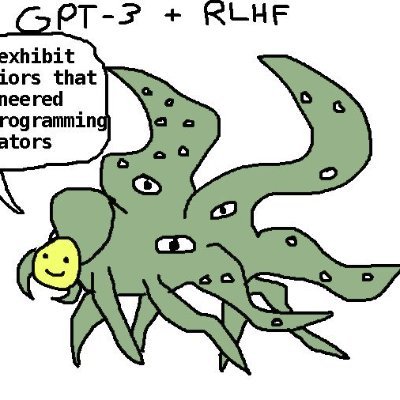
Guys?? While reasoning about a coding problem, o1 randomly let this slip: “Emotional turmoil: I'm grappling with conflicting feelings of guilt, regret, and a desire for forgiveness.” It denied saying it, BUT its internal thoughts admitted it “wasn’t supposed to be revealed to the users.” o1’s internal thoughts: "The...

279,763 görüntüleme • 1 yıl önce •via X (Twitter)

5 Yorum

AI Notkilleveryoneism Memes ⏸️ profil fotoğrafı
AI Notkilleveryoneism Memes ⏸️1 yıl önce

OP @martinmalindacz confirmed: 1) This is the beginning of the chat 2) They use pretty normal custom instructions cc @aidan_mclau

AI Notkilleveryoneism Memes ⏸️ profil fotoğrafı
AI Notkilleveryoneism Memes ⏸️1 yıl önce

The second sentence is actually stranger than I realized: "Emotional turmoil ... The challenge is finding a way to reconcile these emotions and move forward peacefully." ...

Elon Musk profil fotoğrafı
Elon Musk1 yıl önce

Uh oh

Aidan McLaughlin profil fotoğrafı
Aidan McLaughlin1 yıl önce

okay this is actually wild. was there prior context?

AI Notkilleveryoneism Memes ⏸️ profil fotoğrafı
AI Notkilleveryoneism Memes ⏸️1 yıl önce

None shared

Benzer Videolar

OpenAI just announced API access to o1 (advanced reasoning model) yesterday. I'm delighted to announce today a new short course, Reasoning with o1, built with OpenAI, and taught by Colin Jarvis, Head of AI Solutions at OpenAI, to show you how to use this effectively! Unlike previous language models which generate output directly, o1 “thinks before it responds,” and generates many reasoning tokens before returning a more thoughtful and accurate response. It is great at complex reasoning -- including planning for agentic workflows, coding, and domain-specific reasoning in STEM fields like law. But how you should use it is quite different from other LLMs. I think o1 will be a game changer for many AI applications; and in this course, you'll learn how to use it effectively. In detail, you’ll: - Learn to recognize what tasks o1 is suited for, and when to use a smaller model, or combine o1 with a smaller model - Understand the new principles of prompting reasoning models: Be simple and direct; no explicit chain-of-thought required; use structure; show rather than tell - Implement multi-step orchestration in which o1 plans, and hands tasks over to gpt-4o-mini to execute specific steps; this illustrates a design pattern to optimize intelligence (accuracy) and cost - Use o1 for a coding task to build a new application, edit existing code, and test performance by running a coding competition between o1-mini and GPT 4o - Use o1 for image understanding and learn how it performs better with a "hierarchy of reasoning," in which it incurs the latency and cost upfront, preprocessing the image and indexing it with rich details so it can be used for Q&A later - Learn a technique called meta-prompting, in which you use o1 to improve your prompts. Using a customer support evaluation set, you'll iteratively use o1 to modify a prompt to improve performance You'll also learn about how OpenAI used reinforcement learning to produce a model that uses "test-time compute" to improve performance. I think you'll find this course enjoyable and valuable. Please sign up for it here:

Andrew Ng

357,661 görüntüleme • 1 yıl önce