Loading video...

Video Failed to Load

Go Home

Hard work beats talent, when talent doesn’t work hard. ED Mbango outworks everyone‼️⚽️💥🔋 Edd🇨🇩 #BlueClassico3 ⬇️ Choose your favorite part of his song 🎶🎵 1. ED MBANGOOOO 💨 2. HE COMES FROM CONGO 🇨🇩 3. HE DRINKS UM BONGO 🍹 4. HES F🤬🤬🤬🤬 RAPID‼️

27,855 views • 1 year ago •via X (Twitter)

2 Comments

Chris Welch's profile picture
Chris Welch1 year ago

@OfficialRDCKID 1. Got me shouting that on a daily 😂

Mitchell Hand's profile picture
Mitchell Hand1 year ago

@OfficialRDCKID @DionJarvis2 tag mark

Related Videos

Dan Campbell said, "It starts over with the work. There is no complacency. There is no entitlement. We go back to work, and that is the focus. Because, if you don't work, it doesn't matter." It means doing the work. It means competing every day. How The Best Compete: 1. They outwork you - It means consistently showing up, doing the work and committing to your craft. The best in their field value the importance of hard work, going the extra mile, and continuously improving your skills. This dedication sets them apart because they grow and improve consistently. 2. They outhustle you - Hustle beats talent when talent doesn’t hustle. It means having a relentless drive and a never-give-up attitude. It's about taking advantage of every opportunity, being proactive, and staying ahead of the competition. The best understand that effort and determination can outshine natural talent when combined with hard work. 3. They outlast you - It is the principle of perseverance and resilience. Outlasting the competition means maintaining resilience and endurance over the long haul. They stay persistent, overcome obstacles, and continue to move forward when faced with seatbacks. Their steadfast mindset ensures longevity while others are filled with doubt. 4. They out-focus you - It means prioritization and focusing on what matters. It's about prioritizing your efforts and channeling your energy into what truly matters. Competing means you have a clear vision of who you are, what you want, and how you are going to get there. This level of concentration ensures that you maximize your productivity and achieve your objectives. 5. They out-adapt you - It means continuously growing, improving, and adapting. They are masters of constantly reassessing where they are, changing, and reinventing themselves. It's about finding solutions, learning from failures, and continually adjusting your strategies to stay on course. This ability to pivot and persist is crucial for long-term success. Competing every day is a mindset, not a moment. It means do the work, give your all, and never settle.

Coach AJ 🎯 Mental Fitness

94,443 views • 1 year ago

Hard work beats talent when talent doesn’t work hard. Here are a few thoughts from this insightful video clip 👇🏽 1) One who has talent needs to stop being complacent, distracted and lazy and needs to start being focused and working hard to reach one’s goals. ARE YOU FOCUSED AND GIVING YOUR BEST? 2) What if the 🐇 was focused and working hard as well? It would have won the race, and the 🐢 would be left disappointed on losing despite all its sincere efforts. The question is, is it fair to have a race between 2 absolutely different talents/skill sets? Both the 🐇 and the 🐢 may be accomplished in their own skills, but they need to be in a race with those who possess the same skillset for a fair competition. Let’s recall what Albert Einstein said, “Everybody is a genius. But if you judge a fish by its ability to climb a tree, it will live its whole life believing that it is stupid.” ARE YOU IN THE RIGHT RACE? 3) Now imagine that the race was between two accomplished 🐇 🐇 or between two accomplished 🐢🐢 (two individuals of the same skillset) Still, one would win, and the other would lose. Despite all focus and hard work, victory and defeat are a part of life. One day we win, and on another, we lose. When we don’t get what we’ve toiled for, we may feel disappointed, and that’s fine. We’re sentient humans, after all. If we come out of the anguish of our loss in our own time, work with focus and commitment and get back to the race again, we’re a massive success. Real defeat is not the loss in the race but the lack of willingness and motivation to give it a shot again. READY TO GIVE IT A SHOT AGAIN? VC: Unknown #StayFocused #avoiddistractions #hardworkpaysoff #smartwork #SelfDiscovery #beyourself #COMPETITION #dontlosehope #KeepGoing #youcandoit #EnergizeYourMind #lifesamazingsecrets #gaurgopaldas #GaurGopalDas #WednessdayMotivation

Gaur Gopal Das

36,240 views • 3 years ago

Tony Dungy said, "You've got to have talent to win a championship, but that's not number 1." "That team (that won the SB) worked the hardest, stuck together the most, (and) was willing to pay the price to overcome adversity." How to Build a 𝐂𝐎𝐌𝐌𝐈𝐓𝐓𝐄𝐃 𝐓𝐄𝐀𝐌:🧵 1. Set standards, not just goals - It means creating expectations for daily habits, effort, and accountability - not just focusing on end results. Standards guide how the team operates, ensuring consistency and discipline. Success isn't built on goals alone; it's built on the habits that make goals achievable. 2. Build trust and connection - It means creating an environment where teammates feel safe, respected, and valued. Trust allows teams to communicate openly, rely on one another, and face challenges together. A connected team doesn’t just work side-by-side - they work for each other. 3. Set a clear purpose and vision - It means every team member understands why they are showing up and what they are working toward. A clear purpose keeps everyone aligned and motivated. Teams with purpose don’t just work - they work with intention and focus. 4. Embrace hard work - It means showing up every day ready to give your best effort, even when it’s tough. Hard work matters builds discipline, confidence, and progress over time. The teams that succeed are the ones that live the details, do the work consistently, and never settle for "good enough". 5. Build a resilient mindset in everyone - It means building a mindset within the team wants to overcome adversity. Every team faces adversity, but the committed teams don't falter when they face setbacks. They choose to grow, learn, and improve when looking at challenges. 6. Put the team first - It means putting the team’s goals ahead of your own personal desires. Committed teams personify WE over Me. This matters because when everyone sacrifices for the team, trust and unity grow stronger. True commitment shines when individuals support each other, share the workload, and celebrate team success over personal recognition.

Coach AJ 🎯 Mental Fitness

34,960 views • 1 year ago

Carlos Estévez on why Shohei Ohtani is an Android built on discipline and raw talent; (Written and translated by Master Flip) He’s a robot. Straight up, that guy’s a robot. He’s in a league of his own. His routine, the way he prepares from the moment he steps on the field, the discipline it takes to be ready for a 2 p.m. first pitch, it’s not easy. But that discipline is incredible. And it’s where the whole talent vs. hard work debate gets real. I’m a firm believer in hard work. I’m the kind of guy who was made through grind, I don’t have natural gifts like that. I’ve always said hard work beats talent when talent slacks off. But Ohtani? He’s the rare combination of both. That’s how you end up with an Android. As a hitter, he barely needs BP on the field. He heads straight to the cage, does a drill going the other way, and that’s it. Hitting is hard, everyone knows it, but this guy does minimal tuning and still turns into a beast at the plate. Pitching, though? That’s where he puts in the real work. He comes out, throws weighted balls, drills his mechanics, grinds on every detail. Maybe it’s because pitching is the side where he’s humanely made, but he’s naturally a hitter, that’s the way I see it. Either way, his ability is unreal. One time, he made an out against Michael King’s sinker and immediately asked, “What was that? A sinker? How do you grip it?” The very next day in the bullpen, he’s out there throwing sinkers. The day before he pitches, he’ll throw maybe 10–15 pitches in the pen. Then, three pitches into his start the next day, boom, a sinker! I’m sitting there thinking, How?! I’ve spent a thousand years trying to perfect a nasty slider, and he just picks up something new and drops it in game like it’s nothing. The lifestyle that level of player lives is tough. Guys like Trout are the same way, they have to stay low key because everyone knows them. At the ’23 All-Star Game, I flew with Ohtani, hung out with him the whole time until we got to the hotel. Once we arrived, it was straight to the back entrance for him, different access. I just said, goodbye Charlie, I’ll see you later, and went off with the regular mortals. But we bonded over the little things. I play video games, watch anime and read manga, he does too. That’s how we became close. This year at the All Star Game, he was repping the NL and I was on the AL side. He waited for me. My oldest daughter yelled “Ohtani!” and he recognized her right away, so he held up just to talk to me. That’s who he is, he’s a superstar among superstars. All the other MLB stars want pics with him. He’s the only one on that level. I’m not exaggerating. There’s that famous video from the ’23 All Star Game where he was about to take a selfie and the phone almost dropped. It was with me, he was coming over to snap a pic, but I yanked him out of the swarm. Everyone was crowding him with, “Let’s take a pic! Let’s take a pic!” I yelled, “Ohtani, let’s take a pic!” and he ran straight to me. He took the selfie, the phone nearly slipped, that’s the clip that went viral. When we got inside, he looked at me and said, “Thank you.” He noticed right away. He’s not gonna call anyone out or act rude, he just handles it with class.” 🎥 Abriendo Sports

Master Flip 🇩🇴

104,086 views • 4 months ago

The CEO of Uber just revealed his controversial way of running his company. His principle: Hard work is a learned skill. And if you haven't developed it by now, you probably never will. Dara Khosrowshahi went on Diary of a CEO and dropped something most executives would NEVER admit publicly... He was asked a simple question: "Have you ever seen someone who wasn't a hard worker become a really hard worker?" His answer: "No. No one occurs to me." Not one person. In decades of building billion dollar companies. Then he explained why: "The most important skill in life is the skill of working hard. It's not something you can turn on and off. It's a LEARNED skill. That's not something you're born with." Read that again. He's not saying hard workers are special or gifted. He's saying they LEARNED it. Developed it. Trained it like a muscle. And the people who never learned it? They stay that way forever. This is the guy who turned Uber from bleeding $3 billion a year into printing $10 billion in free cash flow. The guy who took Expedia from $2B to $9B in revenue. And his entire thesis on success comes down to one skill most people never bother developing. Here's how he runs Uber: "You come to Uber, you're going to work your ass off. If you're not performing, we're going to let you know. And if you don't fix it, we're going to push you out." He sends emails on Saturdays. If no response by Sunday, he follows up with just "?" When HR told him he was "scaring people" early in his tenure, he said: "Then they can leave." And here's what separates this from toxic hustle culture nonsense: Dara has dinner with his family every night. 6 to 8pm is protected. But he's back on email at 9:30pm. And again at 5:30am. It's not about grinding yourself to death. It's about the refusal to be outworked. "I'm not going to let anyone outwork me. They may be smarter, more talented. But I'm not going to let anyone outwork me." He studied the elites. Ronaldo. Jordan. The pattern is always the same... Talent gets you in the room. But the thing that separates the best from everyone else? "They work their asses off. They're disciplined. They're structured. They're relentless." That's learned behavior. Not genetics. The uncomfortable truth here is that most people had their chance to develop this skill. And they didn't. Now they spend their energy debating whether hard work is "toxic" instead of building something. The question isn't whether this is "fair" or "healthy" or whatever cope people want to throw at it. The question is which SIDE you're going to be on. The people who learned to work? Or the people who learned to make excuses?

Ricardo

736,775 views • 4 months ago

In Moondru Mudichu (1976), Thalaivar's screen presence doesn’t arrive politely, it claims the frame. What makes the performance feel “unbelievable talent” isn’t just that he plays an antagonist; it’s that he plays him with a strange, magnetised confidence, as if the camera already belongs to him even when the narrative doesn’t. 1) Screen presence: the frame bends toward him Even in scenes where he’s not the “hero,” Rajini has that early gift: your attention keeps drifting to him. Part of it is physicality, the way he stands, the way he leans in, the way he lets silence sit before a line. He doesn’t behave like a newcomer trying to impress; he behaves like someone who has already decided he’s dangerous. He fills negative space extremely well. Many actors “perform” constantly; Thalaivar in this film often does the opposite, he holds. That hold creates tension: you don’t watch what he’s doing, you watch what he might do next. 2) The character work: entitlement as a weapon His character’s engine is entitlement, not loud villainy, but a creeping sense that he deserves what he wants. He plays that entitlement with an unnerving normalcy. That’s what makes it effective: it doesn’t feel like a “bad guy act,” it feels like a person who has rationalised his ugliness. The performance is built on micro-aggression: a smile that’s half-charm, half-threat; a casual tone thats pushing boundaries. He weaponises comfort, he’s relaxed while others get uneasy. That contrast is where the menace live(esp in this scene with Sridevi) 3) Voice and timing: the early Rajini rhythm You can already see the Rajini timing that later becomes iconic, that slightly delayed delivery, the confident pause, the line that lands not because it’s shouted but because it’s placed.(every actor after him has copied this particular style atleast once) He uses cadence like a hook: calm, then sudden bite. Even when the writing is straightforward, he finds subtext through rhythm: the line isn’t just information; it becomes a power move. 4) Body language: swagger without “style show” This is important: early Rajini doesn’t “stylise” himself the way later superstar Rajini does, but the seed is clearly there. He moves like someone who belongs everywhere, even when he shouldn’t. The walk, the head tilt, the eye-line, all of it signals control. And when he turns predatory, it’s not theatrical. It’s disturbingly practical. He doesn’t announce evil; he slides into it. 5) Why it feels like raw talent Because he understands something many trained actors take years to learn: Cinema is reaction. Rajini’s face listens, calculates, decides. Power is often quiet. His confidence isn’t volume; it’s certainty. Villainy is most frightening when it feels ordinary. He plays it like a real person, not a category. That’s why, even as a “new actor,” he looks like a fully formed screen phenomenon: not polished, but inevitable. Moondru Mudichu captures the moment where talent isn’t trying to be IT SIMPLY CANNOT BE IGNORED... A STAR WAS BORN... He still rules DOT Rare actor who threw rules out of the window a lot of times.

Ramya

18,066 views • 5 months ago

2. Teasers / MV / Live presentations We believe all the content should include all members. Not some content, but all of it. We see some people excusing the exclusion of Lee Know in some content because "he will appear in other content", we don't understand why he would be excluded out of any content when the group includes 8 members. There isn't an excuse for this to happen all the time. We will only talk about recent releases and God's Menu to not make this even longer. a) Gods Menu - A title track where they gave him zero lines and screen time (song that they continue to sing, so the company could have made a redistribution of the lines). b) Megaverse - They gave him lines in the initial release, but then they cut his part to 3 seconds, and decided to delete his center part leaving him with half of a line. c) Hall Of Fame - Every live presentation they would cut Lee Know on his own part recording from below all of the other members and only listening to Lee Know's voice without being able to look at him. d) S-Class - They stopped recording the kick he does and instead they record the other members, Lee Know sings there. e) JJAM - When it was dance racha time, Lee Know got almost no time, during the life presentation the moment he goes to the center he says his line "I know..." and while he says it, the screen gets black, so he doesn't have that time on screen, later he is placed at the back covered during the dance break. He is the dance leader. f) Walkin on Water' - During the live presentation, they decided to record everyone on his part, and cut it from his own fancam. g) Recent teasers - He was completely excluded from the first teaser and only included in the second one, he got no solo recording on the MV like the other members. h) Giant - There is a part on the video where all the members are shown, Lee Know is covered and the lights are lowered where he is, making him invisible. During the live presentation, they record other members on his part, they put the dance focus on others, being the only part he has where he sings alone. i) YOUTH - After the release of the MV, the company decided to edit the video causing views to freeze and deleting a very important part where it thanked the people involved. The time from when the video was finished to when it was published was enough to arrange all the details, and the part deleted was so big, it was impossible to miss it. This happened before with his other individual work “Dawn”, which was deleted after some time, and re-uploaded, deleting all the views it had accumulated. This means one of two things, the company puts less interest and effort in Lee Know's work, or the company is purposefully hindering Lee Know's work. Either of the two is unacceptable by a company with so many resources and that claims to be a leader in the industry. This only shows a lack of professionalism and care. j) Dance leader - We know he is the dance leader, and K-stays and the members have talked a lot about how involved he is and how hard he works in that position, but the company refuses to include any footage of him doing it, and even cuts the parts where he gives his all. Just recently K-Stays were raving about how hard Lee Know worked as the dance leader and how much effort it took, One Label cut all of that footage from the Talker. It appears they don't want stays to look at anything he does, or to not give him recognition for anything.

LEE KNOW 리노 GLOBAL ★

21,011 views • 1 year ago

In 2009, Lin-Manuel Miranda was invited to perform at the White House. His musical “In The Heights” had just won a Grammy & 4 Tony Awards. So the White House was expecting him to perform something from Heights. Instead, he debuted a song from a rap album he’d been working on: Miranda explained that he'd been working on this "concept album about the life of someone I think embodies hip-hop...Treasury Secretary, Alexander Hamilton." The crowd laughed. "You laugh, but it's true!" Miranda replied. "He was born a penniless orphan in St. Croix of illegitimate birth, became George Washington's right-hand man, became Treasury Secretary, caught beef with every other Founding Father. And all on the strength of his writing. I think he embodies the word's ability to make a difference." Takeaway 1: Lin-Manuel Miranda said he initially picked up Ron Chernow's biography of Alexander Hamilton, "thinking maybe I’ll get a funny song out of it—some jokey-rap thing about the Hamilton/Burr duel." Then, as he read it, "I thought I would write a bunch of songs that tell the greatest hits of Hamilton’s life." Then, as he wrote the songs, he realized it could be a musical. Most things of magnitude start small. Talking about working with Nobel Prize winners, interviewing the great minds of his time, and studying the greats of all time—Richard Hamming famously said, to do great work, you have to: "Plant the little acorns from which the mighty oak trees grow." Takeaway 2: When Lin-Manuel Miranda told people he was working on a hip-hop album about a founding father, people laughed. He worked on the concept for 8 years—so, Miranda said, “I had a lot of people look at me like I was crazy for a very long time.” Speaking to entrepreneurs at the startup incubator Y Combinator, the billionaire Peter Thiel drew a Venn diagram on a whiteboard. In one of the overlapping circles, he wrote, “seems like a bad idea,” and in the other, “is a good idea.” The intersection is the sweet spot for doing great work, Thiel said. Everyone knows that to do great work you need natural ability and you need to work hard. But there’s a third ingredient that doesn’t get talked about or written about as often: the ability to work on what "seems like a bad idea." - - - As he was working on what he thought was going to be a hip-hop album, Miranda met his hero, the composer Stephen Sondheim. Sondheim asked him what he was working on. "And I told him, 'I’m working on this hip-hop album, like a ‘Jesus Christ Superstar’ concept album about Alexander Hamilton.' And he threw back his head and guffawed, and he said, 'No one will expect that from you. That’s amazing. Keep writing that…Keep surprising us.'" Follow Billy Oppenheimer for more content like this!

Billy Oppenheimer

2,228,235 views • 3 years ago

I read over 1,000 pages on Julius Caesar's leadership, these are my five top takeaways... 1. Caesar inspired his troops by fighting alongside them. In a battle against the Helvetii he rode to the frontlines, then sent away his horse to show that he would endure the battle with his soldiers. No matter the outcome. This inspired his men to fight for him, as he shared their danger. Key Lesson- You must always work alongside your employees. Let them know you share in their suffering. 2. Caesar always moved with speed and agility. Napoleon said: "The strength of an army, is estimated by multiplying the mass by the rapidity" The Romans under Caesar were not only the best engineers, but they were also the fastest. This gave them speed and agility both in travel, and in warfare. Key Lesson- Speed and agility. Speed and agility. Speed and agility. 3. Caesar expected his troops to always be ready. “He also made a habit during campaigns of not announcing the hour of the army’s departure beforehand as he expected his men to be prepared to follow him at any time." Key Lesson- You must expect your employees to always be ready. Always keep them moving. Never let stagnation settle in. 4. Caesar pushed his troops to the absolute limits. From his biography: "No Roman general ever pressed his troops harder than Caesar, but no army ever followed its leader more willingly." Key Lesson- Push your troops hard. It simply builds moral. 5. Caesar instilled a meritocracy. Also from his biography: "Caesar didn’t care what kind of background his men came from, wether they were Roman patricians by birth of the sons of a goatherd. All that mattered to him was how they conducted themselves in war." Key Lesson- Give room in the organization for talent to rise up in the ranks. This encourages performance.

Nic Munoz

74,458 views • 2 months ago

THE FOUR HORSEMEN STORY DOESN’T MAKE SENSE!!!🚨🚨🚨 Thread🧵 Notice : this is pure speculation and nothing about this is factual information. All the information provided is fully based on what we see/saw on the internet. Please RT for awareness. First of all i would just like to say that A-Reece has no reason not to answer his phone for a whole month especially from a guy that he worked with before and has a good working relationship with. Something just doesnt feel right. Get your popcorn🍿 1. This first started when Nasty C leaked or hinted on being on the same song as A-Reece. Note that Nasty C specifically mentioned that Stogie T asked him to do a hook for him and says he will work on the verse in the meantime, meaning that he was initially asked to do both a hook and a verse. Also note that the Date of this interview is back in may meaning that the song had been in the making for awhile. BET! 2. Stogie T finally talks about the after it comes out on a radio show. He clearly states that he sent them both the beat and with Nasty C he talks about a hook and with A-Reece he is clearly referring to a verse/bars since he says “things that Slimes know him for”. BET! 3. L Tido invites MAGGZ on his podcast and he clearly indicates that MAGGZ is “ GONNA” (note that word) have the best verse on the song and during this time L Tido only knew that only Stogie T, A-Reece and MAGGZ will have verses while Nasty C is on the hook and i will prove that on number 4. So by this time L Tido already underestimates Stogie T and A-Reece pen. 4. After the song drops L Tido’s tone changes from MAGGZ to Nasty C having the best verse and clearly indicates that Nasty C didn’t have a verse and was initially supposed to be on only the hook and indicates again that Nasty C sent his verse a week before the song released. The song got released on the 28th of November meaning that Nasty C sent his verse during the week 16th - 22th This is 4 proofs that Nasty C was asked for a hook. Note and pay proper attention as this leads into 5 down below…

theboyjay

34,532 views • 5 months ago

Roger Federer: "Effortless is a myth. I worked very hard to make it look easy." "I left school at age 16 to play tennis full-time. So I never went to college. But I did graduate recently. I graduated tennis. I know the word is 'retire', but retired sounds awful. Like you, I finished one big thing and I'm moving on to the next. Like you, I'm figuring out what that is." Lesson 1: Effortless is a myth. "People would say my play was 'effortless.' Most of the time, they meant it as a compliment. But it frustrated me when they'd say, 'He barely broke a sweat' or 'Is he even trying?' The truth is, I had to work very hard to make it look easy." Roger shares the wake-up call: "An opponent at the Italian Open publicly questioned my mental discipline. He said, 'Roger will be the favorite for the first two hours. Then I'll be the favorite after that.' Everyone can play well the first two hours you're fit, you're fast, you're clear. After two hours, your legs get wobbly, your mind starts wandering, your discipline starts to fade. My parents, my coaches, even my rivals were calling me out. So I started to train harder. A lot harder." He explains the paradox: "I got the reputation for being 'effortless' because my warmups at tournaments were so casual that people didn't think I'd been training hard. But I had been working hard before the tournament when nobody was watching." Roger redefines talent: "Yes, talent matters. But talent has a broad definition. Most of the time, it's not about having a gift, it's about having grit. A great forehand can be called a talent. But discipline is also a talent. Patience is a talent. Trusting yourself is a talent. Embracing the process, loving the process, these are talents too. Some people are born with them. Everybody has to work at them." Lesson 2: It's only a point. "You can work harder than you thought possible and still lose. I have many times. Tennis is brutal. Every tournament ends the same way: one player gets a trophy. Every other player gets back on a plane, stares out the window, and thinks, 'How the hell did I miss that shot?'" Roger shares the statistic that changed his mindset: "In the 1,526 singles matches I played in my career, I won almost 80% of those matches. But what percentage of points do you think I won? Only 54%. Even top-ranked tennis players win barely more than half of the points they play." He explains what this teaches: "When you lose every second point on average, you learn not to dwell on every shot. You teach yourself to think: 'Okay, I double-faulted. It's only a point.' 'I came to the net and got passed again. It's only a point.' Even a great shot, an overhead backhand smash that ends up on ESPN's Top 10, that too is just a point." Roger shares the key mindset: "When you're playing a point, it has to be the most important thing in the world. And it is. But when it's behind you, it's behind you. This frees you to fully commit to the next point with intensity, clarity, and focus." He reflects on losing Wimbledon 2008: "Some call it the greatest match of all time. Okay, all respect to Rafa, but I think it would've been way better if I had won. Looking back, I feel like I lost at the very first point. I looked across the net and saw a guy who just a few weeks earlier crushed me in straight sets at the French Open. And I thought, 'This guy is maybe hungrier than I am.' It took me until the third set to remember 'Hey buddy, you're the five-time defending champion. You're on grass. You know how to do this.' But it came too late." Roger shares what champions understand: "The best in the world are not the best because they win every point. It's because they know they'll lose again and again, and have learned how to deal with it. You accept it. Cry it out if you need to. Then force a smile. Move on. Be relentless. Adapt and grow. Work harder, work smarter." Lesson 3: Life is bigger than the court. "A tennis court is 2,106 square feet. That's where singles matches happen. Not much bigger than a dorm room. I worked a lot, learned a lot, and ran a lot of miles in that small space. But the world is a whole lot bigger than that." Roger explains his philosophy: "Even when I was just starting out, I knew that tennis could show me the world, but tennis could never be the world. I knew that if I was lucky, I could play competitively until my late 30s, maybe even 41. But even when I was in the top five, it was important to me to have a life, a rewarding life full of travel, culture, friendships, and especially family. These are the reasons I never burned out." He shares what matters most: "Tennis has given me so many memories. But my off-court experiences are the ones I carry forward just as much. The places I've travelled, the platform that lets me give back, and most of all the people I've met along the way." Roger concludes: "Tennis, like life, is a team sport. Yes, you stand alone on your side of the net. But your success depends on your team, your coaches, your teammates, even your rivals. All these influences help make you who you are." His final words: "Whatever game you choose, give it your best. Go for your shots. Play free. Try everything. And most of all, be kind to one another, and have fun out there."

Jaynit

250,320 views • 3 months ago

Make Something Wonderful is 250 pages of Steve Jobs in his own words, speaking directly to you. The book contains some of Steve's ideas that I've never found anywhere else. Notes from the book: 1. He didn't care about being right. He cared about being excellent. 2. His mind was never a captive of reality. 3. He said working with great people gives you access to wisdom that you can't buy for love or money. 4. He believed technology should be streamlined and practical, simple and sophisticated, and that it should be a tool for enhancing creativity as much as productivity. 5. He believed you should ambush your customers. Meet them where they are. 6. His ideas were not arguments, but intuitions. He had a true inner freedom and an epic sense of possibility. 7. He gave an extraordinary amount of thought to how best to use our fleeting time. 8. By the time he was thirty he was the public face of a Fortune 500 company. 9. At Apple’s first board meeting he put his bare feet on a conference room table. 10. He said you should think of your life as a rainbow arching across the horizon of this world. You appear, have a chance to blaze in the sky, then you disappear. 11. He possessed unbelievable rigor that he imposed first, and most strenuously, on himself. 12. He saw clearly (1) what was not there, (2) what could be there, (3) what had to be there. 13. He said early Apple employees were more like poets and painters than cold technologists. That the passion they put into their products were completely indistinguishable from other creative fields. He said their work was a form of love. 14. He had a verbal mastery that was obvious at a young age. He used simple, descriptive language, told stories, and repeated lines and ideas that were important. 15. He thought it was inevitable that computers would be the dominant medium of human communication. He said this in 1983. 16. He had a talent for spotting markets full of second-rate products. 17. He said you could tell how important a product was based on the amount of time people spent interacting with it. As a result he thought it was inevitable that more design talent would shift from the automobile (1 or 2 hours a day) to computers (6+ hours a day). He said this in the 80s. 18. He said that books kept him out of jail and that it’s a shame there are so many mediocre teachers. 19. Like many great entrepreneurs before him, Steve knew what he wanted to do, but didn't know how to do it yet. He said he wanted to make an insanely great computer that was the size of a book. What he described sounded a lot like an iPad. He said this in the 80s. 20. He believed that you should use your unique set of talents to make things that make the lives of other people better. Most people just take. He said "the ability to put something back into the pool of human experience is extremely neat." 21. He would tell his team “You work for Apple first and your boss second.” He felt strongly about that. 22. He was constantly placing the products he was making in a historical perspective, like comparing the Macintosh to the invention of the telephone. 23. He believed you needed to give yourself more time to make mistakes. He said his taste got more refined as he made mistakes. He said that making mistakes over a long period of time made his aesthetics better. 24. He said the key ingredient to making something great was time. 25. He said he wanted to spend his life building things. He could have retired to a beach in his 20s and thought that was disgusting. 26. He was interested in learning how to hone a company down to its essence. 27. You read this book and a thought jumps out at you: How many people are willing to go through a decade of failure without quitting? Steve had the capacity to take pain. 28. He believed it was better to focus on what you're actually passionate about, instead of what you think will make you the most money. He made the most money that way. 29. He listened to older, wiser entrepreneurs and let them shape and mold his thinking. 30. He wasn't afraid to fail, but had to coach himself to adopt that trait. He didn't want to fail, but he wasn't afraid of it. 31. He said don't let your differentiation evaporate. 32. He said if you let your differentiation evaporate the only solution is innovation. 33. He believed great ideas don't map onto corporate hierarchy. 34. He was incapable of thinking that his work and his life were different, separate things. 35. He said the most important things in life are not the goal-oriented, materialistic things. He said you should tap into the world’s magical, mystical, and artistic sides. 36. He paid attention to subtle insights. He was guided by intuition. 37. He didn't believe in the concept or a career, or think it was wise to follow well-worn paths laid out by others. 38. He said most people make the mistake of not thinking about death. He said: "For me it’s the opposite: to know my arc will fall, makes me want to blaze while I am in the sky." 39. He thought Walt Disney had a great idea: Edit before you make it. 40. He said no amount of technology can turn a bad story into a good story. 41. He believed storytellers were the most powerful people in the world. 42. He believed if you didn't have great people you were doomed. 43. He found great people by looking at great results and finding out who was responsible for them. 44. This is how he interviewed people: "In an interview I will purposely upset someone: I’ll criticize their prior work. I’ll do my homework, find out what they worked on and say, “God, that really turned out to be a bomb. That really turned out to be a bozo product. Why did you work on that?” The worst thing that someone can do in an interview is to agree with me and knuckle under. What I look for is for someone to come right back and say, “You’re dead wrong and here’s why.” 45. He believed the job of the leader was to make sure the work is as good as it should be, and to get people to stretch beyond their best. 46. He believed the job of the leader was to cajole, and beg, and plead, and threaten at times—to do whatever is necessary to get people to see things in a bigger and more profound way and to have them do better work than they thought they could do. 47. He believed the priorities of the leader were (1) recruit, (2) set an overall direction, and (3) inspire and cajole and persuade. 48. He believed a creative company should have a risk-taking, creative environment on the product side and a fiscally conservative environment on the business side. 49. He believed you have to choose what you put your love into really carefully. 50. He had a remarkably consistent set of values that he held dear: Life is short; don’t waste it. Tell the truth. Technology should enhance human creativity. Process matters. Beauty matters. Details matter. The world we know is a human creation—and we can push it forward. 51. He thought when deciding what to work on that you should ask yourself: "What do I give a shit about?" And then go do that. 52. He would never sell Apple. Not for all the money in the world. 53. He believed you should master the basics, simplify the product line, and focus on the gems. 54. He believed marketing was about values. That the world is noisy and you should focus on telling customers what you believe in and what you stand for. 55. He believed one way to invest in yourself is by exploring uncharted paths that are different from your past experiences. You know it's an uncharted path when you have no idea where it will lead. 56. He believed that people that think they’re following a safe path pay the highest price of all. They won't realize it for a decade or two — and by then it's too late. 57. He didn't believe in resting on laurels or sleeping on wins. Make something great. Then do it again. 58. He imagined what reality lacked and set out to remedy it. 59. He believed in straight forward, clear communication. If the work isn't good enough you have to tell them straight: "This isn't good enough. I know you can do better. You need to do better. Now go do better." 60. He remained driven by a mission to "put something back into the pool of human experience." 61. He believed in the basics: great product, great marketing, great distribution. 62. He believed you must keep up with innovations in distribution. 63. He believed brands take decades to build. 64. He would capture the evolution of his own thinking by emailing himself. 65. He viewed Apple has the world's premier bridge builder between normal people and the exploding world of high technology. 66. He wanted to demystify technology. 67. He believed excellence was a habit and we are what we repeatedly do. 68. He believed you should be curious about what came before you and you should spend time to learn about it. 69. He believed you simply could not mix messages when selling something new. A customer can barely handle one great new idea, let alone several. 70. He said it's a circus world and you'll never know what's around the next corner. 71. He believed in management by values. Which means (1) find people that want the same things you want and (2) figure out the best way to get those things along the way. 72. He believed in the mantra: Finding the right people is half the battle. 73. He said you can't plan to meet the people who will change your life. 74. He believed everything is temporary — there is no such thing as safety. 75. He believed that your life is a story and that you should remember that your life is a story and that you should always act like your life is a story. 76. He believed in rejecting dogma, which he defined as living with the results of other people's thinking. He said that dogma can be so loud that it can drown out your own inner voice and you should avoid this. 77. He believed a great place to start was by improving a product you hate. If you can make something you love, you can convince other people to love it too. 78. He said all glory is fleeting and you should just get back to making something wonderful. I'm really proud of the episode I made about this book. You'll learn a lot from Steve by listening to it. You can watch/listen to it in full here, or in your favorite podcast app.

David Senra

205,292 views • 11 months ago

#TAEMIN Global Spin Live at the Grammy Museum - Fan Questions segment [FULL] 🎙️Host: What was the first song you heard from Taemin? 💎Audience: [shouts a bunch of songs] 🐣Taemin: What is your guys’ favorite song? 💎Fan: NEMO! My cat is named Nemo! Taemin: Oh my cat is named Ggung! 1:55 🎙️Question 1: Do you get embarrassed listening to your own voice? [from Denise] 🐣Taemin: When I record my sexy songs like Sexuality, Criminal, something something, I have to acting more emotional—sexy vibe right? Sometimes very embarssed [demonstrates with the sexy part of Want] 2:55 🎙️Question 2: Taemin, your choreo is always so unique. What’s your favorite choreo that you’ve ever danced? [from Stasia] 🐣Taemin: Honestly my choreographer is in here, Kasper! His choreo is very cool but very hard and fast and aggressive, energetic, but I love that style. So for example—Advice. Recently my favorite song is Flame of Love. It’s Korean style, the moves are more contemporary style, that’s more interesting to me recently Lastly my favorite song is Criminal. That song is very conceptive and also choreographed by Kasper. 5:00 🎙️Question 3: What would you consider to be your greatest achievement in live? [from Emily] 🐣Taemin: When I was young I go to audition for…to be artist. So that is my very important moment. I did it! I debuted! 5:50 🎙️Question 4: What is your favorite pre-show ritual [from Gloria] 🐣Taemin: I always clean my teeth, it’s refreshing….and then recently I started consuming things that are a little sour like lemon juice. It helps with the bloating a little bit. And they said it helps with anxiety. 🎙️Host: It helps with bloating?? 🐣Taemin: ah yes!… ah…maybe? That is not… please search it please! [lololololol he was scared he was giving unproven medical advice] 7:20 🎙️Question 5: If you could collaborate with any artist globally who would it be and what kind of sound do you want to create together? [from Jihae] 🐣Taemin: Ah that’s what you’re curious about! There’s so many artist that I love so it’s really hard to pick one but maybe Billie Eilish? I love her attitude. She could draw in concentration even when she makes small sounds and in contrast I can do something much more energetic and maybe the contrast could create something very special. 9:00 🎙️Question 6: Do you ever sing or perform for your cats? 🐣Taemin: I put them on my lap and I maneuver them a little bit and they dance a little bit [Taemin demonstrates the song he sings them] 🎙️Host: Do you do it to your music or other people’s music? 🐣Taemin: It’s an improvised song! 🎙️Host: Are you gonna show these videos? 🐣Taemin: I don’t have hands to film it! Lol 10:15 🎙️Question 7: What’s the style of your new album? 🐣Taemin: You know just yesterday I was sorting through all the music that I wrote and it kind of gets categorized into 3 categories! We have songs that are really powerful and energetic, and songs that are really emotional and beautiful, and then the third category is a little different…maybe RnB? and now it’s something I have to think about how to present these all together. #TAEMIN_Grammy_Museum

cindy 🌥️

17,455 views • 5 months ago

This conversation with benahorowitz.eth gets into sides of his story you don't often hear. The people who shaped Ben tell you a lot about how he sees the world. His father grew up communist and later emerged on the right after seeing the failures of that system firsthand. He taught Ben that bad government and policy can ruin even the greatest countries, which explains why Ben believes technology is far more effective than policy at changing the world. Andy Grove (former CEO of Intel) taught Ben that when you are the industry leader, expanding the entire market becomes your responsibility. Ben explains how he built a16z around that idea and why he set out to build the firm at an unusually large and consequential scale. He sees its role as tied to whether America remains the technological, military, and cultural superpower, and is clear about what is at stake if it doesn't. Ben's story also includes his work with the Las Vegas Police Department. He explains why he is personally funding new technology there, and how its deployment has led to crime falling by more than 50% while making policing safer for everyone involved. Ben and I share a deep love of hip hop. We talk about why he thinks Nas is one of the great storytellers of all time and credits him for changing how he sees the world. Enjoy! Timestamps: 0:00 Intro 1:00 The US Tech Advantage 2:49 A Solution for Everything 4:21 The Fragility of Success 7:14 The New Physics of Company Building 10:48 "Alchemistic" Talent 12:57 Inequality and the Kobe Bryant Effect 17:01 Automation History & The Future of Jobs 20:06 American Leadership in the AI Era 22:42 Andy Grove & High Output Management 26:02 The Hardest Part of Being a CEO 29:56 Founding a16z 35:11 Scaling the Firm & Early Mistakes 39:19 Broken Capital Markets 41:23 Why We Don't Do Private Equity 43:29 Culture Is Action, Not Platitudes 49:54 Coding & Art 52:08 Learning from Nas 56:36 Las Vegas: The Future of Tech-Enabled Policing 1:01:03 The Kindest Thing

Patrick OShaughnessy

594,430 views • 5 months ago

Elon Musk literally sat down for a 45-minute talk with Y Combinator that explains how to build world-changing companies better than any business school on earth. This is the advice he gave a room full of young founders: 1. Don't try to build something great. Try to build something useful. Everyone obsesses over greatness. Musk says that's the wrong target. "I didn't originally think I would build something great. I wanted to try to build something useful. I didn't think I would build anything particularly great. Seemed unlikely, but I wanted to at least try." Aim for useful first. Greatness, if it comes, is a byproduct. 2. When you can't get in the front door, build your own door. Before Musk started his first company, he tried to get a job at Netscape. "I sent my resume into Netscape and nobody responded. I tried hanging out in the lobby to see if I could bump into someone, but I was too shy to talk to anyone. So I'm like, this is ridiculous, I'll just write software myself." He didn't set out to be a founder. He became one because no one would hire him. 3. He slept in the office and showered at the YMCA. The origin of his first company was not glamorous. "We couldn't even afford a place to stay. The office was 500 bucks a month, so we just slept in the office and showered at the YMCA." He couldn't afford proper internet either, so he drilled a hole through the office floor and ran a cable to the internet provider downstairs. That was the founder of the future richest man on earth. 4. Keep the chips on the table. When Musk sold his first company, he received a $20 million cheque. His bank balance went from $10,000 to $20 million overnight. Most people would have stopped. He put almost all of it straight back into his next company. "I kept the chips on the table." He did the same thing decades later, over and over. He hates money sitting idle. Money is fuel for the next mission. 5. Start with the mission, then work backwards to make it a business. Musk didn't start SpaceX to make money. He went on the NASA website to find out when humans were going to Mars, and there was no plan. So he decided to build one. "There had been no prior example of a rocket startup succeeding. A small chance of success is better than no chance of success." The mission came first. The business model came later. 6. He started SpaceX expecting to fail. He is brutally honest about the odds. "SpaceX started in mid-2002 expecting to fail. Probably 90% chance of failing. When recruiting people, I said, we're probably going to die, but small chance we might not die." The first three launches failed. The fourth one worked with no money left. "If the fourth launch hadn't worked, it would have been curtains. We made it by the skin of our teeth." 7. Break every problem down to physics. This is the core of how Musk thinks. "First principles means break things down to the fundamental elements that are most likely to be true, then reason up from there, as opposed to reasoning by analogy." His example is rockets. Everyone priced them based on what old rockets cost. Musk asked what a rocket is actually made of, priced the raw metals, and found the materials were only 1-2% of the historical price. The rest was inefficiency he could attack. 8. When told something takes 24 months, break it down and do it in six. Last year xAI needed a giant computer to train its AI. Suppliers said it would take 18 to 24 months. "It's like, well, we need to get that done in six months or we won't be competitive." So he broke it into parts. Needed a building, so he found an old factory. Needed power, so he rented generators. Needed cooling, so he rented a quarter of America's mobile cooling capacity. He slept in the data centre and ran cabling himself. It got done. 9. Watch your ego-to-ability ratio. Musk's single sharpest piece of advice for young founders is about staying honest with yourself. "A major failure mode is when your ego-to-ability ratio gets too high. Then you break the feedback loop to reality." Keep the ego small, internalise responsibility for everything, and stay ruthlessly connected to what's actually true. "You want to close the loop on reality hard. That's a super big deal." 10. Chase work, not glory. His closing philosophy ties it all together. "It's so hard to be useful. The area under the curve of total utility is how useful you've been to your fellow human beings times how many people. If you aspire to do true work, your probability of success is much higher. Don't aspire to glory, aspire to work." He was ridiculed for years. The press called him "internet guy attempting to build a rocket company." He agreed it sounded absurd. He did it anyway, because a small chance of doing something useful beat no chance at all. Here's the thing though.... Musk became the most followed founder alive because everything he does happens in public. The launches, the failures, the talks like this one. The companies made him powerful. The personal brand made his every word travel around the world before he finishes saying it. We build massive distribution and grow personal brands on X and beyond without our clients lifting a finger. If you're a founder or VC looking for that kind of exposure, book a call below. We average 1.5M views a week.

Lewis 🏴󠁧󠁢󠁷󠁬󠁳󠁿

654,835 views • 12 days ago

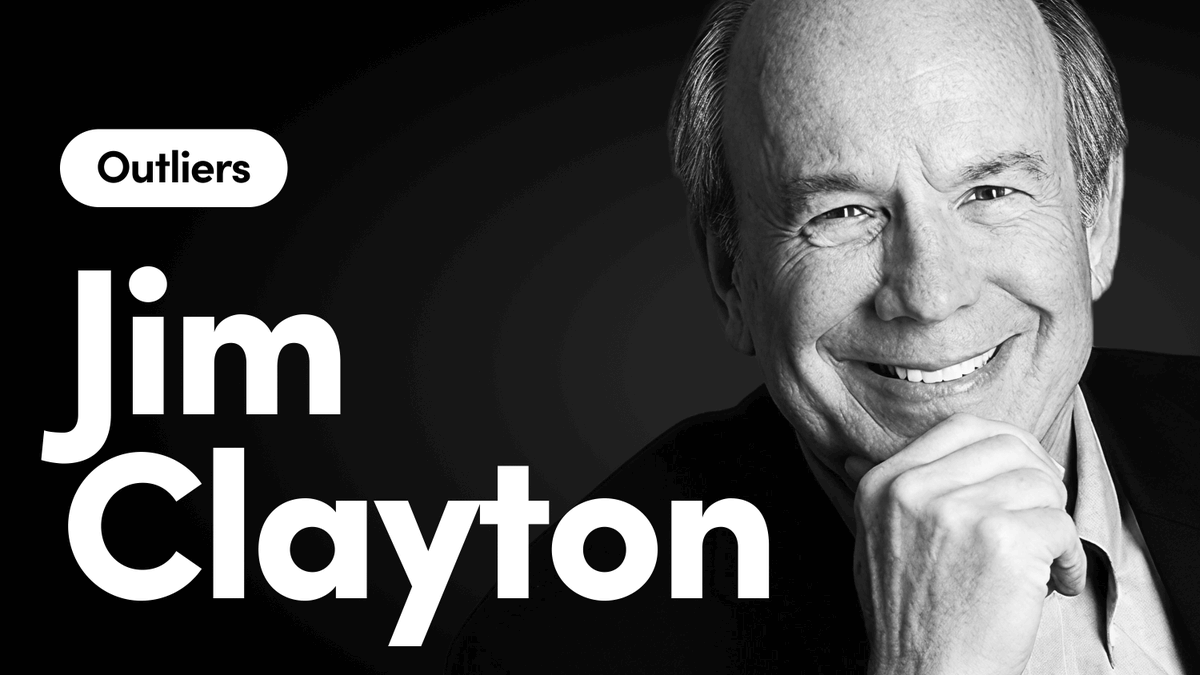
Jim Clayton was forced into bankruptcy at 27. The very next day he started from zero building Clayton Homes into a mobile homes juggernaut, eventually selling to Berkshire Hathaway for $1.7 billion. This is his story and the playbook he used to start over and build something massive. Here are some of the highlights: 1. If you have to swallow a frog, don’t look at it too long. 2. The strong feed during depressions. 3. “Money can’t buy happiness. … but it sure can help you look in a lot more places.” 4. All complaining comes at the expense of improving. 5. Don’t fight the flow. 6. “Positive action produces positive attitudes, which produce a positive atmosphere.” 7. Disappointment is not defeat. 8. Problems are opportunities. Run toward them. 9. “Our lives work only to the extent that we are willing to keep our agreements.” 10. When you lose your sense of direction, don’t act on impulse. 11. Talk less and listen more. 12. “He who has the last laugh has the best laugh.” 13. Bad loans spread like a virus. 14. When people tell you what you want to hear, your judgment takes a sabbatical. 15. People are expected to make 90% of decisions. If they don’t know which ones are in the 10%, they likely lack good judgment in other areas. 16. If you do what everyone else does, you’ll get results like everyone else. 17. “Never shine a light on your competitor. Not even a candlelight.” 18. Hard times reveal friends. 19. The best legal department is happy customers. 20. The spouses of the people you are considering hiring will tell you more about who they are than an interview. 21. Always be the fastest paying customer to your suppliers. 22. Make your plan conform to reality, not the other way around. Either work with the world the way you find it, or it will teach you a lesson. 23. “There are 3 kinds of people: those who make it happen, those who watch it happen, and occasionally, someone who doesn’t know what happened.” 24. “I have never worshipped money and I never worked for money. I worked for pride and accomplishment. Money can become a nuisance. It’s a hell of a lot more fund chasing it than getting it. The fun is in the race.” — Ray Kroc 25. The time to pull the trigger on an employee is the first time you think of it. 26. When hiring, look for people who already have jobs. 27. Sometimes you don’t need to be great; you just need to be better than the competition. 28. Always act like the underdog, even when you’re the favorite. 29. Skin in the game prevents a lot of poor behavior. If you want upside, you need downside. (Listen now "Jim Clayton on The Knowledge Project" or see links in comment below.)

Shane Parrish

325,678 views • 8 months ago

At 14, Jim Simons got a job putting away stock in a basement. He was so bad, they demoted him to floor sweeper. When he said he wanted to study math at MIT, his bosses laughed. He went on to make $100+ billion in trading profits. More than Buffett, Soros, & Dalio combined. In 2010, he spent 60 minutes at MIT explaining how a mathematician became the world's greatest trader: "They thought that was the funniest thing they had ever heard. The guy who couldn't remember where to put the sheep manure is going to be a mathematician at MIT." He applied to MIT. Got accepted. Studied mathematics. It went all right. After graduating, Simons took a job at the Institute for Defense Analysis. Secret government work. Good pay. Half your time on their work, half on your own mathematics. Then the Vietnam War happened. General Maxwell Taylor, the head of the organization, wrote an article in the New York Times about how victory was days away. Simons disagreed. He wrote a letter to the Times expressing that view. "They kindly published it." A few months later, a reporter asked to interview him about people who work for the defense department but oppose the war. Simons agreed. Told his local boss afterward. "He said, 'You did what?' And he picked up the phone and called General Maxwell Taylor." Silence on the other end. "He hung up. Looked at me. Said, 'You're fired.'" "I said, 'I'm fired? I'm a permanent member.'" "He said, 'I'll tell you the difference between a temporary member and a permanent member. A temporary member has a contract.'" "It was the first time, and happily the last time, I was ever fired." On starting Renaissance: Simons left mathematics at 38. Frustrated. Stuck on a problem he couldn't solve. He had some money from an investment that finally paid off. He invested that money. Found out he wasn't bad at it. He brought in the best modeler he knew. A guy named Lenny Baum. "Lenny started making models. But then he seemed to get less interested in models and more interested in reading the news." "Then he started having opinions on what was going to go up and what was going to go down. And he was right enough times." "I said okay, to hell with the modeling. Let's just try to make some money." What happened next: "We multiplied our investors' money by 12 in two years." "We were incredibly lucky." But in the back of his mind, he knew models were the answer. "If you're doing fundamental trading, one morning you come in, you feel like a genius. Your positions are all your way. You think, God, I'm really smart." "The next day you come in, they've gone against you, and you feel like an idiot." "It just didn't seem like a way to live your life." In 1988, he made the decision: 100% models. No human override. "Some firms say they have models. What they typically mean is the model advises the trader what to do. If he likes the advice, he'll take it. If he doesn't, he won't." "That's not science. You can't simulate that. How were you feeling when you got out of bed 13 years ago? Did you like what the model said?" "If you're going to trade using models, you slavishly use the models. You do whatever the hell it says. No matter how smart or dumb you might think it is at that moment." "That turned out to be a wonderful decision." On the secret sauce: "People always ask me, what's the secret? We're not the only quant firm in the world. But we seem to have done better than anybody." "The real secret sauce is that we start with great scientists. First-class people who've done first-class work." "Second, we provide people with a great infrastructure." "The most important thing is an open atmosphere. Everybody knows what everybody else is doing. No compartmentalization." "And people get paid based on the overall profits. Not just on your work. Everyone has an interest in everyone else's success." "Those policies, no one of which seems so remarkable, turn out to be a pretty winning combination." On guiding principles: His wife told him to end with values. He said he wasn't sure he had any. "She assured me that I had some values, if only I could think hard about them." Here's what he came up with: 1. Do something new. "I don't like to run with the pack. For one thing, I'm not such a fast runner." "If you're one of n people all working on the same problem, I'd be last. But if you can think of a new problem that other people aren't working on, maybe that'll give you a chance." 2. Collaborate with the best people you possibly can. "That gives you some reach and some scope. And it's also fun to work with terrific people." 3. Be guided by beauty. "What's aesthetic is doing it right. Getting the right kind of people. Approaching the problem and doing it right." "It's a beautiful thing to do something right." 4. Don't give up. "Sometimes it's appropriate to be trying to do something for a hell of a long time." 5. Hope for some good luck.

Jaynit

73,562 views • 2 months ago

Jerry Seinfeld was offered $110 million to make one more season of his show, but he said no. Why? Dosage. Even the best things get boring when they drag on for too long. Seinfeld says: "Leave the audience wanting more." Here are his rules for comedy: 1. Talent wins: "Get good at something. That’s it. Everything else is bullshit.” 2. Embrace the difficulty of writing: The problem with writing isn’t that it’s hard. The problem is that people want it to be easy, so they run away when it gets difficult. 3. Seinfeld's writing routine: Full focus, no distractions, do it every day. 4. Want to crush your creative spirit? Aim to make something that everybody will like. 5. "If you're efficient, you're doing it the wrong way. The right way is the hard way." 6. The work never stops: Good comedians are always looking for jokes. 7. Coming up with new ideas is important, editing is important, but it's important that you don't try to do both at the same time. 8. Cut the distractions when you write. No Twitter, no Instagram, no texting, no email. Seinfeld says: “You can’t do anything else. You don’t have to write, but you can’t do anything else.” 9. Distraction is the enemy. It's not just getting distracted during writing sessions that crushes productivity. It's building a distracting life that kills people. Seinfeld skipped the admin work, skipped the speaking opportunities, and skipped all the schmoozing that famous people get into. 10. Forget about your audience: The fountain of creativity cannot flow when the judgmental eye of your audience is top of mind as you're creating. 11. Write a lot, publish a little. 12. Never stop focusing on the craft: Seinfeld says that in most TV shows, the writers spend roughly half their time working on the show and the other half dealing with nonsense. But Seinfeld and Larry David spent 99% of their time writing. Just the two of them. With the door closed. That's just a taste. There's so much more in the video below. It's a 45-minute distillation of Seinfeld's writing process. Unlike most How I Write episodes, this one is a monologue, not an interview. I've also published it on Apple, Spotify, and YouTube, and shared the links in the reply tweets.

David Perell

84,836 views • 2 years ago

🇺🇸🔥 The MAGA Movement Didn't Begin with Trump… And That's a Good Thing "Trump didn't create the movement. He saw it—and led it." – Mark Halperin In an eye-opening discussion between Mark Halperin and Newt Gingrich, we are reminded of a profound truth: .President Donald J. Trump Donald J. Trump didn't invent the American populist-conservative movement. He recognized it. He harnessed it. He gave it voice. This conversation is more than a history lesson—it's a spiritual call to remember how God has used unlikely voices across generations to protect truth, liberty, and the dignity of the working man and woman. Here's what they discussed—and why it matters spiritually, politically, and culturally. 👇 ✝️ 1. Ronald Reagan – The Prophetic Patriot "Reagan’s speech for Goldwater—A Time for Choosing—is still relevant today." 🔹 Spiritual Reflection: Reagan’s words echoed a timeless biblical principle from Ecclesiastes 3: “To everything there is a season... a time for war and a time for peace.” Reagan reminded America there comes a time to choose good over evil, freedom over tyranny, and God over government. 🔹 Why It Matters: His communication skills and moral compass showed how faith, optimism, and patriotism could form a powerful moral coalition. 📖 2. Barry Goldwater – The Seed Planter “Goldwater was very formative... ‘The Conscience of a Conservative’ was a spark.” 🔹 Spiritual Reflection: Like John the Baptist, Goldwater wasn’t the final voice—but he prepared the way. His writings stirred the moral conscience of young conservatives, reminding us that truth must be spoken even when it’s unpopular (see Luke 3:4-6). 🔹 Why It Matters: Goldwater laid a foundation that others like Reagan and Trump would build upon—unapologetically and with conviction. 🕊️ 3. Pat Buchanan – The Watchman on the Wall Buchanan warned of globalism, open borders, and cultural decline before it was mainstream. 🔹 Spiritual Reflection: Like the watchmen in Ezekiel 33, Buchanan sounded the alarm long before people were ready to listen. Though mocked, his words now ring prophetic. 🔹 Why It Matters: He exposed the moral cost of surrendering American sovereignty and culture, paving the way for Trump’s America First stance. 📜 4. Grover Norquist – The Organizer of Conviction “He taught the right how to unite under a big tent… on principle.” 🔹 Spiritual Reflection: In 1 Corinthians 12, Paul teaches about unity in the body despite diverse roles. Grover helped conservatives apply this spiritually sound model to political activism. Unity, not uniformity, wins battles. 🔹 Why It Matters: His tax pledge and coalition-building became pillars for resisting liberal overreach. No compromise on fundamental values. 🛡️ 5. Brooke Rollins – The Architect of Ideas “She helped bridge policy into something that could be implemented.” 🔹 Spiritual Reflection: Like Deborah in Judges 4, Rollins showed that wise leadership doesn’t always look loud—but it shapes outcomes. God uses builders as much as He uses warriors. 🔹 Why It Matters: She brought intellectual horsepower to the MAGA agenda, making bold policy grounded in principle. 📻 6. Rush Limbaugh, Sean Hannity 🇺🇸 & Roger Ailes – The Prophets of the Airwaves “They educated, mobilized, and fought media lies.” 🔹 Spiritual Reflection: Romans 10:17 reminds us: “Faith comes by hearing.” Rush, Sean, and Roger created platforms where millions could hear truth not found in legacy media. 🔹 Why It Matters: They were the media counter-Reformation, exposing lies, defending Judeo-Christian values, and shaping the narrative with faith, reason, and grit. 🍟 7. Trump – The Relatable Warrior “He put on a garbage collector’s vest and gave out fries at McDonald’s. That’s identification.” 🔹 Spiritual Reflection: Jesus didn’t dine with kings—He sat with fishermen and tax collectors. Philippians 2:7 says He “made Himself nothing... taking the form of a servant.” Trump’s instinct to relate to the people makes him powerful—not despite it, but because of it. 🔹 Why It Matters: Trump brought truth into the streets, not just into policy papers. His boldness reminds us that David still beats Goliath when God is with him. 🔥 Final Thought: The MAGA Movement Is a Spiritual Movement From Goldwater’s conscience, to Reagan’s voice, to Trump’s fearlessness, this movement is about more than politics. It's about: Restoring truth in a time of lies Defending the dignity of hard work Calling out corruption and elitism Standing firm on biblical values As Paul wrote in Galatians 5:1: “It is for freedom that Christ has set us free. Stand firm, then, and do not let yourselves be burdened again by a yoke of slavery.” The MAGA movement isn’t about one man. It’s about God-given freedom. It’s about truth. And that makes it unstoppable.

Francois Leclerc

34,945 views • 1 year ago