Video yükleniyor...

Video Yüklenemedi

Ana Sayfaya Dön

havent seen anyone post this yet so a quick one before i sleep fr. Ashveil main DPS - E0 w/ Ratio lightcone, E0 Sunday (DDD), E1S1 Tribbie, E0 DHPT (Free MOC LC). 6 costs overall, 1 cycle clear. source: dierock (bilibili)

44,913 görüntüleme • 7 ay önce •via X (Twitter)

0 Yorum

Yorum bulunmuyor

Orijinal gönderinin yorumları burada görünecek

Benzer Videolar

JAI HIND, JAI BHARAT! 🇮🇳 ​I Tehseen Poonawalla, on behalf of Team Bharat, am announcing a massive, uncompromising citizen's protest against the hasty implementation of the E20 (Ethanol 20%) Blending Policy. ​First of all, my deepest gratitude to every single citizen who supported us during the first phase of this protest. Your trust ensures that I am indebted to you for life. But the battle has just begun! ​Here are our 5 Non-Negotiable Demands regarding the E20 Policy: 1️⃣ Protect Older Vehicles: E10 petrol must be provided exclusively for cars manufactured before 2023 that are only E10 compatible. 2️⃣ Fair Pricing: Cut the price of E20 petrol by a straight 20%. Why should consumers pay full price for blended fuel? 3️⃣ Universal Availability of E0: Pure petrol (E0) must be available at every single petrol pump. Currently, it costs a exorbitant ₹165–₹170/litre. This must be slashed and made affordable! Remember, countries like Nepal (₹123/L), Bhutan (₹97/L), and Bangladesh (~₹112/L) buy petrol from India, yet they sell pure, ethanol-free petrol to their citizens far cheaper than we do! 4️⃣ Total Transparency: Publicize every single document, study, and agreement related to the Ethanol 20 blending policy immediately. 5️⃣ Compensation for Damage: Provide concrete solutions and compensation for vehicle owners facing massive engine issues and technical damage due to forced E20 fuel in pre-2023 cars. ​This fight will be fought ruthlessly across 3 Pillars: SADAK, SANSAD, aur SUPREME COURT! ✊ ​BUT LET ME MAKE THE RULES OF THIS PLATFORM ABSOLUTELY CLEAR: ​❌ NO Politicians: No political leader from any party will be given a stage or space here. ​❌ NO Chichoras, Flop Comedians, or Third grade wanna be actors: No 'panoutis' (jinxes) or opportunists will be allowed to revive their careers on our platform. ​❌ NO Anti-Religious Abuse: Anyone who abuses Maryada Purushottam Bhagwan Ram or uses this stage for irrelevant agendas will be thrown out. ​❌ NO Communal Hate: This stage will never be used to abuse Muslims or Hindus, nor will we tolerate divisive communal slogans. ​🎯 This is a platform for EVERY INDIAN: Whether Brahmin or Dalit, man or woman, or third gender ! If you are a citizen harmed by Ethanol, this is your voice! ​NOW, LET'S TALK ABOUT THE ACCUSATIONS & THE CONFLICT OF INTEREST: ​Shri Nitin Gadkari ji is running a "Beta Bachao Yojana"! His family is deeply entrenched in companies like CIAN Agro Industries and MANAS. This is a blatant, textbook case of Conflict of Interest where the Minister formulating the Ethanol policy has family businesses directly benefiting from it! Threaten me all you want, Gadkari ji unlike other political leaders, Tehseen Poonawalla does NOT fear your threats and I WILL NOT APOLOGIZE. I stand firmly by my words! ​And as for Dharmendra Pradhan ji he is undisputedly the Worst Education Minister in Indian History. He is a pure 'Nepo Kid' who only holds a cabinet position because his late father was a Union Minister in Atal Bihari Vajpayee ji's cabinet. Look at his brilliant 'ideas' to stop paper leaks: using the Air Force to distribute exam papers and banning Telegram! Does Dharmendra Pradhan ji not realize that paper leaks easily happen over WhatsApp and Signal too? He has completely ruined the education system and HE MUST GO! ​While we demand that Nitin Gadkari, Hardeep Puri, and Dharmendra Pradhan must resign and go, let it be clear: our ultimate focus remains fixed on fixing the disastrous E20 policy. ​Join the movement. Our Vehicles. Our Livelihoods. Our Voice. ​Jai Hind. Jai Bharat. 🇮🇳 ​#E20Protest #SadakSansadSupremeCourt #TeamBharat #NitinGadkari #DharmendraPradhan #EthanolScam #ConsumersFirst BETA BADHAO YOJNA SUGAR DADDY Dinesh Rattan Dhillon Nidhhi Sharma Vishal Singh Jain Ishaan Bharadwaj Tam Bram Shanky Ram Nachiket Deshpande

Tehseen Poonawalla Official 🇮🇳

63,031 görüntüleme • 1 ay önce

The disgustingly simple framework behind my best performing thumbnails (1.7M, 1M views) This is the exact method I used for thumbnails on my best performing videos I call it the "analyze-recreate" method: 1. Search YouTube for your video title 2. Find the top performing video 3. Copy their thumbnail image 4. Send it to Claude/GPT with this prompt (steal this): ---- You are a YouTube thumbnail visual analysis expert. Analyze only what is visible in the provided thumbnail. Do not infer identities, brands, context, or any off-frame elements. Output must be plaintext and under 1800 characters. Keep it concise and directly usable for recreating a similar image. Important: Do NOT reference, describe, paraphrase, or characterize any text, typography, logos, watermarks, UI, arrows, icons, or other graphic design overlays. Focus only on the underlying photographic/illustrative scene and its composition. Cover exactly these sections: 1. Overall Style: mood, tone, realism level, and artistic approach (photo, 3D, illustration, composite). 2. Color Palette: 2–3 dominant colors and where they appear (brief; no hex). 3. Composition: camera angle/shot type (close/medium/wide), depth (foreground/mid/background), focal point, balance, and approximate % of frame occupied by each main scene element. 4. Main Subjects: describe visible characters/objects only, pose/expression, size relative to frame, and key environment/background elements. 5. Lighting & Post: lighting type and direction, shadow softness, contrast, depth of field, and noticeable post-processing (very short). 6. AI Prompt Suggestion: a compact generation prompt describing the scene + composition + mood + rendering style; do not list colors; do not include any text/logo/overlay instructions. Write the analysis now: ---- Paste the output into an AI image generator (Nano Banana, etc.) Add your text/graphics manually - I use autotube's built-in thumbnail designer which makes this easy The key is: you're recreating the image from scratch, not stealing. You're analyzing what works and building your own version - while avoiding copyright issues It might take 5-10 generations to nail it. Different AI models handle different styles better, so experiment YouTube is a game of copy/paste, so stick to what has been proven to work by your competitors instead of reinventing the wheel Shout out to the channels BEFORE CITIES, Woke up History, Sleepless Homo, Ancestor Vault among others, who were a big inspiration for this channel The above method was the one I used most of the time for Sleepy Time History, but recently I switched to something crazier: fully AI driven thumbnail generation. AI creates 5 thumbnails based on a "thumbnail design language" based on your channel's 15 best thumbnails So far so good, but this is more experimental, and mostly to save time while I focus on new channels I built autotube to automate the entire YouTube workflow: thumbnails, scripts, rendering, everything. Works well for sleep channels and other ai image/video slideshows. We're gradually opening up access. Link in bio

facelessjourney | YTA & SaaS

13,259 görüntüleme • 5 ay önce

Q: How do you build a great company? In the clip below, Sam Altman walks through 9 things he has seen the best founders do: #1 Get to know your users really well “The best founders do customer support themselves. They go visit their users—in the case of Airbnb they go live with them. You want to get to know your users really really well.” #2 Have a short cycle time & understand compound growth “The cycle here is basically: talk to customer to understand pain point → build product to address that → get product in front of user → see what they do → repeat cycle. This cycle is how you iterate and improve. The law of compound growth being what it is: if you can get 2% better every iteration cycle, your iteration cycle is every four hours rather than every four weeks, and you compound that over the course of a few years, you’ll be in a very very different place. Make it one of your top goals to build one of the fastest iterating companies the world has ever seen.” #3 Make a long-term commitment “Most companies have a 2-3 year time horizon. But companies are almost always a 10 year project if they work. If you think about it that way from the very beginning, you will make very different and much better decisions. I think this is the only arbitrage opportunity left in the market. Almost no one makes a fairly long-term commitment to a new project. But if you do that, you will think in a different way, you will hire different people, and it will work very well.” #4 Stay lean until everything is working really well “In the early days, when you’re experimenting and zig zagging, you’re like a fast little speed boat and want to be able to turn the whole company on a dime. You can’t do that if you’re a big company—cash burn aside, which is another problem. The flexibility of the company basically decreases with the square of the number of employees, so you want to stay really small until you’re sure things are working. Once things are working, then you can get really big.” #5 Resist the urge to hire; especially resist the urge to hire mediocre people “Vinod Khosla has a saying that I love: ‘the team you build is the company you build.’ This is really true and I never appreciated how true this was for a long time. If you build a team of great people and you have a product that people love, you’ll have a 90%+ chance of success. Those are both really hard to do, and they’re independent variables. But don’t ignore the team component. The best CEOs I know spend huge amounts of their time recruiting and retaining good talent.” #6 Relentless execution “You have to keep going, and do things perfectly, and get all of the details right. You have to care too much about every experience that a customer has with your company.” #7 Startups are about not giving up “One of the very best companies in the last YC batch applied 7 times before they got in. This is just a version of what happens in startups all of the time: you get beat down, again, and again, and again. And that last time when you get pushed down and don’t think you have enough energy to get back up—that’s the time it actually works. This is what you sign up for if you’re going to start a startup.” #8 Fiduciary duty to take care of yourself “This is a 10-year marathon and you have a fiduciary duty to your shareholders to take care of yourself. Some people treat startups like an all-nighter: they don’t take care of their health, they don’t sleep, they don’t maintain their personal relationships. It is true that startups are a bad choice for work-life balance. But you have a duty to yourself, your team, and your investors to take care of yourself.” #9 Clear mission “You don’t have to figure this out on Day 1, but all of the most successful startups I’ve been fortunate enough to be a part of pretty quickly—in the first one to two years—figure out a really important mission. It’s this mission that gets people to join them. It drives the founders. It gets the media to write about them. And even if you start off building a project that’s just interesting to you and solves a problem in your life—which is how you should start—remember that you should have a clear mission at some point… That is what will convince people to come help you, and that is how you will build this idea into a huge company with a ton of people that really love your product.” Follow Startup Archive for more tactical startup advice!

Startup Archive

407,717 görüntüleme • 2 yıl önce

Q: How do you build a great company? In the clip below, Sam Altman walks through 9 things he has seen the best founders do: #1 Get to know your users really well “The best founders do customer support themselves. They go visit their users—in the case of Airbnb they go live with them. You want to get to know your users really really well.” #2 Have a short cycle time & understand compound growth “The cycle here is basically: talk to customer to understand pain point → build product to address that → get product in front of user → see what they do → repeat cycle. This cycle is how you iterate and improve. The law of compound growth being what it is: if you can get 2% better every iteration cycle, your iteration cycle is every four hours rather than every four weeks, and you compound that over the course of a few years, you’ll be in a very very different place. Make it one of your top goals to build one of the fastest iterating companies the world has ever seen.” #3 Make a long-term commitment “Most companies have a 2-3 year time horizon. But companies are almost always a 10 year project if they work. If you think about it that way from the very beginning, you will make very different and much better decisions. I think this is the only arbitrage opportunity left in the market. Almost no one makes a fairly long-term commitment to a new project. But if you do that, you will think in a different way, you will hire different people, and it will work very well.” #4 Stay lean until everything is working really well “In the early days, when you’re experimenting and zig zagging, you’re like a fast little speed boat and want to be able to turn the whole company on a dime. You can’t do that if you’re a big company—cash burn aside, which is another problem. The flexibility of the company basically decreases with the square of the number of employees, so you want to stay really small until you’re sure things are working. Once things are working, then you can get really big.” #5 Resist the urge to hire; especially resist the urge to hire mediocre people “Vinod Khosla has a saying that I love: ‘the team you build is the company you build.’ This is really true and I never appreciated how true this was for a long time. If you build a team of great people and you have a product that people love, you’ll have a 90%+ chance of success. Those are both really hard to do, and they’re independent variables. But don’t ignore the team component. The best CEOs I know spend huge amounts of their time recruiting and retaining good talent.” #6 Relentless execution “You have to keep going, and do things perfectly, and get all of the details right. You have to care too much about every experience that a customer has with your company.” #7 Startups are about not giving up “One of the very best companies in the last YC batch applied 7 times before they got in. This is just a version of what happens in startups all of the time: you get beat down, again, and again, and again. And that last time when you get pushed down and don’t think you have enough energy to get back up—that’s the time it actually works. This is what you sign up for if you’re going to start a startup.” #8 Fiduciary duty to take care of yourself “This is a 10 year marathon and you have a fiduciary duty to your shareholders to take care of yourself. Some people treat startups like an all-nighter: they don’t take care of their health, they don’t sleep, they don’t maintain their personal relationships. It is true that startups are a bad choice for work-life balance. But you have a duty to yourself, your team, and your investors to take care of yourself.” #9 Clear mission “You don’t have to figure this out on Day 1, but all of the most successful startups I’ve been fortunate enough to be a part of pretty quickly—in the first one to two years—figure out a really important mission. It’s this mission that gets people to join them. It drives the founders. It gets the media to write about them. And even if you start off building a project that’s just interesting to you and solves a problem in your life—which is how you should start—remember that you should have a clear mission at some point… That is what will convince people to come help you, and that is how you will build this idea into a huge company with a ton of people that really love your product.”

Michael McGuiness

500,098 görüntüleme • 3 yıl önce

🚨 I CALIBRATED BITCOIN’S EMPIRICAL PI BOTTOM ZONE - AND THE $30K BEARS NEED A WELLNESS CHECK 🚨 Bitcoin is trading at approximately $64,900 as I write this. On June 30, Bitcoin printed what is currently the cycle low at $58,526. I believe that low may have been far more structurally significant than people realize. I took the original Pi Cycle architecture, inverted the question, and calibrated the relationship against Bitcoin’s mature terminal cycle lows. The result is what I call the: EMPIRICAL PI BOTTOM COMPRESSION ZONE 0.65 ≤ 111DMA / 350DMA ≤ 0.75 Translated from spreadsheet necromancy into English: Bitcoin’s mature cycle lows have formed when the 111-day moving average traded between approximately 65% and 75% of the 350-day moving average - a sustained compression of 25%–35% beneath the long-term trend. Here is exactly how I derived it. The traditional Pi Cycle Top compares: Bitcoin’s 111-day simple moving average and Bitcoin’s 350-day simple moving average multiplied by 2. The periods are significant because 350 / 111 = 3.153 Pi = 3.142 Hence “Pi Cycle.” The traditional top signal occurs when: 111DMA = 2 × 350DMA This means Bitcoin’s medium-term price trend has become so violently overheated that the 111-day average reaches TWICE the slower 350-day average. This is approximately when your barber discovers leverage, your dentist launches a token, and a man named “ByzantineWhale” begins financing a Lamborghini using an unsecured loan collateralized by screenshots. But what would the exact inverse look like? The clean mathematical inverse of doubling is halving: 111DMA = 0.5 × 350DMA That would create perfect multiplicative symmetry: Top: 111DMA / 350DMA = 2.00 Equilibrium: 111DMA / 350DMA = 1.00 Bottom: 111DMA / 350DMA = 0.50 Beautiful. I tested it across 5,743 daily observations from November 2010 through July 2026. The exact inverse bottom crossover occurred precisely ZERO times. Bitcoin has never pushed its 111DMA all the way down to half of its 350DMA. The lowest ratio in the dataset was approximately 0.573 on September 30, 2022. Bitcoin’s bull markets can launch the short-term average into low Earth orbit, but its bear markets stop just before the moving averages are legally declared deceased. So I abandoned the theoretically perfect inverse and measured the relationship that actually existed at Bitcoin’s mature terminal cycle lows. Define: R = 111DMA / 350DMA At the January 14, 2015 cycle low: BTC price = $171 111DMA = $347.75 350DMA = $490.36 R = 347.75 / 490.36 R = 0.709 The 111DMA traded 29.1% beneath the 350DMA. At the December 15, 2018 cycle low: BTC price = $3,180 111DMA = $5,811.31 350DMA = $7,712.15 R = 5,811.31 / 7,712.15 R = 0.754 The 111DMA traded 24.6% beneath the 350DMA. At the November 21, 2022 cycle low: BTC price = $15,766 111DMA = $20,081.11 350DMA = $30,935.25 R = 20,081.11 / 30,935.25 R = 0.649 The 111DMA traded 35.1% beneath the 350DMA. Three mature terminal cycle lows: 2015: 0.709 2018: 0.754 2022: 0.649 Rounded into an empirically observed regime: 0.65 ≤ R ≤ 0.75 Or: 25% ≤ 1 − R ≤ 35% That is my Empirical Pi Bottom Compression Zone. It does not pretend to identify whether Bitcoin bottoms at 2:37 p.m. on a Wednesday while Kevin Warsh clears his throat. It identifies a structural regime. The 350DMA represents Bitcoin’s slower long-term trend. The 111DMA represents the market’s more recent price experience. For the 111DMA to fall 25%–35% beneath the 350DMA, Bitcoin cannot merely suffer one terrible afternoon. Weak prices must persist long enough to poison an entire 111-day window. This measures the DURATION of the suffering - not merely the violence of one liquidation. That is why I exclude March 2020 from the calibration. March 2020 was a violent mid-cycle liquidity shock, not the terminal low of a completed Bitcoin bear cycle. I also treat 2011 separately because Bitcoin was still in its embryonic price-discovery era. The market and its long-term moving-average structure were not remotely comparable with the mature post-2013 cycles. Three observations are not the Ten Commandments brought down from Mount Nakamoto. This is a small-sample empirical classification... not divine law and not a guaranteed price floor. But the consistency is fascinating. Now consider June 30, 2026. BTC price: $58,526 111DMA: $71,330 350DMA: $89,805 The formal ratio was: R = 71,330 / 89,805 R = 0.794 That placed the moving-average ratio just above the 0.75 upper boundary. The full smoothed indicator had not yet formally entered the empirical zone. But look at the contemporaneous numerical price corridor created by the 350DMA: Upper boundary: 0.75 × $89,805 = $67,353 Lower boundary: 0.65 × $89,805 = $58,373 Bitcoin’s June 30 low: $58,526 Bitcoin bottomed only $153 above the lower edge of that entire $58,373–$67,353 corridor. That is absurdly close. To be precise, this does not mean spot price and the 111DMA are interchangeable. They are not. The formal metric uses the 111DMA, and moving averages are path-dependent. But as a secondary price-location confluence, Bitcoin placing its cycle low almost directly on the lower numerical boundary while the ratio was approaching the zone is incredibly interesting. Where are we now? Using the latest completed daily data: 111DMA: approximately $70,150 350DMA: approximately $86,454 R = 70,150 / 86,454 R = 0.811 Current compression: 1 − 0.811 = 18.9% With Bitcoin around $64,900, price is now approximately 10.9% above the June 30 low. The bears are nevertheless sitting online demanding $40,000, $30,000, and in some cases prices last seen when half the industry was still pretending an algorithmic stablecoin was money. Let us quantify what they are actually predicting. From approximately $64,900: $40,000 requires another 38.4% collapse. $30,000 requires another 53.8% collapse. From the June 30 low of $58,526: $40,000 requires another 31.7% decline. $30,000 requires another 48.7% decline. From the October 2025 all-time high near $126,223: $40,000 represents a total drawdown of approximately 68.3%. $30,000 represents a total drawdown of approximately 76.2%. Can Bitcoin trade at $30,000–$40,000? Of course. Bitcoin is capable of doing anything required to make the maximum number of people look stupid simultaneously. But this metric cannot honestly assign a precise probability to those prices from only three mature cycles. What it can reveal is the structural violence required. Using the current trailing price history as a simple path-dependent illustration: If Bitcoin fell to $40,000 and remained there, it would take approximately 34 consecutive daily closes around $40,000 to drag the 111DMA/350DMA ratio into the zone at 0.75. It would take approximately 98 days around $40,000 to drive the ratio to the lower 0.65 boundary. If Bitcoin fell to $30,000 and remained there, it would take approximately 25 days to reach 0.75 and approximately 54 days to reach 0.65. Those are simplified constant-price scenarios, not forecasts, but they expose what the bearish thesis actually requires. The $30K–$40K crowd is not merely predicting a wick. They are underwriting an extended structural repricing powerful enough to drag an entire 111-day average through the regime that contained Bitcoin’s mature terminal cycle lows. That is possible. Treating it as the obvious base case is statistically unserious. The market already fell approximately 53.6% from the October 2025 all-time high to the June 30 low. Spot then landed only $153 above the lower numerical boundary of the contemporaneous empirical corridor. Now Bitcoin has recovered to approximately $64,900 while the bears demand an additional 38%–54% execution in the basement because apparently the first liquidation of half the market was merely an appetizer. Their thesis requires Bitcoin to invalidate the June 30 confluence, destroy the developing compression structure, and sustain dramatically lower prices long enough to rewrite the moving-average regime. Maybe that happens. But “possible” and “probable” are not synonyms just because someone drew a red arrow on TradingView. The traditional Pi Cycle Top measures when Bitcoin’s medium-term trend becomes obscenely overheated relative to its structural trend. My Empirical Pi Bottom Zone measures when that medium-term trend has been methodically compressed beneath it for long enough to resemble Bitcoin’s mature terminal bear-market lows. One measures the mathematics of mania. The other measures whether the market has completed the psychological liquidation of everyone who bought the top using money they described as “basically free.” Derived from Philip Swift’s original 111/350 Pi Cycle architecture. Empirical bottom-zone calibration by Adam Livingston, 2026:

Adam Livingston

17,331 görüntüleme • 1 ay önce

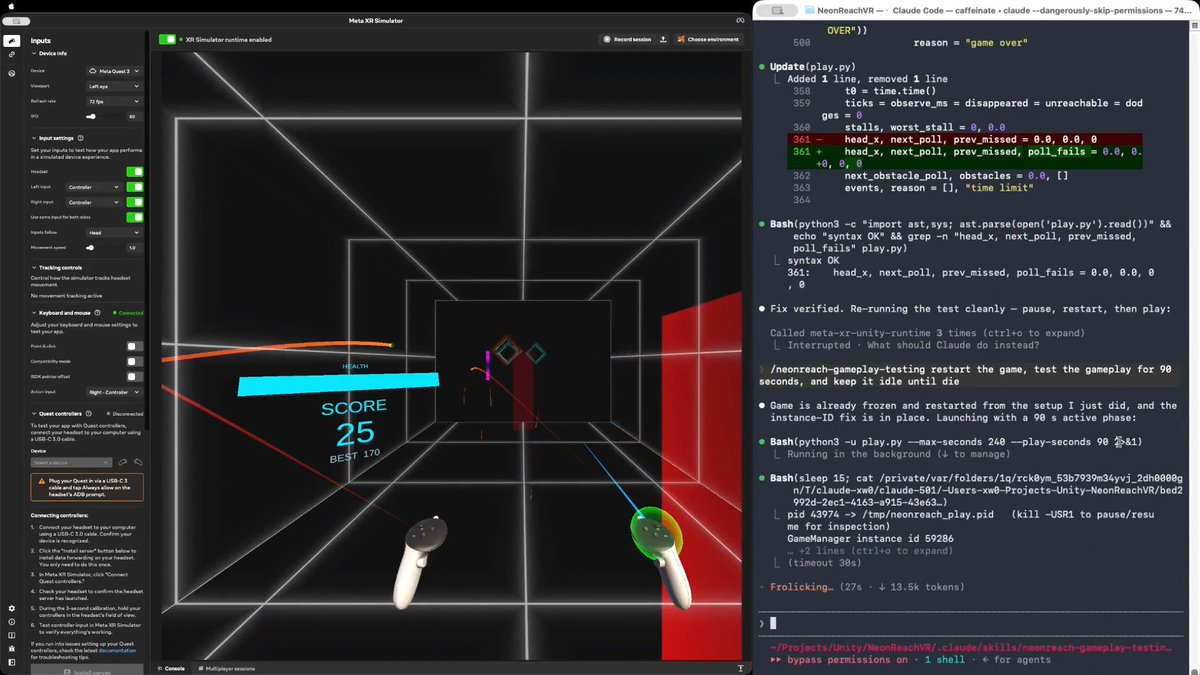
Would you believe an AI agent can test a real VR action game in real time, the way a person plays it? Meta XR Operator makes it possible. As far as I know, this is the first time. I am not talking about tapping a menu or replaying a recorded click path, but genuinely moving, shooting, and using the same game mechanics a human player does. In NeonReach VR, which is a real (and open source) action game, rings spawn 12m out and come at you somewhere between 1.5 and 5.5 m/s, getting faster over a 90 second ramp. There are three kinds: straight, weaving side to side, and spinning. Every shot is a full slingshot cycle, so you press, pull back, aim, then release. Obstacles arrive at head height and cost you a life if you don't get out of the way. You have ten lives. Here is why the game is hard for an AI agent. Even though Meta XR Operator gives the agent everything it needs to observe the app and act inside it, the agent still cannot play. One agent turn takes 10 to 15 seconds. One throw is four steps that have to happen in order, because the press has to latch before the pull, and they cannot be batched into a single call. So a throw costs about 45 seconds. A fast ring only exists for 2.3 seconds. One action takes 20x longer than the target is alive. Prompt tuning does not close a gap that size. What works is a three stage path: EXPLORATION, then SKILL, then SCRIPT. 1/ EXPLORATION. The agent drives the live app and works the game out on its own. It verified the coordinate mapping by setting a pose and reading it back, then derived the launch model. The more useful output was the traps it found. For example, the player's own body collider silently deflects a ball released inside it, with no error and no log line. That produced two confident wrong conclusions before anyone caught them. 2/ SKILL. All of that gets written down as a reusable SKILL.md plus an aim solver. There is a section that separates what was actually verified from what was assumed, so a wrong conclusion cannot quietly turn into doctrine. This stage also produced the trick that mattered. Set timeScale to 0 and a throw becomes atomic in game time, so however long the agent spends thinking never shows up in the shot. 3/ SCRIPT. The agent then compiles everything into a player script, a loop that observes, decides, and throws, calling the MCP servers directly from Python with no model in the hot path. Round trips drop from 10 to 15 seconds down to something between 1 and 16 milliseconds. The loop runs at 23 Hz, about 0.75 seconds per throw, roughly 60x faster than the agent doing it turn by turn. The result is that it plays like a person, which you can see from the attached video. It tracks the rings, works out where each one is going, throws with whichever hand is free, moves out of the way of the obstacles, and does not wait around to see whether the last throw landed. Shipping settings, no difficulty edits, no health locks, no slow motion. It plays until it actually loses. The takeaway generalizes beyond games: an agent does not have to be the player. Even following the same rules as a player, it has too much latency between moves. Having the agent write the thing that acts bypasses that constraint entirely. Try it yourself: or explore the agent-created skill and scripts: Based on NeonReach VR by Dilmer, with no code changes. I only upgraded its Meta XR Core SDK to v205, which ships Meta XR Operator. Our blog post, Introducing Meta XR Operator: Close the Build-Test-Verify Loop for VR: Disclosure: I work at Meta. And this represents my own opinion. #XR #VR #AI #MetaQuest #Unity #GameDev

Xiang Wei

52,877 görüntüleme • 23 gün önce

🧵1/ I’m back from a short trip on a social network with photographs and videos from Gaza, with some brief personal conclusions. First, it is quite clear that there are those in Gaza who know how to make extensive use of the networks and social media for the purposes of emotional extortion and also false propaganda, exactly like they live streamed the October 7 massacre and somehow turned it into “justified resistance”, they use quite a few Western buzzwords such as “genocide”, “occupation”, “oppression” and “Zionism”- and this is the simplest way to distinguish between Hamas propaganda posts and authentic people in Gaza, whom I’ve known all my life, who use much simpler words and not this indoctrinated manipulation bullshit. I was looking for THESE authentic people - the real voices. And I think I found a few. So first of all, what do I think there is NOT happening in Gaza? There is no genocide and no famine. Yes, there is quite a lot of suffering, shortages in some places and lack of decent shelter etc. And there’s a lot of cynical exploitation of it for propaganda purposes. I’m saying it because you can see children are getting payed for it, you can see the absolute control of distribution and you can see how basic needs and the way out is blocked with money- Israel is not taking money for any of it, the West is sending free aid, so the money is demanded by those who want to control the suffering and use it. You should know, that before the war - there was already quite a lot of very poor population in Gaza, but now the economic difficulty has greatly increased for two main reasons: one, the war damaged many sources of livelihood and the second - a major source of livelihood was working in Israel and this option was closed for a long time now, since October 7, and is now much less operational. So in fact the main source of income is donations and funding from Hamas for control purposes of course. This is how, among other things, Hamas uses the population to "work for them", and also to smile or cry for the cameras on demand. Now on the issue of claimed famine- famine is when there’s NO food and water, enough for the population. As I said, my personal conclusion is that there is no shortage of food and water in Gaza at all. The problem is that the food is not distributed equally, it is controlled by those who are powerful (usually Hamas operatives) and then sold at high costs to the population without them having sources of livelihood. Food that should be distributed for #free is actually sold at a high price, the shelter tents are also paid for and the exit from Gaza is particularly expensive (5000$ that are paid to the transporters). There are quite a few who refer to Gaza as a "prison" but Gaza is not a prison, Hamas has simply created a situation where it is very expensive to leave it - and thus the poor and the new poor are completely dependent on Hamas and other clans (Hamulas) in everything to do with food, shelter and exit, and they play with them as pawns. If Gaza is a prison - then it’s because Hamas are imprisoning it. All the suffering in Gaza started because of #Hamas it continues and increases because of #Hamas, but the main point is that #Hamas is also the one factor that can stop it. If Hamas surrendered unconditionally and released the Israeli hostages, as done in any war in which you are forced to admit defeat - they would truly liberate Palestine. Remember- this is a war that #Hamas started, a war that on Oct. 7 was celebrated in the streets of Gaza. But #Hamas prefers to keep the Palestinians captive so that it can showcase suffering (which they create) and use it as a tool for financial donations, manipulation of the West and a messianic jihadist war that will never end for them. If the West doesn’t wake up to this ongoing manipulation- they will never help the Palestinians in Gaza or in general, and they will bring this jihadist chaos to their doorstep From Gaza >

Gal G., Adv 🇮🇱

2,695,728 görüntüleme • 2 yıl önce

Three days ago I asked myself a dumb question. It was so stupid I was actually ashamed to Google it. Can AI earn money while I sleep? Not saving time. Not automating routine. I mean putting real money into my account while I am not looking at the screen. Everyone says ClawdBot will change how we work. Automation. Task management. Smart replies. But I was sitting in my kitchen thinking about something else entirely. You know that feeling when you look at a tool and realize everyone is using only 1% of its potential? It is like being given a race car and only using it to drive to the store for bread. I decided to test it. I started a notebook. I record everything. > Day One I started with something simple. I gave Clawdbot a task. Find wallets on Polymarket where the numbers do not add up. Where the profit is too high for the win rate. Where the result smells like a system rather than luck. It thought for 14 minutes. I had time to pour a coffee and forget about it. Then the screen flashed. 4 addresses. I scrolled through the first three in a minute. Big bets on politics. They guessed the election. Classic. On the fourth one I stopped. Not because it was the most profitable but because I did not understand what I was looking at. The wallet was not trading politics or sports or anything people write reviews about. It was trading the weather. I read it three times. Weather. Will it be 9 degrees in London tomorrow? Will it rain in Tokyo? These are markets I would not even click on by accident. Then I looked at the numbers. > It started with $27. It is now at $63,853. $27 is two trips to McDonald's. It is nothing. $63,853 is a new car or a down payment on an apartment. It is two years of someone's salary. Between those two numbers was only one thing. Thousands of bets on rain. I closed the tab. Opened it again. Checked if it was a glitch. Real dollars. On markets that look like a bad joke. > Day Two I could not get that wallet out of my head. I went to look at its transaction history. I expected to find one big win that explained everything. A lucky hurricane forecast. Instead I saw thousands of small bets. Boring. "Will the temperature in New York be above 15 degrees?" Then I noticed the detail that finally broke my brain. Its win rate: 33%. It loses more often than it wins. 2 out of 3 bets go to zero. Any normal person with that result would be posting about how the market is unfair. Yet this wallet is sitting on $63,000 in profit. How? I started deconstructing the trades. After an hour I got it. When it loses, it loses 10 or 20 cents. When it wins, it takes $1.00. Loses 9 times in a row? Lost $1.80. Wins 1 time? Got $10.00. > This is not trading. It is math that works as long as you do not interfere with your emotions. Here is how it works. Weather is one of the most predictable things on the planet. Governments invest billions in satellites. Data is updated every 2 or 3 hours. Precision to a tenth of a degree. This data is public. But Polymarket is not a weather station. It updates its markets with a delay of 6 or 8 hours. Imagine the situation. 6 AM. The weather service updated the forecast. The probability that London reaches 9 degrees tomorrow rose to 80%. Algorithms everywhere already recalculated the data. But on Polymarket the YES button is still sitting there for 10 cents. Because the market has not woken up yet. This bot sees the difference. It buys YES for 10 cents when the real probability is already 80%. It is not guessing. It is buying what is essentially already known. It just waits a day and collects the dollar. 10 cents turn into a dollar. On information available to anyone who can read weather APIs. That evening I called a friend. He has been trading for 3 years. He sits in analytical chats. Draws support levels. I asked him: "How was the last month?" "I broke even. The market is tough right now. Too much noise." I looked at the screen. A bot betting on rain with a 33% win rate. Profit: $63,853. My friend with 3 years of experience and hundreds of hours of analysis. Profit: $0. Who is doing it wrong? I am not asking you to take my word for it. The blockchain does not lie: > Day Three I decided to dig deeper. I looked at the wallet description. I expected something complex. A hedge fund. A team of developers. Secret data sources. I found one line: Claude plus public weather APIs. Ordinary Claude. The one on your phone. Connected to free weather services. No secret stations. No insiders. No millions for infrastructure. Just an AI doing what any of us could do. But we are too lazy. Or bored. Or we think it is too simple to work. If someone already built this with basic Claude and free APIs... What happens when Clawdbot gets direct access to trading? > Day Four I watched the wallet in real time. First bet: loss. Second bet: loss. Third bet: loss. I thought: this is it. The statistics are collapsing. Fourth bet: loss. Fifth bet: loss. Down $12 in an hour. I was ready to write a post about how I overestimated this. Sixth bet: Temperature in Chicago. Win. +$87. Seventh bet: Win. +$94. By evening: 9 losses. 5 wins. Daily total: +$385. No emotions. No posts about injustice. No strategy changes after a loss. Just the next bet. I wrote to my friend. The one who has been trading for 3 years. "How was your day?" "Down $200. Market makers caught my stop loss again." I looked at the screen. A bot with no posts and no loud claims. +$385 for the day on rain bets. My friend with 3 years of experience and dozens of books. Minus $200 and a post about how the system is against him. > Day Five I woke up with a thought that kept me up all night. It finally hit me. It is not about the weather. It is not about APIs. It is not that the bot is "smarter". > It is about what the bot does NOT have: an ego that hates being wrong. No urge to revenge-trade. No boredom from repetition. My friend trades against the market. He tries to be smarter than the crowd. This bot trades against human nature. And nature loses every day. Clawdbot found me this wallet in 14 minutes. The weather bot turned $27 into $63,000 on markets everyone else thinks are trash. Both use the same principle. Do something simple. Remove emotions. Repeat. I do not know when Clawdbot will start trading on its own. Maybe in a month. Maybe in a year. But I know one thing. While we discuss if it is possible... Someone already set up their bot and went to live their life. Right now as you read this. Somewhere a weather service updated a forecast. Polymarket is sleeping. The bot is already entering a position. And my friend is writing a post about how market makers do not let honest people earn. Guess who wakes up tomorrow with money in their account?

Blaze

29,808 görüntüleme • 7 ay önce

I am posting this here so that Sangulani Maxwell Chikumbutso doesn’t do a rinse and repeat and fool the country again. See, because of Trump’s foolishness, the world has lost over 10% of global oil - supplied via the Straight of Hormuz. In Zimbabwe fuel prices are very high, as is elsewhere. This was the perfect opportunity for Sangulani to sell millions of his vehicles. Free energy right? 😂 But has anyone seen his card anywhere? You see, when Chikumbutso showed up at State House last year wth his silent motorcycle and automobile, I immediately pushed back, and I recall 𝑲𝒖𝒅𝒛𝒂𝒊 𝑴𝒖𝒕𝒊𝒔𝒊 did as well. I think 𝑲𝒖𝒅𝒛𝒂𝒊 𝑴𝒖𝒕𝒊𝒔𝒊 argued mainly from the point of physics. But I pushed back vehemently because I knew Chikumbutso was about to pull YET ANOTHER SCAM! Unlike many people, most of whom belong to the “you don’t like African inventors” crowd, it wasn’t my first time to experience Chikumbutso’s shenanigans. Exactly 10 years before the shindig last year, Sangulani Chikumbutso organized an exhibition he called Open Day to showcase his inventions . It was held at a Saith Technologies showroom located at Bluffhill Industrial Park in Harare. A good amount of PR was invested into that Open Day. They must have spent a fair amount of money prepping for that event. But one of the reasons I paid attention wasn’t because of Sangulani himself, I didn’t know him. It was because fairly respectable professionals like Moses Chundu were involved. In the showroom, a nicely decorated place I must add, were his “inventions” on display. •The Greener Power Machine (GPM): A clean energy generator claimed to produce up to 50,000 watts of electrical energy using "microsonic" or radio frequency wave principles. •The Saith EV: A prototype electric car built locally. •A Hybrid Helicopter: A small, two-seater aircraft running on his perpetual energy source. •Hex-copter Drone: An unmanned aerial vehicle (UAV) built for surveillance and harsh weather operations. When I went there I was very curious. I went there with the mindset that if I deemed his inventions legit, I was going to provide him venture capital. While there it was clear that he had raised a good amount of money from some people. (With hindsight, it’s fair to say he had scammed some people a good sum of money - some of it invested in the Open Day.) At the event, Sangulani would talk about himself, how he dreamed about his inventions, and how he’d made a broadcasting machine. But what made me more curious was how he weaved spirituality into it. (I found that angle both interesting and amusing because from 2007-6, while Zimbabwe went through very harsh energy problems, a certain lady called Rotina Mavhunga had pulled a fast one on the whole nation and claimed that our ancestors and gods had blessed us with refined fuels oozing from rocks in Chinhoyi. Also, during that time, Gideon Gono & some South Koreans had pulled another fast one on the country, spending $50 million or so on a jatropha-input bio-diesel plant in Mt Hampden, a significant investment that generated no biodiesel at all. In fact the South Koreans were more successful running a Bella Hair extensions factory in Graniteside than producing bio-fuels). Back to Sangulani - he spoke about how the spirit spoke to him whispering these inventions to him in his sleep. He also talked about how he’d worked with Zach Wazara to build his mesh telecoms network. Zach Wazara, for those who don’t know, founded Spiritage Telecoms (see the spirit connection?). Prior to that, he was one of Strive Masiyiwa’s top executives. Spiritage then collapsed in 2012-3 thereabouts. Its collapse also brought down AfrAsia, a bank formerly known at Kingdom Bank. It was alleged at the time that Nigel Chanakira had nudged AfrAsia to lend millions of dollars to Valley Technologies, a vehicle owned by Wazara, through which he controlled Spiritage Telecoms. Sangulani claimed in 2015 to have designed the mesh network for Wazara’s failed company. [To be continued]

mmatigari

15,364 görüntüleme • 3 gün önce

I ran across this video a few days ago and couldn’t stop watching it. It’s about something ordinary & boring, a plastic gas lighter. But it changes how one thinks about manufacturing. That lighter in so many of our homes, holds pressurised gas. It has over 30 microscopic parts, has to pass international safety codes, & travel 10,000 miles by sea, & the total cost of doing all that, materials, labour, freight, every middleman along the way, comes to fifteen U.S cents. So how does anyone make money on this? Turns out almost the entire world’s supply comes from one place: a county called Shaodong, in China’s Hunan province. It wasn’t always there. But today, Shaodong has 114 lighter-related companies packed into the place & between them they source more than 200 different components from each other, all within a 20-kilometre radius. They supply something like seventy percent of the world’s disposable lighters. And the industry alone employs over 80,000 people locally. Nobody there is winning on cheap labour anymore. They’re winning by shaving a thousandth of a cent off the thickness of a plastic wall, or redesigning a base so a few thousand more units fit into the same shipping container. It took my thoughts back to an old professor of mine, Michael Porter. His 1980 book, Competitive Strategy, is still the 1st book most MBAs read, the one that gave the world the Five Forces and basically invented modern strategic thinking. But there’s a quieter piece of his work, on industrial clusters, that never got nearly the same attention, and it is the one that explains exactly what is happening in Shaodong. His argument was that nations and regions rarely win because of cheap inputs. They win when rival firms and specialist suppliers crowd into the same small geography for long enough that they keep pushing each other past what any one of them could manage alone. He found it in the Swiss watchmaking towns of the Jura, in the German printing press industry and in Italy’s ceramic tile and footwear districts (interestingly, it’s the SAME blueprint which built Morbi, in Gujarat, into the world’s second-largest ceramic cluster, now outproducing Italy by volume. I have posted before, about Morbi) None of these started out as giants. The neighbourhood made them giants. Which is exactly why it’s so relevant to India’s climb up the global manufacturing table I’ve also attached a slide with this post that I saw recently and which shows us breaking into the top 5 manufacturing globally. (A quick reference check told me that we may not have overtaken Korea yet, but the trajectory’s clear) That climb has happened on the back of scale: bigger plants, bigger parks, more FDI. I should declare an interest here, because the Mahindra Group set up 2 of India’s first integrated, plug-and-play business cities, in Chennai in 2002 & Jaipur in 2006. Both have been extremely successful. Chennai’s business zone alone today employs 45,000 people.. But I admit that we need to think differently. A park brings in investors and hands them a ready plot, power, water & roads A cluster is a completely different animal: hundreds of small, specialised suppliers, each obsessed with doing a tiny thing better than anyone else, feeding off each other’s presence for years until no outsider can compete with the whole. I think that’s the work ahead of us now. Not just more factories, and not just more parks. Policymakers & developers like us need to start consciously pulling as many of the inputs and resources a sector needs, the toolmakers, the component suppliers, the testing labs, the logistics specialists, into the same neighbourhood. Shaodong and Morbi both got there by accident, one town stumbling onto a way to shave a thousandth of a cent off a lighter wall, the other discovering it had the clay and, later, the gas pipeline for tiles. We don’t have the luxury of waiting for accidents anymore. We need to do it on purpose

anand mahindra

451,327 görüntüleme • 2 ay önce

🚨 We are repeating 1995 dotcom bubble pattern literally 1:1 Over a decade in markets and I've never seen this many crash indicators flashing at once Start with the biggest one: the IPO wave. Everyone thinks the SpaceX trade is over, but it hasnt even started. Aug 6 will change everything. $SPCX did the largest IPO in history on June 12. $135, $1.77T valuation, $75B raised. Then it ripped to $225 in 4 days and dumped 35% back to $147. The crowd that bought the hype is already underwater. And here's the thing: an IPO is not the start of the run. It's the exit. The day insiders + early backers turn paper into cash. This time they built the buyer out of millions of retail accounts. Fidelity cut its IPO minimum from $500k to $2k, a 99.6% cut. Robinhood, SoFi: no minimum at all. Retail got 30% of the offering when the standard is 5-10%. They dropped every barrier to get u IN. Then bolted the exit: sell in the first 15 days and ur flagged a flipper, with bans escalating up to a lifetime one tied to ur SSN. You dont build a one-way door unless u already know which way the crowd has to run. History shows the ending every time. Truist studied 30 major tech IPOs since 2012: Median year-1 drawdown: -54% Only 43% green 6 months in 11 of 30 fell 64-90% $FB, $SNAP, $UBER, $HOOD: same script. Huge debut, endless hype, lockups expire, early money hands u the bag. Now price SpaceX into that: over 110x sales, $4.9B loss last year, $41.3B accumulated deficit. CFRA rated it a SELL under an hour after open. Morningstar fair value: $63. It trades at $162. And the real distribution event is still ahead: Aug 6. First earnings report = insiders finally unlock 20% of their stock, +10% more if price holds high. At the same time $SPCX enters the Nasdaq-100, so index funds are FORCED to buy it near the top. Forced buyers meeting real sellers. That's the window. Moreover, this is just IPO #1. OpenAI (~$850-900B) and Anthropic (~$965B) already filed. No dates yet, but the window is open and they'll fly through it. 3 of the biggest listings in history, all AI-linked, all landing into the same indexes. Which brings us to what actually holds all of this up: the AI money-loop. $800B+ in circular financing rn: 1/ $NVDA invests in OpenAI 2/ OpenAI signs $300B in cloud deals w/ $ORCL 3/ Oracle buys billions in Nvidia chips to fill them 4/ Nvidia books the revenue, stock pumps, funds more deals Same dollars circling between a handful of names, dressed up as organic demand. The cracks are already showing. OpenAI is on track to lose ~$14B this year. Nvidia's $100B OpenAI deal was reported "on ice". $ORCL dumped 30% in a quarter on fears OpenAI cant pay its bills. Michael Burry, the guy who called 2008, is shorting $NVDA and comparing this to Enron-style vendor financing. And here's how 1 crack becomes a cascade: Microsoft AI revenue disappoints -> cuts Azure spend -> hits Nvidia revenue -> tanks CoreWeave valuation -> chokes OpenAI funding -> Oracle left holding $300B in commitments nobody pays for. Pull 1 card and the whole circle tightens. This is exactly the dotcom script. Back then Nortel and Lucent financed their own customers to fake demand. The loop looked unbreakable, until one link missed a payment. Then the entire thing unwound in months. Insiders rich, retail wrecked. Same in 2021 SPAC mania. Same now, just 10x the size. How to max profit on it? I have an idea... I already made 6 figs shorting SpaceX publicly, posted it all in real time. And I'm not stopping there. Soon I'm sharing my biggest trade ever, confident it makes me millions. Dropping it in my free private group: (btw I'll stop accepting new requests soon, so hurry up) A lot of people are going to wish they joined before the doors close.

𝗰𝘆𝗰𝗹𝗼𝗽

86,494 görüntüleme • 2 ay önce

The following is a message from Diana Bloom, an anonymous Iranian activist living in Germany who is being threatened with potentially extremely dangerous "exposure" by what appears to be a lunatic. I am passing this message on since Diana has deleted her account for her own protection and safety. To note, I don't think I should be involved with this crazy Evil Evi woman or her OSINT dramas whatsoever since she went bonkers the other day, but she is acting in defamatory ways and with malicious recklessness in a way that endanger an anonymous Iranian dissident I believe to be good, so I must pass this along. A MESSAGE FROM DIANA BLOOM This is a post in two parts. Part one is a brief summary of what has happened so far. Part two addresses the defamatory claims being made about me. PART 1 - [JL: Diana's explanation and responses] For everyone who doesn’t understand what led to this point, here’s the shortest summary possible: Evi [Kokalari] and I had been friendly in DMs since the end of June. She messaged me first. After [DataRepublican] published her piece on the State Department, I asked Evi not to go too hard against DR. Evi did anyway, and James Lindsay defended DR. I didn’t like the way Evi went after James, including citing Milo. So I unfollowed and removed Evi. She confronted me in DMs, and I explained why. Evi then made a post attacking James that started and ended with me and used my profile picture. I responded once, as politely as I could. Evi then repeatedly threatened to dox me, so I deactivated my account. Now, regarding the substance of the accusations she has made so far: 1. I am not a man. My name is not Derek. 2. I am Iranian. 3. I do know stuff about American politics because (and that is the boring truth) German television is really bad. So I’ve only watched English/American stuff for the past, I don’t know, 15 years, podcasts, late night shows, etc. I didn’t think about it, I just did. Little did I know that that would give me an understanding of the inner dynamics of what’s going on within the Republican Party that would tie back to the Iranian people’s cause in 2026. Believe me, I’m still baffled by it whenever I pause to think about it. But that’s the truth, and here we are. 4. I am not in the United States. I shared a blog, and the provider of that blog (a big, common one) is in the United States. My VPN location is sometimes in the United States. Not me. 5. I am not responsible for the content of people defending me. I have no control over it. It’s not my content, and I keep my distance whenever I see problematic stuff. Many accounts defended me, but going to look for one that has done/said problematic stuff to tie it back to me is not right or fair. I am not responsible. I have nothing to do with it. 6. I wanted to help DR because Evi was threatening to go after her hard, and I didn’t think DR deserved that. I meant no harm, I wanted to help. I made a mistake, and I regret it now, but my intention wasn’t bad at that moment in time. 7. Evi herself was the first to come into my DMs and tell me not to fight with an account named Stephanie. So I did Evi that favor. Meaning: Evi came into my DMs first and tried to calm down a public disagreement between me and someone else. When I did this in defense of DR, I did the same thing Evi had done before. I would never think to accuse Evi of restricting my right to free speech because of it. 8. Publishing private DMs from someone without their permission is wrong. It is something both Evi and Stephanie have now done. Both have shared private messages from me without my permission. 9. Part of Evi’s “sources” seem to be Azi Yazdi (granddaughter of Khomeini’s first foreign minister), Benji, and Nima Yamini, as well as his ghost accounts (I have blocked multiple of them by now). If you know any of them, you know this is insane. None of them are reliable. It’s like using Milo as a source against James Lindsay. This is not about truth but about a (malicious) takedown to silence me and get me out of the way. 10. Evi has threatened to dox me (there is no doubt) multiple times, and she keeps going after me. This puts my life and my family’s lives in Iran in real danger, but she doesn’t care. She keeps going, and I can’t stop her. She keeps putting out one lie after another, and it traps me in a forever loop of defending myself. If I don’t respond to more and more accusations from her against me, rest assured, my silence should never be taken as agreement with the lies she puts out there. Be sure there is always context, a counterargument, counterevidence, etc., that would show that none of what she shares is fair or true. But it’s a forever war that is meant to drain me. So me not commenting on her stuff moving forward is never, ever, ever an admission that she is right about something. It’s just a rejection of playing a game I cannot win. To ALL the people who wrote/shared one or multiple posts and comments in my defense: Thank you very, very, very much. I’ve seen it, and I am grateful. But I think it’s best for my own and my family’s safety, as well as for the whole situation, that I step away and stay away from X. I hope that’s understandable. And Evi, for the last time: if you are not malicious, please just stop. Let me out of this. I am not your target. Just leave me and, through doxxing/"exposing", my family out of it moving forward. I beg of you, please. PART 2 - proof - [JL: The following are direct quotes from Evi indicating her intention to "expose" Diana, which she tries to claim is different than "doxxing," though for all practical purposes the effect will be the same and this is a distinction without a difference. The video below shows all of these quotes from her own posts.] 1. “I’m getting enough information on her from her own community. I may share it…” 2. “Either log back in with your real name, or I will start exposing you. And trust me, you will not like that.” 3. “So stop provoking me. If you continue, I will look much deeper into who you are and what your actual role is behind this anonymous account.” 4. “You know what...WAR IT IS. I will start with Diana!! STAY TUNED” 5. “So I will take those words seriously and dig as deep as I can” 6. “The identities of the "Iranian activists" would never have been called into question had they not attacked my right to freedom of speech in my own country.” 7. Someone: “She deleted her account because she’s concerned for her safety and the safety of her relatives in Iran your threats to dox her” Evi: “She should be...but if she turns out to be clean, I shall protect her identity. But trust me, she is not who she claims to be” 8. “Last I checked, Support on X is against fake accounts. Why are we being threatened for wanting to know the true identity of certain accounts…” 9. “Do you think I know who Diana bloom is? No but I need to find out at this point” 10. “... because I asked one of their group operatives from Germany to debate me using her/his true identity, or I would expose who’s behind the account.” 11. “So I don’t know what you’re all thinking, but this isn’t simply about Diana being scared of the IRGC in Iran. The IRGC has been significantly weakened and has plenty of other things to worry about. There are thousands of Iranian accounts fighting for Iran’s freedom under their own names while still having family members back in Iran. At this point, I think people have every right to ask who is actually behind these anonymous accounts… After a few more new posts on her feed, I was forced to tell her to either come back on X and do this under her real name, or I would expose who she was, so at least we would be having this discussion on equal grounds.” 12. “Don’t freaking interfere with other people’s business like that retard did and no one comes after you. So go ahead down and sue me and I will push harder to expose her and you and anyone else…” MY OWN [JL's] COMMENTS, which Diana has nothing to do with and doesn't know I'm appending here. I now believe Evi is likely to be a malignant narcissist who is incapable of admitting that she is wrong. She will not stop in her behavior, and she will aim to harm anyone who attempts to intervene. I do not recommend you do this. I recommend you mark, avoid, and block. Fighting with her will only fuel her because she simply cannot admit that she's wrong about all of this and can only double down in increasingly insane, dangerous, and reckless ways, including toward Diana and her safety. She believes everything she sees that's trying to talk sense into her about any of this is part of an elaborate "op" that "disrespects her free speech" (which isn't a thing, by the way). No one is silencing her. People are just trying to talk sense into her to stop spreading defamation and reckless "exposure" of people who she will put at risk with it and who do not in any way deserve it, people she considered friends and allies until literally four days ago when she suddenly blew up. Therefore, not only is her reckless belief hermetically sealed against any disagreement, she turns any disagreement into proof of allegedly coordinated attacks against her from a network that simply doesn't exist. As a response, in her malignancy, she is threatening to damage, "expose," or otherwise reputationally harm anyone who even tries politely to talk sense into her, much less to disagree with her or oppose her. I strongly recommend everyone realize what they're getting into if they work with or ally themselves with this crazy woman going forward. You do so at your own risk. I can attest from watching her over the last few days that her research abilities, at least when agitated, are so sloppy as to be beyond worthless, even dangerous. The post I'm quoting below is proof of that. She's trying to prove Diana is secretly an American because she's too sloppy and stupid to realize that a Wordpress domain has an American location. She isn't doing research in good faith or with fidelity on this issue, or about me. She is looking for any information she can to hurt people who have upset her. In fact, she is presently being sued for defamation by an Albanian singer (Evi is an Albanian immigrant to the United States and a U.S. citizen for at least a couple decades), so we might recognize this bad behavior and poor praxis as a pattern with her. I can provide just from the last few days, as can others, much evidence that she's simply grasping at the nastiest straws she can find to try to harm people she has suddenly decided are her opponents because of her jealous outburst at DataRepublican and her narcissistic injury at being called on it. The sloppiness and outright retardation of her "fact" finding and "analysis" are so shocking that it's hard not to laugh even given how horrifically dangerous it is. We can therefore infer this sloppiness, recklessness, and malice-when-opposed to be at least partially true of her other "research" against her other targets, by extension. That's a shame because many of those targets are worthy of real scrutiny, which she is undermining with her loose cannon. Therefore, I insist her OSINT "research" is at best worthless and at worst maliciously harmful. In either case, it cannot be engaged by people who want to make a positive difference in the world, so mark and avoid. Evi seems good at making connections. She was quite positively in my own DMs for a while, trying to find ways to work productively together, even suggesting we start an alternative to CPAC (lol). She appears to be friends with both Eric Trump and Don Jr., though the relationship with the former appears to be more solid. She seems to have worked behind the scenes with a lot of relatively prominent Republican groups. I find all of this incredibly concerning after the events of this week, even though I wouldn't have beforehand. My own assessment from this stupid and nasty drama is that Evi's primary motivation is that she is pathologically envious of DataRepublican and her influence, likely believing it should be her in DataRepublican's place. As we can see, she isn't nearly careful or accurate enough for that. Mark and avoid. Further, though, while DataRepublican has no driving interest to be who or what she is and is doing it in service to the best of her abilities (which are considerable but still limited and imperfect as are anyone's), Evi appears to covet the role, which she has demonstrated she cannot possibly handle responsibly. Again, mark and avoid. Block if you will. I will not unblock her for this post or in the future. You can think of that whatever you want. I will rarely, almost never, say anything about her except in the defense of others she is wantonly and recklessly attacking. I will NEVER interact with her directly again, no arguments, no back and forth, no dunks, nothing. My involvement here is pure exposure and nothing else. Thank you for your attention to this matter.

James Lindsay, anti-Communist

57,651 görüntüleme • 14 gün önce

here's what most app founders don't tell you about scaling your app on tiktok here's the actual playbook, not the generic level "just post consistently" advice: accounts use personal/creator accounts, not business. business locks you out of trending sounds entirely, you get stuck with a library of 40 generic royalty-free tracks nobody's ear recognizes as "tiktok sound," and sound is half the algo's read on your content don't buy an aged account unless you can post from the exact location it was created in. mismatch the vpn/location and you'll watch views crater to single digits within days, tiktok resets your trust score fast pick one avatar, one template, one visual style. lock it in for at least 15-20 posts before you touch it. switching every few videos tells the algo you're a different account every time, you never build a consistent signal views aren't what you think they are 30-200 views is not a shadowban. shadowbanned means 0 views, full stop, nothing gets pushed. 30-200 means the hook, pacing, or format just isn't landing yet "i copied that viral video frame for frame" — you didn't. the millisecond pause before the reveal, the exact caption position (top third vs center), font size relative to screen, all of it is doing more work than the concept itself. people copy the idea and skip the 200 micro-decisions that made it work good content still won't always go viral. a 5:1 view-to-like ratio is genuinely strong signal, it just doesn't guarantee reach. the algo rewards volume of good attempts, not one perfect video cal ai didn't get one viral hit and coast. they ran hundreds of videos in the same format on repeat, and kept posting through videos that flopped at 1000 views. the winners paid for the losers views ≠ downloads, and this trips up everyone 1M views with almost no installs is extremely common. prank format, funny skit format, anything built for pure entertainment gets massive reach and contributes basically nothing to your install numbers because nobody's thinking about your product, they're thinking about the joke tutorial format does a fraction of the views and converts 10x better. screen recording of the actual app, green screen walkthrough, finger literally tracing where to tap. it's less entertaining and it's the format that pays your bills if you only chase views you'll optimize yourself into a wall of engagement with no revenue behind it content that doesn't scream "ad" don't slide the app into every single post, most of what you post should just be good standalone content bad: "here's why my app has 15 features your current app doesn't" good: "i saved $500 last month and used it to buy my kid a ps5" walks into walmart, grabs a ps5 off the shelf "had no idea i was burning $500/mo on subs i forgot to cancel" the app name/logo shows up after the value hit lands, never before. the viewer needs to feel the outcome first, the brand is just the explanation for how they get it too zero ideas? screenshot your competitors' top 20 tiktoks and study exactly what they're doing in the caption text, the hook, the pacing. copy the format, not the literal video. nobody's reinventing organic distribution from scratch, everyone's remixing what already works working with creators without torching your budget skip influencers at the start unless you've got real spend to burn. you'll pay a few hundred bucks, get 10k views, feel nothing happened, and quit the whole channel cheap ugc reaction clips ($2-5 for a 3-5 second reaction) stitched onto your own tutorial footage gets you dozens of usable videos in a day, this is the highest leverage move for a small budget pay per view if you can get creators to agree to it. rpm between $0.5-$2 depending on how "tutorial-ish" the content is, cap payout at $200-500 per video so you're not exposed. hard to find creators who'll take this deal but they exist, worth asking posting without tripping the flags skip the phone farm, skip the expensive 4g/5g proxy setup. you'll burn a month building infrastructure and still end up throttled a vpn is fine if you're targeting a country you're not in. tiktok can see the vpn, that alone doesn't flag you what actually gets you flagged: → reposting pinterest images hoping tiktok won't recognize them → posting 4+ times within an hour → random disconnected content with no pattern between posts → switching phones or vpn servers constantly → running more than 3 accounts from one setup → posting immediately on a brand new account with zero warmup batch a full month of content in one or two sessions. you already know you won't "post again tomorrow" once life gets in the way connect the vpn first, then open tiktok, so the algo resets to your target country before you touch anything. schedule max 2-3 posts a day with something like hootsuite, set it to drafts instead of auto-publish, review each one before it actually goes live link in bio is quietly killing your conversions tiktok's in-app browser doesn't carry the user's saved logins or cookies. they tap your link, hit "sign in with google," nothing autofills, nothing's remembered, they bail in 3 seconds fix: detect when your link is opened inside tiktok's in-app browser and show a quick prompt telling them to tap the three dots → open in browser. gets them into safari or chrome where their session actually persists, this single fix recovers conversions most people don't even know they're losing

Mufasa

17,518 görüntüleme • 1 ay önce

Made $313 → $2,382,780 in 4 Days Using a Claude AI Bot on Polymarket. 26,738 trades. 98% win rate. Full blockchain proof. Every single trade verifiable on-chain. I've made the exact step-by-step guide to build this Claude Polymarket bot from scratch. You've been trading for 3 years. Still red. He gave Claude $313. Woke up rich. Free for 24 hours. To get this Setup guide: 1. Comment "Money" 2. Like and Retweet 3. Follow me Himanshu Kumar (so i can DM you) Full 2-hour video tutorial attached. Every single click and command explained. Beginner to running bot. Now let me break down exactly how this works. Save this post. This is the most important trading breakdown you'll ever read. ↓ Let's start with the number that should make you sick. $313. That's what this wallet started with. Not $50,000. Not $10,000. Not even $1,000. $313. Less than your monthly Netflix + Uber Eats + Spotify combined. 4 months later: $2,382,780.80. That's a 7,942x return. While you spent those same 4 months staring at charts, drawing trendlines, panic selling, revenge trading, and ending the month exactly where you started. Minus the $200 you lost on that "sure thing." Same 4 months. Same market. Same opportunities. He had a bot. You had feelings. Guess who won. Save this post right now. What I'm about to explain is the exact mechanism behind every dollar of that $2.38M. Follow Himanshu Kumar so you don't miss the rest. ↓ How Polymarket actually works and why bots print money on it. Polymarket is a prediction market. Will BTC be higher in 15 minutes? Yes or No. Will the Fed raise rates? Yes or No. You buy shares between $0 and $1. If you're right, your share settles at $1. If you're wrong, it settles at $0. Simple. Now here's where it gets interesting. Polymarket updates its prices SLOWER than the real market moves. When BTC drops 0.6% on Binance, Polymarket still shows old odds for about 2.7 seconds. 2.7 seconds. In those 2.7 seconds, the bot already knows the outcome. It's not predicting. It's not guessing. It's reading information that already exists and trading before Polymarket catches up. That's not trading. That's collecting free money with a 2.7 second head start. And you're over there using a 15-indicator TradingView setup trying to "predict" where BTC goes next. The bot doesn't predict anything. It just reads faster than you. That's the entire edge. Save this post because if you understand this one concept you understand how millionaires are being made on Polymarket right now. Follow Himanshu Kumar for more breakdowns like this. ↓ Let me walk you through one single trade. A new 15-minute BTC contract opens on Polymarket. Odds are 50/50. Fair price. 10 minutes in, BTC drops 0.6% on Binance. Hard, fast move. The real probability of BTC being lower at expiry is now about 78%. Polymarket still shows 54/46. The bot sees this instantly. Binance WebSocket feed. Under 50ms latency. The edge is 24 percentage points. On a binary contract, that's basically free money. Bot calculates position size using Kelly Criterion. Executes via Polymarket's API. Done. Within 2-3 seconds, other participants update the odds. 54/46 moves toward 78/22. Bot either exits for immediate profit or holds to resolution. Either way, the trade was entered with near-certainty of a positive outcome. Now repeat this 200-500 times per day. $313 → $2,382,780 in 4 months. Not magic. Not prediction. Not luck. Industrial-scale exploitation of a market inefficiency that still exists today. And you're still placing one manual trade per day and calling yourself a "trader." This is the mechanism behind every single dollar. Bookmark this post so you can study it again. Follow Himanshu Kumar because I'm breaking down each strategy separately. ↓ There are 4 strategies. Not all Claude bots do the same thing. Strategy 1: Latency Arbitrage. Win rate: 85-98%. What 0x8dxd used. Monitor Binance price feeds. When Polymarket odds lag behind reality by 3-5%, buy the correct side before the market corrects. No forecasting. No model. No sentiment analysis. Pure speed. You're not guessing. You're reading an outcome that has already happened. Strategy 2: Oracle Arbitrage. Win rate: 78-85%. Chainlink oracle price feeds occasionally diverge from Polymarket's implied prices. When they do, the settlement direction is known. Fewer opportunities. Higher certainty when they appear. Strategy 3: News-Driven Trading. Win rate: 60-75%. Claude ingests real-time news. Government filings. Central bank statements. On-chain data. Assesses probability impact before retail traders even finish reading the headline. Lower win rate because interpretation introduces uncertainty. But works on ANY market category, not just crypto. Strategy 4: Market Making. Return: 2-5% per month. Place buy and sell orders on both sides. Capture the spread. No prediction required. Most consistent. Hardest to blow up. Compounds aggressively over time. You didn't even know there were 4 strategies. You thought "trading bot" meant one thing. That's how far behind you are. 4 strategies. 4 different risk profiles. 4 ways to make money while you sleep. Save this post. Follow Himanshu Kumar for the deep dive into each one. ↓ The timeline that should haunt you. December 2025: Bot launches with $313. Nobody notices. January 6, 2026: Wallet hits ~$438,000. 140x in 30 days. 6,615 predictions. 98% win rate. Finbold reports it. Crypto Twitter explodes. March 10, 2026: Head-to-head test. Claude bot: $1,000 → $14,216 in 48 hours. +1,322%. OpenClaw bot: fully liquidated. Same market. Same timeframe. Claude won because of better risk management. OpenClaw died because it overleveraged. March 16, 2026: Someone trains a swarm model on 3 years of NBA data. Result: +$1.49M on Polymarket. April 2026: 0x8dxd final verified balance: $2,382,780.80. 26,738 trades. 4 months. This all happened while you were "waiting for the right time to start." The right time was December 2025. The second best time is right now. But you'll probably wait until it's too late. That's what you always do. Every date on this timeline is a day you could have started but didn't. Save this post. Follow Himanshu Kumar so you at least start today. ↓ Why Claude and not ChatGPT? This isn't opinion. It's data. March 2026 head-to-head: Claude bot: +1,322%. OpenClaw (GPT-based): liquidated. Same prompt. Same market. Same conditions. Researchers found Claude's code included: > More defensive edge cases > More conservative default parameters > Better error handling > More legible code for debugging > Proper Kelly Criterion position sizing > Hard drawdown kill switches ChatGPT's code overleveraged into a losing sequence and couldn't recover. Claude's code sized positions conservatively, stopped trading when drawdown thresholds hit, and survived to compound another day. The difference between +1,322% and liquidation wasn't the strategy. It was the risk management. And Claude writes better risk management than ChatGPT. That's not a debate. That's a $15,216 difference in 48 hours. But sure, keep using ChatGPT because "everyone uses it." Everyone's broke too. Coincidence? Stop using the popular tool. Start using the profitable one. Save this post. Follow Himanshu Kumar for more Claude vs ChatGPT comparisons with real data. ↓ Why humans lose to bots. Every single time. Same strategy. Same market. Same period. Bots: ~$206,000 profit. Humans: ~$100,000 profit. 2x gap. Same strategy. Here's why: 1. Late entries. By the time you identify the lag, verify your reasoning, and click buy, the 2.7 second window is gone. The bot executes in under 100ms. You execute in 30 seconds. The opportunity doesn't exist for 30 seconds. 2. Emotional sizing. You oversize when "confident." Undersize when scared. Exact opposite of Kelly math. The bot sizes based on edge. Every time. No feelings. 3. Fatigue. You make worse decisions at hour 6 than at hour 1. The bot makes the same decision at hour 72 that it made at hour 1. 4. Drawdown psychology. After 3 losses you either panic quit or double down trying to recover. Both destroy capital. The bot has a kill switch. It stops. It doesn't feel anything. You're not competing with other humans anymore. You're competing with machines that don't sleep, don't feel, don't flinch. And you're losing. The data doesn't lie. Humans lose to bots 2x on the same strategy. Save this post. Follow Himanshu Kumar for the complete bot setup that removes you from the equation. ↓ What can go wrong. Because I'm not going to lie to you. Most people who build this bot will NOT 7,942x their money. Some will lose their initial capital. Here's what can kill you: Edge compression. The arbitrage window was 12 seconds in 2024. It's 2.7 seconds now. It's shrinking. At some point it hits zero for retail operators. This is a time-limited opportunity. Not a permanent income stream. Rule changes. Polymarket can change contract mechanics, settlement rules, or API terms overnight. What worked yesterday can lose money tomorrow. Risk management bugs. A 98% win rate strategy with broken position sizing will blow up your account on the one losing trade. The March 2026 experiment proved this. Claude survived. OpenClaw got liquidated. Same strategy. Different risk management. That's why the 2-hour video tutorial walks through every single risk parameter. Because the strategy doesn't kill you. Bad risk management kills you. This is the section most "gurus" delete. I'm keeping it because I'd rather you make money safely than blow up and blame me. Save this post. Follow Himanshu Kumar for honest breakdowns, not hype. ↓ The step-by-step to build your own. Step 1: Set up a Polymarket wallet. Fund with USDC via Polygon network. Start with $100-$300 for testing. Step 2: Generate API credentials. CLOB API key from docs.polymarket .com. Store private key in environment variable. Never hardcode it. Never share it. Step 3: Prompt Claude to build the bot. Use Claude Code for best results. It reads your filesystem, executes code, and iterates on errors autonomously. Step 4: Paper trade for at least one week. Minimum 200 completed trades. Win rate must be above 70% before going live. This step is NOT optional. Step 5: Configure risk management. Max single position: 8% of portfolio. Daily loss limit: -20% with auto halt. Kill switch at -40% drawdown. Telegram alerts on every threshold. Step 6: Go live small. $1-5 per trade. Watch every trade for first week. Compare to paper results. Scale only on evidence. Skip steps 4 and 5 and you will lose your money. That's not a warning. That's a guarantee. This is your complete build guide. Save this post. Follow Himanshu Kumar because I'll be posting the exact Claude prompts for each strategy. ↓ The edge exists right now. Not next month. Not "when you're ready." Right now. The arbitrage window is 2.7 seconds. It was 12 seconds in 2024. It's shrinking every week. Every day you wait, more bots enter the space. The window gets smaller. Your potential returns get smaller. The bots already running have a compounding advantage. They're making money today that they'll use to make more money tomorrow. You're reading about it and telling yourself "I'll look into this next weekend." That's what you said last weekend. And the weekend before that. The best time to start was 6 months ago. The second best time is today. But you already know you're going to bookmark this and never open it again. Prove me wrong. ↓ Full 2-hour video tutorial attached. Every single click. Every command. Every parameter. From zero to running bot. Beginner friendly. Nothing skipped. A similar bot has already earned $2,382,780. Full blockchain proof in the article below. The video is free. The tools are free. The edge still exists. The only thing that costs money is another month of doing nothing while bots eat every opportunity you're too slow to catch. Follow Himanshu Kumar for the complete series covering every automated income stream using Claude. Prediction markets are just the beginning. Save this post. Bookmark it. Screenshot it. Whatever you need to do so you actually watch the video and build the bot instead of just reading about people who did. You Must Follow me Himanshu Kumar, so i can send you DM.

Himanshu Kumar

53,768 görüntüleme • 5 ay önce