Video wird geladen...

Video konnte nicht geladen werden

Zur Startseite

🙏🇺🇸🙏 He painted his face for war and jumped into enemy territory before the invasion even began. Jake McNiece turned fear into a weapon. Jake McNiece was a U.S. Army paratrooper in World War II. Part of a demolition unit later called the Filthy 13. They were not known...

161,386 Aufrufe • vor 3 Monaten •via X (Twitter)

0 Kommentare

Keine Kommentare verfügbar

Kommentare vom Original-Post werden hier angezeigt

Ähnliche Videos

This is real gun camera footage from a P-51 Mustang, chasing a German Bf 109 down to the treetops until it goes down in flames. The American pilot flying it, Lt John Kirla, shot down five enemy planes in a single day, becoming an ace in one mission. This footage captures one of his victories over a Bf 109. This is his story.. From Trainee to the Yoxford Boys John Kirla was not a born fighter ace. He was an ordinary young American who had come up through flight training in Texas, graduating at the start of 1944. He learned his trade on trainers, moved up to fighters, and got just 15 hours in the P-51 Mustang before being sent to England as a replacement pilot. He joined the 362nd Fighter Squadron of the 357th Fighter Group, a unit based at Leiston that was already becoming a legend. The 357th was the first group in the Eighth Air Force fully equipped with the Mustang, and it would go on to produce more aces than any other fighter group in the Eighth, including Chuck Yeager and Bud Anderson. Kirla was the newest pilot in a squadron already filled with experienced aces. His job was to escort American bombers deep into Germany and protect them from the Luftwaffe. On November 27 1944, he got the day that would define him. Five Victories in One Mission That morning the 357th ran headlong into a massive swarm of German fighters trying to get at the bombers. Kirla's flight dropped their fuel tanks and dived straight into the middle of it. Almost immediately, the fight became a swirling, low-level brawl of Mustangs, Messerschmitts, and Focke-Wulfs twisting across the sky. Kirla picked out his first target and opened fire, and from that moment he did not stop hunting. In his own account, he spotted a Bf 109 that was attacking an American bomber. He went after it, closed to just 30 yards, and when the German threw his fighter into a tight barrel roll straight down toward the ground, Kirla stayed glued to his tail and, in his words, clobbered him all over until he went down. An Ace in a Day He kept finding more. Again and again through that wild, sprawling fight, Kirla latched onto an enemy aircraft and did not let go. At one point he watched a German fighter shoot down one of his fellow Mustang pilots right in front of him, and closed in for revenge. As he described it afterward, he opened fire, saw pieces start to fly off the enemy aircraft, and watched it fall out of the sky like a leaf drifting to the ground. Rather than breaking away and climbing back to safety, Kirla chased his targets down low, following them almost to the ground, the fighters weaving over villages and treetops until the enemy aircraft finally went down. By the time the fight was over, John Kirla had shot down five German aircraft in a single mission. He had become an ace in a day, one of the relatively few American fighter pilots to achieve that in a single mission. The Mustang That Changed the Air War The Mustang was the aircraft that made days like Kirla's possible. The P-51 combined long range, high speed, and deadly firepower, and it could follow the bombers all the way to their targets and fight the German fighters on equal or better terms. By the end of the war, P-51 groups had claimed close to 5,000 enemy aircraft shot down, about half of all American air-to-air kills in the European theater. Kirla's own group, the 357th, became the top-scoring Mustang group in the Eighth Air Force. Flying one of the finest escort fighters of the war, men like Kirla helped turn the tide of the air war over Germany. The gun-camera film rolling every time he pressed the trigger captured it all, including the footage you are watching. John Kirla's Legacy John Kirla flew on to the end of his combat tour and finished the war as a double ace, credited with 11 and a half enemy aircraft destroyed in the air. He was awarded the Silver Star and the Distinguished Flying Cross for his courage in the skies over Europe. He had gone from a trainee with a handful of hours in a Mustang to one of the deadliest fighter pilots in one of the deadliest fighter groups of the war, in the span of a single year. The footage of his Mustang chasing a Bf 109 down to the trees is only a few seconds long. But behind those few seconds is a young American who climbed into a fighter, dove into a swarm of the enemy, and shot down five of them before the day was out. This was the story of John Kirla. I post a story like this every single day. Most people never see them. Follow so you don't miss the next one.

Untold War Stories

156,281 Aufrufe • vor 10 Tagen

In 1499, Michelangelo overheard people crediting his greatest work to someone else. He snuck into St. Peter's at night and carved his name on the sculpture. He regretted it immediately and never signed anything again for the rest of his life... He was 24 years old. The year before, a French cardinal had paid him 450 gold ducats to sculpt a statue for his own tomb. The contract had one strange clause: it had to be "the most beautiful work of marble in Rome, one that no living artist could better." Michelangelo had never completed a major public commission. He accepted anyway... He carved for two years from a single block of Carrara marble that he later called the most perfect stone he ever worked. What he produced was the Pietà: the body of Christ, lifeless, across the lap of his mother. When it was unveiled, visitors refused to believe a 24-year-old Florentine had made it. They credited the work to a more famous Lombard sculptor. So according to Vasari, Michelangelo slipped into the basilica with a chisel and carved his name in Latin across the sash running between Mary's breasts: MICHAELANGELUS BONAROTUS FLORENTINUS FACIEBAT. "Michelangelo Buonarroti, the Florentine, made this." Then he vowed never to sign another work. He kept that vow. Through the David. Through the Sistine Chapel. Through the dome of St. Peter's. Through 65 more years of work, until he died at 88. Not one of them bears his name. What I can never quite get over is that he was only 23 when he started. A young man who believed he could carve the most beautiful object on earth. And then he did... If you enjoyed this, I write a newsletter read by over 50,000 people who love rediscovering the wonder and beauty of the past, one story at a time. You can join us here: History is more beautiful than we remember.

James Lucas

751,715 Aufrufe • vor 2 Monaten

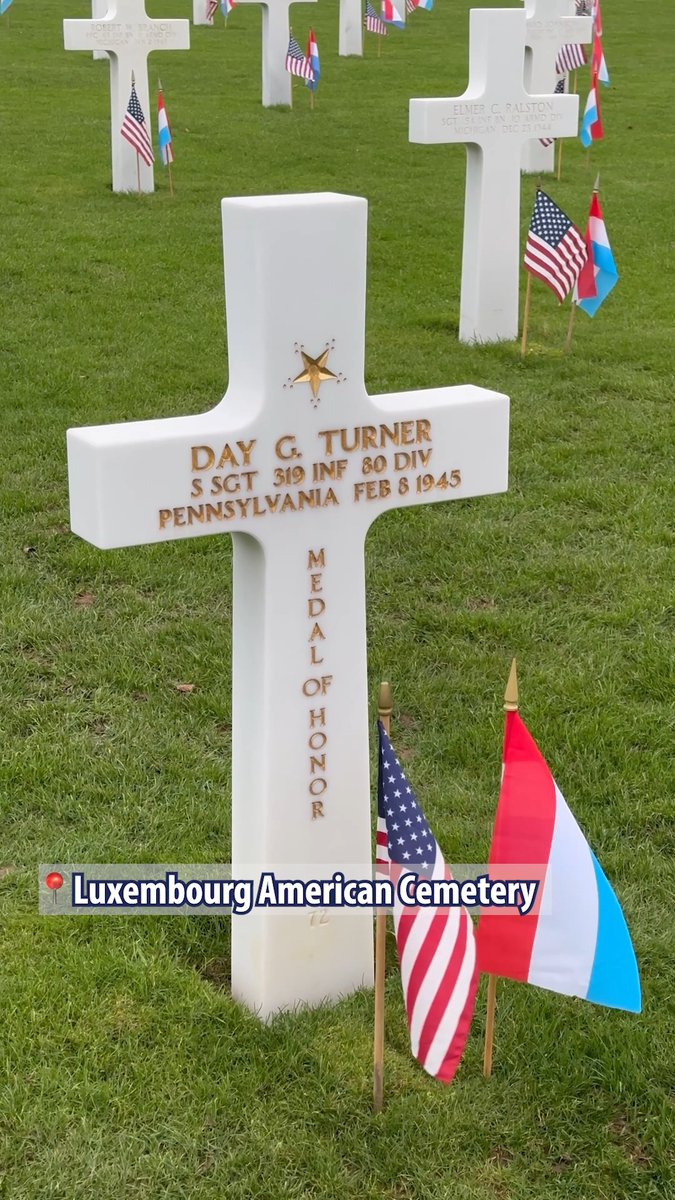
Today we remember WWII Medal of Honor recipient Staff Sgt. Day G. Turner, buried at Luxembourg American Cemetery. 🇺🇸🇱🇺 His Medal of Honor citation reads: "Turner commanded a nine-man squad with the mission of holding a critical flank position. When overwhelming numbers of the enemy attacked under cover of withering artillery, mortar, and rocket fire, he withdrew his squad into a nearby house, determined to defend it to the last man. The enemy attacked again and again and were repulsed with heavy losses. Supported by direct tank fire, they finally gained entrance, but the intrepid sergeant refused to surrender although five of his men were wounded and one was killed. He boldly flung a can of flaming oil at the first wave of attackers, dispersing them, and fought doggedly from room to room, closing with the enemy in fierce hand-to-hand encounters. He hurled hand grenade for hand grenade, bayoneted two fanatical Germans who rushed a doorway he was defending, and fought on with the enemy's weapons when his own ammunition was expended. The savage fight raged for four hours, and finally, when only three men of the defending squad were left unwounded, the enemy surrendered. Twenty-five prisoners were taken, 11 enemy dead and a great number of wounded were counted. Turner's valiant stand will live on as a constant inspiration to his comrades. His heroic, inspiring leadership, his determination, and courageous devotion to duty exemplify the highest traditions of the military service." We remember his service and sacrifice.

ABMC

26,945 Aufrufe • vor 5 Monaten

Visiting Venice changed Claude Monet's life By 1908, he had spent forty years teaching the world to see light. He was 68, in poor health, and losing faith in his own work. He had just abandoned his water lily paintings, discouraged after a trusted advisor questioned whether anyone would even want them. The man who had founded Impressionism, whose 1873 canvas "Impression, Sunrise" had given the entire movement its name, was convinced his best days were behind him... His wife, Alice, suggested a trip to Venice. Monet resisted. The city had been painted to death by Canaletto, Turner, and Whistler, and he had always insisted, "I will not go to Venice." It was, he said, "too beautiful to be painted." He went. And the moment he arrived, standing before the light on the water, he exclaimed: "It is too beautiful to be painted! It is untranslatable!" Within days he could not stop working. He fell into a fierce daily rhythm, painting the Doge's Palace, the churches, and the palazzos along the Grand Canal at the same hours each day, chasing the shimmer of Venetian air on stone and water. In just over two months he began 37 canvases. His wife wrote home that she was overjoyed to see him so impassioned again, doing beautiful work, and something other than "those same old water lilies." In a letter to a friend, Monet wrote: "My enthusiasm for Venice continues to grow, and it saddens me that the moment is coming when I must leave this unique light." He never returned. His beloved Alice died a few years later, and for a long time he could not bring himself to finish the Venice canvases. But when he did, and when they were finally shown in Paris in 1912, they were a triumph. And the trip had given him back something he thought he had lost: the discouraged old man who had walked away from his water lilies went home and took them up again, and spent his final years creating the enormous, luminous Nymphéas, the paintings the world now loves most. Sometimes the thing that revives us is an unexpected encounter with beauty we almost talked ourselves out of. He nearly didn't go. It turned out to be the doorway to his greatest work...

James Lucas

36,830 Aufrufe • vor 7 Tagen

🇨🇳🇮🇶 This is Ahmed Mohammed Jaber Alkalthoom, a 30-year-old from Iraq. The US invasion of Iraq in 2003 turned this child from a wealthy family into a displaced refugee. He left his homeland and went to Syria. He was only 9 years old that year. During the war, one of Alkalthoom’s eardrums was ruptured, leaving him with hearing in just one ear. Nine years later, conflict erupted in Syria as well. In the midst of the Syrian war, Alkalthoom not only endured emotional trauma but also suffered physical injuries. While out buying food one day, he was caught in crossfire and was shot. Afterward, Alkalthoom moved between Lebanon and Egypt before finally arriving in Ningxia, China. There, he began learning Chinese and adopted the name “Wang Lixuan.” The people of China were very kind to him, and he became one of the most popular food bloggers on Chinese social media, affectionately nicknamed “Iraqi Lao Wang.” Lao Wang said that when he first arrived in China, he would get startled whenever someone honked their car horn. On his first day, he fell into deep despair because he thought he heard “gunfire” and saw “troops gathering.” However, he quickly realized he had misunderstood. People around him explained that it wasn’t a military operation but students participating in military training exercises. During the 2024 Spring Festival, while recording food videos in Henan, he was eating at a barbecue stall when the sudden sound of firecrackers frightened him. For a few seconds, his eyes were filled with fear. “I thought it was the sound of a bomb exploding.” Once he realized he was safe, he let out a bitter smile, shook his head, and continued eating. Lao Wang says that so far, he has learned to write three Chinese characters: “爱” (love) and “和平” (peace).

𝘊𝘰𝘳𝘳𝘪𝘯𝘦

63,968 Aufrufe • vor 1 Jahr

I keep thinking about one of the original moments that the Left really started targeting Charlie and making Turning Point the enemy and how Charlie never backed down. When we hired Candace Owens, I had the honor of it being the three of us traveling around quite a bit… we went everywhere. Between work and building organizationally, to putting her on tour for the very first time with Charlie, helping with her personal socials and website— just everything. Charlie wanted to do everything he possibly could to maximize her voice as he did with so many because he loved her and saw her ability to do so much good for America. But this was in the era of the rise of Antifa that was manufactured by the Left. The first real danger I think we ever experienced where we were just living our lives and it made us realize we were in for a larger long term war was when we were together, just eating breakfast before some meetings and suddenly outside our window a large gang of antifa had assembled and harassed us out of our meal and then, while shouting “fascists” over and over took us to the streets to surround us and scream in our faces. They poured water on us and I’m sure wanted to throw other things at us had the police not arrived on the street and got us out of there. Charlie never backed down, in fact, instead of getting angry or physical, he stood bravely and tried have a debate with these obviously paid antifa bad actors. My young and honorable friend, (he was always genuine in his desire to save every single person he could) stood there and gave those people as he did everyone the chance to talk about ideas and I personally witnessed how fearless he was many times in the face of dangerous, unhinged activists, early early on. He never once feared these people. He just wanted to do right by what he knew was right. He knew other bystanders were always watching and learning and there was no way he could back down and let these people lie and falsely frame America the way they were trying to do. I’ll never forget his smiling face, “have a wonderful day, enjoy your capitalist breakfast.” He would have tried to talk sense into anyone and everyone and that is what he did every single day. That is why Charlie won over America. He was honest, true and genuine. Never gave up and stood in the pocket in the face of paid agitators and evil.

Tyler Bowyer

25,495 Aufrufe • vor 10 Monaten

Claude Monet painted the same stretch of cliff more than ninety times. The place is Étretat, a small fishing village on the coast of Normandy, where the chalk cliffs fall into the sea in great arches and a single spire of rock, the Aiguille, stands alone in the water. Monet had known the place since childhood. He grew up in Normandy, and these cliffs were among the first landscapes he ever saw... He returned to paint them again and again. He worked through the 1880s in front of the same rock formations, and across that time he produced more than ninety canvases of them: the cliffs at dawn, at sunset, under storm, under calm, in winter light and in the gold of a clear evening. In his letters to Alice, the woman he would later marry, he described the agony of it: the weather turning, the tide rising, the sun moving, the colour he had begun to capture vanishing before he could finish. He often worked on several canvases at once, switching between them as the conditions changed, racing each one against the hour. In a letter to his friend Frédéric Bazille he wrote: "It is beautiful here in Etretat. Every day I discover even more beautiful things. It is intoxicating me, and I want to paint it all, my head is bursting. I want to fight, scratch it off, start again, because I start to see and understand. It seems to me as if I can see nature and I can catch it all." The cliffs of Étretat had stood for millions of years and would look, to most people, the same on any given day. Monet saw that they were never the same even for two minutes. He stood on that shore and tried to hold, on canvas, something that exists only for an instant and then is gone forever. And that's exactly what those paintings really are: 90 attempts to keep a single, vanishing moment of light from disappearing. As Dylan Thomas once wrote: "Do not go gentle into that good night. Rage, rage against the dying of the light." -- -- -- If you want a deeper dive into the craft of painting, I recently wrote a piece exploring it in detail. You can read it here: And if you'd like to support my work, a paid subscription is what makes it possible:

James Lucas

57,710 Aufrufe • vor 1 Monat