Loading video...

Video Failed to Load

Go Home

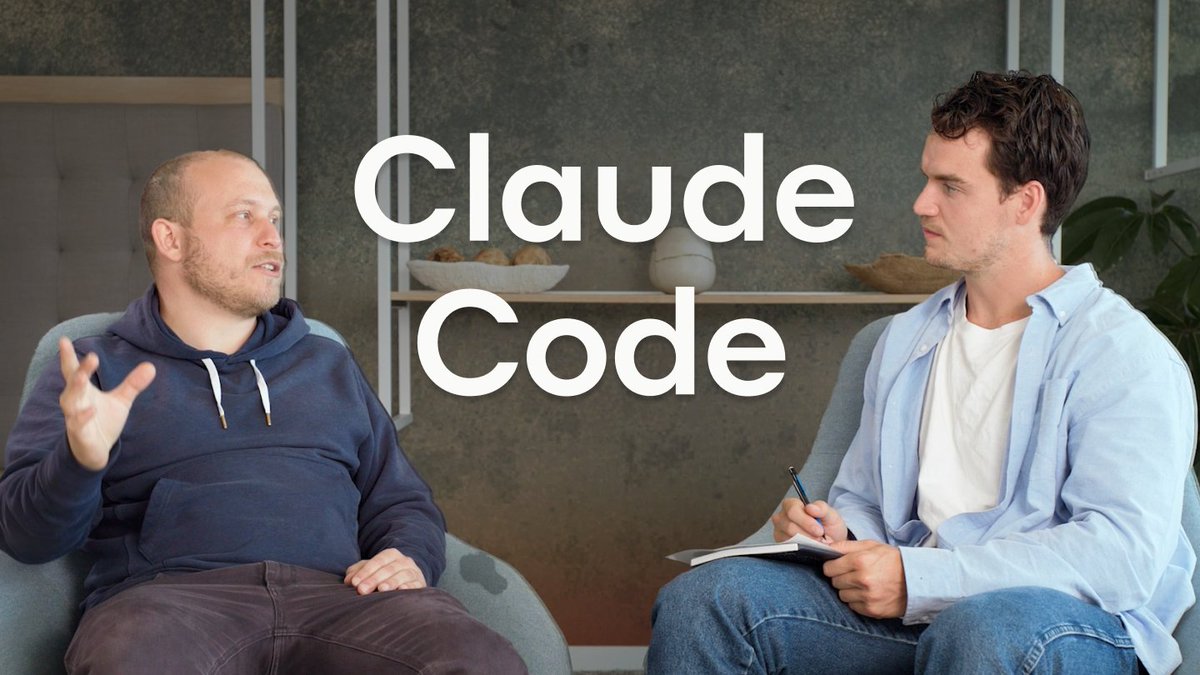
Head of Engineering for Claude Code at Anthropic. Fiona Fung: "After a while, it could start being a lonely experience - we were all just working with our agents so much." Claude now writes 80% of Anthropic's code. The team ships 8x more. An engineer, in Anthropic's own report:...

33,041 views • 25 days ago •via X (Twitter)

0 Comments

No comments available

Comments from the original post will appear here

Related Videos

Anthropic just released a talk on building headless automation with Claude Code. Presented by Sid Bidasaria, Member of Technical Staff at Anthropic live at Code with Claude on May 22, 2025 in San Francisco. Here is what the talk covers. Headless mode lets you run Claude Code without a person actively typing prompts from inside an automated script. Instead of a live session, a script calls Claude with a pre-written instruction using the -p flag. This opens the door for Claude Code to become a piece of a much larger, automated process. In plain terms: Claude Code stops being a tool you use and starts being a service that runs on its own. What this unlocks: Scheduled tasks: Run Claude Code on a cron schedule without anyone at a keyboard. Fix linting errors across an entire codebase. Automatically. Overnight. CI/CD integration: Trigger Claude Code as a step in your build process. Open a PR. Claude reviews it, flags issues, and pushes fixes before a human ever looks at it. GitHub automation: A project manager comments "Claude fix this" on a GitHub issue. Claude reads the request, finds the code, writes the fix, and opens the PR. Multi-machine workflows: One orchestrator dispatches tasks to multiple Claude Code instances running in parallel across different repos simultaneously. When you combine headless mode, hooks, and GitHub Actions, development teams can automate tasks that usually eat up significant time freeing senior engineers to focus on architectural problems while Claude handles the repetitive ones. If you use Claude Code for anything beyond single sessions this talk is worth 20 minutes of your time.

Elias

14,028 views • 1 month ago

Anthropic is running the oldest predatory playbook in Big Tech (Save this). Here is what actually happened. Anthropic's own Chief Product Officer, Mike Krieger, was sitting on Figma's board and he resigned on April 14, 2026. Three days later, Anthropic launched Claude Design, a direct competitor to Figma's core product that allows users to generate prototypes, slide decks, and visual assets through conversation. Figma's stock dropped 7% the day of the launch and the stock has shed approximately 80% from its all-time high, erasing nearly $50 billion in market cap. Anthropic's valuation surged toward $800 billion in the same period. This is not an accident but rather a deliberate, systematic strategy and once you see the pattern, you cannot unsee it. Anthropic watched Cursor build the coding assistant category on top of Claude's models, Cursor became one of Anthropic's biggest customers. Cursor's usage patterns and product insights flowed through Anthropic's infrastructure every single day then Anthropic launched Claude Code, entering the exact category Cursor had created armed with every data point it needed to know the market size, the use cases, and the user behavior. The same pattern has now repeated across Claude Science, Claude Security, Claude Legal, and Claude Financial, every single one a vertical that was previously served by companies building on top of Anthropic's own models. The companies that trusted Anthropic's platform were simultaneously handing Anthropic the product roadmap for what to build next. Every company currently building on top of a closed frontier model is in the same position Figma was in before April 14, 2026. The only question is which category Anthropic targets next. David Sacks

Milk Road AI

69,499 views • 14 days ago

I got curious how compaction works as a PM, so I did some brain surgery on Claude Code: (Anthropic's been doing really interesting work on context editing - they showed Claude Opus playing Settlers of Catan for 75+ minutes in a single thread by constantly editing the context instead of starting fresh. When I saw that Claude Code has a compaction command with optional custom instructions, I wanted to understand what's actually happening.) Abhishek Katiyar and Aman Khan gave me the key tip: Claude Code stores all your conversation history as text files on your computer. Open a new directory and give Claude Code a task. Here's how to watch compaction happening: 1. Go to your user's root directory 2. Press Command+Shift+Period (Mac) to show hidden folders 3. Navigate to ~/.claude/projects/ 4. Find your project folder and use Cursor/VSCode to open it (there's a reason) 5. Install the JSONL Gazelle plugin (open source, thank you Gabor Cselle!) 6. Open the most recent JSONL file - each row is a message in your conversation 7. Run the compact command in Claude Code with custom instructions 8. Watch what happens in the file What I learned: When you compact, Claude Code doesn't just summarize and delete everything. It creates a "compact boundary" in the conversation file, writes a summary of what happened before, but keeps the full original conversation (!!!!) The new thread can still retrieve any details from before compaction if needed. That is so damn cool. Why this matters: What you're getting in Claude Code is similar to what Anthropic ships in their developer SDK - so inspecting your daily tools is how you build real product intuition. The best way to understand AI systems is to open them up and look inside. Everything is text files.

Tal Raviv

57,910 views • 6 months ago