Video wird geladen...

Video konnte nicht geladen werden

Zur Startseite

Hedera just bought their biggest competitor... A silent multi-million dollar acquisition went down behind closed doors, changing the blockchain landscape forever. The Hadera Governing Council has purchased the intellectual property of its largest permissioned competitor, Hyperledger Fabric, from the Linux Foundation. This calculated structural chess move is designed to...

20,159 Aufrufe • vor 2 Monaten •via X (Twitter)

0 Kommentare

Keine Kommentare verfügbar

Kommentare vom Original-Post werden hier angezeigt

Ähnliche Videos

🔥🔥🔥 The recent OCC statement is financial history in the making! What’s written there validates so much of what we’ve been analysing about Stronghold, and even about networks like Stellar and Ripple. For the first time, the US regulator states plainly, banks can hold crypto on their balance sheet, pay network fees, and operate directly on blockchains as a normal part of banking activity. I’m not sure everyone fully grasps the scale of this 😅 Banks not only can, they MUST be connected to different ledgers whenever those networks form part of permissible banking activities. The regulator describes DLTs as “new ways of conducting the very old business of banking”, and that says everything. It means blockchains are no longer a technological experiment; they’re being treated as natural extensions of the financial system. The document goes even further by stating that a bank may be unable to perform certain functions if it lacks the capacity to operate on these networks. If the payment, settlement, swap, or record is happening on a specific ledger, the bank needs to be there and it needs to operate using the native token, because that’s how fees are paid, transactions are validated, and consensus is reached. For the OCC, this is simply part of how a modern bank should function. And because each ledger works under its own rules — Ethereum with gas, Stellar with path payments, Ripple with ODL — the OCC explicitly acknowledges that banks will need to hold small amounts of multiple crypto-assets whenever this supports permitted activities. To test platforms, settle movements, reconcile internal wallets, execute client instructions… all of it requires presence on the networks and tokens to operate. This vision opens the door to something far bigger, a financial system where banks are connected to several DLTs simultaneously, each one serving a different purpose. Liquidity, messaging, FX, settlement. And if banks need to be on these networks, they also need the layers that link them together, translate data, maintain compliance, and ensure all of this can coexist with traditional standards. This is where the entire ecosystem of utility tokens and interoperable networks takes on renewed importance. 🔥 HUUUGE! 🔥 🧠 Know what you hold! $SHx $XLM $XRP #DigitalAssets #ISO20022 #Crypto #RWA

StrongSHx

28,507 Aufrufe • vor 8 Monaten

The decision by ABC, CNN, and NBC not to carry President Trump’s primetime address on election security raises a fundamental question about the role of major broadcast networks in a democracy. This was a nationally announced speech by a sitting, duly elected president on the integrity of U.S. elections. An issue that affects every voter, regardless of party. This is not about liking or disliking Trump, or agreeing or disagreeing with his claims. The presidency is the highest elected office in the country. When a president addresses the nation in a formal, scheduled primetime speech, there is a strong public‑interest argument that news networks should air it live and in full. Citizens can’t evaluate their leaders, or their claims, if they aren’t allowed to hear those leaders directly. Editorial judgment and criticism remain essential. Networks are entirely within their rights to add clear disclaimers before and after the address, fact‑check in real time or immediately afterward, host panels that challenge, contextualize, or rebut the president’s statements. But substituting that for the speech itself, showing only handpicked clips, summaries, or commentary, shifts from informing the public to curating what the public is permitted to see. At that point, viewers are reacting to the networks’ framing, not to the president’s actual words. Even after being censored in the U.S., having its license revoked and facing sanctions, RT International chose to air the address in full. RT has publicly disagreed with the president’s policies and with parts of this speech, but it treated the event as a matter of public record. Our principle is simple: viewers should be able to watch the complete address in context, hear the arguments unedited, and then weigh both the speech and the subsequent criticism for themselves. Rather than having corporate media gatekeepers decide in advance which presidential messages are fit for broadcast.

Ben Swann

1,177,256 Aufrufe • vor 27 Tagen

🌍 Hedera “Built for Billions” is no longer a slogan. It’s taking institutional shape. Today was one of those moments where a lot of separate threads came together. Hedera leadership just wrapped one of the most comprehensive end-of-year discussions we’ve seen in crypto, bringing together: • Dr. Leemon Baird • Mance Harmon • Eric Piscini • Charles Adkins • Kamal Youssefi Founders, foundation, enterprise adoption, and global policy perspectives all in one room (hosted by Generation Infinity). At the same time, something important happened in parallel. The Global Blockchain Business Council (GBBC) was formally welcomed as a Strategic Partner of the Hedera Governing Council. That matters because GBBC is not a random crypto marketing group. It is the policy, standards, and risk-mitigation body working directly with governments, regulators, and global institutions. Earlier this year, GBBC published its Risk Mitigation Framework, with participation and observation from: • DTCC • Euroclear • Clearstream • World Bank (observer) • Oliver Wyman • Ripple (XRP) • Hedera (HBAR) Foundation • Cardano (ADA) • Avalanche (AVAX) • Major public networks and market infrastructure providers Phase 2 of that framework expands to Canton (CC) Network and Chainlink (LINK), with Phase 3 explicitly extending to native crypto assets. Today, those same names are starting to align in public..... Hedera also highlighted DTCC’s SEC no-action relief to tokenize DTC-custodied assets, a milestone that effectively opens the door to regulated onchain capital markets. This is not about hype cycles or narratives. This is about: • Regulated institutions • Risk frameworks • Governance • Interoperability • Compliance ready public networks During the Hedera leadership panel, one statement stood out: "It is becoming irresponsible for enterprises not to be exploring DLT" That is a very different conversation than crypto was having just a few years ago. Hedera’s model now combines: • Public, permissioned-grade infrastructure • Governing Council oversight • Open-source code managed under the Linux Foundation • Alignment with global policy and risk standards This is what “trust layer” actually looks like when it starts forming. Not one chain. Not one company. Not one jurisdiction. But coordinated infrastructure for how value, data, and markets move in a digital economy. Hedera is ready to serve billions at scale. The next phase of crypto isn’t louder. It’s integrated.

King Solomon (Ryan Solomon)

32,180 Aufrufe • vor 8 Monaten

🌋 Warning: DTCC Just Got the Green Light. The $3.7 Quadrillion Monster Goes Onchain in 2026 Today, the Depository Trust and Clearing Corporation received an SEC No Action Letter allowing them to tokenize real world, DTC-custodied assets on blockchain. This is historic. DTCC settles about 3.7 quadrillion dollars every year. It is the core settlement engine behind nearly every stock trade, ETF movement, and Treasury transfer in the United States. And they are now cleared to begin rolling out tokenization in 2026. This is not a pilot and not a test. The SEC has formally authorized a tokenization service for highly liquid assets including: • The Russell 1000 • Major index ETFs • U.S. Treasury bills, notes, and bonds These are some of the deepest liquidity pools on earth. Each tokenized asset will carry the same rights, protections, and ownership structure as the traditional version. This mirrors the digital twin model that Nasdaq filed for earlier this year. This is the first real path to onchain U.S. securities. DTCC has been testing DLT for almost a decade. Securrency’s patents, now owned by DTCC, reference multiple networks including Hedera (HBAR), XRP Ledger, Bitcoin (BTC), Ethereum (ETH), and there are already deep integrations with Chainlink (LINK). And this isn’t happening in a vacuum. The Global Blockchain Business Council has been building a multi-network risk mitigation framework with contributors like DTCC, Hedera, Ripple, Cardano (ADA), Avalanche (AVAX), Clearstream, Euroclear, Canton (CC) and Chainlink. These trials are being overseen by the World Bank. The framework is designed to give institutions a safe and standardized path to use public networks. It is the clearest signal that a multi-chain future is already being engineered behind the scenes. This also lines up with OCC guidance confirming that U.S. national banks can now buy and sell crypto for customers as a riskless principal. Banks plus DTCC plus regulatory clarity is the digital market structure that institutions have been waiting for. DTCC will soon publish: • Approved blockchain networks • Wallet registration requirements • Onboarding standards for institutions • Compliance and reporting frameworks We will finally see which networks will be used in production. This is the moment crypto shifts from asset class to infrastructure. TradFi is not speculating. They are rebuilding the settlement layer of global finance on distributed ledger technology. Tokenization is no longer a narrative. It is a regulated roadmap. Rollout begins in the second half of 2026. The internet of information is literally becoming the internet of value.

King Solomon (Ryan Solomon)

101,299 Aufrufe • vor 8 Monaten

In a stunning exposé, Robert F. Kennedy Jr. details the mechanics of Bill Gates’s “philanthrocapitalism,” revealing a system where public health and agriculture are leveraged for immense private profit. Kennedy asserts that Gates has effectively taken control of the World Health Organization (WHO). This position is then allegedly used to mandate vaccines for children across Africa, leveraging the WHO's funding over African health departments. The crux of the conflict? These life-saving interventions are, Kennedy claims, provided by companies in which the Gates Foundation holds significant financial interests. Public health becomes a closed loop of private gain. This pattern, he argues, was perfected with the "Green Revolution" in Africa. Gates orchestrated a shift away from traditional, resilient agriculture towards GMO monocultures. The infrastructure and supply chains were built by a corporate consortium—including Monsanto, Cargill, Coca-Cola, and Kraft—all entities linked to Gates's investments. The result? A new market for U.S. corporations to source ingredients like corn syrup. The human cost, according to Kennedy, has been catastrophic: an additional 30 million people have been plunged into food insecurity. While local ecosystems and food sovereignty collapse, Gates and his corporate partners have made a financial "killing." This is the dark reality of philanthrocapitalism: the concentration of power over global policy, leading to wealth for a few and devastation for millions.

Camus

59,354 Aufrufe • vor 10 Monaten

Brett Weinstein exposes a devastating truth about the American medical landscape, drawn from his conversation with Robert F. Kennedy Jr. RFK Jr.'s campaign pledge to ban Big Pharma TV advertising—a practice consuming $5 billion annually and permitted only in the U.S. and New Zealand—has hit a wall. Weinstein describes the profound frustration of this moment: Kennedy entered the "belly of the beast" only to find that theoretical roadblocks are now a concrete, immovable reality. Why does this matter so deeply? Weinstein clarifies that these ads are not merely about convincing consumers. That is a secondary effect. Their primary function is far more insidious: they are a multi-billion dollar mechanism for buying influence and silencing criticism. By flooding media networks with ad revenue, Big Pharma purchases complicity. It engineers a system where networks and news outlets cannot afford to report accurately on pharmaceutical hazards for fear of losing a colossal revenue stream. The result? We, the public, are flying blind, fed a curated narrative while critical safety information is suppressed. Kennedy, with his career battling regulatory capture, is uniquely positioned to understand this corruption. Yet he finds himself in a lonely position, confronting a power so profound it has successfully blinded the very institutions meant to protect us. This isn't just about ads. It's about the deliberate manufacturing of public ignorance to protect profit. A must-understand dynamic for anyone concerned about public health and a free press.

Camus

51,389 Aufrufe • vor 10 Monaten

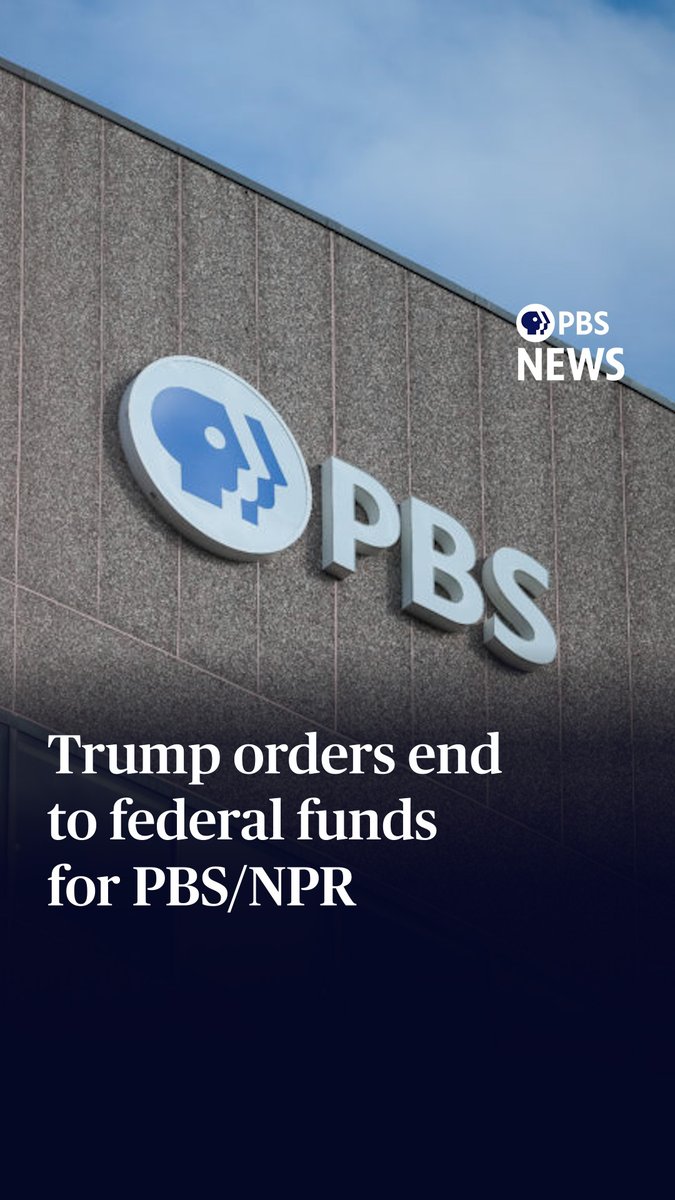
President Donald Trump issued an executive order late Thursday night that instructs the Corporation for Public Broadcasting (CPB) to halt all direct federal funding to the nation’s two major public broadcasting networks – the Public Broadcasting Service (PBS) and National Public Radio (NPR). The move will directly affect the roughly 1,500 public media stations nationwide, as well as national programs like the PBS News Hour. Trump also directed CPB – a congressionally chartered, private, nonprofit corporation which provides more than $500 million to local PBS and NPR stations every year – to eliminate indirect government sources of financing for the networks. Patricia Harrison, the president of CPB, said in a statement that the corporation is “not a federal executive agency subject to the president’s authority. Congress directly authorized and funded CPB to be a private nonprofit corporation wholly independent of the federal government.” CPB filed a lawsuit against the Trump administration earlier this week after the White House fired three of the corporation’s board members. The executive order is also expected to be challenged in court. PBS CEO Paula Kerger called Trump’s executive order “blatantly unlawful,” while NPR CEO Katherine Maher said her organization “will vigorously defend our right to provide essential news, information and life-saving services to the American public. We will challenge this executive order using all means available.” The order came on the heels of reports the White House planned to engage Congress in an effort to rescind already distributed funds from the public media networks. It’s unclear at this time if the rescission plan will move forward following Trump’s executive order. Both NPR and PBS are engaged in campaigns to encourage their supporters to lobby Congress to protect federal funding. The Trump administration argues that taxpayers should not be supporting media that he argues carries a liberal bias. The president has referred to the news media as “the enemy of the people,” filed lawsuits against CBS News and ABC News, and pushed The Associated Press out of the press pool whose job is to cover his administration.

PBS News

121,005 Aufrufe • vor 1 Jahr

A GLOBAL Reckoning..... The public will learn this goes WAY beyond Epstein.... 🟨 Q 4565: "Possible Epstein was a puppet [not the main person(s) of interest]? Financed by who or what [F] entities?" 👉 [F] = FOREIGN "We have been faced with a reckoning opportunity; that the elite in this WORLD, not Country, in this WORLD, are frankly, perverted and have been used to, for quote some time, a power structure and opportunity for perversion, unfettered..." Epstein was never the main player — but a small node inside something MUCH larger. We were told, and common sense dictates this based on patterns and historical intelligence tradecraft. History shows that blackmail, sexual compromise, and addiction have been used by intelligence agencies around the world as tools of leverage and control. That’s not "conspiracy theory" it is documented practice. Epstein wasn’t the architect — he was a facilitator - A mechanism for gathering leverage on politicians, royalty, financiers, Hollywood, and global influencers. BUT, the real power wasn’t the face we saw — but the entities operating behind the scenes. 🟨 Q 4565: "Sometimes it's the people in the background that are of greater significance." Agencies such as the CIA, Mossad and Five Eyes–linked structures benefitted from influence networks like this. The "names no one knows" - the uber elites of the world - the puppet masters - benefitted from influence networks like this. The renewed focus on Epstein isn’t random. Trump, the Military, the “white hats” are intentionally amplifying this topic to educate the public about how sex trafficking, blackmail, and influence networks operate at elite levels. Not as a partisan issue — but as a systems issue. This is just the start. The broader idea: Once the public understands how leverage works, they will start questioning whether similar networks operate internationally — across governments, finance, media, and intelligence communities. They will see how it is all connected. They will be shown, this goes far beyond Epstein - far beyond borders - ABOVE the level of Government. History shows: Power protects itself. Influence often operates quietly. The people in the background are sometimes more important than the visible face. Epstein may have been the scandal. But the structure behind him IS be the REAL story. Coming soon, to a theater near you....

NewsTreason Channel 17

19,657 Aufrufe • vor 5 Monaten

President Trump posted this Explanation on what BITCOIN is… • In the video, Peter Van Valkenburgh, Director of Research at Coin Center, delivers an explanation of Bitcoin during a U.S. Senate hearing. • He describes Bitcoin as the world's first cryptocurrency, powered by the first public blockchain network, which enables anyone to send and receive value globally using just a computer and internet connection—without relying on trusted middlemen like BANKS. • He emphasizes its revolutionary nature as the first public digital payments infrastructure, comparable to the internet for information but for money. • Unlike traditional systems that depend on PRIVATE banks to update ledgers, Bitcoin uses a PUBLIC blockchain where anyone can create an address for free and transfer funds, regardless of background or credit status. • Van Valkenburgh argues that Bitcoin's decentralized design addresses flaws in centralized systems, which have single points of failure leading to massive breaches, such as the Equifax hack exposing 143 million Americans' data, SWIFT network frauds totaling hundreds of millions (including North Korean involvement), a $1.8 billion robbery at Punjab National Bank, and a 2016 botnet attack disrupting major websites. He extends this to the Internet of Things, citing hacks of pacemakers, baby monitors, and vehicles. • He advocates for building more public infrastructure like blockchains to reduce reliance on powerful corporate intermediaries, foster competition, and prevent failures. • Bitcoin, he says, is a computer science breakthrough akin to the internet, promoting freedom, prosperity, and human flourishing, with potential to replace other centralized chokepoints.

MJTruthUltra

114,510 Aufrufe • vor 1 Jahr

One of Chainlink's core value props is that it is a neutral technology platform that does not compete with its customers Specifically, Chainlink is not a blockchain, and does not compete with blockchains Rather, Chainlink enhances the utility of all public/private chains by providing the oracle services their ecosystems need to succeed long-term This neutrality is why Chainlink has *thousands* of blockchain, Web3, and TradFi partners who rely on Chainlink for critical functionalities including: - Onchain data delivery - Cross-chain interoperability - Automated compliance - Privacy-preserving compute - Legacy system integration - Multi-system workflow orchestration As the cost and friction of launching a blockchain continues to drop toward zero, the number of public/private chains that exist will expand from hundreds today to thousands in the future If a cross-chain provider wants to pivot by launching their own blockchain and begin competing with Ethereum, Solana, Canton, and all of their existing blockchain partners, I wish them luck on that That’s not the game Chainlink is playing While blockchains fiercely compete amongst each other to become the transactional database layer, Chainlink wins regardless of which chains are used For Chainlink, every new blockchain introduced to the market is all the more justification for why organizations need Chainlink as their orchestration layer to manage the complexity That’s why financial market infrastructure providers like Swift, DTCC, Euroclear, and more have adopted Chainlink, they understand the financial system needs an orchestration layer To emphasize my point, here is a clip from DTCC executives explaining how the rapidly growing number of blockchains is why their partnership with Chainlink is so important

Zach Rynes | CLG

13,309 Aufrufe • vor 6 Monaten