Загрузка видео...

Не удалось загрузить видео

На главную

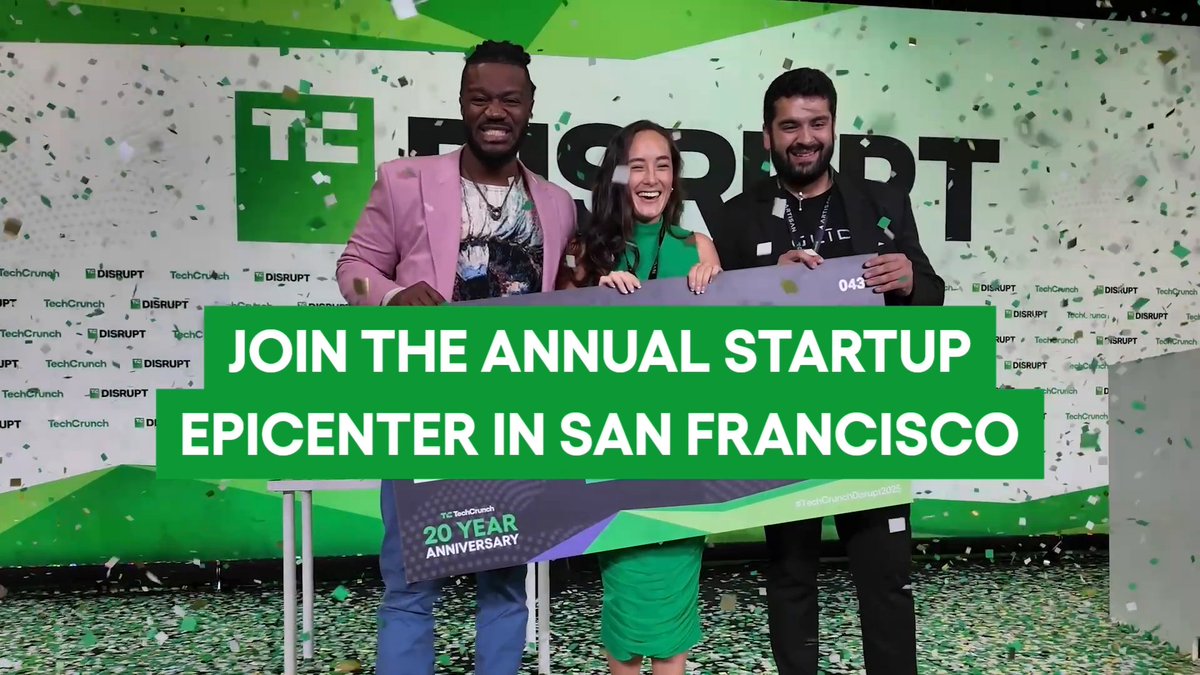
Here are three things a fundraising founder should know about Disrupt 2026, with just a few days left on current pricing: 1. Our Founder Pass is built around structured investor access, not just a badge and a hallway conversation. 2. Startup Battlefield 200 puts you in front of the...

20,414 просмотров • 1 день назад •via X (Twitter)

Комментарии: 0

Нет доступных комментариев

Здесь появятся комментарии из оригинального поста
Похожие видео

Jeff Bezos just told you exactly how to price AI. Nobody listened. Bezos: “AI is real and it is going to change every industry. In fact it’s a very unusual technology in that regard in that it’s a horizontal enabling layer.” Horizontal enabling layer. Three words that reprice the entire technology sector. The iPhone was a vertical. One product. One new market. Electricity was a horizontal. One substrate that rewired every market on Earth. Wall Street is pricing AI like it is the next iPhone. Bezos is telling you it is the next electrical grid. Right now, thousands of companies are trying to sell AI as a product. A feature. A tool. A subscription tier. Every single one of them will be priced to zero. You do not sell a horizontal layer. You do not compete with it. You build on top of it or you disappear beneath it. For a century, entire industries survived on one thing. Complexity. The friction of navigating law, medicine, logistics, finance. That was the moat. If you could not memorize the maze, you could not compete. A horizontal layer does not navigate the maze. It dissolves the walls. Electricity did not compete with the candle industry. It erased the need for one. The most dangerous part of a horizontal shift is how quiet it is. It moves underneath the economy. The surface looks normal. Revenue still holds. Every day you operate on the old substrate, you accumulate a debt you cannot see and cannot repay. The internet repriced distribution. AI is repricing cognition itself. When intelligence becomes a utility that runs through the walls of every company on Earth, the premium on human expertise does not erode. It evaporates. This is not a disruption. Disruptions replace products. This replaces the ground you are standing on.

Dustin

541,865 просмотров • 4 месяцев назад

Elon Musk gave the entire entertainment industry its expiration date, and he is the one building the thing that kills it. Musk: “My guess is that we see the first compelling half hour, pure AI show next year.” Next year. A complete show generated entirely by AI. No writers. No actors. No cameras. No sets. No crew. No studio. Just a prompt and enough compute to render a reality that never physically existed. And shows are the easy part. Musk: “I say probably we’re maybe three years away from AI does the whole video game.” A show plays the same way every time. A game has to generate a living world that reacts to every decision in real time across every single frame. That is a fundamentally harder class of problem. And Musk put three years on it. Right now a single AAA title takes seven years and half a billion dollars across thousands of engineers and artists just to ship it. Musk is describing a world where one person types a paragraph and gets something comparable. The entire value proposition of a multi-billion dollar industry lives inside that gap. And it closes in thirty-six months. But the prediction is not the story. The person making it is. This is not an analyst speculating from the sidelines. This is the man building the largest AI compute clusters on the planet. The man who built xAI from zero in under two years. The man stacking hundreds of thousands of GPUs into facilities designed to do exactly what he is describing. When Musk says three years, he is not guessing about what someone else might eventually ship. He is reading you a delivery date off his own roadmap. Every media company on Earth is valued on a single assumption. That quality content is expensive and difficult to produce at scale. That one assumption is the structural foundation underneath every studio, every network, and every publisher in existence. Musk is dismantling it with raw compute. The studios still parading thousand-person production teams are not demonstrating strength. They are advertising the exact cost structure that one person with a prompt and a GPU allocation is about to make irrelevant. And it does not stop at entertainment. If AI can generate an interactive world that responds to human input in real time, it can generate anything. Advertising. Architecture. Training simulations. Product design. Every industry built on humans manually constructing visual experiences frame by frame is sitting on the same countdown Musk just read out loud. Now zoom out. Because this is not just an industry story. For the entire history of human civilization, the distance between imagining a world and actually creating one required thousands of people, millions of hours, and billions of dollars. That distance built Hollywood. That distance built the gaming industry. That distance made content scarce and studios powerful. Musk is collapsing that distance to zero. When the gap between imagining something and it existing disappears, every business model built on the difficulty of creation disappears with it. That is not disruption. That is a full inversion of how human beings create. Musk did not make a casual prediction on that podcast. He told you what he is building. He told you the timeline. And he told you which industries do not survive it. The entertainment industry is still debating whether this future is real. Musk is not part of that debate. He is building. And he just told you the delivery date.

Dustin

22,390 просмотров • 1 месяц назад

Jeff Bezos just described AI in three words that make most of the economy temporary. Bezos: “AI is real and it is going to change every industry. In fact it’s a very unusual technology in that regard in that it’s a horizontal enabling layer.” Horizontal enabling layer. Not a product. Not a platform. Not a feature. A layer. Underneath everything. Everyone is asking which AI company wins. Bezos is telling you that is the wrong question entirely. A horizontal layer does not produce winners. It produces a new floor. Everything standing on the old one either gets rebuilt or gets erased. This has happened exactly twice in modern history. Electricity. The internet. Both times the same pattern. The new layer appeared. The old economy kept running above it. Revenue held. Careers continued. Everything looked normal. Then quietly and permanently the entire structure reorganized around the new substrate. The people who did not move were not outcompeted. They were made structurally irrelevant. Not because they were wrong. Because the ground they stood on stopped being ground. Bezos is telling you it is happening a third time. Not with a product. Not with a platform. With intelligence itself becoming infrastructure. A horizontal layer does not compete with the expert. It makes expertise free. It hands a 22 year old with zero credentials the same cognitive output you spent a decade and a quarter million dollars learning to produce. For $20 a month. That is not disruption. Disruption replaces a product with a better product. This dissolves the scarcity your entire career was priced on. Not because the work disappeared. Because the wall around it did. Every profession that exists because knowledge is hard to acquire. Every company that profits because analysis takes time. Every industry that survives because complexity locks outsiders out. All of it rests on a single assumption. That cognition is scarce. AI does not challenge that assumption. It retires it. The people who understand this are already rebuilding. Quietly. Deliberately. While everyone else argues about whether the thing underneath them is real. Bezos did not give you a prediction. He gave you a position on a map. You are either above the new layer or beneath it.

Dustin

104,086 просмотров • 1 месяц назад

Elon Musk just identified the next crisis in AI. It’s not a shortage. It’s an unusable surplus. Musk: “By the end of this year, chip production will outpace the ability to turn chips on.” For three years the world was starved for silicon. Every lab, every government, every company racing to secure the chips that determine who wins the AI era. That bottleneck is ending. A new one is replacing it. Musk: “The chips are going to be piling up and not be able to be turned on.” Billions of dollars of the most advanced AI hardware ever built. Sitting dark. Not because the chips don’t work. Because there isn’t enough electricity to run them. You can’t print a power plant the way you print a chip. The fabrication plants scaled. The grid didn’t. And now the most valuable hardware in history is about to hit a wall that no amount of capital can instantly solve. Compute is about to become abundant. Electricity is about to become the most valuable commodity on earth. Three years obsessing over silicon yields. Physics doesn’t care about your chip architecture if your data center can’t pull enough megawatts. The war isn’t about who can manufacture the most silicon anymore. It’s about who has the raw power to plug it in. Whoever solves energy first doesn’t just win. They own the infrastructure everyone else needs to compete. The losers stack useless chips in warehouses waiting for power that never arrives. We built a trillion dollar engine and forgot the fuel. That’s the AI race right now.

Dustin

705,613 просмотров • 6 месяцев назад

The world just paid $2 trillion for a rocket company that lost $4.9 billion last year. And the rockets are not why it lost the money. They are the only part making any. SpaceX went public Friday, the largest IPO in history. Up 19%, a $2 trillion valuation, Elon Musk the first trillionaire. Then you open the filing. Three businesses sit inside it. Starlink, the satellites, brought in $11.4 billion, 61% of all revenue, and $4.4 billion in profit. It is the only piece that earns a dollar. The rockets that land themselves run a small loss reinvesting in Starship. And the AI arm, Grok plus the app once called Twitter, folded in this February, lost $6.4 billion in a single year on $12.7 billion of spending. Read that again. The satellites pay for everything. The AI loses more than the satellites make. And the AI is the part the market fell in love with. It gets bolder. The prospectus claims a total market of $28.5 trillion, the largest any company has ever put in a filing. Larger than the GDP of the United States. That is the number underwriting a $2 trillion price tag built on a division bleeding $6 billion a year. Now the structure. About 4% of the company trades. That sliver sets the price for all of it. Musk is locked up for 366 days and holds roughly 80% of the votes. The public bought a company they cannot steer, priced on the one segment losing the most. This is the whole year in one ticker. The profit is satellites. The story is AI. The market bought the story. The rockets were never the risk. The risk is a $2 trillion price resting on the one bet that has yet to make a cent.

Shanaka Anslem Perera ⚡

721,880 просмотров • 2 месяцев назад