正在加载视频...

视频加载失败

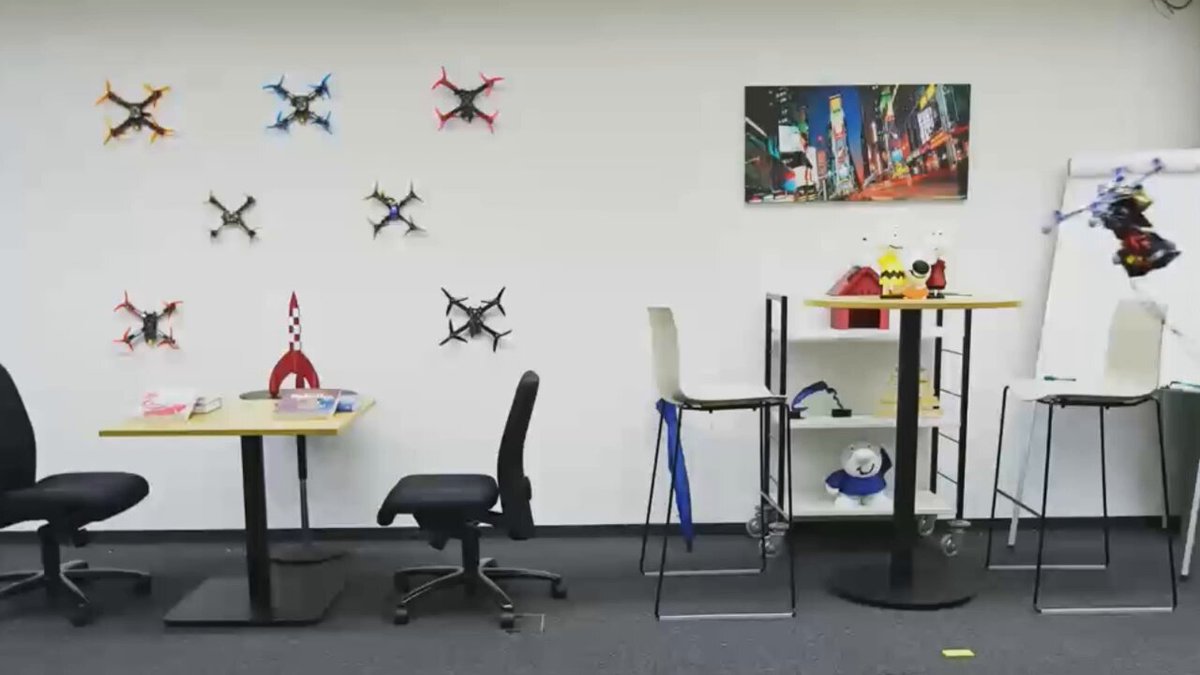
here's a follow up ground based drone tracker :> this little setup runs with 100Hz+ tracking updates, ~20ms latency, low light, no motion blur. (4d object tracking + 6dof pose/velocity)

116,320 次观看 • 2 个月前 •via X (Twitter)

0 条评论

暂无评论

原始帖子的评论将显示在这里

相关视频

We are excited to share our work “Event-Aided Sharp Radiance Field Reconstruction for Fast-Flying Drones” published in IEEE Transactions on Robotics IEEE Transactions on Robotics (T-RO), which tackles sharp radiance field reconstruction under agile drone motion, where RGB frames are heavily motion-blurred and pose priors become unreliable! 4 years in the making! Code & dataset released! PDF: Code & Dataset: Full Narrated Video: High-speed flight is essential for time- and battery-constrained missions (e.g., inspection, exploration, search & rescue). However, fast motion corrupts visual data with severe motion blur and introduces drift/noise in visual-inertial odometry, making NeRF-based 3D reconstruction particularly brittle. We propose a unified framework that leverages asynchronous #EventCamera streams together with motion-blurred frames to reconstruct high-fidelity radiance fields from agile drone flights. Our key idea is to embed event-image fusion directly into radiance field optimization while jointly refining a shared, continuous-time camera trajectory initialized from event-based VIO. This enables us to recover sharp radiance fields and accurate trajectories without ground-truth supervision during training. We validate our method on synthetic data and on real sequences captured by a drone flying up to 2 m/s. Despite severe blur and noisy pose priors, our method preserves fine scene details and achieves a performance gain of over 50% on real-world data compared to state-of-the-art methods. Kudos to Rong Zou and Marco Cannici! Marco Cannici Reference: Rong Zou*, Marco Cannici*, Davide Scaramuzza Event-Aided Sharp Radiance Field Reconstruction for Fast-Flying Drones IEEE Transactions on Robotics (T-RO), 2026 NCCR Robotics European Research Council (ERC) AUTOASSESS UZH IfI University of Zurich UZH Science Prophesee SynSense UZH Space Hub

Davide Scaramuzza

12,006 次观看 • 5 个月前

🎋MOCOPI vs VIVE TRACKERS🎋 I got a crazy crazy upgrade on full body tracking thanks to the support of my bambuds, so I made a silly dance comparison to compare the tracking between my old FBT and my new one!! ✨ I danced Bibbidiba by Suisei! (ft. bae as my guide lol) I had to use a different model for the Vive comparison because my Toffee model doesn't work well with the trackers! PROS AND CONS 🔽 1. Mocopi is SO MUCH EASIER to set up! It's very very beginner friendly as well and a great asset to get if you're just starting on doing 3D stuff or want to try it out! Vive trackers are lowkey a pain to set up each time! 2. Vive trackers are EXPENSIIIVEEEE!!!!! The tracking is so so so good but only invest in it if you plan to do lots of 3D content! Mocopi is a much affordable option! 3. Related to point 2, but you get what you pay for when it comes to tracking. Vive may be more expensive, but the tracking quality and accuracy makes it worth it. 4. This is only for people that don't have the Valve Headset, but I use a Quest 3 and I have to do EXTRA SETUP to calibrate the trackers with an external program to use in VRChat! (Mocopi also needs an external program (SlimeVR) but it's much easier to set up imo). 5. Since calibration is paired to your headset with the vive trackers, if your headset goes to sleep or something the calibration will be LOST and you will have to recalibrate again which may take 1 to 2 minutes. Mocopi doesn't have this issue and recalibrating is only one button. 6. Mocopi is an IMU so no base stations required but because of this the trackers need to be recalibrated A LOT of times. This may be annoying if you're streaming and you constantly have to press the button to recalibrate. Vive trackers may take longer but you VERY RARELY have to recalibrate if your headset doesn't go to sleep. 7. Vive trackers take a lot of space on your setup. Each tracker needs to be connected to the PC so if you have a lot you may need to buy an USD hub! 8. You need to have a good room space to use vive trackers properly because the base stations need to have a clear view of your trackers or else they can lose tracking! Mocopi is an IMU, so no amount of obstruction will make the trackers lose tracking. 9. The amount of poses and movement that you can do with vive trackers is NIGHT AND DAY compared to the mocopi. A lot of poses or rapid movements will make the mocopis mess up their tracking and you will have to recalibrate. Vive trackers will not need any recalibration. Basically if you're a vtuber that only wants to dabble into 3D content as a fun little thing I think mocopis are very much a good choice! But if you'd like to do 3D stuff that require more intensive tracking like dancing, vive trackers are excellent and very much worth the price!

Toffee 🐾🎋

80,586 次观看 • 1 年前

DRONE VIDEOGRAPHERS CHARGE $10K FOR THIS SHOT. HE PULLS IT FROM GOOGLE EARTH AND A PROMPT You never buy a drone, book a pilot, or leave the house. You pick any city on Earth, trace the flight path you want, and let Gemini render it as real-looking FPV footage. Clients pay thousands for this shot. You make it from a screenshot Here is the exact process: 1. Open Google Earth. Find the city or building you want. Frame the angle you'd want a drone to start from and take a screenshot 2. Draw the path. On that screenshot, draw a red line showing exactly where the drone should fly through the scene. This line is what the AI follows 3. Open Gemini and drop in the screenshot. Use the video generation in the Gemini app, the part that animates a still image into motion. Nano Banana handles images, the video engine is what turns your shot into footage 4. Paste the prompt. Tell it to follow the red flight path through the city, fast smooth motion, banking around buildings, golden-hour light, motion blur, 9:16 vertical, real FPV drone look. Full prompt is in the comments 5. Generate and clean it up. One clip is a few seconds. Stitch a couple together for a full flythrough and you have a reel Set the prompt once and you can re-run it for any location on the planet Who pays for this: Real estate agents, hotels, restaurants and event venues all need aerial b-roll and almost none can afford a real drone shoot Pull listings or venues with flat, ground-level photos and zero aerial footage. Send a free sample flythrough of their own location, then charge per clip or a monthly rate for ongoing reels One agent with ten listings is a recurring client, fully online Full prompt in the comments Bookmark this

Yarchi

53,000 次观看 • 2 个月前

Neon Drift: The 46 JDM Legend – Midnight High-Speed Run Made with seedance 2.0 Prompt: Cinematic 30-second vertical 9:16 video, highly detailed anime/cinematic 3D style like Arcane + Cyberpunk 2077, night to golden hour transition. A handsome young man with messy blonde hair, black thick-rimmed glasses, light beard, serious intense look, full sleeve tattoos on both arms, wearing black shirt and grey pants, standing in a rainy neon-lit cyberpunk city street at night. He checks his glowing smartphone, then walks confidently towards a white Honda Integra/JDM coupe with bold black "46" graffiti on sides, red underglow lights. He opens the door, sits inside, presses the start button (close-up on tattooed hand), dashboard view with his glasses reflecting colorful neon lights on the gauges. White smoke bursts from the exhaust. Dynamic driving sequence: car speeding through wet neon streets under overpasses with colorful signs, then powerful drift with thick white + red smoke, red underglow glowing on wet road. Epic wide shots of the white sports car with "46" graphics drifting and accelerating on a big bridge during beautiful purple-orange sunset, city skyline in background, dramatic lens flares, motion blur, cinematic camera angles (low tracking shots, side profile, rear tracking, aerial). Moody cyberpunk atmosphere, reflections on wet roads, volumetric fog, intense colors, smooth transitions, high energy, satisfying car sounds implied, premium car commercial feel, ultra realistic details, 4K, cinematic lighting --ar 9:16 --stylize 250 --v 6

Noor

17,131 次观看 • 21 天前

Created this race using GPT Image 2 and Seedance 2.0 on TapNow Prompt Follow the storyboard strictly in exact order from Panel 1 to Panel 9. Do not skip, merge, or rearrange scenes. Keep the SAME female cyclist identity across the entire film. No face changes, no hairstyle changes, no helmet changes, no body proportion inconsistencies. Baby pink must remain the dominant apparel color throughout all cycling scenes. Avoid black wardrobe replacements. Preserve realistic nighttime lighting continuity between shots. Maintain the same cool blue tones and subtle red light reflections. Heavy rain intensity must stay visually consistent across all scenes. Water physics must look physically accurate: droplets, splashes, mist, wheel spray, and runoff should behave naturally. Avoid artificial AI motion. Camera movement should feel like real cinema rigs, FPV drones, mounted bike cameras, or stabilized tracking systems. Drone shots must maintain locked framing and smooth movement without random drifting or orbiting. Use subtle cinematic motion only — no excessive shaking or jitter. Keep realistic breathing, body fatigue, pedaling mechanics, and fabric reactions to wind and rain. Preserve shallow depth of field in macro shots and atmospheric haze in wide shots. Keep the environment dark, moody, and cinematic with strong contrast between wet reflections and darkness. Ensure all reflections on asphalt, water droplets, and bike components react naturally to changing light sources. Maintain premium commercial pacing: slow controlled preparation and macro shots transitioning into aggressive high-speed riding sequences. Final output should resemble a high-budget Nike / Rapha night cycling commercial shot during a real mountain storm. Ultra-realistic cinematic night cycling commercial about female endurance cyclists riding through an intense rainstorm in the mountains at night. Premium Nike / Rapha aesthetic with baby pink performance cycling apparel as the dominant accent color. Hyper-realistic documentary look, no stylization, no anime look, no beauty filters. Natural skin texture, realistic rain interaction, physically accurate water behavior, cinematic low-key lighting, cool blue night tones mixed with subtle red rear-light reflections. Heavy rain, fog, wet asphalt reflections, cinematic motion blur, high dynamic range, shallow depth of field, premium sports commercial quality. The film follows a strict 9-panel storyboard structure with seamless cinematic transitions and continuity preserved across every scene. The SAME female cyclist identity must remain consistent throughout the entire video: same face, helmet, glasses, body proportions, baby pink apparel, lighting style, and overall appearance. Maintain continuity of rain intensity, wetness, fog density, and environmental lighting between all shots. Panel 1: Extreme macro close-up of the female cyclist’s eyes and face in heavy rain at night. Focus on soaked eyelashes, wet skin texture, raindrops streaming across the face, baby pink helmet and baby pink face mask visible. Red rear bike light flickers dynamically across her eyes and skin while cool blue night tones dominate the scene. High contrast cinematic lighting, shallow depth of field, subtle breathing motion, intense determined expression. Panel 2: Cinematic medium close-up frontal shot of the cyclist riding aggressively through heavy rain at night. She pedals hard with strong effort and forward-leaning posture. Baby pink waterproof cycling jacket soaked with rainwater. Front bike light cuts through fog and rain with subtle flickering illumination. Wet asphalt reflects red and white lights. Smooth cinematic tracking shot with controlled stable motion and slight natural float. Panel 3: Ultra-realistic macro shot of large raindrops impacting wet asphalt at night. Crown-shaped splashes and overlapping ripples in slow motion. Rough wet asphalt texture, cool blue cinematic tones, subtle reflections from bike lights.

Sharon Riley

72,716 次观看 • 2 个月前

Everyone is sleeping on Meta's SAM 3 release. But it's actually a big deal. Here's why: Companies spend millions paying humans to label images and videos frame by frame. A single autonomous driving dataset? Months of work, hundreds of annotators, millions in cost. Without labeled data, you can't train custom models. Without custom models, you're stuck with generic solutions. This is why most companies never move past pilots. SAM 3 breaks this cycle. First let's look at the evolution: SAM 1 segmented objects when you clicked on them. Revolutionary, but one object at a time. SAM 2 added video tracking with memory. Game-changing, but you still manually prompted every object. SAM 3 changes everything with text prompts. Type "yellow school bus" and it finds ALL of them in your image or video. Not just one. Every instance across thousands of frames. Now here's where people get confused: "Can't I just use GPT-5 or Gemini for this?" No, and here's why that's a terrible approach. Large multimodal LLMs are great for reasoning, but they're slow and expensive for production visual tasks. You're paying API costs per image, waiting seconds for responses, getting inconsistent results. SAM 3 runs in 30 milliseconds on a single GPU for 100+ objects. That's 100x faster, and you own the infrastructure. More importantly, SAM 3 gives you precise pixel-level masks, not descriptions. Try asking an LLM to segment every defective part on a manufacturing line in real-time. It won't work. SAM 3 does this effortlessly. The real breakthrough is their data engine. Meta built an AI-human hybrid system that's 5x faster for complex annotations. They trained SAM 3 on 4 million unique visual concepts - 50x more than existing benchmarks like LVIS. SAM 3 is trained on 4 million unique visual concepts, it handles everything: - Text-based concept search - Interactive refinement with clicks - Video tracking across frames - Zero-shot detection of new concepts The model is open source. Weights, code, and benchmarks are on GitHub. If you're building computer vision applications, this is the foundation model to evaluate. The annotation time savings alone will pay for integration costs within weeks. Find the relevant links in the next tweet!

Akshay 🚀

46,421 次观看 • 8 个月前

Tiny drone hits invisible mode by twisting faster than eye can detect | Omar Kardoudi, New Atlas Engineers at Northwestern University have built a drone that vanishes without camouflage or transparent panels. Its trick is spinning so fast that your eyes simply give up trying to focus, a stealth edge that could turn surveillance into something almost invisible. The aircraft, nicknamed Phantom Twist, rotates up to 25 times per second, a rate that outpaces how quickly our visual system can process sharp detail. Instead of true invisibility, the drone dissolves into a faint, ghostly blur that blends into whatever is behind it. The work, led by associate professor Michael Rubenstein, was presented on July 16 at the Robotics: Science and Systems 2026 conference in Sydney, Australia, under the title Computational Design of a Low-Visibility UAV Using Human-Aligned Perceptual Metric. "Most efforts to hide drones focus on making them look like their surroundings," says Rubenstein. "Instead, we asked whether we could design the drone itself around the way humans perceive motion. This idea of low visibility through persistent motion is something few people have explored." That distinction matters because drones are increasingly used to watch wildlife, check aging infrastructure, or survey wetlands, but their mere presence changes the behavior of whatever they're observing. Birds scatter, animals flee, people act differently. A drone that's hard to spot could do the same job without that side effect. Prior attempts at motion-based concealment offer useful context here. The Northwestern paper points to an earlier project nicknamed the Boomerang Drone, covered in a 2006 New York Times Magazine piece, which tried a similar high-speed rotation trick but couldn't spin fast enough to fully exploit the blur effect, leaving it largely visible. The paper authors also trace the broader idea of active concealment back to the "Yehudi light," a counter-illumination project developed by the National Defense Research Committee in 1944 to hide Allied sea-search aircraft from enemy view. The Phantom Twist itself takes a very different shape from those earlier attempts. Rather than a typical quadcopter with four separate rotors, it runs on a single motor and a single propeller, with the propeller spinning one way while the rest of the drone's body spins the opposite way. "For a typical quadrotor drone, the propellers are spinning, but the robot is stationary," Rubenstein explains. "So, you still see its body. For our drone, the whole thing is rotating, so there are no stationary parts." To reach that layout, the team's computer model generated roughly 20,000 possible drone configurations capable of stable flight, then used artificial intelligence and optimization algorithms to repeatedly rearrange the motor, propeller, circuit board, counterweight, and batteries. Each design was simulated spinning mid-flight and overlaid on 100 real-world backgrounds, then scored by a perceptual model built to mimic human vision, where a lower score meant better camouflage. The 500 best-scoring designs were run through the optimizer again to squeeze out further gains before a final version was built. Emma Alexander, an assistant professor of computer science and one of the study's co-authors, explains the underlying physics. "The human eye takes time to accumulate signals, roughly analogous to the exposure time of a camera," she says. "When an object spins quickly, we perceive it as blurring out and losing distinct features. Because this new drone is almost entirely transparent, its few opaque components are visually averaged with the background for an overall appearance of a slight haze." According to the paper's visibility metric, the finished drone is about 10 times harder to spot than a standard quadcopter. But the spinning trick has real limits that make this drone far from being completely unnoticeable. The propeller still makes an audible whir that gives the drone away even when the eye can't, and its support wires and rods remain partly visible. The paper's authors suggest future versions could lean on more transparent materials and quieter propulsion, edging the drone ever closer to true – and somewhat scary – invisibility. After all, the same trick making a drone less impactful on wildlife could just as easily help it sneak around for reasons that aren't so friendly.

Owen Gregorian

24,217 次观看 • 15 天前

A normal football moment turned into a futuristic legend. ⚽⚡🔥 From a dream shot to a cyber-powered goal AI brought this cinematic football universe to life. Made with GPT Image 2 + Seedance 2.0 Mini on Pollo AI Prompt: Scene 1 (0–2s) – Stadium Establishing Shot A packed football stadium at night under brilliant floodlights. The crowd roars as the camera slowly pushes toward the pitch. Flags wave, atmospheric particles float through the air, and the stadium feels massive and alive. Ultra-realistic sports broadcast quality. Scene 2 (2–4s) – Perfect Cross An original football athlete wearing a sleek futuristic white-and-neon football kit tracks a perfect aerial cross. The camera follows the ball before smoothly transitioning to the athlete's focused expression. Dramatic anticipation builds with cinematic slow motion. Scene 3 (4–7s) – The Leap The athlete explodes into an incredible bicycle volley. The camera switches between low-angle tracking shots, slow-motion close-ups, and dynamic aerial perspectives. Flying grass, dust, and motion blur enhance the realism. Scene 4 (7–10s) – Time Freeze At the exact instant before the foot touches the ball, time completely freezes. Every particle hangs motionless. The camera performs a slow cinematic orbit around the athlete while the stadium remains perfectly frozen. Scene 5 (10–13s) – Cyber Transformation Mechanical armor assembles over the athlete's body piece by piece. Blue and orange energy lines ignite, the visor activates, mechanical wings unfold, and the football transforms into a glowing plasma sphere surrounded by electricity, fire, sparks, and floating energy fragments. Scene 6 (13–15s) – Cliffhanger The transformation completes. The cyber athlete remains frozen inches away from striking the glowing plasma ball. End with a dramatic close-up, intense lens flare, floating energy particles, and a seamless cliffhanger ready for Part 2. Style: Original fictional character only. Hyper-realistic, Unreal Engine 5 quality, cyberpunk-mecha anime fusion, premium VFX, volumetric lighting, HDR, cinematic sports commercial, smooth camera movement, 1080p detail, blockbuster visuals. Negative Prompt: No real football players, no celebrity likeness, no club logos, no copyrighted jerseys, no watermarks, no text, no subtitles, no storyboard visible, no extra limbs, no deformed anatomy, no blurry frames, no flickering, no low quality, no camera shake, no glitches. Part 2 Scene 1 (15–17s) – Action Resumes Time suddenly resumes from the frozen frame. The cyber athlete unleashes a devastating bicycle volley. The instant the foot strikes the plasma football, a massive burst of blue electricity, orange fire, sparks, plasma energy, and shockwaves explodes outward. Capture the impact with ultra slow motion and dramatic close-ups. Scene 2 (17–20s) – Plasma Ball Flight The plasma football rockets toward the goal at incredible speed, leaving behind blazing fire trails, blue lightning, glowing plasma particles, and motion streaks. The camera alternates between tracking shots, side views, and behind-the-ball perspectives while the crowd becomes a cinematic blur. Scene 3 (20–22s) – Goal Impact The glowing plasma football smashes into the top corner of the goal. The net ripples violently as a gigantic energy explosion erupts. Sparks, debris, plasma waves, and holographic shockwaves spread throughout the stadium with blockbuster visual effects. Scene 4 (22–25s) – Stadium Celebration The stadium erupts with fireworks, holographic lights, smoke, confetti, waving flags, and roaring fans. Bright floodlights illuminate the entire arena while glowing energy particles drift through the air. Epic cinematic drone shots reveal the celebration. Scene 5 (25–28s) – Hero Landing The cyber athlete lands powerfully on the pitch. Mechanical wings slowly fold back into the armor while blue energy lines gradually fade. Floating sparks and glowing fragments surround the athlete as the camera circles dramatically. Scene 6 (28–30s) – Epic Finale The athlete stands in a victorious heroic pose facing the roaring stadium. The camera slowly pushes in while cinematic lens flares, volumetric lighting, drifting smoke, and holographic particles fill the scene. End on a premium blockbuster frame with an unforgettable cinematic finish. Style: Original fictional football athlete only. Do not resemble or recreate any real football player, club, team, logo, jersey, or copyrighted content. Hyper-realistic, Unreal Engine 5 quality, cyberpunk-mecha anime fusion, HDR, volumetric lighting, premium VFX, smooth cinematic camera movement, ultra-detailed 1080p, realistic physics, blockbuster sports commercial. Negative Prompt: No real football players, no celebrity likeness, no club logos, no copyrighted jerseys, no watermarks, no subtitles, no storyboard visible, no extra limbs, no deformed anatomy, no blurry frames, no flickering, no glitches, no low quality, no camera shake. #PolloAI #PolloCup

Stonic AI

30,576 次观看 • 1 个月前