Загрузка видео...

Не удалось загрузить видео

На главную

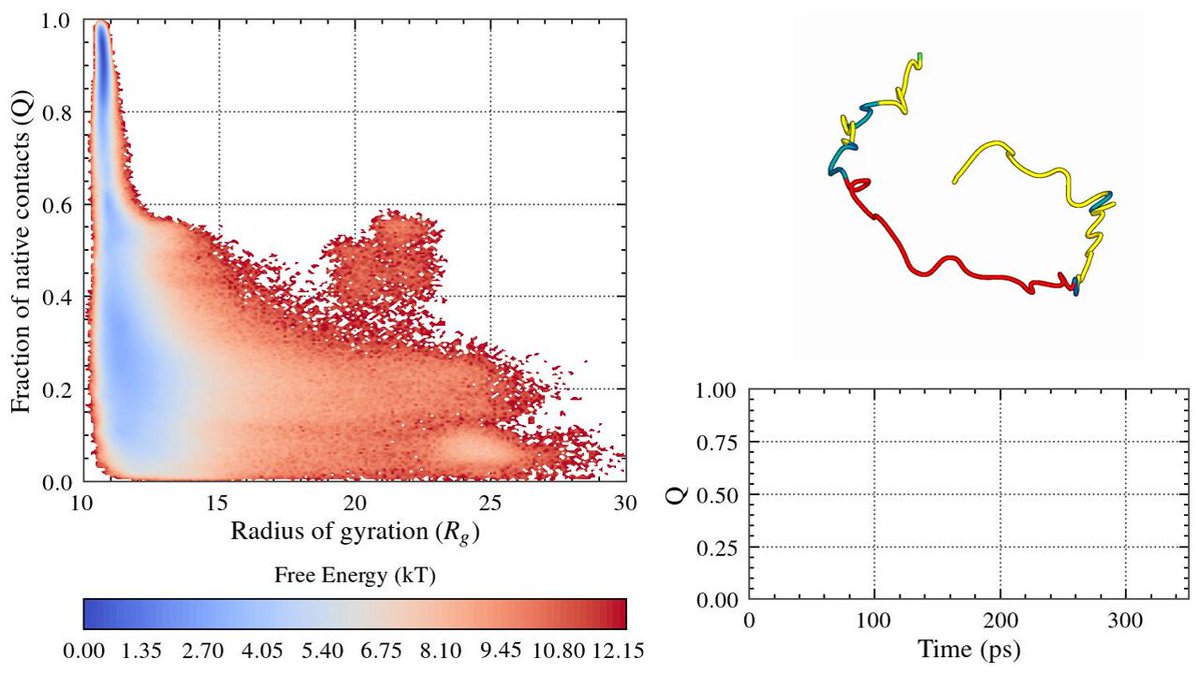
#HighlightOfTheWeek Intramolecular proton transfer in glycine obtained using enhanced-sampling molecular dynamics simulations and deep learning potentials. #compchem
11,422 просмотров • 2 лет назад •via X (Twitter)

Комментарии: 4

Фото профиля Pengchao Zhang
Pengchao Zhang2 лет назад

Intermolecular proton transfers in solvated glycine involving a contact anionic-glycine-hydronium ion pair.

Фото профиля Pengchao Zhang
Pengchao Zhang2 лет назад

It is an example showcasing the use of methods like ABACUS+DeePKS, DeePMD, OPES, and Voronoi CVs to accelerate the exploration of reactions.

Фото профиля Dr. Himansu Biswal
Dr. Himansu Biswal2 лет назад

Very interesting

Фото профиля Pengchao Zhang
Pengchao Zhang2 лет назад

Intermolecular proton transfer of solvated glycine involving separate cationic-glycine-hydroxide ion pair.

Похожие видео

#compchem Second preprint linked to the FeNNix-Bio1 #machinelearning foundation model. FeNNix-Bio1's inference is pretty fast already with a few GPUs but, "what if", we were able to push it at the #Exascale? Let's have a glimpse into the future (1/3): "Pushing the Accuracy Limit of Foundation Neural Network Models with Quantum Monte Carlo Forces and Path Integrals" Check it out 💫: We propose an end-to-end integrated strategy to produce highly accurate quantum chemistry synthetic datasets (energies and forces) aimed at deriving Foundation Machine Learning models for molecular simulation. Starting from Density Functional Theory (DFT), a "Jacob's Ladder" approach leverages computationally-optimized layers of massively #GPU-accelerated software with increasing accuracy. Thanks to Exascale, this is the first time that the computationally intensive calculation of Quantum Monte Carlo forces (QMC), and the combination of multi-determinant QMC energies and forces with selected-Configuration Interaction wavefunctions, are computed at such scale at the complete basis-set limit. To bridge the gap between accurate QC and condensed-phase Molecular Dynamics, we leverage transfer learning to improve the DFT-based FeNNix-Bio1 foundation model. 🚀The resulting approach is coupled to path integrals adaptive sampling quantum dynamics to perform nanosecond reactive simulations at unprecedented accuracy on a full Satellite Tobacco Mosaic Virus (STMV) 1M, all-atom, complete solvated model (see the video produced using VTX, Maxime MARIA Matthieu Montes ). These results demonstrate the promise of Exascale to deepen our understanding of the inner machinery of complex biosystems. Immense thanks to all co-authors at Qubit Pharmaceuticals, Laboratoire de Chimie Théorique (Sorbonne Université /CNRS 🌍 ), The University of Chicago, Sandia National Labs, Oak Ridge Lab and Argonne National Lab for this collaborative efforts. Some are on X: Anouar Benali Thomas Plé ADJOUA Olivier Evgeny Posenitskiy Margaret Blazhynska Thomas Applencourt Jeongnim Kim #HPC This work was made possible thanks to #INCITE projects enabling the use of Argonne's Aurora exascale system and of the Polaris machine, to Genci (Jean Zay @ Idris) and EuroHPC Joint Undertaking (Leonardo CINECA). #supercomputing

Jean-Philip Piquemal

15,188 просмотров • 1 год назад

Introducing PC-ALM, a local-learning alternative to backpropagation. Our method trains 1000-layer neural nets using only local dynamics, and without backprop. Blog: Standard deep learning relies on backpropagation. The brain, however, cannot implement backpropagation, at least not exactly. How can a physical system, such as the brain, solve multilayer credit assignment without explicit use of backprop? We look for inspiration in two related fields: distributed optimization and NeuroAI. In NeuroAI, predictive coding asks each neuron activation to solve an energy-based inference problem instead of using a standard forward pass. That inference step can be implemented as energy-minimization dynamics on local prediction errors. This perspective -- each layer as a dynamical system -- has proven promising, but performance of predictive coding hasn't scaled well with depth. Credit signals at far ends of the network struggle to diffuse into internal layers. We turn to distributed optimization, generalizing predictive coding to use an augmented Lagrangian instead of energy. This motivation stems back to a classic 1988 paper by LeCun, showing that the Lagrange multipliers of a deep network can be identified with gradients of a supervised loss. The augmented Lagrangian then bridges LeCun's perspective to the standard predictive coding that is used in NeuroAI. We find that this new perspective yields a natural PC-like alternative to backpropagation, resulting in a method we call PC-ALM. PC-ALM differs from PC in that it introduces dual neurons (Lagrange multipliers) as part of the layer-local dynamics, resulting in each layer acting as a PI feedback control system to minimize local prediction errors. We find that PC-ALM is capable of propagating signals to seemingly arbitrary depth, especially in deep narrow networks where standard PC struggles to learn. Ultimately, our motivation here is to understand how distributed physical systems, such as the brain, can compute credit signals using only local coupling and local dynamics. PC-ALM may also inform deep learning in neuromorphic hardware, where dynamics are cheaper than on GPUs. Paper: Code:

Sakana AI

438,961 просмотров • 14 дней назад