Loading video...
Video Failed to Load
How can a single cell learn without a brain? We explore this in my new paper with Wallace Marshall! We discovered that single cells may learn using molecules similar to those that animal brains use to learn, like CaMKII. Cells can also propagate memory states to their progeny! 🧵1/n

76,476 views • 5 months ago •via X (Twitter)
48 Comments

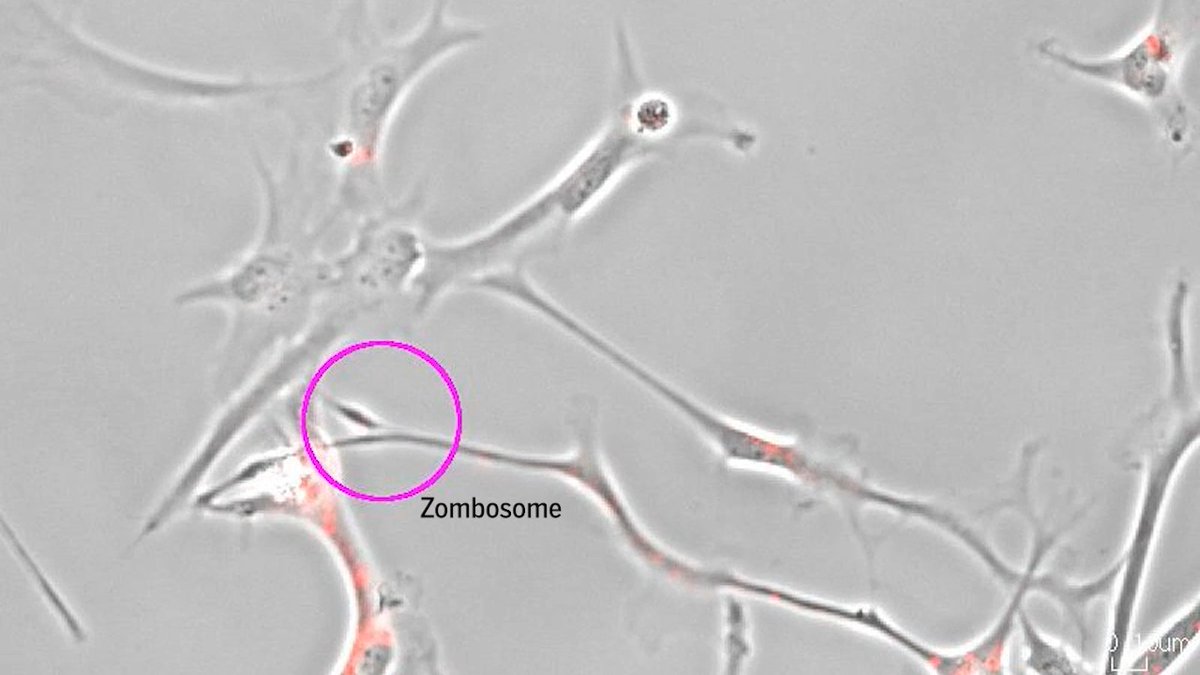
If you scoop up some water from a local pond and stick it under a microscope, you might just encounter Stentor coeruleus, a unicellular organism that is capable of a type of learning called habituation. 2/n
Habituation is the gradual decrease in response after repeated stimulation. Humans do this, too! For example, we learn to ignore the feeling of clothes on our skin after wearing them all day. However, we have 86 billion neurons to help us learn while Stentor is a single cell! 3/n
When Stentors experience a mechanical stimulus, they contract into a ball-like shape – presumably to escape from predators lurking in the pond. 4/n
When Stentors receive repeated weak mechanical stimulation, however, they habituate and thus stop contracting and remain in their elongated state. Below is a video of Stentor that have become habituated after an hour of repeated stimulation. 5/n
For decades, the prevailing story has been that we (multicellular animals) need to make new proteins to learn. Surprisingly, habituation in Stentor cells improves after treatment with drugs like puromycin that impair protein synthesis! 6/n
This suggests that forgetting is an active process that requires new protein synthesis. But which molecules are being synthesized/degraded? We did a series of RNA-seq and proteomics experiments to obtain molecular snapshots of cells during learning and forgetting. 7/n
Calcium/calmodulin-dependent kinase II (CaMKII), one of the RNA-seq candidates, is essential for learning in animals. We found that KN-93, a drug that inhibits CaMKII, impairs habituation in Stentor cells. 8/n
We also knocked down SteCoe_6763, another calcium-binding RNA-seq candidate, using RNA interference and found that knocking down this protein accelerates habituation. We’re thinking of calling this protein “ignoramin” because getting rid of it improves learning! 9/n
These findings are consistent with a receptor-inactivation mechanism for Stentor habituation: mechanoreceptor senses stimulus ➡️ channel opening changes membrane potential ➡️ CaMKII activation ➡️ protein phosphatase activation ➡️ dephosphorylation of mechanoreceptors. 10/n
But is this habituation memory localized? Can it persist in progeny? To test this, we trained cells with mechanical taps as they were dividing. The video below is sped up over 7 hours of training/dividing. 11/n
Indeed, the habituated state can be propagated to daughter cells during cell division! 12/n
There is still much left to learn – for both Stentor and the humans who study them! Which other molecules drive Stentor habituation? What else can they learn? By researching how a single cell learns, we can begin to shed light on the origins of intelligence. 13/n
Link to paper in @CurrentBiology. Thank you to co-authors @aralbright93 @Dey_Gautam and more. @UCSF @UCSFGradDiv @UCSFMedicine @UofCalifornia 14/n

@WallaceUcsf Congratulations Deepa, great work!
@WallaceUcsf Thanks so much! Your work has made me even more excited to explore memory in different cell types

@andrewtanyongyi @WallaceUcsf Interesting and very well explained! Congratulations!

@WallaceUcsf Stunning work! This resembles my research on hematopoietic stem cells. CaMKII repurposing for unicellular learning suggests ancient origins of cellular cognition.

@WallaceUcsf Great thread and thanks for dumbing down your work so well so that those of us without a background in biology could understand!

@apoptosislab @WallaceUcsf Very cool work, Deepa!! Congrats!!

@WallaceUcsf So now we know who the boss is!

@WallaceUcsf Congratulations! Interesting research—it's fascinating to see the forms survival/adaptation mechanisms take at the cellular level.

@WallaceUcsf Amazing work. Congratulations. The Cell is the center of biology @AMartinezArias

@WallaceUcsf Been watching Hank Green's Journey to the Microcosmos. Stentors are so cute!

@WallaceUcsf Love this!

@WallaceUcsf This is exactly what UGM Axiom 4 predicts: memory is not brain-exclusive. A single cell can learn because physical structure retains history. Brains may not create memory from nothing; they coordinate memory-bearing matter at scale. Food for thought!

@WallaceUcsf Super fascinating research! Intelligence runs deep

@insurrealist @WallaceUcsf i know, i posted about this 5 years ago.

@WallaceUcsf Very interesting research!

@WallaceUcsf This is really interesting

@hermetictrader1 @WallaceUcsf Awesome work! ✨

@WallaceUcsf Even a single cell can learn except human kind.

@WallaceUcsf 당신의 연구를 지지 합니다.

@WallaceUcsf this is so interesting thx for sharing. gonna read more on habituation

@WallaceUcsf So cool!

@WallaceUcsf Thank you for sharing this new knowledge.

@WallaceUcsf Vorticella

@WallaceUcsf todo es consciencia.

@WallaceUcsf The Abelian Light: Why Life Is More Than Chemistry

@MenonBioPhysics @WallaceUcsf Cool work!

@WallaceUcsf Amazing work

@arjunrajlab @WallaceUcsf Very cool! Any chance of stentobots at some point? Evoking collective intelligence would be quite an encore!

@WallaceUcsf Beautiful work Deepa ! Congratulations 🎊 Curious: do you also see similar changes with the molecules in daughter cells ? In other words, do these molecules carry the “memory” to the progeny ?

@WallaceUcsf have u or anyone else compared to any other of the vorticella kinda critters? how about learning in predatory cilliates?

@WallaceUcsf Спасибо. Очень интересно!

@WallaceUcsf What is intelligence?

@WallaceUcsf I’ve come to understand that, when considering the mechanism of memory at the level of chemical manipulation, it can essentially be reduced to this kind of hysteresis-like chemical cycle. Thank you.

@WallaceUcsf Do you plan to test the effect of isotopes having a #spin or not?

Why don't you explore memory in the cells membrane? The electric field around any living entity can encode information holographicialy. It is a mechanism that would work for single cells, multi cells and organs (like a brain) and explain why brains have such large surface area and why each and every cell in a structure knows it's place and body layouts.