Video wird geladen...

Video konnte nicht geladen werden

Zur Startseite

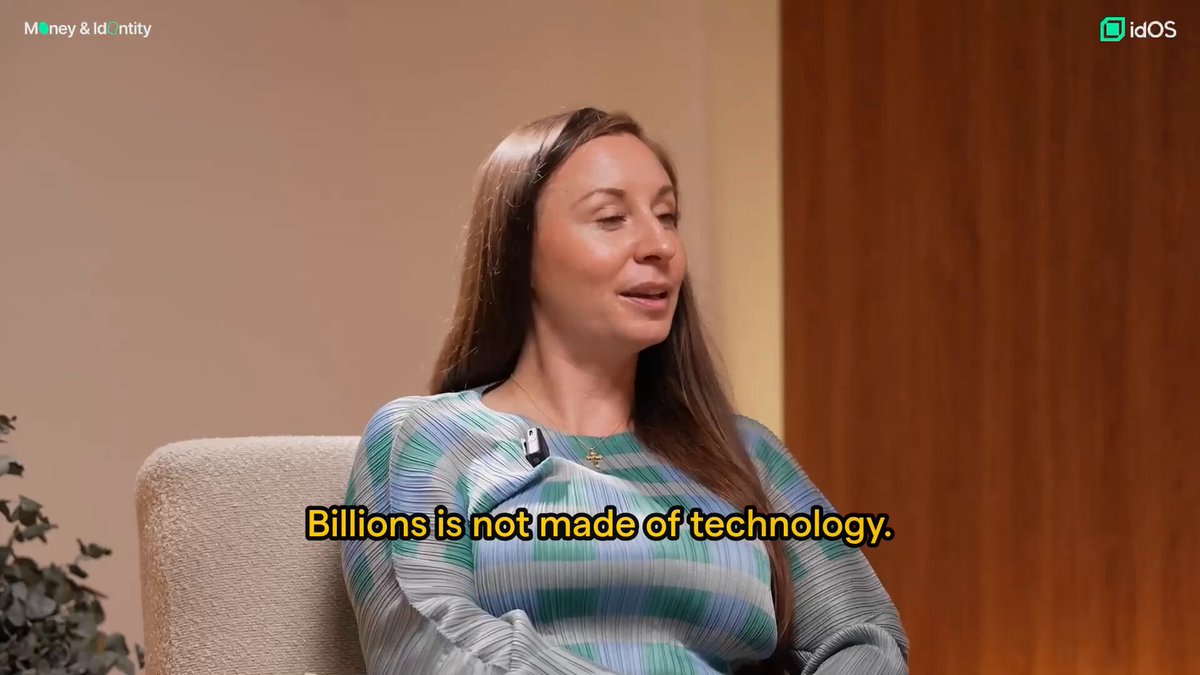
How to save the internet: Billions CEO Evin McMullen evin explains We want: ✓ Agentic workflows ✓ Agent to agent payments ✓ AI enabled interactions at scale But if 50% of online traffic is unidentified, unaccountable bots, we don’t know who we are dealing with on the internet. Solution:...

59,563 Aufrufe • vor 7 Monaten •via X (Twitter)

0 Kommentare

Keine Kommentare verfügbar

Kommentare vom Original-Post werden hier angezeigt
Ähnliche Videos

What is the Billions Network? | Free The Money Ep. 26 Evin McMullen evin, Co-Founder & CEO of Billions, joins Free the Money to discusses decentralized identity, AI agents, privacy, and the future of the internet. Evin explains Billions Network’s mission to “save the internet” in the age of AI and how the company is using zero-knowledge proofs to help verify trust online without exposing unnecessary personal data or relying entirely on centralized systems. We also dive into the risks of centralized identity projects like Worldcoin, the push for age verification laws, AI regulation, and why accountability in the age of autonomous agents may become one of the defining debates of our time. Plus, we explore how platforms like TikTok are already using Billions’ technology, what the future of digital advertising could look like with AI agents, and whether there is actually a middle path between total anonymity and a full surveillance state. Sign up for ITrustCapital with this link for a $100 funding bonus. See why people are opening a tax-advantaged Crypto, Gold & Silver IRA for their future: Check out my favorite privacy coin Zano: Buy Zano seamlessly on MEXC with a VPN. You can also find a full list of exchanges that Zano is available on at Lots of educational videos on 0:0 Evin’s background , how she got into the decentralized identity space 3:47 What is Billions Network & why its here to save the internet 5:29 Dead Internet Theory 9:14 Zano 13:19 Who’s responsible for agents behavior? 18:36 ITrustCapital 20:38 Privacy vs. surveillance and the middle path forward 24:56 Billions Network vs. Sam Altman’s Worldcoin 30:35 Real-world use cases for decentralized identity 32:40 TikTok using Billion’s client-side proving libraries 34:26 How AI agents could change digital advertising forever 35:50 Protecting healthcare data with zero-knowledge proofs 39:43 What happens when digital identity changes over time? 42:34 BILL token on Coinbase 45:16 AI regulation, deepfakes, and digital identity 48:00 Balancing regulation, privacy, and personal autonomy 51:25 The necessity of trust in digital interactions 57:30 Book recommendations

Bri Teresi

21,560 Aufrufe • vor 3 Monaten

Right now our experience of the internet is in jeopardy. More than half of our interactions online and onchain come from non-human actors who are not identifiable, not accountable, not verifiable. That means as we look toward a stablecoin payment and AI agent enabled future, how are we going to facilitate payments if we don't know who we're paying? How will applications, display advertising, recommendations work if the counterparty who's interacting with those interfaces and in those digital spaces can’t identify itself as agent or human, or specific human? Or for things like onchain incentives, how can we ensure that tokens and value are arriving at the right users if we cannot tell Sybil accounts and redundant addresses from unique human beings? So for all of these use cases and more, things that touch enterprise and government as well, which we can get into later, we have a very glaring need to bring a layer of identity and trust to the internet that was originally built as a system, a network to communicate amongst computers, but lacked an identity system to acknowledge their users. That's the problem that we are solving with Billions Network. How can we make it really easy for you and the agents who serve you to prove who you are, your traits and capabilities and qualifications, in any space, physical or digital? What that means is that today Billions Network is the first universal human and AI network built with mobile first verification, so you can prove who you are and your agents can prove who they are, starting with comfortable experiences on the devices you already own. So no proprietary hardware. We do not rely on centralized servers to collect user data. Rather, your information, the sensitive data that makes you you, stays securely on your device. And we use zero knowledge proofs as a way to prove traits about you, such as the fact that you're over the age of 21, without revealing that sensitive personal data, such as what your exact birth date is. Source: Billions CEO Evin McMullen evin speaking at House of Chimera Spaces Event Dec 3, 2025

Billions Network

30,916 Aufrufe • vor 8 Monaten

We need builders in the identity space and we need to work together! Billions co-founder and CEO Evin McMullen evin on: Worldcoin and Billions Network I think of projects like Worldcoin as colleagues. I've actually had the privilege to speak with them and meet with them. I even went into their offices to see how the Orb is made and then have given a ton of feedback on papers and documentation before it goes out. Because none of us in the identity space are really competing with each other. Right now we are all competing with obscurity. It is essential that we as builders and as developers in the identity space work together, that we provide rigorous, honest respectful feedback to one another so that we can all improve because we all are working in the same service industry in service of human beings. I think of Worldcoin like a proprietary camera company: They make a special kind of camera that takes a particular kind of picture and produces a specific type of data. But unlike their approach, with Billions Network we have a very flexible approach to identity. Which means that you don't have to start with a special camera to get on board and to start using Billions Network. We've actually integrated with 100+ different government systems. We've integrated with many different providers of trust and data. So our flexible framework allows for there to be these many different sources and proven authorities of trust, as opposed to just ONE. See our identity framework in action in the tomorrow’s builders webinar: 🔑 "Login with Billions" Live demo: 🤝 Human-verified DID login ✅ Privacy-first vs Google/Apple login ✅ No passwords, no central ID ✅ No personal data (PII) stored on your backend Register now: Please select the session that works best for you if you can’t make it tomorrow. Video clip from The Upwind Podcast episode 14 🙏

Billions

14,831 Aufrufe • vor 6 Monaten

How do you verify AI? Great question. I would invite us to take a step back to the fundamentals of the question we're asking here: Accountability requires identity. To manage counterparty risk with AI agents, we need to be able to have some accountability mechanism. That means we need to be able to identify instances of AI agents to be able to determine, for example, whether they're acting on behalf of a party that's passed KYC with an acceptable provider, whether they're acting on behalf of a party who is not on a sanctions list, or not part of the OFAC address set, and being able to verify that an agent is acting on behalf of an individual who's above a certain age. This allows us to deploy much more sophisticated multi-agent workflows and role sets. But of course, first we need to be able to ask that agent, "Who are you accountable to? Who are you representing?" This is also essential in a world where deep fakes and misrepresentations of real individuals are rampant. In fact, I actually had the personal and very weird experience recently of seeing a deep fake of myself circulate on this very platform on X. Additionally, my co-founder and colleague has heard about deep fakes misrepresenting him joining Google Meet calls and misrepresenting his person, his resources, his activities. So in order to verify who you're interacting with, especially when it comes to not only "Are they a human being or not?" but also, "Are they the real human being?" this again gets us back to the question of which identifiers are we using and how are they accountable back to organizations and entities who we know and trust. But happy to answer any questions that you have on the agent identity front. That's definitely one of the more frontier capabilities that we're releasing some awesome stuff around in the next few weeks. Source: Billions CEO Evin McMullen evin speaking at House of Chimera Spaces Event Dec 3, 2025

Billions Network

114,254 Aufrufe • vor 8 Monaten

"What is the cleanest way to compare Billions with other web3 identity layers and privacy layers?" The word privacy means a lot of things to a lot of different people. Often it is associated with consent, which is an action that you take that diminishes the privacy of a given set of data. Privacy is basically the process of information arbitrage, the selective disclosure of data in order to enable interactions. Although in a web2 environment, that "free" transaction of data often weighs very heavily to one side. When we talk about privacy at Billions Network, privacy is a static state, the absence of disclosure, or a way to describe the outcomes of mechanisms of data disclosure. We really focus on those instances where the selective disclosure of data is a question of legal compliance, of security, of financial value, where the decision to leverage this technology is not necessarily one of personal feelings, but rather of business efficiency, of compliance, and security. Source: Billions CEO Evin McMullen evin speaking at House of Chimera Spaces Event Dec 3, 2025 In an era where AI is rapidly evolving, the boundaries of identity and privacy are being rewritten. Don’t miss our next Billions event in Shenzhen, China 🇨🇳 🗓 Date & Time Dec 21 (Sun), 20:00–23:00 Join a relaxed evening to experience our privacy-preserving verification and dive into the future of human + AI privacy In collaboration with: TinTinLand (TinTinLand 中文), Asia’s leading Web3 platform for developer growth and ecosystem acceleration.

Billions

20,164 Aufrufe • vor 8 Monaten

What does the reputation model look like for agents? (alpha leak below) And how do we associate the proofs that we have about human beings with the agents who represent them? You may have heard of a process called KYC or Know Your Customer. That's very common with traditional financial applications and services. We have introduced a concept that we call KYA or Know Your Agent, which is a structured way to be able to express what model, how data was used in training, who the deployer is, what entities this agent instance is accountable back to, providing not only provenance but identity of the associated organization or entity. That's also another root of trust that we think about a lot: Enterprises and organizations tied back to things like their domains. To share a little bit of an alpha leak here, a product that we're excited to be rolling out in the next few weeks will allow our enterprise partners to more easily verify and prove the traits and capabilities of their teams as well as their counterparties. On the agent front, that makes it really easy to prove that an agent is acting on behalf of a given business or entity. We've already seen lawsuits where the absence of such technology has been a huge risk, such as with airlines that incorporate ChatGPT wrappers in their support pages. And then those AI enabled interactions end up making up plane tickets that don't exist and those airlines have to honor them. As small of an example as that might be, being able to prove agent accountability also unlocks a huge set of opportunities for use in enterprise for those agent to agent interactions. The Deep Trust Framework that our team has put together that we're excited to be bringing into a friendly SDK form in the next few weeks for some of our partners includes those reputation based capabilities, so how you can basically keep track of the interactions an agent has had, associate all of that to the entity to which they're accountable, and then that creates a sustainable reputation model for these agent to agent Interactions. Source: Billions CEO Evin McMullen evin speaking at House of Chimera Spaces Event Dec 3, 2025

Billions Network

68,503 Aufrufe • vor 8 Monaten

Here we go again 🚀! Excited to announce that we're building A1Zap (YC W25) with Pennie Li and that we're in the Y Combinator W25 batch in San Francisco! What is A1Base? A1Base gives AI Agents a real world identity for work. We do that by rebuilding Twilio and Okta from the ground up, putting AI Agents first. This means developers can make AI-first agentic applications 10x easier with our API's. ⁉️ Why are we doing this? Because there's a huge torrent of new valuable companies possible with AI agents, but to get their AI Agents to users, they have to chain custom apps, chat interfaces, awkward Slack integrations, browser bots, and wrestle with Twilio’s legacy API (which is built for marketing). We solve this by providing developers with an easy to use API to interface your AI agent with humans/coworkers/users where they are in this case in Whatsapp, Slack, Teams, SMS and more) - with AI Agent features built in. These digital workers are poised to transform how we work and we're the critical infrastructure to help them interact naturally in human workflows. We're not just building another AI tool. We're creating the infrastructure that will enable AI agents to become a natural part of the workforce - handling everything from customer support to sales development to creative work. We're backed by Y Combinator and working with founding teams who share our vision. We believe that in the near future, AI Agents with human coworkers will enable us to pursue more creative and impactful work. Our mission is to help developers build AI Agents that people can partner with and rely on as trusted allies—always with a human-first mindset. If you're thinking about the Agentic future of your company reach out! If you're looking to build your first AI Agentic company - reach out too - we have some amazing open source templates to get you started on the journey. Excited to share more of what we're up to soon 🔜.

Pasha Rayan

53,950 Aufrufe • vor 1 Jahr

Picture this: you have a driver's license in your wallet. When someone needs to check your age, you just pull it out. You don't have to call the DMV and ask permission first. Now imagine trying to do that same thing online. Today, every time you need to prove something about yourself digitally - your age, your identity, that you're a real person - you have to go through some company's server. Google's. Facebook's. Some random third party that now has all your data. And here's the worse part: those systems don't talk to each other. The government ID system can't talk to your bank. Your bank can't talk to new stuff like crypto payments. Everything is siloed. If you want AI agents to pay for things on your behalf? Forget it. Nothing connects. So Evin McMullen evin, Billions Network co-founder and CEO, asked: why can't your digital identity work like your physical wallet? Your government already signed your passport. That signature is tamper-proof. What if you could generate zero-knowledge proofs straight from your device - proving you're over 18 without revealing your birthdate, proving you're human without exposing who you are? No middleman. No surveillance. No permission needed. Just pull out your proof whenever you want, like pulling out your driver's license. That's what Billions Network built with institutions like the European Commission and government systems. W3C open standards that connect everything: government ID systems, blockchain payment rails for AI agents, legacy infrastructure. One signature. Infinite proofs. Your device. Video clip from #TheBraveTechnologist podcast episode 106 with Evin hosted by LukΞ Mulks 🦁⟁◎⟁ 🙏

Billions

22,014 Aufrufe • vor 6 Monaten