Video wird geladen...

Video konnte nicht geladen werden

Zur Startseite

🚨 HUGE! J Sai Deepak makes sharp arguments in Sabarimala hearing 💥 — He argues: "If a practice is SACRED & beyond court reach, State cannot INDIRECTLY drag it under scrutiny by framing laws around it." Calls it a Constitutional OVERREACH. Surya Kant responds firmly, do not question the...

202,556 Aufrufe • vor 4 Monaten •via X (Twitter)

0 Kommentare

Keine Kommentare verfügbar

Kommentare vom Original-Post werden hier angezeigt

Ähnliche Videos

Armed men accompanied by the Zimbabwean police forced their way into the offices of Prof Lovemore Madhuku’s political party, violently interrupting a meeting and attacking several participants, among them the constitutional lawyer, Prof Lovemore Madhuku. This attack is deeply troubling for Zimbabwe as it reflects a dangerous erosion of democratic space and shows that even lawful constitutional engagement is no longer safe from intimidation and violence. When armed individuals can storm a civic and political meeting with apparent impunity, it casts serious doubt on the state of the rule of law and the security of citizens exercising their constitutional rights. Prof Madhuku is opposed to Constitutional Amendment No. 3, which seeks to extend President Mnangagwa’s term of office and change the presidential term from five to seven years. He has an active case before the Constitutional Court challenging this process. Targeting him, as the state has now effectively done, sends a deeply disturbing message that this amendment will not be handled through open, democratic engagement where citizens are free to oppose or support it without fear. When a constitutional lawyer with a matter before the highest court is assaulted and intimidated, it undermines the integrity of the judicial process itself. It shows that power is being asserted through coercion rather than constitutionalism. Instead of allowing robust debate and lawful challenge, the authorities appear to be repeating the very mistakes that have, in the past, drawn damaging international scrutiny and weakened the country’s global standing. Heavy handed tactics do not silence controversy, they amplify it. If this process continues in this manner, it will inevitably attract serious international attention and further erode confidence in Zimbabwe’s commitment to the rule of law and democratic governance. These violent attacks even make it difficult for those who were supporting the amendment to continue doing so publicly, because they expose the reality that this process is not being advanced on the basis of legal principle or genuine constitutional reform. Instead, it increasingly appears to be driven by intimidation, violence and repression aimed at forcing citizens into submission without honest, open debate. When support for a constitutional amendment must be sustained through fear rather than persuasion, the legitimacy of that amendment is already compromised. A constitutional change of this magnitude should stand on the strength of its arguments, not on the silencing of critics. Resorting to coercion does not strengthen the case for reform, it weakens it and deepens national division. If a constitution must be amended at gunpoint, then it is no longer reform, it is a declaration that power fears the very people it claims to represent. You don’t win hearts and minds through violence, you do so through engagement!

Hopewell Chin’ono

65,274 Aufrufe • vor 6 Monaten

Mahua Moitra & J Sai Deepak's Fiery Exchange Over Hindutva & Hinduism “Hindutva Exists Because…” The Debate 2026 by the Calcutta Debating Circle sets the stage for a charged and unfiltered clash on one of India’s most polarising questions: “Hinduism Needs Protection From Hindutva.” A fiery face-off between TMC MP Mahua Moitra and legal scholar J Sai Deepak as they lock horns over faith, politics, identity, and the future of Indian democracy. Sharp arguments, ideological fault lines, and no easy answers. This is a debate that cuts to the core of contemporary India. Moitra took jibes at her senior Swapan Da, which obviously people found uncalled for and not funny at all. J Sai Deepak, opposing the motion, he argued that Hinduism actually needs protection from secularism, rather than Hindutva. He challenged the narrative that Hindutva began with V.D. Savarkar in 1923. Instead, he traced its roots to 19th-century Bengal (1860s–1909) as an “organic Shakta response” to colonial invasion, citing figures like Bankim Chandra Chatterjee and Sri Aurobindo. He countered claims that Hindutva is “hyper-masculine” or strictly “Brahminical vegetarian,” asserting that Bengali masculinity and Shakta traditions (which include offerings of meat and alcohol) are foundational to Hindutva. J Sai Deepak argued that Hindutva is a civilizational necessity that translates into a political vision, and that it is unconstitutional to deny political representation to Hindutva while allowing it for other ideologies like communism. The event featured sharp rebuttals against co-debaters Mani Shankar Aiyar and Mahua Moitra. He accused Aiyar of conflating Hindutva solely with Savarkar and questioned Moitra on whether she had similar critiques for non-Hindu worldviews. The debate, which also featured Sudhanshu Trivedi and Ashutosh, concluded with the audience overwhelmingly voting against the motion, supporting J Sai Deepak's stance. In no way Moitra could’ve matched J Sai, nowhere near and totally decimated. Credit : ANI.

Augadh

100,122 Aufrufe • vor 4 Monaten

Texas has now crossed a serious line. Through HB 1605, passed in the last session, championed by TEA Commissioner #MikeMorath, Governor Greg Abbott, Representative Brad Buckley, Senator Brandon Creighton and others on both sides of the asile, the state is explicitly establishing a mandated “canon of literature” for every student K through 12. That word canon matters. Canon is not an academic term. It is a value laden term rooted in authority, belief, and the power to declare what is foundational truth. This is not about teaching students how to read across genres. The state’s own testimony confirms the intent is to create a shared body of works all students are expected to read, understand, and internalize as foundational knowledge. That is a shift away from academic skill development and toward shaping values, beliefs, and behaviors. When the state becomes the arbiter of what is canon, it assumes authority over truth itself. And when that canon begins to include biblical references embedded in a state owned and mandated curriculum, the question must be asked plainly. Is the state now defining its own religious canon? This is not about faith. It is about government power, coercion, and the constitutional danger of the state deciding what our children must believe, rather than what they must learn. The Bible is sacred scripture. It is not a tool of the state. And it should never be filtered, excerpted, reframed, or repackaged by a government agency.

Alice

53,790 Aufrufe • vor 7 Monaten

Yesterday, our Judiciary Committee passed HR 38, National Reciprocity. I support this bill, but there is a better option, and it is National Constitutional Carry. 29 states already have Constitutional (i.e. permitless) Carry. Why not extend it to all 50 states? Under HR 38 (Reciprocity), a resident of one of the Constitutional Carry states can carry in any state that allows their citizens to obtain a permit. The recent “Bruen” Supreme Court decision requires all states that aren’t Constitutional Carry to issue carry permits to their citizens. This means that when HR 38 passes, any resident of those 29 Constitutional Carry states will be able to carry in any of the 50 states without a permit. Ironically, however, residents of the 21 states (like New York or California) that aren’t Constitutional Carry will need a permit to carry in their own state, while visitors from states that are Constitutional Carry (like Kentucky or Ohio) won’t need a permit to carry in states like New York or California. If Congress, relying on the Second Amendment, can force California to allow “Permitless” Carry for Kentuckians who visit California, why would we not force California to allow “Permitless” Carry for Californians who are in California? In other words, why not pass National Constitutional Carry and afford everyone in the United States the right to “bear arms” which is enshrined in the Constitution? The other quirk of HR 38 is that (I believe) it would allow a person from Kentucky to carry an AR-15 pistol with a 20-round magazine in California, while Californians would not be allowed to carry, or even own, the same equipment. The Supreme Court decision in “D.C. v. Heller,” whether you agree with it or not, allows states to have some regulations on firearm equipment and eligibility to possess, but HR 38 seems to contradict that framework. Contrast this with my National Constitutional Carry bill which basically says if a state allows people to possess (KEEP) a particular firearm, that state must also allow people to carry (BEAR) that firearm. I introduced my National Constitutional Carry bill in committee yesterday as a substitute amendment to HR 38, National Reciprocity. After introducing the amendment for the record and describing it, I withdrew the amendment instead of putting my Judiciary Committee colleagues in the position of deciding whether to replace National Reciprocity with National Constitutional Carry. The dilemma is that not enough Republicans in the whole House understand the difference, and the prevailing opinion is that Reciprocity can pass the whole House, but Constitutional Carry cannot. Perhaps when more of my colleagues who are not on the Judiciary Committee understand why we should pass National Constitutional Carry instead of (or in addition to) National Reciprocity, we can make a strong push to report National Constitutional Carry out of the Judiciary Committee for a vote in the full House of Representatives. In the meantime, I’m glad HR 38 is going to the House floor for a vote.

Thomas Massie

229,372 Aufrufe • vor 1 Jahr

During the cross examination, Chief State Prosecutor Joseph Kyomuhendo was asked for a single statute that provides for witness protection. He tried to “intimidate” Frederick Mpanga by throwing around a 2008 case; Soon Yeon Kong Kim & Another Vs Attorney General (Constitutional Ref No 6 of 2007) It’s a constitutional court case upholding the basic constitutional principles of fair hearing including the right to full disclosure instead of trial by ambush that the DPP seems to prefer, etc. I’ve seen it repeatedly quoted by the defense in the Katanga case as they repeatedly reminded the prosecution to disclose evidence against their clients. So it was curious to see this prosecutor quote it back to Dr Besigye’s defense lawyer as some sort of basis for their prayer to somehow keep the identities of the witnesses pinning Dr Besigye and his co-accused hidden. One problem for the Chief State Attorney; the lawyers he was quoting the case to are the very ones who successfully argued it in the constitutional court. And they knew it didn’t say what he was claiming it said. They let him rumble on, trying to bamboozle them with his half-knowledge then handed him the decision and asked him to point them to where it says what he claimed it said. It was embarrassing beyond belief. Another Chief State Attorney Richard Birivumbuka asked for a one and a half hour break “to study the decision”. The Judge gave them a safe corridor and asked to pack that part of the cross examination. If I were Mr Kyomuhendo, my Gishu pride wouldn’t let me stay on that stand. I’d walk out and go for a run or go grab a drink. Uganda siinze njizaala, I can’t allow such embarrassment. 🤭 Anyway, here’s a video clip for those like me who like legal violence.

Anthony Natif

61,344 Aufrufe • vor 4 Monaten

NEWS ALERT: Democrat Richard Blumenthal LIED in his questioning of OMB Director nominee Russ Vought when he claimed the Supreme Court had ruled in 1975 that the Impoundment Control Act (ICA) was constitutional. The Court did no such thing. In fact, the Court SPECIFICALLY wrote in Train v. New York City that “no issues as to the reach or coverage of the Impoundment Act are before us.” Why would Blumenthal lie about this and claim Russ Vought would “defy” a Supreme Court ruling that never happened?? As I have explained elsewhere, Train was confined to a specific statutory scheme at issue and did not address the President’s constitutional impoundment power—the constitutional issue was not even presented in that case. Russ Vought did a superb job in his testimony, including not backing down in his view that the President has the constitutional power to impound and that the ICA is unconstitutional. Blumenthal is flat out lying to claim that Russ’s view is in defiance of Train’s holding. The Supreme Court has NEVER ruled on the constitutionality of the ICA nor on the President’s constitutional power to impound funds. And we have 170 years of Presidents regularly using his impoundment authority to rein in wasteful or constitutionally problematic spending. Appropriations is a legislative act, the power of the purse. The spending power is an executive power and is vested in the President. Would it be constitutional for Congress to mandate that the President spend $100M to investigate and prosecute certain disfavored individuals? Of course it would not be constitutional and the President has the authority to refuse to spend those funds. Likewise, if Congress appropriated $100M to provide aid to a known terror state or international organization, the President has the constitutional authority (in fact duty) to refuse to do send those funds to this terror entity. There are limits to Congress’ authority to require the President to spend funds. The Impoundment Control Act is a terrible law. It turns history on its head by requiring a President to spend every dollar of an appropriation, even if the project can be done for less. It makes an appropriation a floor rather than a ceiling. The ICA is designed to shovel money out the door regardless of whether it’s necessary to a program, and it’s wildly irresponsible for our fiscal health.

Mark Paoletta

217,757 Aufrufe • vor 1 Jahr

I have listened to the debate on Constitutional Amendment Bill No. 3 between legal scholar Dr Justice Mavedzenge and political scientist Prof Jonathan Moyo today on Twitter. Without any doubt, Dr Justice Mavedzenge explained, clarified, and made ordinary people understand the issues, and more importantly, in my humble view, he won the debate on whether there is need for Constitutional Amendment Bill No. 3 to be subjected to a referendum or not. Anything done for the people, as Prof Jonathan Moyo says these monumental amendments are, should be subjected to the people. The Constitution is not ambiguous on this. It is clear that term limits should be subjected to a referendum for any change to be done legally. Under Section 328 of the Constitution of Zimbabwe, any amendment that seeks to extend the length of time a President may hold office, or to remove or alter term limits in a way that benefits an incumbent, cannot apply to the sitting President and must be subjected to constitutional safeguards. You cannot claim to be doing something for the people and yet deny those same people the right to have a say. Prof Jonathan Moyo has a right to his views, but those views must be subjected to the law for the amendments to be implemented legally, and based on what I have read in our Constitution, his views are not aligned with the law. And I am not making this up. It is in the Constitution. Even veteran Zimbabwean lawyer and former ZANUPF legal secretary, Patrick Chinamasa, has said so. In this video, he explains in front of President Mnangagwa that what they are attempting to do today, which Prof Jonathan Moyo argues does not require a referendum, would in fact require two referendums. One to remove or alter presidential term limits from five to seven years, and another to extend the sitting president’s tenure to 2030. This position was declared, and not contradicted, at a ZANUPF conference in Bulawayo. What the broader legal fraternity in Zimbabwe is saying, save for a few lawyers who have since revised their positions and now echo the same view, is that the Constitution is explicit on these prescripts. Anything else is political propaganda to win hearts and minds. The problem with propaganda is that it cannot be anchored in constitutional provisions. It rests on opinion. In this instance, however, we are not expressing opinions. We are stating what is contained in the Constitution and what ZANUPF itself has previously acknowledged. You can decide today that you want a 20-year presidential term. That is your right to hold that view, but you must subject that proposition to the law. If you believe in it, take it to the citizens in the manner prescribed by the Constitution. You cannot decide, through opinion or political argument, whether a referendum is required or not. That question is not settled by what anyone thinks. It is settled by what the law says. If the Constitution requires a referendum, then you must subject yourself to it. That is how constitutional democracy works. We know that the judiciary in Zimbabwe is captured. We know how they are going to rule, but the whole world knows the truth, that if they rule in favour of these amendments going ahead without a referendum, they are simply a captured judiciary without the respect that is required for anyone holding such an important office, and history will remember them as such.

Hopewell Chin’ono

62,431 Aufrufe • vor 6 Monaten

🚨 “Ignore Them.” Constitutional Lawsuit Against Letitia James Moves Forward Amid Federal Case Chaos RealAmerica.Vote CEO Marly Hornik is leading what she calls a first-of-its-kind constitutional civil rights lawsuit against Letitia James and the New York State Board of Elections. The allegation? That state officials failed to properly qualify voters according to New York law and retaliated against citizens who exposed it. Hornik says independent audits of official state election records revealed serious qualification failures. When those findings were made public, she claims the response wasn’t transparency - it was suppression. In court filings, attorneys representing the state reportedly ended a motion with two words: “Ignore them.” Hornik argues this lawsuit is fundamentally different from past election cases. It is not just about procedures - it is rooted in the Constitution’s guarantee of representative government and the First Amendment rights of citizens to speak, audit, and petition their government without retaliation. “This is a case of first impression,” she says. “No one has ever filed a civil rights action against a state for failing to qualify voters according to law.” While headlines focus on prosecutorial technicalities, this constitutional challenge could have long-term implications for how states conduct and oversee federal elections. The question now: Will courts take seriously claims that voter qualification standards were ignored and that citizens who exposed it were punished? Or will powerful state actors once again avoid accountability?

LindellTV

14,266 Aufrufe • vor 7 Monaten

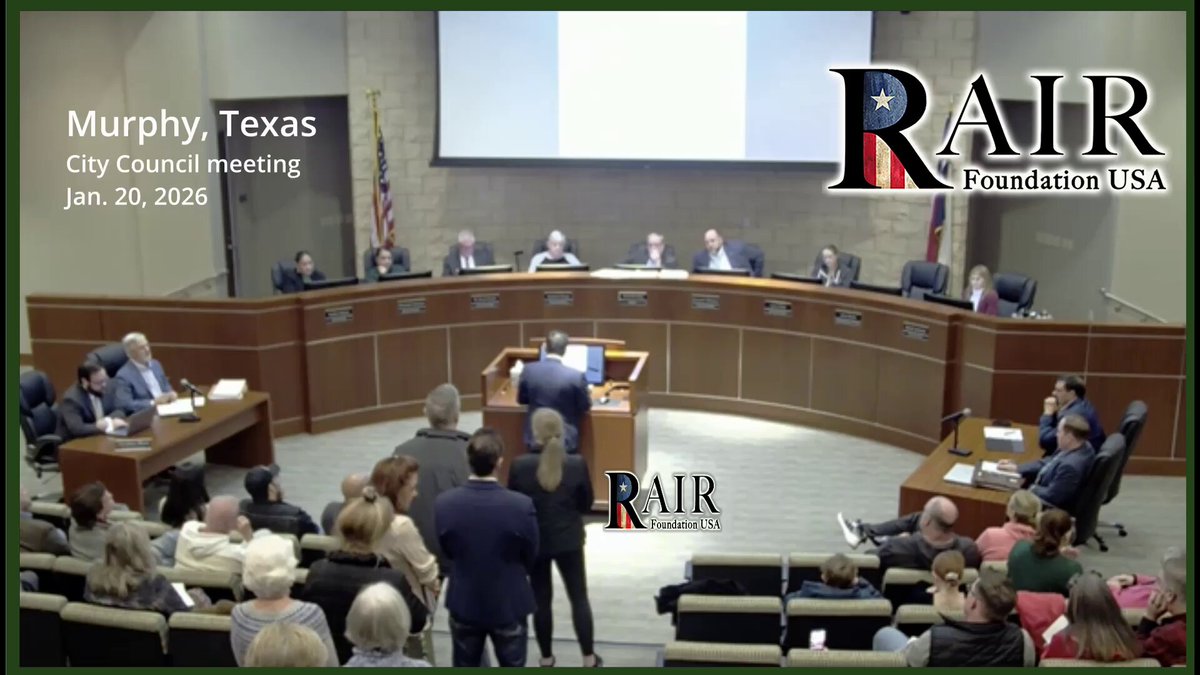
🚨 AMERICANS ARE RISING UP - ARE POLITICIANS LISTENING!? MURPHY, TEXAS — CONSTITUTIONAL FIRE: "ISLAM IS INCOMPATIBLE WITH OUR CONSTITUTIONAL REPUBLIC... AN ISLAMIC CENTER IS A BEEHIVE DESIGNED TO SEED A SEPARATE SOCIETY!" A resolute patriot stood before the packed council last night and delivered a razor-sharp constitutional warning against the proposed Islamic expansions: "Preserve, protect and defend the US Constitution... Local American governments must maintain our national and state identities, as well as our secularism. Article Six establishes the Constitution as the supreme law of the land - our political, legal, and social structure all flow from it. Islam is a way of life that is incompatible with our Constitutional Republic. It is a distinct and separate political, legal and social structure. An Islamic center, through my research, is a beehive designed to be a seed for a separate and distinct society. It is a place for study, for family meetings, for supplying a battalion of men, for academic courses, for political and legal training, for sports. It is designed as a social club, as an office for domestic political and legal resolutions, and the Center for distributing their media. Local American governments must maintain our national and state identities as well as our secularism. We as a nation and as a society, do not have to accommodate the Islamic way of life. It is okay to say no. In fact, there are times that we must say no." BOOM. This is constitutional clarity. Article VI supremacy means no parallel systems. No separate societies seeded in our suburbs. No "beehives" for battalion-building, political resolution, or media propagation under the guise of religion. Murphy's fight against these expansions (IAM Masjid phases advancing, parking/traffic burdens, learning center pushes) echoes the Explanatory Memorandum raided by the FBI - proving these centers aren't just houses of worship; they're multifaceted footholds. Texas patriots: We MUST say NO when it threatens our Republic, secularism, and identity. AMERICANS ARE REJECTING THE ISLAMIZATION!

Amy Mek

17,104 Aufrufe • vor 7 Monaten