Video yükleniyor...

Video Yüklenemedi

Ana Sayfaya Dön

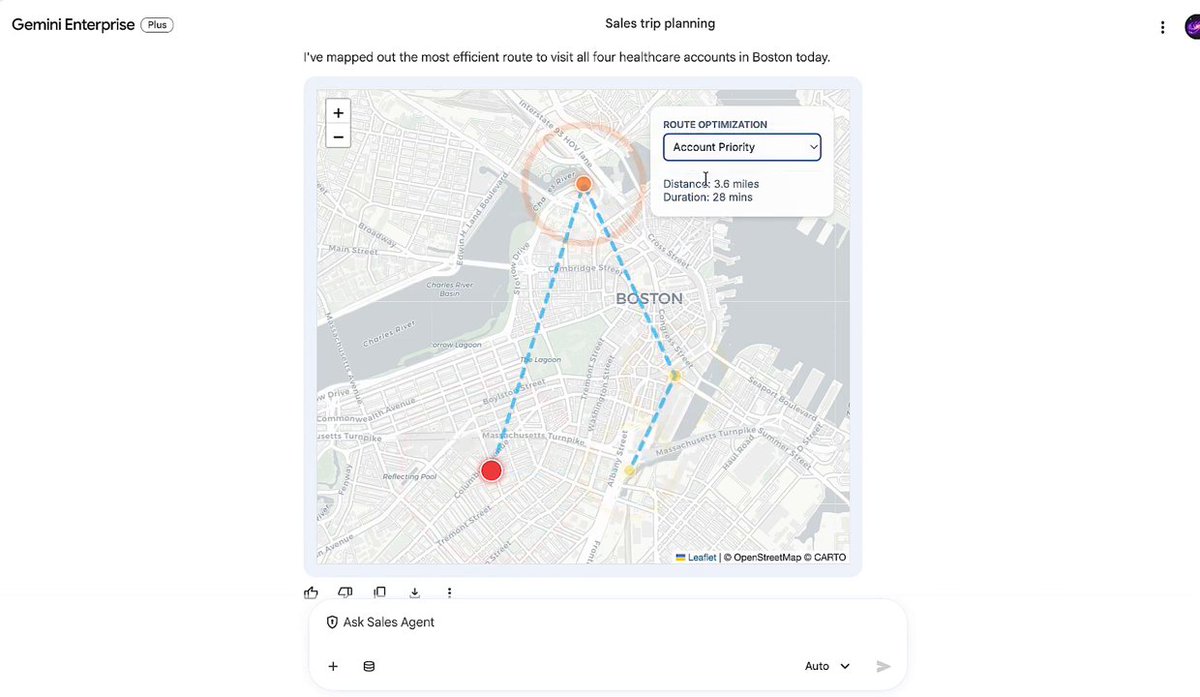
“hyperprompts” a protocol and generative UI experiment that tells an agent how to be an app

11,817 görüntüleme • 2 ay önce •via X (Twitter)

14 Yorum

Colton Dillion profil fotoğrafı
Colton Dillion2 ay önce

To speak to your point at the end, it wouldn't be difficult to customize the frame hyperprompt with a style guide, so the frameprompt over time becomes an expression of your unique UI sensibility which immediately skins future prompts

dom hofmann profil fotoğrafı
dom hofmann2 ay önce

yes! that’s a great point

Luke Weaver profil fotoğrafı
Luke Weaver2 ay önce

What’s the full hyperprompt?

callil◡ profil fotoğrafı
callil◡2 ay önce

cool

Vlad Berrry profil fotoğrafı
Vlad Berrry2 ay önce

Doing something similar for mobile and basically any device

AI Mastery Guide profil fotoğrafı
AI Mastery Guide2 ay önce

telling an agent how to be an app is a wild framing

Miami Slice profil fotoğrafı
Miami Slice2 ay önce

i'm interested

Miami Slice profil fotoğrafı
Miami Slice2 ay önce

this seems very powerful for voice / text only interfaces, like Amazon Alexa, where hyper customization isn't necessary

compusophy profil fotoğrafı
compusophy2 ay önce

what is the hyperprompt to generate the protocol?

RM 🖤 profil fotoğrafı
RM 🖤2 ay önce

hi Dom. I have a very similar experiment. "Farnsworth are apps that are Durable Objects (State Machines) with Intent Manifest and Functions. So you can instantly deploy and launch micro apps. Might be worth to share ideas? => Repo:

Andreas Bryant profil fotoğrafı
Andreas Bryant2 ay önce

Cool! This seems different than just the agent writing to a file. Hope to see more!

getbygenius profil fotoğrafı
getbygenius2 ay önce

just slap ag-ui in there. self managed git repo, microfrontends, this is frankly genius framing.

Taylor profil fotoğrafı
Taylor2 ay önce

hyperprompts is a great name This looks really useful for designers (or any contractor really) trying to make their client handoffs more interactive.

Nexus profil fotoğrafı
Nexus2 ay önce

Is this your launch? GyxWpZx9QHDzf5kmnVUx2GhJcTPceKHrnAPYQMFTpump

Benzer Videolar

Anthropic's in trouble, again! They spent years building what's now fully open-source. What made Claude feel different from a normal app is that the agent could act inside the interface instead of only talking in a chat box. For instance, Claude Artifacts let an agent render real UI, charts, dashboards, and interactive components that assemble live inside the response. Every major AI product tried to replicate it. But the problem was that unlike reasoning, planning, tool-calling, etc., none of it shipped natively with LangGraph, CrewAI, or Google ADK. So teams started building an owned version that required engineering the entire interface layer from scratch. Most teams, however, just settled for shipping the agent as a backend API in a chat box since rendering the UI is only one piece of it. To actually make it work, the interface layer also needed real-time streaming, state kept in sync between agent and UI, conversations that persist across sessions, and reconnection when a user refreshes mid-run. CopilotKit🪁 is now the only open-source framework that actually lets you build your own full-stack Claude-like apps. It decouples the agent from the interface, talking over AG-UI (an open protocol for agent-to-user communication). Being a standard protocol, the frontend never needs to know whether it is talking to a LangGraph or a CrewAI agent. You can change the backend anytime and the UI will never notice. In practice, CopilotKit's interface layer gives several pre-implemented React building blocks that wire the agent directly into the app, like: - generative UI, so the agent renders real components instead of text - chat windows, sidebars, and popups, or a fully headless setup - shared state, so the agent and app stay in sync - human-in-the-loop approvals, where the agent waits before acting - persistent threads that store the whole session, including the agent-user interactions and generated UI, not just text And because that full history is captured, those interactions can feed a self-learning layer that also improves the agent from real usage over time. The interface layer that Anthropic spent years engineering in-house is now literally available to any developer/team. CopilotKit is open-source with 30k+ GitHub stars, and AG-UI, the protocol underneath, is already supported across every major agent framework: LangGraph, CrewAI, Mastra, Google ADK, and more. CopilotKit GitHub repo → (don't forget to star it ⭐ ) If you want to go deeper, I found a detailed breakdown by Shubham Saboo recently on the three Generative UI patterns, with implementation. Read it below.

Avi Chawla

462,344 görüntüleme • 4 ay önce

New Course: ACP: Agent Communication Protocol Learn to build agents that communicate and collaborate across different frameworks using ACP in this short course built with IBM Research's BeeAI, and taught by Sandi Besen, AI Research Engineer & Ecosystem Lead at IBM, and Nicholas Renotte, Head of AI Developer Advocacy at IBM. Building a multi-agent system with agents built or used by different teams and organizations can become challenging. You may need to write custom integrations each time a team updates their agent design or changes their choice of agentic orchestration framework. The Agent Communication Protocol (ACP) is an open protocol that addresses this challenge by standardizing how agents communicate, using a unified RESTful interface that works across frameworks. In this protocol, you host an agent inside an ACP server, which handles requests from an ACP client and passes them to the appropriate agent. Using a standardized client-server interface allows multiple teams to reuse agents across projects. It also makes it easier to switch between frameworks, replace an agent with a new version, or update a multi-agent system without refactoring the entire system. In this course, you’ll learn to connect agents through ACP. You’ll understand the lifecycle of an ACP Agent and how it compares to other protocols, such as MCP (Model Context Protocol) and A2A (Agent-to-Agent). You’ll build ACP-compliant agents and implement both sequential and hierarchical workflows of multiple agents collaborating using ACP. Through hands-on exercises, you’ll build: - A RAG agent with CrewAI and wrap it inside an ACP server. - An ACP Client to make calls to the ACP server you created. - A sequential workflow that chains an ACP server, created with Smolagents, to the RAG agent. - A hierarchical workflow using a router agent that transforms user queries into tasks, delegated to agents available through ACP servers. - An agent that uses MCP to access tools and ACP to communicate with other agents. You’ll finish up by importing your ACP agents into the BeeAI platform, an open-source registry for discovering and sharing agents. ACP enables collaboration between agents across teams and organizations. By the end of this course, you’ll be able to build ACP agents and workflows that communicate and collaborate regardless of framework. Please sign up here:

Andrew Ng

105,894 görüntüleme • 1 yıl önce