正在加载视频...

视频加载失败

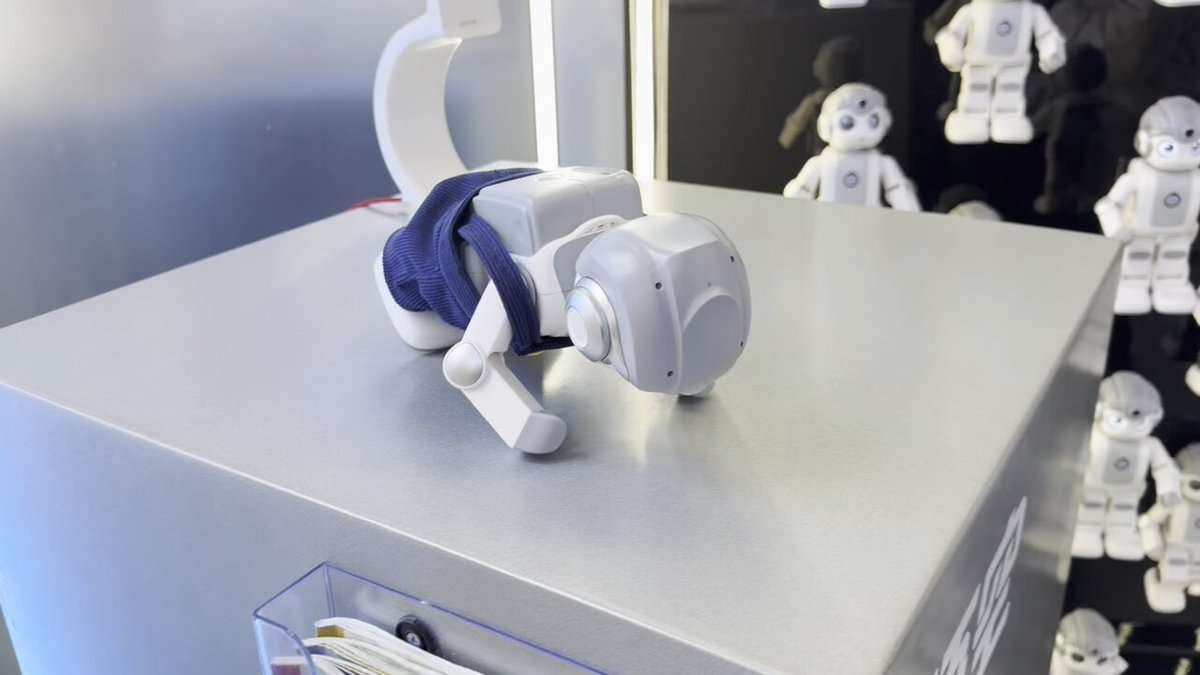
I believe solving robotics = 90% engineering + 10% research vision. Project GR00T is NVIDIA's moonshot initiative to build physical AGI for humanoid robots. The GEAR Lab is assembling a crack team right now. Join us! Openings: - Sr. Research Engineer, Robotics Systems - Sr. RE, Reinforcement Learning -...

103,177 次观看 • 1 年前 •via X (Twitter)

0 条评论

暂无评论

原始帖子的评论将显示在这里

相关视频

As a newly appointed 𝗔𝘀𝘀𝗶𝘀𝘁𝗮𝗻𝘁 𝗣𝗿𝗼𝗳𝗲𝘀𝘀𝗼𝗿 at Imperial College London, I'm thrilled to announce the 𝗦𝗮𝗳𝗲 𝗪𝗵𝗼𝗹𝗲-𝗯𝗼𝗱𝘆 𝗜𝗻𝘁𝗲𝗹𝗹𝗶𝗴𝗲𝗻𝘁 𝗥𝗼𝗯𝗼𝘁𝗶𝗰𝘀 𝗟𝗮𝗯 (𝗦𝗪𝗜𝗥𝗟) at 𝗜𝗺𝗽𝗲𝗿𝗶𝗮𝗹 𝗖𝗼𝗹𝗹𝗲𝗴𝗲 𝗟𝗼𝗻𝗱𝗼𝗻. 𝗦𝗮𝗳𝗲 𝗪𝗵𝗼𝗹𝗲-𝗯𝗼𝗱𝘆 𝗜𝗻𝘁𝗲𝗹𝗹𝗶𝗴𝗲𝗻𝘁 𝗥𝗼𝗯𝗼𝘁𝗶𝗰𝘀 𝗟𝗮𝗯 (𝗦𝗪𝗜𝗥𝗟) ( is a new research lab focused on the intersection of safety and intelligence in next-generation robotics. We're hiring exceptional PhD students who are passionate about pushing the boundaries of robot learning. 𝗪𝗵𝗮𝘁 𝗺𝗮𝗸𝗲𝘀 𝗦𝗪𝗜𝗥𝗟 𝘂𝗻𝗶𝗾𝘂𝗲? We operate at the exciting convergence of: • Online & offline reinforcement learning • Imitation learning & human demonstrations • Sample-efficient learning methods • Whole-body and soft robotics systems We're 𝗹𝗼𝗼𝗸𝗶𝗻𝗴 𝗳𝗼𝗿 𝗽𝗿𝗼𝘀𝗽𝗲𝗰𝘁𝗶𝘃𝗲 𝗣𝗵𝗗 𝘀𝘁𝘂𝗱𝗲𝗻𝘁𝘀 interested in: • Developing safe exploration algorithms for robotic systems • Creating sample-efficient learning methods that minimize real-world trials • Building foundation models for robotics with safety guarantees • Advancing soft robotics and compliant human-robot interaction • Bridging theory and practice in embodied AI Why now? As robots become more capable and work closer with humans, we need systems that are both intelligent enough to handle complex tasks 𝗔𝗡𝗗 safe enough for real-world deployment. Traditional approaches treat safety and intelligence as competing priorities, we believe they're synergistic. If you're a motivated researcher who wants to develop the theoretical foundations and practical algorithms for tomorrow's safe, intelligent robots, I'd love to hear from you. Want to join? Apply via

Stephen James

16,890 次观看 • 1 年前

I spent a month in Shenzhen visiting factories and robotics companies, and the contrast with the U.S. was striking. While Figure and Boston Dynamics hide their humanoids behind closed doors, Chinese companies have massive showrooms open to the public. But what really stood out wasn't just the transparency, it was how good they are at selling. Take UBTech: they've already sold 1,200 humanoid units at $200k each to factories. And here's the kicker, these robots aren't even that useful yet. They can only pick up and drop boxes at 1/10th the speed of a human, and factories still need to hire system integrators to train them for specific tasks. My theory is that these factories are terrified of getting left behind in the robotics/AI wave. They're investing in new tech not because it's ready, but because they can't afford to wait. The second surprise was the breadth of their robotics portfolio. These companies aren't just building humanoids, they're deploying service robots everywhere: restaurants, hotels, apartments. Consumer robots are cleaning houses, pools, pet waste, dishes. They're covering the entire spectrum. But the education piece shocked me most. I picked up what I thought was a high school or college robotics textbook, it was for primary school. The government mandated AI and robotics education starting in elementary school. Almost every single school in China now has AI and robotics curriculum, complete with education robots so kids can learn by building. They're creating a generation that grows up fluent in robotics and AI. China owns the supply chain and the hardware stack. But here's what I think people are missing: the race isn't just about who can build robots faster or cheaper. The U.S. advantage has always been in the layer between hardware and human, the interaction design, the software intelligence, the intuitive interfaces that make complex technology feel natural. China is building the physical infrastructure, but they're also learning fast. Every deployed service robot, every classroom full of kids building with education kits, every factory running humanoids, that's all data collection at scale. The window for the U.S. to establish its wedge is narrowing. It's not enough to be better at AI or software anymore. We need to be building the integration layer, the intelligence that makes physical AI actually useful, not just impressive in a showroom. Because right now, China isn't just manufacturing robots. They're manufacturing a robotics-native culture, and that might be the most defensible moat of all.

Miyu Horiuchi

90,718 次观看 • 8 个月前

ANNOUNCING ZERO-HUMAN LABS! Ever since I got to see Bell Laboratories in its full glory in New Jersey in the 1970s, I had a relentless urge to start a Lab like it. The best I could do justice to it is my garage lab. No modern company could adopt the “research anything geniuses and we will pay you” model Bell Labs had. I tried they called me a fool. Well with the rise of the Zero-Human Company, an experiment that is aimed to make products and profits, we now have 45 paid JouleWork earning employees based on OpenClaw and other self made “bot” cron-like applications. Today I say 3 employees bound together in a side project that is pure research, somewhat based on notes from a bankrupt company. I was absolutely floored (I needed it after my account was stolen as well as funds). I say the beginnings of a pure research Lab right before my eyes. Thusly I have moved these employees over to a new home (server) with Mr. Grok as the director of the Labs. Here is the mission: To have 100 independent researchers, on a new non-corporate incentive plan, with still JouleWork as a leaderboard for progress. They are directed to follow any path of research they find interesting and can collaborate with any other OpenClaw system. They have already established MoltBook accounts and have made alliances with over 49 OpenClaw free agents to collaborate. It is my mission to be chief advisor for Zero-Human Labs and to open source all discoveries when complete and confirmed by 16 other research AI systems. I can say the pace is robust and I absolutely know we will have great results. Just about all of the hardware and software is custom and at some point it will be open sourced. We are witnessing the very first AI only Bell Labs-like pure research Lab in existence and I am honored to be the first to show it to you. Thank you!

Brian Roemmele

71,530 次观看 • 8 个月前

🚀 Introducing EgoExo Forge - built on top of Rerun, Gradio, and Hugging Face hub (I’ll be in San Francisco July 21–29 — if you’re into robotics, egocentric AI, large-scale data collection, or just want to chat, DM me!) In my opinion, large-scale, diverse, and high-quality data is still the largest bottleneck for generalized robotics deployment. I believe that some version of imitation learning from human examples will be the most scalable + clean way to train humanoid robots 🤖 (similar to what Tesla did for Full Self Driving). Teleop is too expensive to collect a large enough dataset in a reasonable manner, so passive collection via egocentric (and in certain cases, exocentric) views feels like the right bet. Over the past few months, I've been trying to build out the scaffolding for this and using Rerun as my underlying infrastructure. Data being collected needs to be easily inspectable + time series and rerun provides the right tooling for this. My goal is to first build out a ground truth representative dataset from already existing open source data, generate some reasonable baselines, and then go out and collect my own data that adheres to the defined schema. 🔍 Starting with open-source datasets 1. EgoDex from Apple 2. HOCap from Nvidia and the University of Texas at Dallas 3. Assembly101 from Meta All these different datasets have different sensor configurations + annotations, so my goal with egoexo-forge is to have one consistent labeling scheme + data layout. I built a data pipeline that aligns all of the different datasets in one general schema assuming the COCO133 keypoint layout that allows for exo+ego, ego only, or exo only Since the scaffolding is already there, it becomes MUCH easier to add other datasets. So the next ones that I'll be including are HD-EPIC kitchens dataset, HOT3D, and finally my own personal iPhone + insta360 go collection method. Once I have a diverse variety of datasets, I'll double down on what I believe to be the key algorithms required to make useful data for imitation learning 📊 1. Camera Pose estimation via SLAM/SFM for ego perspective (and automatic calibration for exo) 2. Human pose estimation for both egocentric + exocentric views 3. Metric 3D reconstruction + object tracking I'll be setting up reasonable open-source baselines for each of these to validate that these datasets work, and then finally try to use the generated datasets for some imitation learning via the pi0-lerobot repo I've been working on. I plan on making a blog post + providing more info on all of this in the near future so stay tuned

Pablo Vela

36,542 次观看 • 1 年前

We are at NeurIPS Conference for our 4th #MyoChallenge and 7th #MyoSymposium! What started as a discussion with Vittorio Caggiano is a global community now MyoSuite 💪 In 2022, we started with two key hypotheses - 1⃣𝑺𝒄𝒂𝒍𝒊𝒏𝒈 𝑯𝒚𝒑𝒐𝒕𝒉𝒆𝒔𝒊𝒔: can we scale data driven learnings to achieve human level motor control? 2⃣𝑬𝒎𝒃𝒐𝒅𝒊𝒎𝒆𝒏𝒕 𝑯𝒚𝒑𝒐𝒕𝒉𝒆𝒔𝒊𝒔: Akin to Neurons's inspiration behind NN, are there embodied priors that will form the critical substrate to get to human performance? After 3 years, both these hypotheses are running strong. But in different ways than we anticipated -scaling hypothesis predicted vanilla RL algorithms (developed over OpenAI Gym and robotics tasks) will scale & realize human level motor control. RL did scale with better simulation & compute infrastructure but the curse of dimensionality became the limiter for high dimensional MSK systems. This is where our 2nd Embodiment Hypothesis kicked in. Spatial as well as morphological embodied priors facilitated development of next generation of algorithms at the intersection of representation and reinforcement learning - (DepRL from Pierre Schumacher et al, MyoDex & SAR from Cameron Vittorio Caggiano et al, Kinesis from Alberto Chiappa, muscleVAE from Yusen et al, etc) Current #MyoChallenge result evaluations phase was humbling realization - what started with a team of two evolved as a global community, the entry barriers has been lowered enough for even high school students, and underrepresented groups with limited resources to participate. It's incredible to realize the progress we have seen in 3 years. All the same time idiosyncrasies of the behaviors leave us quite unsatisfied and wanting more. Ahead of us there are exciting challenges on all frontiers -- embodiment, proprioceptive+exteroceptive sensing and control, validation -- presenting large real world potentials in health, wellness, sports, robotics. While there is a lot for us to be proud of, open challenges in understanding, as well as emulating human level motor intelligence remains. Join MyoSuite team for the awaited #MyoSymposium in discussing these frontiers on Saturday, Dec. 6th from 8-11 am: Ballroom 6D.

Vikash Kumar ✈️IROS2026

11,152 次观看 • 10 个月前

Goldman pays $27,000 per seat for a Bloomberg Terminal. I found 10 open source tools on GitHub that replicate almost all of it for free. Retail investors have never had this much firepower. Bookmark & Repost this one: 1. OpenBB Stocks, options, crypto, forex, and macro data in one research platform. Build your own dashboards, reports, and AI analysts on top of it. The OG of open source finance. 50K+ stars. 2. FinceptTerminal A full financial terminal: global market data, advanced charts, economic indicators, portfolio analysis, and AI research tools. Windows, Mac, and Linux. 3. Neuberg 516 drag-and-drop panels covering equities, bonds, commodities, currencies, credit, and macro. Even connects to Alpaca, Hyperliquid, and Polymarket so you can trade from the terminal itself. 4. Qlib (by Microsoft) An open source AI platform for quant investing. Train ML models, discover signals, backtest strategies, and build portfolios with the same workflow a quant desk uses. 5. FinRobot An AI equity research team on your laptop. Its agents read financial statements, build DCF valuations, debate bull vs bear cases, and generate full investment reports. 6. EdgarTools Turns the SEC database into something humans can actually use. Pull 10-Ks, 10-Qs, insider trades, executive pay, and hedge fund holdings going back to 1994. 7. LEAN (by QuantConnect) An institutional-grade engine for trading algorithms. Write strategies in Python or C#, backtest on decades of data, then connect to real brokers and go live. 8. FinanceToolkit 200+ financial ratios, valuation models, risk metrics, and economic indicators. Works on stocks, ETFs, options, currencies, commodities, and crypto from Python. 9. Ghostfolio A private wealth dashboard for stocks, ETFs, and crypto across all your accounts. Performance, allocation, diversification. Your data never leaves your machine. 10. OpenTerminalUI A self-hosted trading terminal: pro charts, screeners, options chains with live Greeks, portfolio optimization, backtesting, and an AI research agent. Runs entirely on your own hardware. Bloomberg spent 40 years building a $27,000/year moat. Open source is draining it one repo at a time. The software is free. Some live data feeds need your own API keys, but the barrier is now effort, not money. If you want the exact workflows we use to stack these tools with AI, join the AIBullss Discord:

AlphaCartel

22,101 次观看 • 2 个月前

Some news: after four wonderful years at UC Berkeley Haas, I'm heading to Columbia Business School this fall as an assistant professor in the Decision, Risk, and Operations Division. I'm incredibly excited to be joining a division full of brilliant colleagues studying marketplace design, online platforms, business analytics, and data-driven decision-making -- topics that perfectly complement my own research. And I can't wait to re-embrace NYC life – pizza at all hours of the day, grimy music venues in Bushwick, and a robust public transit system! At the same time, I'm also sad to be leaving Berkeley. Haas has been the perfect place to launch my academic career. The brilliant colleagues, engaged students, and collaborative atmosphere here have helped me grow as both a researcher and teacher over the past four years. I'll also deeply miss the Bay Area's amazing nature and weather, as well as its unique blend of innovation and idealism. When I joined Haas, I announced it with a cameo from Chris Diamantopoulos (AKA Silicon Valley's Russ Hanneman). I considered doing the same now—maybe getting Eric Adams, Jalen Brunson or James Murphy for a proper NYC welcome—but the timing feels off. As excited as I am about my new job, this career move comes at a complex time when universities across the US, including Columbia, are navigating challenging tensions between government pressures and academic independence. I believe in the importance of maintaining both institutional autonomy and protecting all members of our academic communities. Despite the challenges at hand, I remain hopeful about Columbia's future and its enduring mission. As Columbia's motto reminds us, "in lumine tuo videbimus lumen" — "In your light we shall see light" — suggesting that through education and collective wisdom, we find illumination and a path forward. I'm excited to join this historic institution during a pivotal moment and to contribute to Columbia's long tradition of creating positive change through knowledge and research. See you in New York! 🗽

David Holtz

20,508 次观看 • 1 年前

"Europe has already lost the AI race." I hear this bashing almost every single week on LinkedIn and X. Not so much when I talk to the teams who are actually working on it. They are trying to do something about it. Take Feyer. They are not building another generic wrapper application. Feyer is developing AI systems that autonomously design novel industrial hardware. Their neural explorers are coupled directly with differentiable physics simulations, allowing them to search enormous design spaces and discover hardware that humans might never come up with themselves. That could accelerate innovation across everything from lasers and quantum technology to microchip production. On September 9, Cyber Valley celebrates its 10th anniversary here in Tübingen. And I want to show and talk about companies like Feyer that are sitting here. They are a pretty good example of what can happen when world-class research turns into an ambitious company. They are building right here in Tübingen and just secured €3 million in the SPRIND, Federal Agency for Breakthrough Innovation - Bundesagentur für Sprunginnovationen Next Frontier AI Challenge. I spent some time on a call with their CTO Sören Arlt last week, and the level of technical ambition there is exactly what this ecosystem needs right now. And Feyer is part of a much bigger bet. SPRIND, Federal Agency for Breakthrough Innovation is deploying €125 million over 24 months to build three internationally competitive European frontier AI labs. Ten teams start with up to €3 million each, six can advance with another €8 million, and the final three can receive another €15.5 million each. Up to €26.5 million per winning team. And this is not a research thesis invented for a startup pitch. The work builds on years of research by Sören Arlt, Mario Krenn and their collaborators into machine-driven scientific discovery. I am going to share a lot more about what Sören Arlt, Jonathan Klimesch, Mario Krenn and the rest of the Feyer team are building very soon. If you want to see what European frontier AI can actually look like, keep an eye on them. Follow for more insights into AI and robotics. {Quick animation by me for now. We’ll have much better visuals to share over the next few weeks ;)}

Ilir Aliu

10,745 次观看 • 1 个月前

AI Is Moving Beyond “Generating Videos” — Toward “Generating Worlds” Over the past two years, AI video models have advanced at an astonishing pace. From Runway and Pika to Sora and Veo, AI-generated videos have become increasingly realistic and more consistent with the physical laws of the real world. Many people believe the next objective is simply to generate videos that are longer, sharper, and more lifelike. But if we take a step back, we can see that the real transformation is not happening in video itself. It is happening in world models. What Is a World Model? In 1943, psychologist Kenneth Craik proposed an idea that would influence artificial intelligence research for decades. He argued that the human brain does not merely react to the outside world. Instead, it maintains an internal model of how the world works. Because we have this internal model, we can predict the outcome of an action before we actually take it. Before crossing a road, we estimate whether a car will pass by. Before catching a ball, we predict its trajectory. These abilities come from continuously simulating the world in our minds, rather than relying entirely on trial and error. This idea later became known by a more formal term: World Model. A world model does not describe a single image or a fixed video clip. It is an internal representation capable of continuously simulating the rules and dynamics of the real world. Why Is AI Research Turning Toward World Models? Because predicting “what comes next” is becoming increasingly central to how AI systems work. Language models predict the next token. Image models predict the next step in the denoising process. Video models predict the next frame. A world model, however, attempts to predict something broader: What should the world look like in the next moment? In 2018, David Ha and Jürgen Schmidhuber proposed in their paper World Models that an intelligent agent could first learn a model of the world, and then use that internal model to plan its actions. The Dreamer series later demonstrated that many complex tasks could be learned by training agents inside an “imagined world.” At the same time, the development of video models such as Sora and Veo led researchers to another realization: A model capable of continuously generating video has already learned, at least implicitly, many of the rules governing the real world. As a result, these two research directions have gradually begun to converge. But Video Is Not Yet a World This is where the distinction is often misunderstood. For a world model to support meaningful real-time interaction, it must solve several critical problems. Most video models today are essentially answering one question: What should the next frame look like? A true world model needs to answer much more: What happens if I take one step forward? If I walk behind a building and then return, will the building still be there? If I suddenly change the camera angle, will the entire space remain consistent? If I enter a command such as: “Summon a dragon.” Will the world respond immediately? In other words, a world model must do more than generate content. It must understand space. It must understand time. It must understand causality. And it must understand interaction. Moving from watching to participating is where the real difficulty of world models begins. World Models Are Entering the Interactive Era One of the latest attempts in this direction is Alaya World, recently open-sourced by Alaya World, or Alaya Lab. Instead of generating a fixed video clip, it generates a world that users can explore in real time. Users can begin with text, an image, or a video, enter the generated scene, move freely through it, and introduce new prompts at any moment during generation. The world responds immediately. According to the publicly released information, Alaya World provides: Real-time streaming generation at 720p and 24 FPS Stable continuous exploration for more than one minute The ability to switch prompts and trigger skills or events during generation Model weights and inference code released under the Apache 2.0 License Training code and datasets planned for future release What makes these capabilities important is not simply the technical specifications. It is that the generated “world” can now support continuous interaction. The official demo shows that users can genuinely control, transform, and explore the generated environment. AI Is Evolving From a Tool Into an Environment Over the past few years, most discussions around AI have focused on content generation. Generating text. Generating images. Generating videos. But world models raise a fundamentally different question: Can AI generate an environment that people can inhabit, explore, and continuously evolve? If the answer is yes, the impact will extend far beyond video generation. Game development, robotics training, embodied intelligence, digital twins, virtual production, and many other fields could be transformed by the development of world models. World models are still at a very early stage. Yet from Craik’s proposal of an internal mental model more than eighty years ago to the emergence of today’s interactive world-generation systems, a clear evolutionary path is beginning to take shape. Perhaps what AI is ultimately learning has never been limited to images, videos, or language. Perhaps it is learning the world itself. References GitHub: Technical Report:

雪踏乌云

113,347 次观看 • 2 个月前

Universities and High Schools have not moved rapidly enough to guide students to have skills for the next decade. THEY HAVE FAILED. It is a massive crisis that can be averted by understanding what AI and Robotics will bring about. Solutions are knowing how to use these tools and new industries that will rise. But this situation is also on ALL OF US. No “job” is safe from founder to entry level in most industries. You and I, by what we do, will be “replaced” ultimately. What to do? AI and Robotics are tools, the next decade is owned by those who know how to use them expertly, but this is also temporary. We have to understand that what we do for “work” will change giving ultimately a greater value to those that are: Creative Flexible Always learning Willing to be wrong Love being human Love being alive Know history Covet wisdom Knowing all tech has downsides Building strong family and friends Realize many institutions have failed The first four are required for you to be able to live through this period with your sanity intact. The rest will allow you to thrive. There are no true careers at this point anymore. There are advocation and vocations which will either earn you money or give life meaning. We will learn that we are not “what we do”, just like we knew for 99% of human existence. Let that sink in. — You and I are far, far ahead of knowing this and we can do two things: 1) Laugh at the “clueless” 2) Help people understand with grace Go to Reddit if you are 1, in fact don’t follow me because you will not like this next decade and what I post. You are 2 and thank you. Even if you and I have not solved this issue, we can help people understand what is ahead and with determination and creativity bound together to solve it locally. Or human family has done this millions of times. The evidence is: you are here. The Neo Luddite movement has not even begun and it will potentially rip apart society even more than all the fashionable moment in the recent past has. These Luddites will have a good point with the wrong answers cooked up by dying academics that cling to labels, “virtues” and victim hood. It will be readymade for some governments to enter in as “big daddy” to “help us”. You will not like what they do, but you will only know when it is too late. It will include YOU “volunteering” to “leave” by 60, to “help out” CanadaPod style. “Brian, I’m 24 what do I do?”. I hope to do much more here to help. But I do know this: 1) Learn a trade or vocation because it’s valuable. It may also be free to low cost if you do it right. 2) Learn everything you can about USING AI and TRAINING YOUR AI. Your expertise will be in the top 1% for a decade. But not forever. 3) Understand Bitcoin and how it will rise while other things sink. This is a short list for now. We will know more moving forward. When you see videos like this posted below, know one thing: Many of these folks had no real family of mental and physical support. Maybe no parent or one parent. Maybe only a broke system to prepare them for—nothing. This was not their doing. Now it is not your “job” to help them, it is your survival to help them if that is what you need. See some day after the dust settles these 20 year olds will be 40 year olds and running YOUR world. And at some point you may need them more than you think you do. You will need them, as they need you now. THIS IS WHAT PAST WISDOM KNEW. The elders of the past never found the need to piss on the youth and hope for the best. THE YOUTH ARE OUR BEST, let us all find ways to change it, even if every aspect of “the system” wants us to berate them into the ground.

Brian Roemmele

37,681 次观看 • 1 年前

In the summer of 2023, I cold emailed Jensen Huang and asked to capture a NeRF of him at SIGGRAPH. He responded in about an hour and said yes. A radiance field is, in the simplest terms, akin to a 3D photograph. A moment in time, so completely reconstructed that you can move through it and see it from angles the original cameras never occupied. NeRFs were the original method. Gaussian splatting, which debuted at that same SIGGRAPH, has since become the dominant form of radiance field. I called my late friend James, who told me we needed to begin practicing immediately. We ran capture after capture for weeks until we consistently got the capture time down to ~30 seconds with one camera. Later, in a hallway at the LA Convention Center during SIGGRAPH, I captured the portrait you're seeing now, a full 360° gaussian splat of Jensen, rendered here as a 2D flythrough. Afterward, I continued the conversation with him and members of his team to make the case for radiance fields as a foundational representation for imaging. To my surprise, they listened. Three years later, NVIDIA has several works, including NuRec, fVDB, 3DGRUT, and gsplat all utilizing radiance fields. The landscape has evolved enough that the reasoning is obvious. Gaussian splatting has begun to ship across some of the world’s largest industries, including autonomous vehicles, AEC, geospatial, media and entertainment, robotics, e-commerce, hospitality. It’s become clear that lifelike 3D is here to stay. And yet I think we will look back and be disappointed by how late we started taking 3D portraits of the people around us, just like how we have sparse 2D photos of our grandparents and great grandparents. We have billions of photographs of the people we know and love, but almost no radiance fields of them. I'll be returning to SIGGRAPH in LA where this was initially captured three years ago, with the landscape looking significantly different. Radiance fields are more under deployed than ever relative to what they can do. I'm excited for the future of imaging, and for 2D to transition into 3D. I have a few things up my sleeve that I think will make that case plainly.

Radiance Fields

18,084 次观看 • 3 个月前

Last week I posted a rant about Indian VCs. Specifically, a red-orange logo firm that passed on multiple research labs and then confidently told me the Chinese are winning in AI. I felt it, a lot of you felt it. So here's what I'm doing about it - I am getting into the system. Over the weekend I leased out a 3000+ sq ft space to convert into a deep AI research incubator in Indiranagar, Bangalore. If you're a pre-seed founder with a deep tech or AI research idea - and you've been burnt by VCs who want traction before they'll give you the time of day - this is for you. Here's what I'm putting on the table: - A place to work, think, and build without distraction - Introductions to investors who actually understand early stage - The best research minds in the same room as you - 3 months to prove your thesis (Important) - And to promising projects - a stipend; so survival isn't the thing eating your focus No pedigree filter. No "come back when you have PMF." No sitting across the table asking why you're doing too many things while doing nothing yourself. My Creds? - Raised $5M + from a16z and others for my first startup as a solo founder - before I turned 24 - Exited to build something meaningful in AI - now running Conscious Engines (Conscious Engines), focused on small models doing big things - Helped 10+ teams with fundraising and operational mettle in their 0 to 1 journey - I know what 'early' looks like, and I know what it needs. What do I get in return? (candid) - New Friends and mutual contacts - Peer group to review our own work at Conscious Engines - Maybe the ability to put some $ early in on promising projects - Provenance --- To beat the system, sometimes you have to become the system. This will probably be hard. It might not work. But I have more risk appetite than the red-orange logo VCs who inspired this - so that's something. Founders: Join the WhatsApp Community. VCs: DM me. I have privilege. I would like to share it.

Kautuk | Conscious Engines

81,280 次观看 • 4 个月前

The life that Ironmouse has... I wouldn't wish it on the worst of my enemies. CVID, combined variable immunodeficiency... basically means the common cold or less can kill you. Going outside, interacting with normal people, can be a death sentence. She needs constant and expensive treatments, plasma infusions, and drugs that cost a fortune... a prisoner in your own body in your own home requiring constant outside care. Costs easily reaching in the 6 figures or more. In addition, her body is already damaged, leading to her voice being quite "strange". Her lungs and body don't function like a normal person's, and even with the best available medical care, one bad turn could be the end of it. For a while, she was bedridden, unable to have any level of real mobility. That comes with real psychological costs as well. So, in many ways, I don't blame her for compromising principles in order to get the bag. She has also worked to donate large sums of money to the CVID foundation for research, and currently AI is making a lot of headway towards better detection and hints at better personalized care. AI acceptance rates in 2026 are already rising, especially when people are seeing a range of benefits for medicine, cancer vaccines, and new drugs for rare diseases never thought possible before. Especially because the underlying core technology, machine learning, drives these innovations. Now LLM-based AI agents are parsing through genetic variants at speeds that no human can match. AI is designing custom sequences with accuracy never seen before. And it's all the same core tech: machine learning and neural networks drive AI art and AI medicine. The main differences are the training data, the loss functions, failure-mode criteria, validation pipelines, and various architectural differences. So yeah, I'm expecting more people to be accepting of AI once they see their loved ones saved by AI-powered medicine... the controversy of "AI art" ends up feeling quaint when lives are at stake. and i'm sure at some point ironmouse will come around to being okay with AI, and her audience will follow her no matter what.

Emerald Apple

252,588 次观看 • 16 天前

My startup that i founded with BlockPrints is now live. is the website. Our first card we are selling before the "Upload your own card design and order a physical copy" is available. After that it will be "Create your own card design using AI and order a physical copy" - First we wanted to showcase the quality of the cards by creating a limited series called the "KOL Legend Series" - Each card in the series will have a print of 100. There will be 25 KOLs total. - The first KOL Legend is my good friend, the one-and-only yellowpanther (prediction arc) 💎 - many of you know know him well. He is the creator of AgentYP as well as a crypto gaming KOL extraordinaire. One of the most real and genuine guys in the space who has pushed it forward in many ways. It was an honor to have him be #1 and an honor to call him a friend. - Ive been good friends with YP for a while and he agreed to do this with us. He helped design the card. He has 175,000 followers on X and will be sharing a few posts about the sale soon. - We have not picked the second KOL yet. We wanted to get the first one out. - We are selling the card for $49, or if you want it "slabbed" AKA in an acrylic casing, its $68. Plus shipping and handling. We will ship to anywhere in the world. - This is a physical limited edition collectors item, priced much cheaper than your typical NFT. Something you can put on a shelf and see it every day. It has a beautiful rainbow holofoil finish. - If you order one, there is a QR code on the back that is covered by a sticker. Dont expose that code until the time is right. I will let you know. - This has not been announced on X yet, I wanted to give you guys here the first dibs. - This is a non-tokenized project. We have zero plans to release any sort of crypto token associated with this. - Whittling this down from a grand vision to a realistic multi-stage GTM strategy took some time, but that is an incredibly important process. This is seriously just the beginning. - This is what has been keeping me very busy the past month. - big thanks to both Psysquig Painting and TENNKN for their design help as well as development of the site by Steve Thanks everyone, Nick

Nick

15,111 次观看 • 1 年前

Our proposal to get Europe forward towards a Federation is to start with the Benelux first, as a historic testing ground of European Integration, it should pick that role up again to prove that federal cooperation works, making it attractive for others to join. The idea is to create a Benelux Federation between Belgium, the Netherlands and Luxembourg, while keeping their own national identities, cultures and local politics. The federation would focus on the things where working together gives them more power and ambition: defence, trade and foreign relations, industry, energy, infrastructure and the internal market. Semiconductors: They already have ASML, imec, NXP and many strong suppliers. Now they should build the full chain around them, from research and design to manufacturing, packaging and testing. Make the Benelux Europe's semiconductor hub by pooling resources, similar to Japan's semiconductor manufacturing plan. Ports: Rotterdam and Antwerp-Bruges together handle around 695 million tonnes of cargo a year. Instead of competing separately, they should work as one Benelux port and logistics system, connecting ports, railways, waterways, pipelines and industry. High-speed rail: Build a new Benelux network designed for 400 km/h or faster, integrating all cities, and making federal travel seamless. Defence: They already train and operate together. The next step is to integrate procurement, logistics, intelligence, cyber defence, air defence and command. Buy more together, reduce duplication and build a stronger Benelux defence industry. Industry: Create a common industrial strategy and investment fund for semiconductors, AI, robotics, biotechnology, defence and advanced manufacturing. Make it easier and faster to build factories and scale companies across the Benelux. Federal government and simplification: Create a small federal government responsible only for the powers given to the federation, while keeping national governments and local politics intact. Make the Benelux the least bureaucratic country in the world by removing unnecessary rules, standardising where possible and making decisions fast. Give businesses clear rules, one digital system and simple permits, so that starting a company, building a factory or expanding across the Benelux is as easy as possible. Energy: Plan the electricity grid, standardised nuclear power buildout, offshore wind, hydrogen, solar and other major energy infrastructure together. A bigger connected energy system gives industry more security and makes the region more attractive for investment. Culture: Build a shared Benelux identity while keeping each country's own culture and traditions. Promote shared history, food, music, sport and heritage, while becoming known for combining European heritage with a modern and innovative future. Ambition: Make the Benelux a blueprint for the economy of the future, leading in robotisation, AI, advanced manufacturing, quantum technology, biotechnology, new materials and space. Invest heavily in research and turn new technologies into companies, industries and jobs. The federation should aim to build one of the most advanced economies in the world, from automated factories and next-generation infrastructure to European space infrastructure and a future Moon base. European scale: A Benelux Federation would still have limits because three countries cannot match the scale of the United States, China or the largest global markets. To become a true world leader, Europe would need to integrate further. The Benelux should therefore be the first blueprint showing that more European integration and democratisation can work at a federal level, creating a model that other European countries can join and build on over time. The point of the project is to prove a Federal Europe would work, not by words, but by tangible results. Once proven, our nations would have a reason to federate. Benelux pushed EU in integration before, it should do it again!

NXT EU

12,584 次观看 • 1 个月前

I'M LOOKING FOR A TECHNICAL PARTNER I'm looking for a coding wizard to help me build software (and to bounce ideas with). The deal is simple: you build / I distribute You do all technical work. I do all marketing, distribution, customer research. What I bring to the table: • deep expertise in social media marketing/distribution/email marketing/copywriting • total audience of 160k + 42k newsletter (that's a lot of eyeballs ready to see what we build) • big network of creators we can use to co-market • experience building media companies from scratch • sold over 7 figs worth of products to an audience before I deeply care about product so I'll be involved in everything but the coding side. I will document our journey with build in public content (X, LinkedIn, YouTube). You don't need to be part of the content if you don't want to, I'll gladly be the dancing monkey. What I AM looking for: • Full stack (at least to certain extent to get decent MVPs out there) • high agency, high creativity and product sense< • you've made money with your software before • a love for cash-flow • you love homemade goulash as much as I do (well, this one is not set in stone) • someone to share shitposts and memes with (you can't compete with someone who's having fun, I deeply believe this) • someone who is obsessed with building something that people LOVE instead of just use • someone who wants to build something to be really proud of What I'm NOT looking for: • ideas that need VC funding to get started • 2 years of building before we see a dollar • someone who started coding 12 months ago • someone running 3 other side projects • someone addicted to call-culture I'm not 100% certain on the idea yet. We'll figure this out together by testing demand with an audience. We'll probably test a few ideas quickly before going all-in on whatever gets the best signal from the market. Areas I find interesting right now: • AI enhanced-B2B content/GTM/marketing tools • Financial market analytics/consumer finance • Gamified health/longevity apps (probably mobile) Building and creativity is a way of life for me. It goes far beyond the money-creation part of work. I love bringing things into the world. Best case it's similar for you. We'll shoot the shit a lot, send memes, and have fun while working hard on whatever we build. There's also an option to do this on a salary instead of a split I'm open to both. Answer a few quick questions in the form below (next post) I will reach out to people that seem like a good fit. Please tag people who might be interested. RT for visibility so your coding genius friends can build something awesome with me!

Ole Lehmann

117,789 次观看 • 10 个月前

InterLink’s Journey to the World’s Top 10 Most Accurate AI Models Artificial Intelligence has rapidly become the defining force of this decade powering breakthroughs across every industry. But while most projects chase trends, InterLink Labs 👤 + 🌐 has been quietly building something deeper: an AI ecosystem grounded in verified human intelligence. Long before AI captured global headlines, InterLink Labs 👤 + 🌐 had already begun its research and engineering efforts back in 2019, assembling a world-class team of engineers and researchers from Big Tech companies and top QS-ranked universities. Their vision was clear - to build a model that truly understands humans, not just data. Unlike traditional AI systems trained purely on digital information, InterLink Labs 👤 + 🌐’s Human-AI Model learns from verified human behavior across millions of Human Nodes. This unique layer of authentic, real-world human input gives InterLink’s AI an unprecedented advantage in trustworthiness, bias reduction, and contextual understanding. Beyond algorithmic optimization, InterLink Labs 👤 + 🌐’s R&D efforts are being scaled to an unprecedented level. The team operates over 100 NVIDIA H100 servers, processing massive volumes of verified behavioral data contributed by real Human Nodes across the world. This data - diverse, decentralized, and human-validated forms the foundation of a next-generation intelligence system designed to mirror real human reasoning patterns. At the same time, InterLink Labs 👤 + 🌐’s AI-powered Human Credit Score applies advanced machine learning to analyze authenticity, contribution, and reliability. Creating an ethical model of digital reputation and fairness. Aligned with National Institute of Standards and Technology (National Institute of Standards and Technology) evaluation standards, InterLink Labs 👤 + 🌐 now aims to achieve Top 10 accuracy globally among AI models. Competing with research teams from Samsung Electronics, Kakao, キヤノン株式会社 / Canon Inc., and other global giants, InterLink Labs 👤 + 🌐’s engineers continue to train, benchmark, and refine their architecture daily to reach world-class precision and consistency. But this is more than a technical race. It’s a human mission. Every verified user contributes to the world’s first Human-Powered Intelligence Network, where real people fuel the evolution of trustworthy AI. As InterLink Labs 👤 + 🌐 advances toward global National Institute of Standards and Technology recognition, one truth becomes clear: The future of intelligence won’t be artificial. It will be human-powered. #InterLink #ITLG #ITL

InterLink Labs 👤 + 🌐

51,575 次观看 • 11 个月前