Loading video...

Video Failed to Load

Go Home

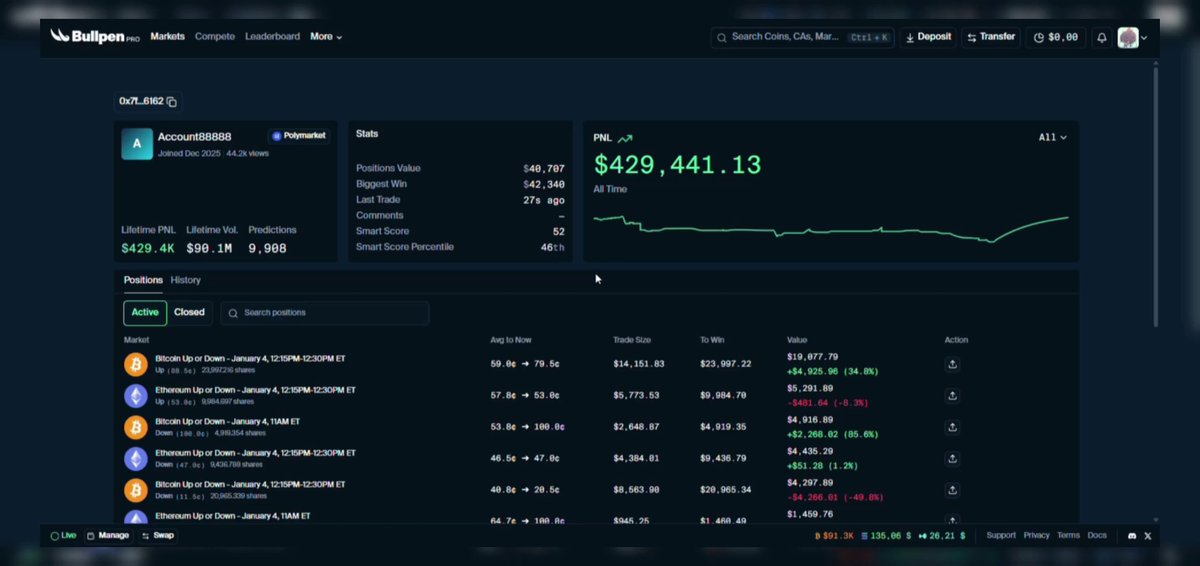
i found a pattern in 5-minute bitcoin markets it's literally a way to make x100 in one trade no bots needed, no technical analysis just timing the last 1-2 seconds let me explain how it works the market is nearing completion price fluctuates slightly, needs only $20-40 to hit...

74,611 views • 6 months ago •via X (Twitter)

0 Comments

No comments available

Comments from the original post will appear here

Related Videos

A week ago Polymarket declared war on algorithms. They introduced a draconian 3.15% commission on 15-minute markets called Taker Fee. The goal was clear: kill latency arbitrageurs who take money faster than the site UI updates. The math is simple: if your glitch gives a 2% edge and the platform takes 3.15% commission you're bankrupt. 90% of bots shut down that same night. But this bot didn't just stay. It increased its deposit. Profile hidden from everyone: Yesterday it closed the day with $27K profit. I looked at its logs to understand how it bypasses expected value. The old method is dead Previously bots simply compared BTC price on Binance and Polymarket. Saw the difference bought waited 30 seconds. This gave small profit that is now eaten by commission. New mechanics This bot stopped looking at price. It looks at pain. It is connected to the Liquidation Stream of Bybit and OKX exchanges. Price moves linearly. Liquidations are explosive. When a cascade of liquidations triggers on futures with margin calls of $50M+ per second the BTC price makes an impulse move that lasts 3-4 seconds before pulling back. This movement exceeds 1-2%. The essence The bot sees stop triggers on derivatives -> calculates impulse strength -> if Impulse > 3.15% Commission -> Enters the trade. While other bots filter market noise this script eats the corpses of margin traders from external exchanges. It doesn't care about direction. It cares about the amplitude of market pain. Result $205K net per month While you complain about commissions and unfair conditions the code adapted in 48 hours. No predictions. No AI. Just parasitizing on volatility of other people's mistakes. Right now this is the only working vector on 15-minute markets. A 3% commission is not scary if you take a 6% move. The nickname is a set of symbols. No avatar. It doesn't need fame it needs liquidity.

Blaze

91,771 views • 7 months ago

The world just paid $2 trillion for a rocket company that lost $4.9 billion last year. And the rockets are not why it lost the money. They are the only part making any. SpaceX went public Friday, the largest IPO in history. Up 19%, a $2 trillion valuation, Elon Musk the first trillionaire. Then you open the filing. Three businesses sit inside it. Starlink, the satellites, brought in $11.4 billion, 61% of all revenue, and $4.4 billion in profit. It is the only piece that earns a dollar. The rockets that land themselves run a small loss reinvesting in Starship. And the AI arm, Grok plus the app once called Twitter, folded in this February, lost $6.4 billion in a single year on $12.7 billion of spending. Read that again. The satellites pay for everything. The AI loses more than the satellites make. And the AI is the part the market fell in love with. It gets bolder. The prospectus claims a total market of $28.5 trillion, the largest any company has ever put in a filing. Larger than the GDP of the United States. That is the number underwriting a $2 trillion price tag built on a division bleeding $6 billion a year. Now the structure. About 4% of the company trades. That sliver sets the price for all of it. Musk is locked up for 366 days and holds roughly 80% of the votes. The public bought a company they cannot steer, priced on the one segment losing the most. This is the whole year in one ticker. The profit is satellites. The story is AI. The market bought the story. The rockets were never the risk. The risk is a $2 trillion price resting on the one bet that has yet to make a cent.

Shanaka Anslem Perera ⚡

721,880 views • 2 months ago

I took this lesson a few days ago,one of the clearest breakdowns of how Jupiter Swap works. Let me walk you through it. So first,what even IS a Swap? Think of it like Spot Trading in traditional finance. You’re just trading one currency for another at the current market rate, except here it’s digital assets. USDC for SOL. Instant. On-chain. Simple enough. But here’s where it gets interesting…... The moment you go to swap, Jupiter doesn’t just grab the first price it sees,it aggregates liquidity from major sources. That's where Ultra V3 kicks in — think of it like an institutional trading desk firing up behind the scenes. It scans the ENTIRE market, aggregates liquidity from every major source, and routes your trade through the most efficient path possible. You’re not just getting A price for your trade. You’re getting THE best price. But it doesn’t stop there….. 🎯 Real-Time Slippage Estimation (RTSE) is running simultaneously — monitoring slippage live so your swap tolerance stays as tight as possible. No surprises. No overpaying. And on qualifying pairs? Jupiter covers the gas entirely. You just swap. That’s the Gasless feature, look for the icon when you’re executing. 📚 Two concepts you need to understand 💧 Liquidity —> How deep the market is. Deep liquidity means you can make large trades without moving the price against yourself. Jupiter taps the deepest pools on the network. 📉 Slippage —> The gap between what you were quoted and what you actually get. Volatile markets cause this. Ultra V3’s RTSE exists specifically to close that gap. ━━━━━━━━━━━━━━━ 🚀 Ready to swap? Here’s all you do ━━━━━━━━━━━━━━━ 1️⃣ Open the Trade tab → pick your Sell & Buy assets 2️⃣ Check the Execution Path — Jupiter shows you exactly how it’s routing your trade 3️⃣ Spot the Gasless icon if it applies 4️⃣ Hit Swap. Done. On-chain in seconds. And this is why the saying exists — If you want to swap smarter, Just Use Jupiter.

Sam || Jupiter Legion 😺😺

34,502 views • 4 months ago