Video yükleniyor...

Video Yüklenemedi

Ana Sayfaya Dön

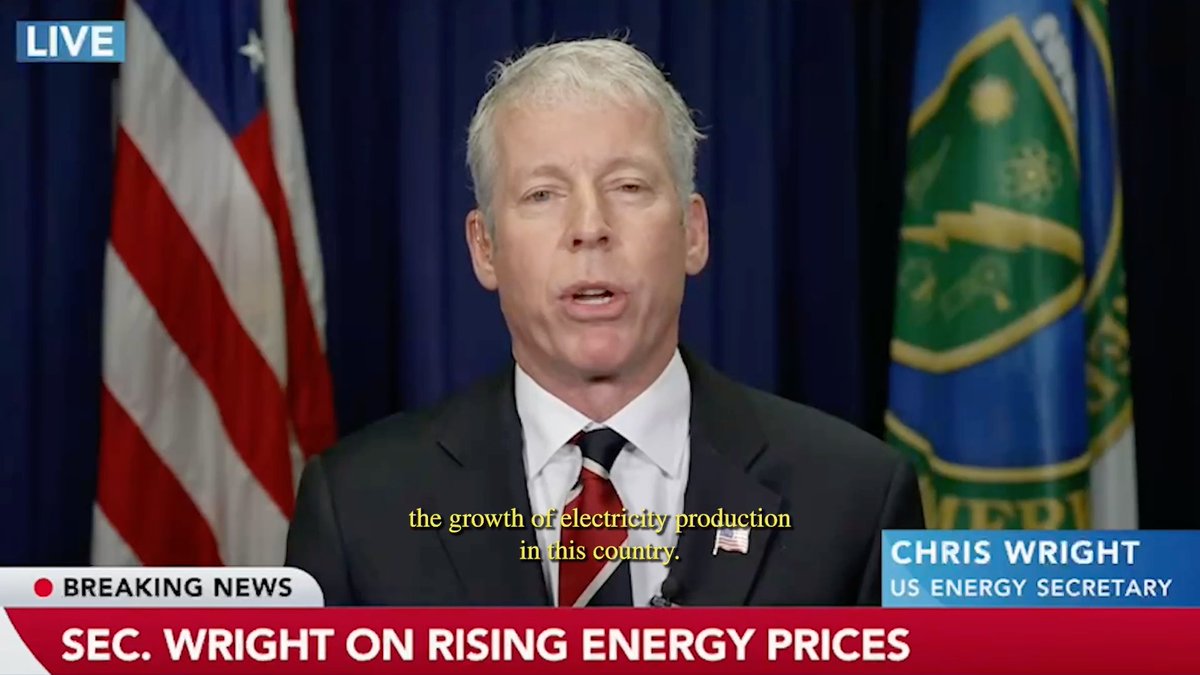
“I think next decade is going to be all about energy. Even Sam Altman from OpenAI talked about the evolution of AI — algorithms run on chips, but ultimately the chips need electricity. The algorithms will get better and better, and chips will get cheaper and cheaper. But at...

118,797 görüntüleme • 1 yıl önce •via X (Twitter)

9 Yorum

Pearlli profil fotoğrafı
Pearlli1 yıl önce

It’s stunning that President Brandon did everything that he could to stunt America's energy production and long term capabilitities. I’m not sure if it’s enough or in time, but at least President Trump has directed his Admin to cut red tape and enable energy supremacy. I pray we have enough time under his leadership to right the ship that the dark powers have worked long and hard to capsize.

MILES 'n MILES of TEXAS profil fotoğrafı
MILES 'n MILES of TEXAS1 yıl önce

... the climate fvck sticks & do-gooders set us how far back!?

Surf Panther profil fotoğrafı
Surf Panther1 yıl önce

Or lack thereof

𝗟𝗶𝗯𝗲𝗿𝗧𝗮𝘀𝗪𝗮𝗿𝗿𝗶𝗼𝗿 profil fotoğrafı
𝗟𝗶𝗯𝗲𝗿𝗧𝗮𝘀𝗪𝗮𝗿𝗿𝗶𝗼𝗿1 yıl önce

That makes total sense.

DCancilla profil fotoğrafı
DCancilla1 yıl önce

Interesting! 🤔

Volfe profil fotoğrafı
Volfe1 yıl önce

Nuclear and Solar

Rutro 🇺🇸 profil fotoğrafı
Rutro 🇺🇸1 yıl önce

Also national security

Chris profil fotoğrafı
Chris1 yıl önce

And we've been doing everything but investing in the best and most economical times.

Barb Ginther profil fotoğrafı
Barb Ginther1 yıl önce

We have energy, an abundance, always have.

Benzer Videolar

.Scott Nolan to Shawn Ryan: Energy Will Decide U.S.-China Race for AI and Economic Dominance "I think the next decade's going to be all about energy. Even Sam Altman from OpenAI had some recent hearing or talk where he talked about just the evolution of AI. You've got algorithms. Algorithms run on chips, but ultimately the chips need electricity. And what he said, if thinking back to this interview, the algorithms are going to get better and better and better and cheaper, and the chips will get cheaper and cheaper, but at the end of the day, you have to get the electrons, and the electrons have a fundamental price, and ultimately it's going to come down to that. I think even the AI, the AI competition between different companies in the U.S., between different countries, it's ultimately going to come back to the electricity production. Next decade, it's going to be all about power production. AI, military, if you think you need kinetics and military, that comes back to manufacturing. If you think economics, we have to have the biggest economy so that we can just have the most productive capacity, energy. Next decade is going to be all about energy, and we've stayed flat for a decade, for 15 years, we haven't done anything, more like 20 years, our grid's been pretty stagnant, and if we want U.S. leadership, it's going to have to grow. I think that's going to be the story we see, and it's going to be about solving different supply chain needs, whether it's fuel, maybe it's transformers, maybe it's transmission, all these things are going to come up. It's going to be chips. We'd have to go back to that chart and see exactly where is China today, where were they before in terms of per capita, but I think a lot of that production, the doubling of their grid relative to our grid, a lot of that's gone into manufacturing. We've shifted manufacturing from the U.S. to overseas. A lot of that's in China now, we've let them do it. A big part of that, people thought was, well, Chinese labor is much cheaper, but a lot of these processes can be automated. And so once you automate it, it just comes back to energy cost. And so China said, let's double our grid. Let's keep going. Let's work on tripling our grid, and we'll do it in the cheapest way possible because we want to win on manufacturing and get all this economic activity over here. Meanwhile, the U.S. has said, we have a bunch of regulations, which are good, and probably some that are unnecessary and have slowed us down, and so we haven't done the growth, and we've been very thoughtful about emissions, environmental impact, carbon. Meanwhile, China's doubling, tripling their grid and has done a lot of that with coal. And so we've shifted manufacturing here that would have been cleaner over there and just probably ended up net producing more carbon than we would have, more pollutants than we would have, and just kind of outsourced that. But as we know, carbon flows everywhere. If you're really worried about carbon emissions, letting China double their grid with coal and move energy-intensive manufacturing there is not actually the answer. The answer is the U.S. has to unblock building here, doing industrial activity, do it cleanly, do it with nuclear or other sources, even natural gas, half the carbon emissions of coal, and the world would be way better off. Their grid doubling hasn't just meant that everyone there has a better quality of life. I think it just means that we've taken a lot of manufacturing from here and done it over there."

Josh Caplan

28,340 görüntüleme • 1 yıl önce

Elon Musk: The real bottleneck for AI is not chips, it is electricity. “If you look at electrical output outside of China, everywhere outside of China, it’s more or less flat. It’s maybe a slight increase, but pretty close flat. China has a rapid increase in electrical output. But if you’re putting data centers anywhere except China, where are you going to get your electricity? Especially as you scale. The output of chips is growing pretty much exponentially, but the output of electricity is flat. So how are you going to turn the chips on? Magical power sources? Magical electricity fairies? It’s harder to build on land than it is in space. It’s harder to scale on the ground than it is to scale in space. But also, you’re going to get about 5 times the effectiveness of solar panels in space versus the ground, and you don’t need batteries. I almost wore my other shirt, which says it’s always sunny in space because you don’t have a day-night cycle or seasonality, clouds, or an atmosphere in space. The atmosphere alone results in about a 30% loss of energy. So, any given solar panels can do about 5 times more power in space than on the ground, and you avoid the cost of having batteries to carry you through the night. So it’s actually much cheaper to do it in space. And my prediction is that it will be by far the cheapest place to put AI. It will be space in 36 months or less, maybe 30 months.” Dwarkesh Podcast, February 5, 2026.

ELON CLIPS

65,484 görüntüleme • 24 gün önce

Former BlackRock fund manager Ed Dowd on students booing AI: "[The] sales pitch seems to be white collar jobs are going to disappear in 18 months. We need your electricity and your water. Good luck" "That's not a good pitch" "Executives actually say this" "I think the constraining factor [for AI buildout] is electrons, water, and social acceptability of this. And there's going to be a lot of fights. So it's all coming to a head" This clip of Dowd (Edward Dowd), a former BlackRock fund manager and co-founder of Phinance Technologies, is taken from a discussion with Adam Taggart (Adam Taggart) posted to YouTube on May 21, 2026. ----------------Partial transcription of clip--------------- "I've already seen the AI bulls come out and defend the students booing. They say the same sentiment occurred around the Internet, which I was there. It did not. No one was booing anybody talking about the Internet... So that did not happen. "They got a marketing sales pitch problem and I pointed this out on X. Their sales pitch seems to be white collar jobs are going to disappear in 18 months. We need your electricity and your water. Good luck. That's not a good pitch. "These executives actually say this. Now part of the reason I don't think the AI bubble is going to continue is because there actually is a shortage of, you know, capacity to run these data centers and there's not enough water to do it. So they're running into, running into opposition. "So I'm of the opinion Capex is going to be scaled back as they realize they can't plug into anything. And there's somebody on X, who's an analyst who's running around the country looking at all the data centers. And he said you'd be surprised at how many of them are not completed yet. "So there seems to be this, all this future Capex announcements, but then the actual going in the ground, getting it up and running is not as fast as people think. And that's the bottleneck and that's how you end up with like a ton of, inventory of Nvidia chips and everything that you can't deploy it. So it's sitting in a warehouse. "And you don't even need, and you don't need to order any more Nvidia chips. I think the constraining factor is electrons, water and social acceptability of this. And there's going to be a lot of fights. So it's all coming to a head."

Sense Receptor

68,409 görüntüleme • 2 ay önce