Loading video...

Video Failed to Load

Go Home

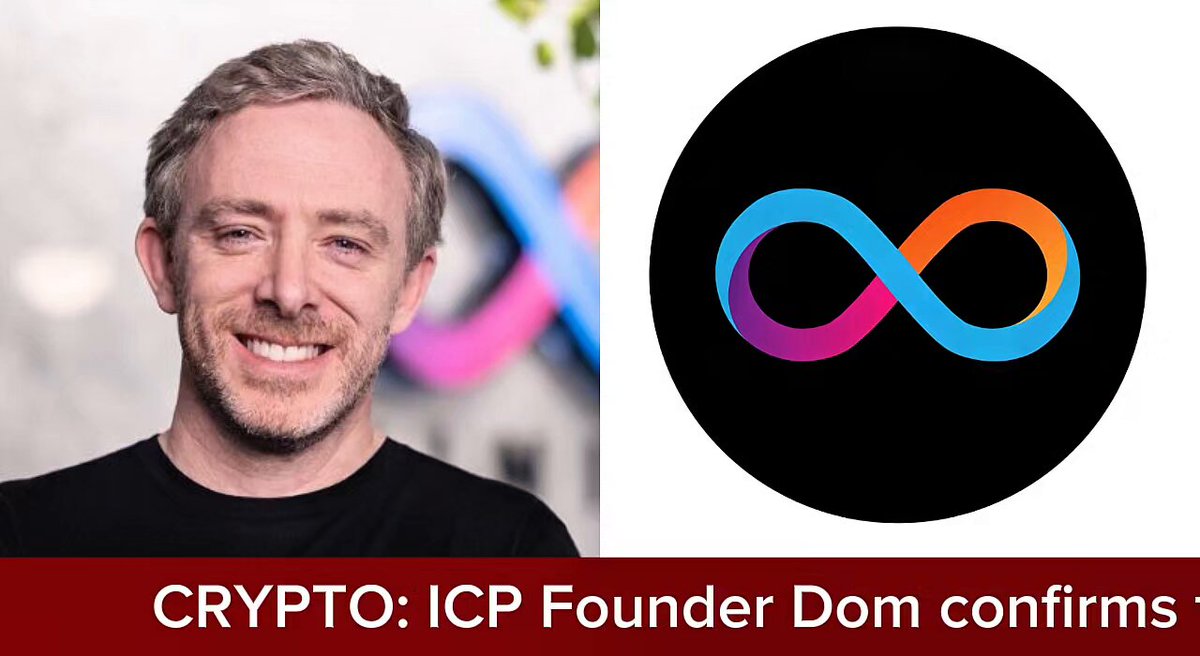
ICP Has Hit 294 Billion Transactions... DFINITY Foundation’s Internet Computer officially reaches 294B total transactions, cementing its role as the dominant high-velocity cloud blockchain. Real-time network activity records 910.6 tx/s with a 480ms block time and 0s finality. $ICP average transaction fees remain at a negligible $0.00008845, facilitating the...

20,882 views • 1 month ago •via X (Twitter)

0 Comments

No comments available

Comments from the original post will appear here

Related Videos

$ICP = World Computer (Since 2015)⬇️ In 2014, dom williams.icp ∞ , Chief Scientist of the DFINITY Foundation became involved with the early Ethereum community. At the time, the concept of a blockchain that could run software (i.e. smart contracts), which stored and processed data within an unstoppable, tamperproof and autonomous on-chain environment, was both revolutionary and controversial within the industry. At some point, the concept of a blockchain playing the role of a “World Computer” was mooted within the Ethereum community. One interpretation was that such a network would perform a trickle of simple but important smart contract computations for the world. However, Dominic’s interpretation, based on his work, was that World Computer blockchain would inevitably eventually host much of humanity’s systems and services, and all its data and compute, largely replacing traditional IT, and transforming social media, gaming, finance, enterprise systems and many other domains. In 2015, however, Dominic was a lone heretic, and was largely alone in believing that the creation of a true World Computer blockchain was technically feasible, let alone that it might be capable of successfully playing that role in competition with centralized computing infrastructure. Since Dominic strongly believed otherwise, based on his accumulated technical experiences and work on crypto theory, he decided to dedicate himself to blockchain research that might realize the concept, originally, he hoped, in the form a more advanced Ethereum 2.0. He stopped work on Pebble, and directed all his future efforts towards the realization of the World Computer blockchain vision. In early 2015, Dominic’s thinking about blockchain design had become more mature, and he began proposing new approaches to consensus, applied cryptography and blockchain network architecture. Around that time, he began using the name DFINITY as a brand for his work, which takes its characters from decentralized infinity. Through the period 2015 to 2016, Vitalik Buterin, and associates such as Vlad Zamfir, were the Ethereum project’s primary consensus researchers, and were highly focused on developing cryptoeconomic schemes, including under the Casper banner. Meanwhile, Dominic was more focused on finding new ways to leverage advanced cryptography and distributed computing math, and devising alternative blockchain architectures, which might enable a World Computer to be produced. Owing to the long-term nature of Dominic’s work, and it’s more technical approach, eventually it became clear to him that DFINITY should become an independent project. Panel Moderator: Martin Koeppelmann, Panel (from Right to Left): Dominic Williams, Vitalik Buterin, Vlad Zamfir, Jae Kwon, Recorded at the Silicon Valley Ethereum Meetup – October 22nd, 2016

Fabio

12,765 views • 8 months ago

Please enjoy my latest Journey Man episode with Mike Cagney 🇺🇸 00:00 Introduction 02:14 Interview with Mike Cagney Begins – A Pioneer in Tokenization 02:46 Mike's Background in Finance and Transition to Blockchain 04:20 The Evolution from Hedge Funds to Fintech and Blockchain 05:23 Bitcoin, Blockchain, and Displacing Trust with Truth 06:27 How Blockchain Can Reshape Capital Markets 07:58 The Role of Blockchain in Lending and Prime Brokerage 09:27 The Impact of Blockchain on Financial Intermediaries 12:00 Extracting Cost Savings Through On-Chain Transactions 14:36 Traditional Financial Institutions Adopting Blockchain 16:44 Creating a Permanent Capital Guarantor for Private Credit 18:22 Real-Time Remittance Tracking and Its Impact on Hedge Funds 19:52 The Struggle to Get Banks and Regulators on Board 21:27 Public Blockchain Adoption: Resistance and Opportunities 23:39 Developing a Blockchain-Native Security for Fiat Rails 25:14 The Future of On-Chain Securities and Banking Infrastructure 27:26 Building a Decentralized Exchange for Blockchain Assets 30:07 The Vision of a Fully Cross-Collateralized Financial System 32:49 The Expansion into Public Equities and Disrupting Prime Brokerage 34:29 How Traditional Financial Institutions View Blockchain 36:48 Challenges of Tokenizing Traditional Financial Systems 39:04 Why Financial Institutions Are Hesitant to Embrace Blockchain 41:07 The Future of Blockchain in Global Finance 42:49 Scaling Challenges for Blockchain in Financial Markets 44:44 Ethereum vs. Other Chains: The Institutional Perspective 48:02 The Potential of JP Morgan Launching a Stablecoin on Ethereum 50:39 Figure’s Plans for Public Listings and Market Expansion 53:44 Expected Regulatory Changes and Market Structure Updates 57:29 Key Takeaways: The Future of Blockchain in Finance 58:36 Raoul's Final Thoughts and Reflections on the Interview 1:00:00 Conclusion and Final Thoughts

Raoul Pal

154,659 views • 1 year ago

After an incredibly successful week at Token2049, the highlight was undoubtedly presenting our SPIN whitepaper at the Bleeding Edge Summit! While still waiting for the official video, we would like to share a recording from the audience. With SPIN, we're introducing a revolutionary approach to building proof-of-stake blockchains. There is a well-known chicken and egg problem when it comes to launching a new proof-of-stake blockchain. You need high value at stake to achieve economic security, but at the same time, for achieving that, you already need to be secure. With SPIN, you can borrow security from well-established networks such as Polkadot or Ethereum. Unlike a Layer 2, which completely gives up chain sovereignty and frequently sacrifices scalability and throughput to satisfy Layer 1 validation protocols, SPIN maintains full sovereignty of the Fast Chain while still benefiting from the security of the Anchor Chain. Our SPIN protocol addresses this fundamental challenge by enabling a fast, sovereign chain to maintain and grow its economic security with its own validator network, while simultaneously leveraging an established anchor chain to provide a second layer of finality. With SPIN, we take an unlimited set of stakers, reduce it to a limited set of validators who can run very quickly, producing a consecutive sequence of blocks during their staker period. This design allows for blocks with very small block times, as low as 0.1 seconds and beyond. Our full SPIN whitepaper will be released soon.

QF Network

25,547 views • 1 year ago

Tokenization of real-world assets (RWAs) is one of the most transformative developments in finance and blockchain. Traditionally illiquid assets such as real estate, private equity, commodities, and art are digitized into blockchain-based tokens, enabling fractional ownership, greater liquidity, global accessibility, enhanced transparency, and efficient trading without intermediaries. Experts (incl. BlackRock) see tokenized RWAs as a multi-trillion-dollar shift. Projections range from hundreds of billions to trillions in coming years, driven by institutional adoption, clearer regulation, and scaling from pilots to production. Enter Realio Network ( a leading player built specifically to capture this RWA revolution. Realio Network’s Cutting-Edge Technology Realio Network is an interoperable Layer-1 blockchain developed using the Cosmos SDK, with full EVM compatibility (allowing Ethereum-style smart contracts) and powered by the Comet BFT (formerly Tendermint) consensus engine. It features a unique native multi-staking Proof-of-Stake (PoS) mechanism, the first of its kind, that secures the network not just with its native token but also with real-world value through staking of tokenized RWAs and hybrid security tokens. As a multi-chain ecosystem, Realio leverages the IBC protocol for seamless interoperability across EVM and non-EVM chains (like Ethereum, Algorand, Binance Smart Chain, Solana and Base - bridges), enabling compliant issuance, management, and trading of digitally native RWAs. It’s open-source, permissionless, and compliance-focused, bridging traditional finance (TradFi) with decentralized finance (DeFi) while reducing barriers for issuers and investors. The $RIO Token: The Heart of the Network $RIO is the native gas and utility token of the Realio Network. It powers all transactions on the chain paying for gas fees, executing smart contracts, and facilitating operations across the ecosystem. Validators and delegators can bond $RIO (along with other assets like security tokens) to secure the network and earn block rewards, creating a system backed by both crypto and real-world value. With a capped supply of 175million total, depending on sources and multi-chain presence, $RIO drives governance participation, staking rewards, and overall network utility. It’s purely a utility token (not an investment in the entity), with value driven by network adoption and speculation always DYOR. Realio isn’t just infrastructure it’s building a full ecosystem for RWAs. Starting with Freehold Wallet This non-custodial, multi-chain DeFi wallet app is built directly on Realio’s blockchain infrastructure. It offers secure management of digital assets across chains, portfolio analytics, staking, and investment tools with a beginner-friendly mobile experience (available on iOS). Freehold empowers users to access and interact with RWAs seamlessly, and it enables anyone to tokenize any RWAs on the Realio Network Layer-1 blockchain, lowering barriers for creators and issuers to bring real-world assets on-chain. Districts A real-world-themed immersive virtual world that connects physical and digital realities. Users can own tokenized districts (RWAs) and shape the virtual world. Built on Realio Layer-1 with its own token $DSTRX “Own a piece of the digital world. Shape its future. Build your legacy.” Adding $RST: Hybrid Equity & Security Token $RST is a pioneering hybrid digital security token in the Realio ecosystem. Issued under Reg D/S, it gives holders real equity ownership and profit-sharing in Realio Technology LTD (the entity behind the network’s IP and development), plus blockchain utility features. Realio Network leads the RWA boom with strong tech, $RIO utility token, and tools like Freehold + visionary Districts project. Worth exploring if you’re into tokenized assets always DYOR and mind the risks! #RWAtokenization #Crypto #bitcoin #Binance

JA

52,350 views • 7 months ago

Most $SUI holders know one thing about the token: total supply is capped at 10 billion. They have never read the mechanic that makes that cap matter. It is called the Storage Fund. And it is the most important thing in the $SUI tokenomics docs that nobody is talking about. Here is exactly how it works: Every time a transaction adds data to the Sui blockchain, the user pays a storage fee. That fee does not go to validators directly. It goes into the Storage Fund, a pool of SUI that never fully depletes. Here is where it gets interesting. The Storage Fund has its own stake in the network. It earns staking rewards the same way every other stakeholder does. Those rewards are then distributed to validators to compensate them for storing historical data. This solves a problem every other blockchain ignores: When a new validator joins Sui, they have to store all the historical data from transactions that happened before they existed. Why would a new validator pay to store someone else's old data? The Storage Fund pays them for it. Past users who created the storage requirements in the first place funded the pool. Future validators get compensated from that pool indefinitely. The fund pays out only the returns on its capital, never the principal. It cannot be drained. It is designed to survive forever. Now here is the part that directly connects to $SUI token value. The Sui docs state this explicitly: Deflation is a feature of Sui, not a bug. Here is why: Total supply is capped at 10 billion SUI. As network activity increases, more transactions are processed. More transactions mean more storage fees flowing into the Storage Fund. As the Storage Fund grows, it holds more SUI. More SUI held in the fund means less SUI in active circulation. Less circulating supply against the same or growing demand means the value of each SUI token increases. Network growth directly reduces circulating supply. That is not speculation. That is the economic model built into the protocol at the architecture level. One more detail worth knowing: If you delete data you stored on chain, you receive a partial refund of your original storage fees. The system charges for storage, rewards deletion, and compounds the fund's stake indefinitely. Most people holding $SUI today are pricing the speed narrative: The parallel transaction processing. The sub-second finality. The Move language safety. They have not started pricing the storage fund deflation mechanic. That gap between what the tokenomics actually does and what the market currently understands is where the long-term thesis lives. The people who read the docs always buy before the people who read the price.

2xnmore

47,562 views • 3 months ago

"I used to be a bitcoiner. The transition to a new store of value only happens once every 3,000 years. That's the main prize -- just focus on that. But [security] is the criteria that ultimately convinced me to flip from Bitcoin to ETH." "I have a higher degree of certainty that Ethereum will be around longer [than Bitcoin]. The reason for that is because Bitcoin relies on proof-of-work, which is less efficient than proof-of-stake and doesn't scale with the value of the network. And as the block subsidy of Bitcoin halves every four years, it is increasingly becoming more and more reliant on transaction fees to fund the security budget paid to miners." "If you look at [Bitcoin's] security budget right now, about 0.6% of revenue to miners is transaction fees... The problem with that is if Bitcoin becomes 'digital gold', flips gold, and becomes a $30 trillion asset, but it only costs $10-20 billion to attack it, that's too asymmetric." "You want the security budget to scale with the market cap, similar to how countries spend a % of their GDP on defense. The more valuable something is, the more you need to spend to protect it." "Ethereum, with the Merge, migrated to proof-of-stake, which is fundamentally more secure because it's less reliant on transaction fees and it scales with the value of the network. If 1/3rd of ETH is staked and then you need 1/3rd of those ETH to censor the network, you're looking at roughly 10% of the total market cap as the cost to attack the network." "So if Ethereum flips Bitcoin and gold and becomes a $30 trillion asset, it'll cost ~$3 trillion to attack the Ethereum network versus Bitcoin at like $10 billion." "The other aspect here is that as AI hyperscalers invest more and more in AI, proof-of-work becomes increasingly vulnerable because the cost to attack the Bitcoin network is starting to look close to the quarterly CapEx these hyperscalers are spending on their data centers." Full interview on Bankless with Vivek Raman discussing the new Etherealize "Productive Money" report below.

Michael McGuiness

120,514 views • 3 months ago