Video yükleniyor...

Video Yüklenemedi

Ana Sayfaya Dön

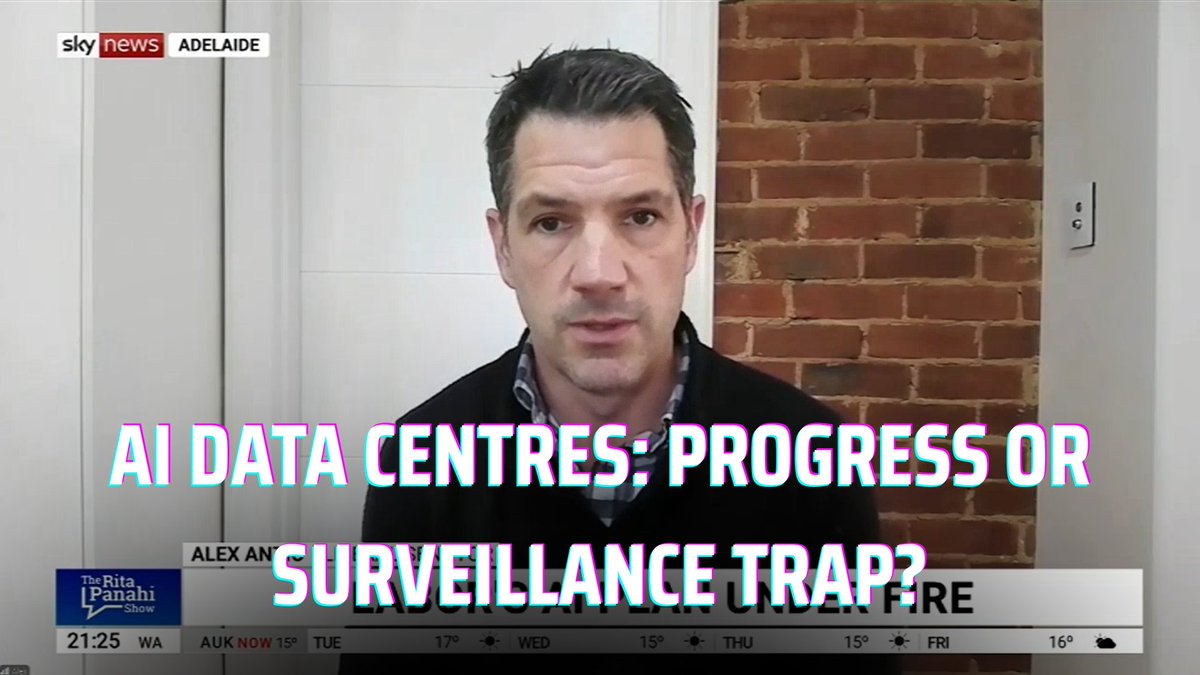
If climate change is an emergency, why build water/power hungry data centres? This Victorian AI Hub will guzzle more grid power than it generates onsite battery & turbines just prop up the shared system (with gas backups). Data centres could hit 13% of Australia’s electricity by 2040, spiking prices,...

17,564 görüntüleme • 1 ay önce •via X (Twitter)

0 Yorum

Yorum bulunmuyor

Orijinal gönderinin yorumları burada görünecek

Benzer Videolar

The biggest power grab since Standard Oil is happening today and almost nobody is paying attention. Tech companies are building their own power grid. They're about to produce more electricity than entire COUNTRIES. Right now at the White House, CEOs from Amazon, Google, Meta, Microsoft, OpenAI, Oracle, and xAI are signing a pledge that most people will scroll past. But it might be the most important business deal of the decade. They're committing to build, bring, or buy 100% of their own electricity for every new AI data center. Their own power plants. Their own transmission lines. Their own energy infrastructure. These are SOFTWARE companies agreeing to become power utilities. Here's why this matters for everyone reading this: By the end of this year, at least 5 US data centers will each consume over 1 gigawatt of continuous power. 1 gigawatt powers 850,000 homes. 5 of these facilities will use more electricity than some entire countries. The US grid physically cannot handle it. Capacity prices in the PJM grid, which covers 13 states, exploded from $28.92 per megawatt-day to $329.17 in just two years. That's literally a 1,000% increase. So what do you do when the grid can't support you? You stop using the grid. Amazon is buying nuclear reactors. Microsoft restarted Three Mile Island. Meta signed 20-year nuclear deals. Chevron is building a 2.5 gigawatt natural gas plant in West Texas specifically to power data centers. These companies aren't supplementing the grid. They're replacing it. For themselves. Think about what's actually happening here: 7 companies now control more computing power than most governments. And today they're signing paperwork to control their own energy supply too. Computing. Data. Energy. Infrastructure. That's not a "tech" company anymore. A Harvard energy law professor already called the pledge "meaningless" because utilities in PJM are spending tens of billions on power projects for data centers and those costs are STILL being spread across ratepayers anyway. The pledge has zero legal teeth. No enforcement mechanism. No compliance monitoring. No penalty for breaking it. It's a political move designed to get tech companies through the midterms without becoming the villain of every campaign ad about electricity bills. But the underlying shift is real and irreversible: Tech companies are becoming energy companies. Energy companies are becoming AI infrastructure. And the line between Big Tech and Big Energy is about to disappear completely. The big question here: When seven companies control both the world's intelligence AND the power that runs it, who exactly is governing who?

Ricardo

146,676 görüntüleme • 4 ay önce

In the next 15 years, data centers are expected to add an additional $160 billion to grid costs in the US Estimate say electricity rates for average households will spike by as much as 70% Data centers are projected to triple their share of US electricity demand in the next few years The main driver is the explosive growth of data centers built by Big Tech companies like Amazon, Meta, Microsoft, Google, OpenAI and more to power artificial intelligence Places like Northern Virginia already has over 200 data centers with massive new ones planned. Utilities are striking secret proprietary deals with Big Tech companies. These are hidden behind NDAs that shift much of the infrastructure costs onto regular residential customers Just in the PJM energy market of 13 states covering 65 million people, data centers were responsible for 63% of last year’s record 800% spike in capacity prices (This is INSANE) Residential customers in places like Virginia and Louisiana are being forced to subsidize billions in new power plants and grid upgrades for data centers. An Examples of this is in Louisiana, Meta’s data center deal leaves the public potentially on the hook for half or more of a $3–4 billion power plant Again, without major policy changes, average household electricity bills could rise by up to 70% over the next 15 years due to data center demand. There is only one real way we can stop this, we must create a separate customer class for data centers Maryland and Oregon have already passed laws doing this Forces data centers to pay for the specific infrastructure they need instead of spreading the costs to everyone else. More states need to do the same Ban secret sweetheart deals Require full public disclosure of all contracts between utilities and Big Tech Prohibit deals where data centers pay below the actual cost of service Make data centers pay the full cost of new power plants and grid upgrades Change regulations so utilities cannot socialize the cost of data-center-driven infrastructure to residential and small business ratepayers This needs to be done immediately

Wall Street Apes

57,720 görüntüleme • 1 ay önce

The world knows we have a PM who is more interested in headline-making announcements than the consequences that follow. A single Meta data center in Georgia reportedly consumes around 5,00,000 gallons of water every day — nearly 10% of an entire county’s supply. One facility in Iowa used almost a billion gallons in a year. Google’s operations consumed nearly 6.1 billion gallons of water in 2024 as AI cooling demands surged. Most of this water is lost through evaporation. Now imagine aggressively pushing this model into a water-stressed country like India. India already has 132 data centres and plans to add 87 more. Nearly 80% are foreign-funded. Governments are offering huge incentives — tax exemptions for years, subsidised land, electricity duty waivers, and special treatment for foreign corporations. Meanwhile, ordinary citizens are constantly told to save water and electricity. Google’s AI hub is coming up in Visakhapatnam. More such projects are being pushed across states in the name of “development,” yet hardly anyone is discussing groundwater depletion, electricity burden, environmental damage, or long-term sustainability. When communities in the U.S. began resisting these projects over water usage, electricity costs, land consumption, and noise pollution, companies started looking elsewhere. The Modi government readily embraced them — because for Modi headlines mattered more. Over $64 billion worth of data centre projects in the U.S. have reportedly been delayed or blocked due to growing public opposition over environmental and resource concerns. But in India, every announcement is celebrated without questioning who truly benefits — and who will pay the environmental price for decades to come.

Harmeet Kaur K 🇮🇳

16,254 görüntüleme • 1 ay önce

Dylan Patel just mapped out the most important investment theme in AI infrastructure (Save this). "In about two years, solar plus battery will be cheaper than gas." Every new NVIDIA Blackwell rack pulls 120 kilowatts, Rubin Ultra rack pulls 600 kilowatts and the next generation hits a megawatt. The US grid cannot keep up, interconnection queues now run five years in many markets so the entire industry is being forced to solve power from first principles. The solar thesis is already happening. BloombergNEF's 2026 LCOE report, covering 800+ financed projects across 50+ markets puts solar plus 4 hour battery storage at $57 per megawatt-hour. Combined cycle gas turbines hit $102 per megawatt hour, the highest on record, up 16% year over year. In California and parts of Texas, solar plus storage is already cheaper than gas for data center power today and solar panel costs are expected to drop another 30% by 2035. Getting power from the grid into the form chips actually require is an entire industry unto itself and NVIDIA just rewrote the rules. The 800 volt DC transition is the most important infrastructure shift that's happening right now. Today's data centers run on 48 volt DC power delivery, a single next-generation GPU pulls over 2,500 watts and at 48 volts, the current required to power a megawatt rack would melt the copper wiring. The investment thesis breaks into four layers and the first layer is power semiconductors, specifically silicon carbide and gallium nitride. At 800 volts, traditional silicon based IGBTs hit their physical limits. SiC and GaN devices are the mandatory replacement. Infineon estimates $175,000 of semiconductor content per megawatt of AI rack power, versus almost nothing today and by 2030, power semiconductor content per AI cabinet grows from $15,000 to $115,000+. The names here are Infineon ($IFNNY), ON Semiconductor ($ON), Wolfspeed ($WOLF), Navitas ($NVTS), and STMicroelectronics ($STM). The second layer is power management and conversion. Vertiv ($VRT) is NVIDIA's lead architectural collaborator for the 800V transition, building the hardware that converts grid AC to 800V DC and the DC to DC power shelves for ultra dense racks. Eaton ($ETN) and Monolithic Power Systems ($MPWR) round out this layer. The third layer is grid to site infrastructure, GE Vernova ($GEV) builds the heavy electrical equipment that connects utility power to the data center campus. Orders are running at twice the rate of shipments, the classic leading indicator of sustained multi year revenue growth. The fourth layer is behind the meter power generation like your bloom energy because grid interconnection queues run five years, hyperscalers are bypassing the grid entirely, building dedicated gas, solar and battery systems on site. Make sure to follow me Melvin for more opportunities across the AI supply chain.

Melvin

103,592 görüntüleme • 3 gün önce