Loading video...

Video Failed to Load

Go Home

“If you can vertically center a div, you can probably learn assembly”. Casey Muratori, Casey Muratori, programmer and performance nerd, on why it’s essential for optimization: “People often ask: assembly language, what would I ever need that for? There's a very good reason for it: everything else that you...

69,647 views • 3 days ago •via X (Twitter)

5 Comments

The Pragmatic Engineer's profile picture
The Pragmatic Engineer3 days ago

Find out why software performance matters and how developers can write faster code with Casey Muratori on The Pragmatic Engineer podcast: • YouTube: • Spotify: • Apple: • Summary and transcript:

mndz's profile picture
mndz3 days ago

@cmuratori Assembly generated by GHC (Haskell compiler) is incomprehensible to me. I spend years reversing malware and Haskell remains one of the best obfuscation techniques I’ve discovered.

Swarup Karavadi's profile picture
Swarup Karavadi3 days ago

@cmuratori Centering a div on a blank html page is one thing, centering a div while different parts of the dom tree use different layout schemes with z-index hacks littered all over is another thing. You can also look at llvm byte code - that is also quite informative.

Ben Mo's profile picture
Ben Mo3 days ago

@cmuratori one small loop, its generated assembly, then change one thing and look again. that feels like a much friendlier way in than starting with an instruction manual

Hi O'laverly's profile picture
Hi O'laverly2 days ago

@cmuratori It's also genuinely fun to build things in assembly. I'm not saying people totally exaggerate the impracticality of using it for larger projects, but you can easily structure projects in assembly just as in other languages to be manageable and extensible.

Related Videos

Rick Rubin tells Andrew Huberman how he deals with creative or writer’s block. He treats his work like a diary entry (and doesn’t worry about internal or external judgment): ➡️ “What's the cause of the block? The block is usually something that's either personal ("I'm not good enough") or it can be a confidence issue ("I don't have anything to say") or it could be...thinking about someone else ("nobody's going to like what I make"). Do you know what I'm saying? So, it's either fear of self-judgment or external judgment. If you're making something with a freedom of "this is something I'm making for myself for now", that is all [you have to do]. It is a diary entry. Everything I make is a diary entry. The beauty of a diary entry is that I can write my diary entry and you can't tell me that my diary entry wasn't good enough. Or that [the diary entry] is not what I experienced. Of course it's what I experienced: I'm writing a personal diary for myself and no one else can judge if it is my experience of my life. Everything we make can be that: a personal reflection of who we are in that moment of time. It doesn't have to be the greatest you could ever do. It doesn't have to have any expectation that it's going to change the world. It doesn't have to sell a certain number of copies for any reason. It doesn't have any of those things at all. It is "I'm making this thing for me and I want to do it to the best of my ability and to where I feel good about it". [The work] is honest of where I'm at and if you're living in this world of just being honest to where you're at, there's nothing blocking you. There are no blocks. The blocks are all based on dealing with a different force or a different perception that is made up.” ⬅️

Trung Phan

1,652,308 views • 2 years ago

Jordan Peterson: "If you can't fix your room, you can't fix your life" "Why should you even bother improving yourself? The answer is something like: so you don't suffer anymore stupidly than you have to. And maybe so others don't have to either. It's not some casual self-help doctrine. If you don't organize yourself properly, you'll pay for it. In a big way. And so will the people around you." Peterson continues: "You can say, 'Well, I don't care about that.' But that's actually not true, you do care about it. Because if you're in pain, you will care about it. It's very rare that you can find someone in excruciating pain who would say, 'Well, it would be no better if I was out of this.' Pain brings the idea that it would be better if it didn't exist along with it. It's incontrovertible." On how to start: "Look around for something that bothers you and see if you can fix it. You can do this in a room. Sit in your bedroom and think: 'If I wanted to spend ten minutes making this room better, what would I have to do?' You have to ask yourself that, it's a genuine question. And things will pop out. There's a stack of papers bugging you. Some rubbish behind your computer monitor you haven't attended to for six months. Cables tangled up." He explains why this matters: "If you were coming to see me for psychotherapy, the easiest thing would be to get you to organize your room. You think, is that psychotherapy? It depends on how you conceive the limits of your being. Start where you can start. If something announces itself as in need of repair that you could repair, fix it. Fix a hundred things like that, your life will be a lot different." On fixing what you repeat every day: "People tend to think of their daily routines as trivial. You get up, brush your teeth, have breakfast. Those probably constitute 50% of your life. People think, they're mundane, I don't need to pay attention to them. No, that's exactly wrong. The things you do every day are the most important things you do. Hands down. Just do the arithmetic." On staying within your competence: "Sometimes you don't know how to fix something. Imagine you're walking down the street and there's a guy who's alcoholic and schizophrenic and has been homeless for ten years. That's a problem. It would be good if you could fix it, but you haven't got a clue. You walk around that and go find something you could fix. Just because something announces itself as in need of repair doesn't mean it's you, right then and there, who should repair it. You have to have some humility. You don't walk up to a helicopter that isn't working and just start tinkering away." Peterson shares the key insight: "As soon as you give your mind a genuine aim, it'll reconfigure the world in keeping with that aim. That's actually how you see to begin with. You've all seen the video where you watch basketballs being tossed back and forth, and while you're doing that, a gorilla walks into the middle of the video and you don't see it. If you thought about that experiment for five years, that would be about the right amount of time to spend thinking about it." He explains what it reveals: "What it shows you is that you see what you aim at. If you can get one thing through your head, that would be a good one. You see what you aim at. One inference you might draw from that is: be careful what you aim at. What you aim at determines the way the world manifests itself to you. So if the world is manifesting itself in a very negative way, one thing to ask is: are you aiming at the right thing?"

Jaynit

68,799 views • 5 months ago

jihoon answering teumes’ worries at dawn live 👤: I really wanted to receive a psychiatric (treatment) but I don’t have the courage to do it. Should I go? I think I’m going to have a hard time accepting that I am falling apart. 🐶: but I recommend going to the psychiatrist, whether if it’s receiving a psychological counselling or a psychiatric examination, it’s good to receive a treatment for it. Everyone, going to the psychiatrist doesn’t make you weird. If you caught a cold, you go to the internal medicine department, If your joints or bones hurts, you go to the orthopaedics. It’s just a cold that come to the mind. It’s not that going to the psychiatrist makes me a weird person, no it’s not that. It’s just that I’m exhausted for a while, it’s just a hospital. There’s more people going there more than you think, if you go to hospital, the queuing are the longest. Nowadays, it’s the same as the past too but there’s no one who doesn't have a hard time. In this hard world, although there are people who look at the hard times in a good way, & there are also people who don’t look at it in a good way… but since it’s a world where we lived together, there's nothing we can do about it, right? But those kind of, “ah I went to the psychiatrist & I collapsed” I don’t think you have think of that. It’s just, “I am having a hard time these days so I’m just going to get help for it” just think of it as if you caught a cold. I hope you don’t think of this deeply. Of course you can go. If your stomach hurt, you can go to the internal medicine, if your head hurts, you can go to the Otolaryngology. It’s just that your heart is having a hard time for a while. This is not something to be ashamed of, you don’t need to read the air with the people around you for this. Always cheer up, even if you collapse, let's practice the strength that can make you rise again slowly, treasure makers. You can do it, everyone, I know you can do it.

ain

376,990 views • 2 years ago

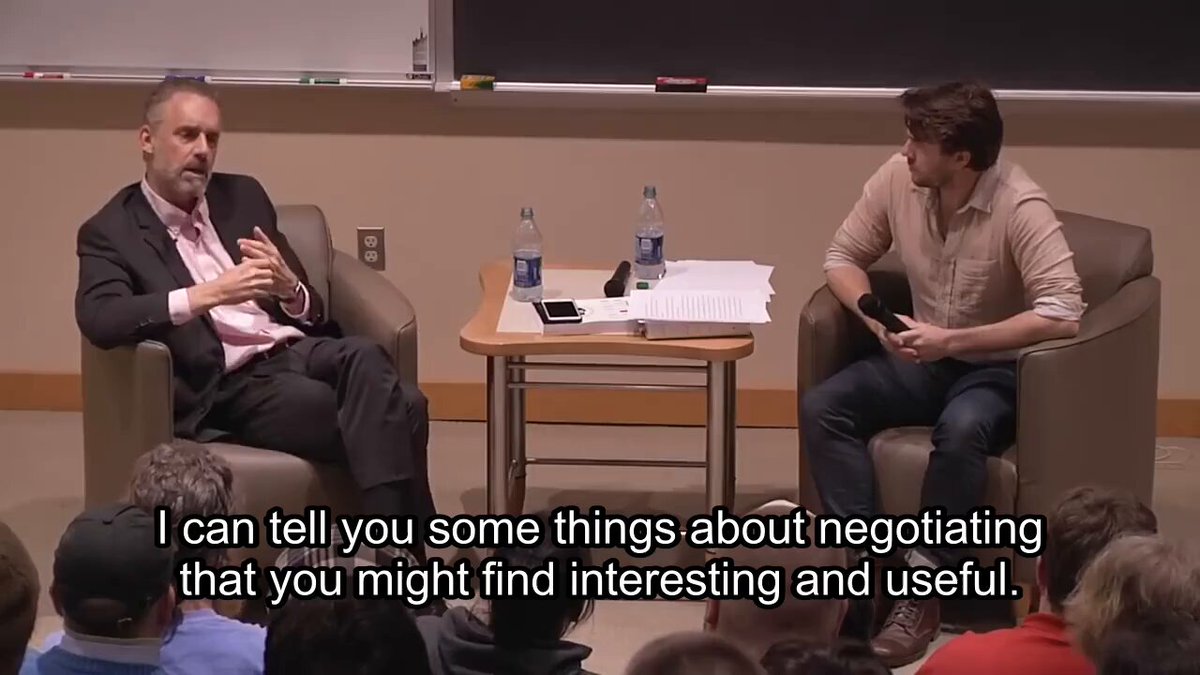
Jordan Peterson: "If you're competent and silent you will be ignored." "You might think well people should reward you because you're competent. And yes of course they should. But if you're competent and silent then you're just part of the background that's keeping everything functioning" On why you cannot negotiate from a position of weakness: "If you want to push your career forward you have to push it forward. You have to be competent and you have to be strategic" "To be strategic when you negotiate for a new position or a new salary you have to be able to say if you don't give me what I want then something you don't like will happen to you" "It's not a physical threat. It's that you have an option" "You have your CV in order. You're educated and competent and desirable to people outside of your immediate job. You're willing to instantly put yourself on the job market" "So that when you go talk to the person you're negotiating with you're credible" On the one thing most people completely miss about negotiation: "It's very seldom that you're talking to the person who's at the top of the pecking order. What you need to do is tell them a story that they can tell to their boss to make you not a problem" "A good story is look we really need this person because they're hyper competent and they have a better offer" "If you go in there with no power you're going to lose. Obviously" He concludes with the one thing every competent person needs to hear: "The first thing you need to know if you're going to negotiate is that you have to be able to say no. And what no means is that you're not going to do it"

Brad

35,334 views • 1 month ago

Martin Lewis, founder of MoneySavingExpert. com, on the four things it takes to be really successful, and why the most important one isn't what you'd expect: He opens with a clear framework: "It takes four things to be really successful. Talent, you've all got it, as do many more people than you think. Hard work. If you want to be really successful, you're going to have to work hard. Focus. Zone in on what you're good at." On focus, he pushes back against the idea that you need to be exceptional at everything: "Understand, none of us are unfailingly brilliant at everything. So, find the thing that you're good at and zone in on that. And that is what will create your success." But the fourth factor is where his message turns unexpected: "The most important thing is luck. You can do everything right, but it still not work for you. And you need to know that now." This reframes how he wants people to think about setbacks: "Failing does not make you a failure. Do not judge yourself. See it as a way to learn and to give yourself a better opportunity the next time." Martin Lewis then challenges a common assumption about what success actually delivers: "Success can be stressful. Success is not a synonym for happiness. As you go through your working careers, at sometimes you may want to make a call. Do I continue to push that hard or do I smile at what I've got and enjoy happiness and the other things that life starts to give me?" He closes with a message aimed at those who do make it big: "One or two of you in here will make it really big. If that's you, remember of those four things, the most important one is luck. And that means if you're that super successful one in the room, you have a moral duty to give back."

Big Brain Business

292,025 views • 5 months ago