Loading video...

Video Failed to Load

Go Home

I'm still exploring what I can do with Jev but I made this little app which does the following - talk about your day (or anything really) - audio gets transcribed to text - text is parsed for cues across 12 colours linked to an emotion [a logic I...

11,247 views • 14 days ago •via X (Twitter)

23 Comments

Soumya's profile picture
Soumya14 days ago

using all my subscriptions at one place with this app 🤪

Vamsi Batchu's profile picture
Vamsi Batchu14 days ago

this is so damn cool !

Soumya's profile picture
Soumya14 days ago

Thanks Vamsi! Haha :)

siddy's profile picture
siddy14 days ago

words → colours → painting → music 😭 this is such a beautiful use of Jev

Soumya's profile picture
Soumya14 days ago

Thanks!

micah rich's profile picture
micah rich14 days ago

Holy crow I love this what

Disha Shah's profile picture
Disha Shah13 days ago

this is such a cool idea, soumya! Love it!

siddharth's profile picture
siddharth14 days ago

fantastic!

Nihal Srivastava's profile picture
Nihal Srivastava14 days ago

This feels like more alive than a boring journaling. have you tried feeding the exact same story twice to see how consistent Jev’s colour interpretation is?

Soumya's profile picture
Soumya14 days ago

I did actually. My audio note was repeated once more because I kept taking pauses. Worked for me. But I will keep testing it because this is a huge issue with LLMs producing different results each time

Nihal Srivastava's profile picture
Nihal Srivastava14 days ago

Hmmm maybe having a fixed mapping between emotions and colours could help.. Let Jev figure out the emotion, but keep the emotion <> colour mapping deterministic idk

Soumya's profile picture
Soumya14 days ago

It is exactly doing that. I also mentioned that it is not repeating results, but I highlighted a risk with LLMs hallucinating.

Nihal Srivastava's profile picture
Nihal Srivastava14 days ago

Makes sense

Markiian's profile picture
Markiian14 days ago

words to a painting to a melody, so much fun

Aanand Madhav's profile picture
Aanand Madhav14 days ago

I can image an entire orchestra being played from one day of my emotional turmoils 😂😂

Shreyash Siddharth's profile picture
Shreyash Siddharth14 days ago

@amuldotexe so the music repeats after 12 ! permutations ?

Soumya's profile picture
Soumya14 days ago

@amuldotexe It will never repeat because it is taking cues from your audio input

Josh Madeiros's profile picture
Josh Madeiros13 days ago

What about this?

চৈতালি পাঠক's profile picture
চৈতালি পাঠক14 days ago

Have you looked into mapping this into Hawkins' levels of consciousness?

Josh Madeiros's profile picture
Josh Madeiros14 days ago

Explore here!

Brjan | AI Builder's profile picture
Brjan | AI Builder14 days ago

transcribing audio is a solid start, but parsing emotions adds real depth

Himanshu Gupta's profile picture
Himanshu Gupta14 days ago

great use of juvenile soumya

Deepak Sethi 🇮🇳 ॐ's profile picture
Deepak Sethi 🇮🇳 ॐ14 days ago

UPI पर MDR चार्ज का असर व्यापारियों और ग्राहकों पर क्या हो सकता है? इस विषय एक छोटा सा इंटरव्यू जरूर देखिए और अपनी राय साझा कीजिए। 🙏 👇 पूरी बात यहाँ 🙏👆

Related Videos

Jev has been blowing up lately. If you've got the Jev API but don't know how to play around with it yet, you can just copy this checklist. 1. jev-ultrafast A high-speed browser Agent built with Browser Use. Jev only judges "what to do, which element to click" at each step, and only calls the small model when typing is needed. Searching for a flight on Google Flights takes about 7 seconds. 2. fast-jev-compaction Context compression for Claude Code. Before each tool call, have Jev judge if there's anything still useful; delete the useless stuff, and keep the original text without rewriting it. 3. json-render Vercel Labs' generative UI framework. In experiments, Jev doesn't write JSON token by token; it just handles selecting components, properties, and layouts. 4. typesafe-mcp Best for people who just got the API. Plug Jev into Claude Code, Claude Desktop, Codex, and Pi, and do Choice / Score / Noul anytime. 5. jev-mcp Ready-made Agent judgment toolkit: fact-checking, content screening, semantic ranking, classification, and information extraction. 6. SemDecide Turn Jev into a command-line tool. Directly classify, score, and filter in the Shell—great for hooking up to crawlers, CI, and data pipelines. 7. jev-codex-router First have Jev judge how hard this round of programming tasks is, then decide the model tier, reasoning depth, and speed mode. 8. Winnow Context garbage collection for Claude Code. When Read / Bash / Grep spits out a ton of stuff, Jev first judges which parts are really relevant to the current task. 9. jev-review Before code review, run it through Jev first to pick out high-risk changes, then hand them off to a pricier big model or a human. Comes with a local dashboard. 10. Blink Use Jev as a code repository navigator. At each directory level, judge which files are most relevant to the current issue, then keep digging down. Copy these complete Jev blueprints - then read full Jev setup below ↓ ↓

rody

202,492 views • 14 days ago

If you are confused about why 𝗝𝗲𝘃 is being called the "Internet" moment for the AI industry. This is 100% worth your time. In fact, you should watch it: It tells LLMs what to do next, in milliseconds & at almost zero cost. If you set it up correctly, you will have the AI engineer’s setup for 2028. How to set up & use Jev (to actually get the 100x): 1. Join the waitlist; it's fairly quick: typesafe .ai. 2. Then go to Claude Code or Codex. 3. Choose Opus 5-Low or Sol-Low. 4. Copy and paste this prompt: "[claude or codex] plugin marketplace add typesafe-ai/skills [claude or codex] plugin install typesafe@typesafe-ai" 5. When you type /typesafe, the skill shows up. 6. Paste your API key once and click "Allow" 7. Start with $5 in free credit. It's hard to spend more. ----- Now, here are the 3 ways to actually use Jev: 1. Jev for Linkedin I have 38,000 connections & invitations on LinkedIn. I have a new company to launch. I need to find a couple of hundred people to message. to do while saving time: > Export your LinkedIn connections and invitations. > Connect Claude to GitHub, Vercel & Apify. > Create an Apify API key to enrich your data. > Go to LinkedIn Settings → Data privacy. > Get a copy. LinkedIn will email you a ZIP file. > Open the file & find the Connections CSVs. > Upload the files to Jev. > Use Jev to classify your contacts. > Review the shortlist. 2. Jev for Gmail To go through all of my Gmail contacts and email the right people. > Go to Google Contacts. Open Other contacts. > Select all contacts. Export them. > Upload the file to Claude Code or Codex. > Use Jev to sort them into: Keep, Review, Remove and Review everything before removing anything. 3. You got lost in Claude Code, GitHub, Vercel, Apify, Jev, Typesafe. I feel you. It is overwhelming. That’s why I included the entire copy-and-paste prompt for each use case in the newsletter: A 45-second TL;DR by Matija Sosic.

Ruben Hassid

172,145 views • 14 days ago

this is unreal f*cking gold for Jev builders 20 repos people are building on Jev right now. browser agents, context tools, trading bots, even a drone 1. JEV-Ultrafast - a browser agent built for speed ↳ 2. Fast-JEV-Compaction - squeezes your context down ↳ 3. JSON-Render - UI generated on the fly ↳ 4. Typesafe-MCP - plugs Jev into any client ↳ 5. JEV-MCP - a toolkit for judgment calls ↳ 6. Semdecide - a classifier right in your terminal ↳ 7. JEV-Codex-Router - sends every task to the model that fits it ↳ 8. Winnow - clears the junk out of your context ↳ 9. JEV-Review - sorts code reviews by what needs eyes first ↳ 10. Blink - finds your way around any repo ↳ 11. Agent-Desktop - runs your desktop for you ↳ 12. Typesafe-Mario - an agent playing Super Mario ↳ 13. JEV-Drone - flies a drone ↳ 14. OneVOneJev - a shooter in your browser ↳ 15. JEV-Trader - high-frequency market making ↳ 16. Prism - spots liquidity signals ↳ 17. Neo4Jev - walks a knowledge graph ↳ 18. JEV-Curate - screens training data ↳ 19. Canny - confirms a task is really finished ↳ 20. KillMyIdea - scores a startup idea before you sink time into it ↳ start where your work is: > coding -> JEV-Review, Blink, Canny, JEV-Codex-Router > context -> Fast-JEV-Compaction, Winnow > automation -> JEV-Ultrafast, Agent-Desktop > clients and tools -> Typesafe-MCP, JEV-MCP, Semdecide > UI -> JSON-Render > trading -> JEV-Trader, Prism > data -> Neo4Jev, JEV-Curate > founders -> KillMyIdea > for fun -> Typesafe-Mario, OneVOneJev, JEV-Drone pick one, build on it this week, and you'll be the person on your team who actually knows Jev engineering when it gets asked for

Mr. Buzzoni

11,667 views • 5 days ago

Jev is cool. So is it's OSS companion, Laya. The Latest Cool Thing In AI™ tends to get a lot of hype, sometimes without everyone even understanding it. So... what is this thing? Jev is an AI model that consumes input and produces output VERY differently than chat, claude, grok. The input is two things: 1) Text state to assess. Email, html, code, whatever. 2) A set of questions which will be asked about the attached state. The canonical example from TypeSafe's docs is to identify the urgency of a support ticket. We pass the model the customer text + a single noul question "is this urgent?". Jev returns a full set of JSON. This JSON is not generated with token-by-token autoregression. Jev is not trained to produce sequences of text tokens, rather to answer questions, and guarantees well-formed responses. In the example below, we see it produces a 0.99 probability (on a 0-1.0 scale) that the answer is "yes." Jev supports exactly three types of questions (seconds example in video): a) Noul: 0–1 probability that the answer to a yes/no question is "yes." b) Choice: Ask question with pre-defined set of answers. Jev chooses the best and assigns probabilities to each. c) Score: Ask question with pre-defined scale of answers. Jev produces a position on the scale. Jev computes answers for all questions in parallel, making responses super fast even for many questions in a single request. This might seem like a narrow set of capabilities, but in the right contexts leads to incredible potential. It also makes for a useful API / primitive for programming, since the outputs are... *ahem*... type-safe and predictable in structure. Jev is not going to replace LLMs for writing your code, auto-generating your docs, or being at the core of an agent harness. But Jev IS incredibly cool, and will be used to build a lot of amazing tech. Hope this helps.

Ben Dicken

40,810 views • 16 days ago

this is f*cking gold 20 GitHub repos with 500K+ combined stars that will level up your JEV workflow AGENTS > jev-ultrafast: Jev picks every click and DOM target, a small LLM only types > hermes-jev-skills: routing, memory, compaction and skill picks in one pack > typesafe-computer-use: OCR reads your Mac screen, Jev picks the next click MEMORY > fast-jev-compaction: scores every tool call keep, truncate or drop instead of summarizing > jevmem: project memory for Claude Code, Cursor and Codex, updated every turn > jev-second-brain: your Obsidian vault, Jev judges which notes duplicate, revise or contradict SAFETY > jev-guard: a gate before every tool call, Jev scores the risk, you set allow, ask or deny TOOLS > skills: the official TypeSafe skill for Claude Code and Codex > system-one-adapter-python: dry-run your questions on an ordinary LLM before you burn a Jev key > jev-mcp: claim checks, screening and ranking as MCP tools > typesafe-mcp: plug Jev into any MCP client > json-render: Vercel's generative UI, where Jev picks the components OPEN MODELS > SemIf-OpenJev: semantic ifs from frozen open models kev: Jev-like models on Qwen that run on your MacBook > laya-mlx: the Laya decision engine on Apple silicon > clm: an open System One model with Choice, Noul and Score > jevlike: train your own Jev-like model TRADING > jev-trader: one buy or sell decision per Monad block START HERE > awesome-jev: the biggest map of everything built on Jev > awesome-jev-by-typesafe: use cases, patterns and starter code bookmark it before your next build

NO1ennn

18,445 views • 7 days ago

Jev has been exploding in popularity recently. If you already have access to the Jev API but aren't sure how to start experimenting with it, just copy this checklist: 1. jev-ultrafast Browser Use's fastest agent. Jev decides the next action and which element to click, and a language model is only called when text has to be typed. 2. typesafe-mario Jev plays Super Mario Bros. from structured emulator state, choosing every action from features pulled out of the game. 3. jev-plays-pokemon Reads Pokémon Red's game state as text, answers typed questions each turn, and lets plain code turn the answers into moves. 4. jev-drone A camera-only autonomous drone in MuJoCo with a Jev judgment model sitting in the control loop at 2.5 Hz. 5. robo-harness A real SO-101 robot arm workbench where Jev picks bounded joint steps from typed candidate actions under a spend budget. 6. fast-jev-compaction Claude Code plugin that replaces the compaction summary with Jev decisions, scoring every tool call for whether it is still needed. 7. jev-claude Routes Claude Code's own judgment calls through Jev: typed choices with probabilities at plan approval, on questions, and before risky commands. 8. is-malicious Supply-chain check before you run anything: Jev Noul checks over source and build files, returning the implicated files and lines. 9. sqlite-jev Jev inside SQL. Noul, Choice and Score judgments exposed as SQLite functions, with confidence on every row. 10. jevinci Paints images by having Jev predict every pixel's colour in parallel, with confidence deciding how wide each stroke is drawn. Copy these complete Jev blueprints - then read full Jev setup below ↓ ↓

Hanako

29,894 views • 11 days ago

this is unreal f*cking gold for Jev builders 20 repos people are building on Jev right now. browser agents, context tools, trading bots, even a drone 1. JEV-Ultrafast - a fast browser agent ↳ 2. Fast-JEV-Compaction - context compression ↳ 3. JSON-Render - generative UI ↳ 4. Typesafe-MCP - use Jev with any client ↳ 5. JEV-MCP - a judgment toolkit ↳ 6. Semdecide - a classifier that lives in your CLI ↳ 7. JEV-Codex-Router - routes each task to the right model ↳ 8. Winnow - garbage collection for your context ↳ 9. JEV-Review - code review triage ↳ 10. Blink - a repo navigator ↳ 11. Agent-Desktop - desktop automation ↳ 12. Typesafe-Mario - an agent that plays Super Mario ↳ 13. JEV-Drone - drone control ↳ 14. OneVOneJev - a browser FPS ↳ 15. JEV-Trader - HFT market making ↳ 16. Prism - liquidity signal detection ↳ 17. Neo4Jev - knowledge graph traversal ↳ 18. JEV-Curate - training data screening ↳ 19. Canny - checks whether a task was actually completed ↳ 20. KillMyIdea - scores startup ideas before you build them ↳ pick by what you do: > coding -> JEV-Review, Blink, Canny, JEV-Codex-Router > context -> Fast-JEV-Compaction, Winnow > automation -> JEV-Ultrafast, Agent-Desktop > clients and tools -> Typesafe-MCP, JEV-MCP, Semdecide > UI -> JSON-Render > trading -> JEV-Trader, Prism > data -> Neo4Jev, JEV-Curate > founders -> KillMyIdea > just for fun -> Typesafe-Mario, OneVOneJev, JEV-Drone grab the one closest to your job and ship something on top of it this week

Mr. Buzzoni

29,333 views • 10 days ago

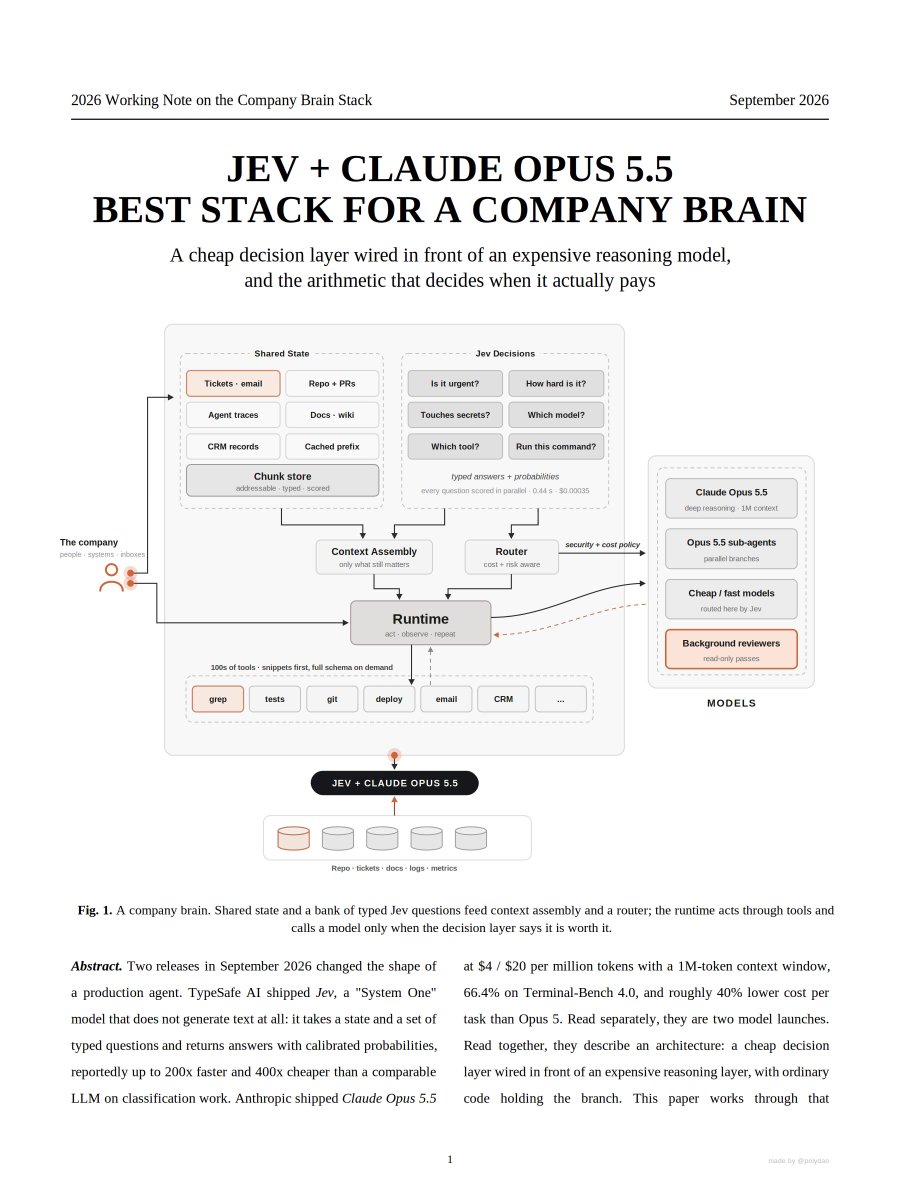
JEV + OPUS 5.5 IS INSANE FOR BUILDING A COMPANY BRAIN I pulled the whole architecture out of the TypeSafe and Anthropic docs and packed it into a 14-page PDF the 10 steps: 1. meet the pair > Opus 5.5 thinks, Jev decides, your code holds the branch 2. stop asking a text generator for a yes or no > Jev returns a typed answer with a calibrated probability in 0.44s for $0.00035 3. ask everything at once > Choice, Score and Noul run in parallel, so the fourth question costs almost nothing 4. branch on the number > 0.999 goes straight into the if statement. ~99% of turns end right here 5. stop routing blind > Opus 5.5 to Sonnet and back costs 5.84 against 3.32 for staying on 5.5 6. keep one context warm > cache reads at $0.20 per Mtok are 20x cheaper than a fresh load 7. escalate the hard part > the toughest 1% goes to Opus 5.5 with 1M context and 66.4% on Terminal-Bench 4.0 8. score every chunk on every query > keep whole, summarize or drop. the context gets rebuilt each turn 9. gate the actual command > every bash call gets classified before it runs, inside your own code 10. judge 100% of runs > $3.50 a day for 10,000 traces, and it matched the human label on all 500 decisions the result: a while loop that paid a frontier model for every tiny call turns into a brain that spends a fraction of a cent to notice and pays properly only when it has to think the person who brings this into their team walks into the budget meeting with the AI bill cut and the output up the PDF maps the company brain. the loop side of it - how Jev takes a Claude bill from $765 to $3 a month - is in the article below ↓

Mr. Buzzoni

85,590 views • 7 days ago