Loading video...

Video Failed to Load

Go Home

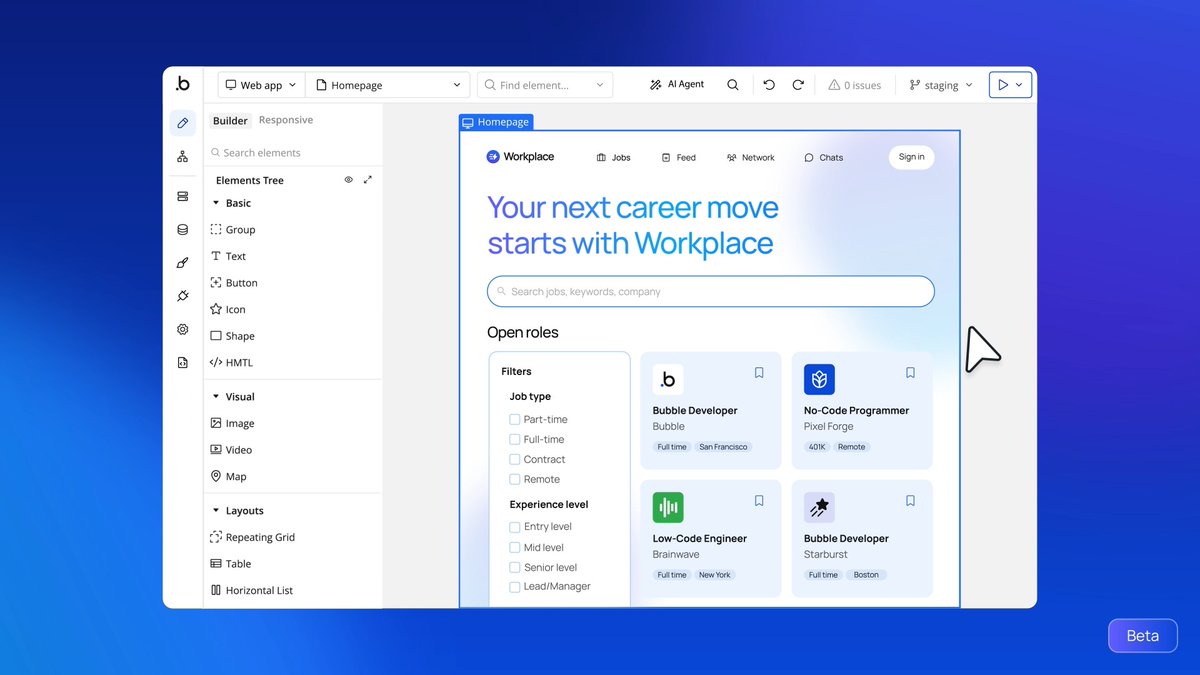
Image upload is live in the Bubble AI Agent — hand it a design reference or a mockup and it builds out that interface in the editor. It's also gotten better at understanding your app, so expression generation and responses are more reliable across the board. A picture is...

11,192,349 views • 1 month ago •via X (Twitter)

0 Comments

No comments available

Comments from the original post will appear here

Related Videos

Hermes agent just left the terminal. 𝗛𝗲𝗿𝗺𝗲𝘀 𝗗𝗲𝘀𝗸𝘁𝗼𝗽 dropped yesterday. native app for macOS, Windows, and Linux. for months Hermes was the agent that learned your projects, wrote its own skills, and built a model of who you are. all of it buried in terminal logs. now it has a window. the important part is that it's not a wrapper. it runs the same agent core, the same sessions, memory, and skills as the CLI. you can start a task in the terminal and finish it in the app without anything resetting. the state is shared across every interface, not copied between them. what the GUI actually adds: → streaming chat that shows live tool calls and inline reasoning instead of a spinner → a preview rail that renders pages, code, and images right beside the conversation → an artifacts panel that collects every file the agent has ever produced → remote gateway mode, so you can point the app at a VPS and run the heavy work elsewhere → skills, cron, profiles, and gateways managed point-and-click instead of through YAML → voice mode, drag-drop files, and inline image generation remote gateway mode is the one worth slowing down on. the agent runs 24/7 on a $5 server while you control it from your laptop like a local app. other agent UIs are chatboxes with a logo. this one shows the autonomy instead of hiding it, so you watch the skills load, the tools fire, and the artifacts pile up as it works. it was teased in Jensen's GTC keynote. MIT licensed, local-first, no telemetry. if you already run Hermes, download it and everything is already there. your chats, memory, and skills carry straight over. i wrote a full masterclass on Hermes Agent that walks through the SOUL. md identity layer, the three-tier memory system, the self-evolving skills loop, and how to run three specialized agents 24/7. desktop is the interface that finally does all of it justice. the article is quoted below.

Akshay 🚀

50,822 views • 16 days ago

Anthropic's in trouble, again! They spent years building what's now fully open-source. What made Claude feel different from a normal app is that the agent could act inside the interface instead of only talking in a chat box. For instance, Claude Artifacts let an agent render real UI, charts, dashboards, and interactive components that assemble live inside the response. Every major AI product tried to replicate it. But the problem was that unlike reasoning, planning, tool-calling, etc., none of it shipped natively with LangGraph, CrewAI, or Google ADK. So teams started building an owned version that required engineering the entire interface layer from scratch. Most teams, however, just settled for shipping the agent as a backend API in a chat box since rendering the UI is only one piece of it. To actually make it work, the interface layer also needed real-time streaming, state kept in sync between agent and UI, conversations that persist across sessions, and reconnection when a user refreshes mid-run. CopilotKit🪁 is now the only open-source framework that actually lets you build your own full-stack Claude-like apps. It decouples the agent from the interface, talking over AG-UI (an open protocol for agent-to-user communication). Being a standard protocol, the frontend never needs to know whether it is talking to a LangGraph or a CrewAI agent. You can change the backend anytime and the UI will never notice. In practice, CopilotKit's interface layer gives several pre-implemented React building blocks that wire the agent directly into the app, like: - generative UI, so the agent renders real components instead of text - chat windows, sidebars, and popups, or a fully headless setup - shared state, so the agent and app stay in sync - human-in-the-loop approvals, where the agent waits before acting - persistent threads that store the whole session, including the agent-user interactions and generated UI, not just text And because that full history is captured, those interactions can feed a self-learning layer that also improves the agent from real usage over time. The interface layer that Anthropic spent years engineering in-house is now literally available to any developer/team. CopilotKit is open-source with 30k+ GitHub stars, and AG-UI, the protocol underneath, is already supported across every major agent framework: LangGraph, CrewAI, Mastra, Google ADK, and more. CopilotKit GitHub repo → (don't forget to star it ⭐ ) If you want to go deeper, I found a detailed breakdown by Shubham Saboo recently on the three Generative UI patterns, with implementation. Read it below.

Avi Chawla

449,931 views • 15 days ago