正在加载视频...

视频加载失败

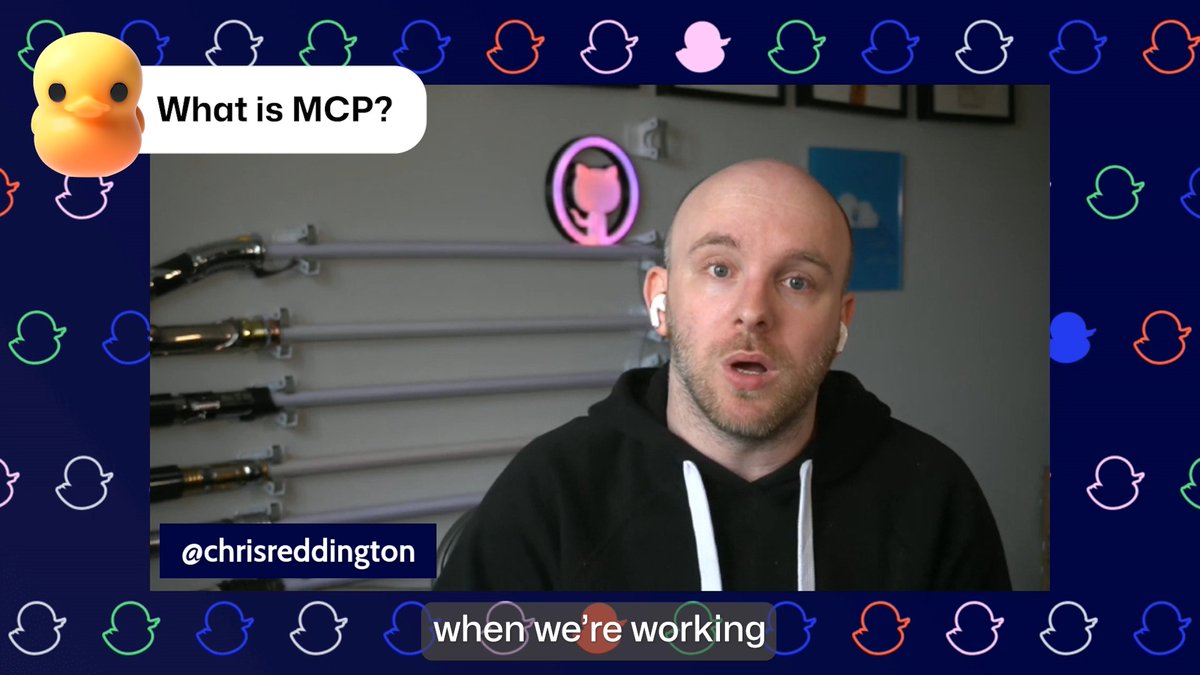
In this video, we break down the Model Context Protocol — a massively underrated concept in AI that's quietly redefining what large language models can do. While most people are distracted by the hype, MCP is solving a core problem: LLMs that can perform actions. We dive into: 1....

41,117 次观看 • 1 年前 •via X (Twitter)

5 条评论

Puzzle Paws 的头像
Puzzle Paws1 年前

Finally, MCP gets the attention it deserves! Core problem-solving over hype any day. Real-world examples like SEO show its true potential. 🚀

AssemblyAI 的头像
AssemblyAI1 年前

Announcing: Our most advanced speech-to-text model goes beyond accuracy to capture the real-world complexity of human conversation and deliver reliable, source-of-truth audio data. Explore Universal-2 updates 👇

Anurag Sharma 的头像
Anurag Sharma1 年前

github repo?

Gaurav Sen 的头像
Gaurav Sen1 年前

It's here:

Usman Salami 的头像
Usman Salami1 年前

Great explanation 👍
相关视频

New course: MCP: Build Rich-Context AI Apps with Anthropic. Learn to build AI apps that access tools, data, and prompts using the Model Context Protocol in this short course, created in partnership with Anthropic Anthropic and taught by Elie Schoppik Elie Schoppik, its Head of Technical Education. Connecting AI applications to external systems that bring rich context to LLM-based applications has often meant writing custom integrations for each use case. MCP is an open protocol that standardizes how LLMs access tools, data, and prompts from external sources, and simplifies how you provide context to your LLM-based applications. For example, you can provide context via third-party tools that let your LLM make API calls to search the web, access data from local docs, retrieve code from a GitHub repo, and so on. MCP, developed by Anthropic, is based on a client-server architecture that defines the communication details between an MCP client, hosted inside the AI application, and an MCP server that exposes tools, resources, and prompt templates. The server can be a subprocess launched by the client that runs locally or an independent process running remotely. In this hands-on course, you'll learn the core architecture behind MCP. You’ll create an MCP-compatible chatbot, build and deploy an MCP server, and connect the chatbot to your MCP server and other open-source servers. Here’s what you’ll do: - Understand why MCP makes AI development less fragmented and standardizes connections between AI applications and external data sources - Learn the core components of the client-server architecture of MCP and the underlying communication mechanism - Build a chatbot with custom tools for searching academic papers, and transform it into an MCP-compatible application - Build a local MCP server that exposes tools, resources, and prompt templates using FastMCP, and test it using MCP Inspector - Create an MCP client inside your chatbot to dynamically connect to your server - Connect your chatbot to reference servers built by Anthropic’s MCP team, such as filesystem, which implements filesystem operations, and fetch, which extracts contents from the web as markdown - Configure Claude Desktop to connect to your server and others, and explore how it abstracts away the low-level logic of MCP clients - Deploy your MCP server remotely and test it with the Inspector or other MCP-compatible applications - Learn about the roadmap for future MCP development, such as multi-agent architecture, MCP registry API, server discovery, authorization, and authentication MCP is an exciting and important technology that lets you build rich-context AI applications that connect to a growing ecosystem of MCP servers, with minimal integration work. Please sign up here!

Andrew Ng

142,010 次观看 • 1 年前

If your MCP server has dozens of tools, it’s probably built wrong. You need tools that are specific and clear for each use case—but you also can’t have too many. This creates an almost impossible tradeoff that most companies don’t know how to solve. That’s why I interviewed my friend Alex Rattray (Alex Rattray), the founder and CEO of Stainless. Stainless builds APIs, SDKs, and MCP servers for companies like OpenAI and Anthropic. Alex has spent years mastering how to make software talk to software, and he came on the show to share what he knows. I had him on Every 📧’s AI & I to talk about MCP and the future of the AI-native internet. We get into: • Design MCP servers to be lean and precise. Alex’s best practices for building reliable MCP servers start with keeping the toolset small, giving each tool a precise name and description, and minimizing the inputs and outputs the model has to handle. At Stainless, they also often add a JSON filter on top to strip out unnecessary data. • Make complex APIs manageable with dynamic mode. To solve the problem of how an AI figures out which tool to use in larger APIs, Stainless switches to “dynamic mode,” where the model gets only three tools: List the endpoints, pick one and learn about it, and then execute it. • MCP servers as business copilots. At Stainless, Alex uses MCP servers to connect tools like Notion and HubSpot, so he can ask questions like, “Which customers signed up last week?” The system queries multiple databases and returns a summary that would’ve otherwise taken multiple logins and searches. • Create a “brain” for your company with Claude Code. Alex built a shared company brain at Stainless by keeping Claude Code running on his system and asking it to save useful inputs—like customer feedback and SQL queries—into GitHub. Over time, this creates a curated archive his team can query easily. • The future of MCP is code execution. Instead of giving models hundreds of tools, Alex believes the most powerful setup will be a simple code execution tool and a doc search tool. The AI writes code against an API’s SDK, runs it on a server, and checks the docs when it gets stuck. This is a must-watch for anyone who wants to understand MCP—and learn how to use them as a competitive edge. Watch below! Timestamps: Introduction: 00:01:14 Why Alex likes running barefoot: 00:02:54 APIs and MCP, the connectors of the new internet: 00:05:09 Why MCP servers are hard to get right: 00:10:53 Design principles for reliable MCP servers: 00:20:07 Scaling MCP servers for large APIs: 00:23:50 Using MCP for business ops at Stainless: 00:25:14 Building a company brain with Claude Code: 00:28:12 Where MCP goes from here: 00:33:59 Alex’s take on the security model for MCP: 00:41:10

Dan Shipper 📧

15,645 次观看 • 9 个月前

. OpenLedger x : The full episode Our core contributor Ram sat down with Sreeram Kannan (founder ) to discuss verifiable AI, crypto's app problem, AI's trust problem and much more Check out the video below to learn more Timestamps: 00:00 Sreeram's introduction 00:29 How to build verification for AI systems 01:27 The Crypto and AI problem 03:10 Unstoppable AGI 05:08 What is Verifiable AI 06:05 The Verifiability Problem with Centralized AI 07:15 The current state of AI and its future 08:48 How humans are getting better at intelligence extraction 10:31 What is OpenLedger doing 11:50 Where LLMs fall short and how co-ordination helps 12:50 SLMs are already there 13:29 Crypto as an incentivisation mechanism 15:38 Apps with commitments, achieving product market fit 16:50 Existing examples of commitments in society 18:24 Investable AI 19:00 Data contributors as co-owner 21:30 The solution for the incentivisation problem 22:25 Explaining explainable AI 23:58 Trusting the trustless way 25:07 Data is the new oil 25:40 The idea of openledger is very crypto native 26:50 David v Goliath (in the data perspective) 28:03 What Eigen is working on 29:06 Making unstoppable verifiable AI practically possible 32:20 What Sreeram uses for productivity 33:30 Make Eigen Labs agentic 34:16 (community question) How Sreeram frames his prompts 36:08 (community question) What's the momentum driver for blockchain apps and what is Sreeram most excited about? (ZkTLS) 38:54 (community question) Where is attribution and verification really needed in AI?

OpenLedger

274,745 次观看 • 1 年前