Video wird geladen...

Video konnte nicht geladen werden

Zur Startseite

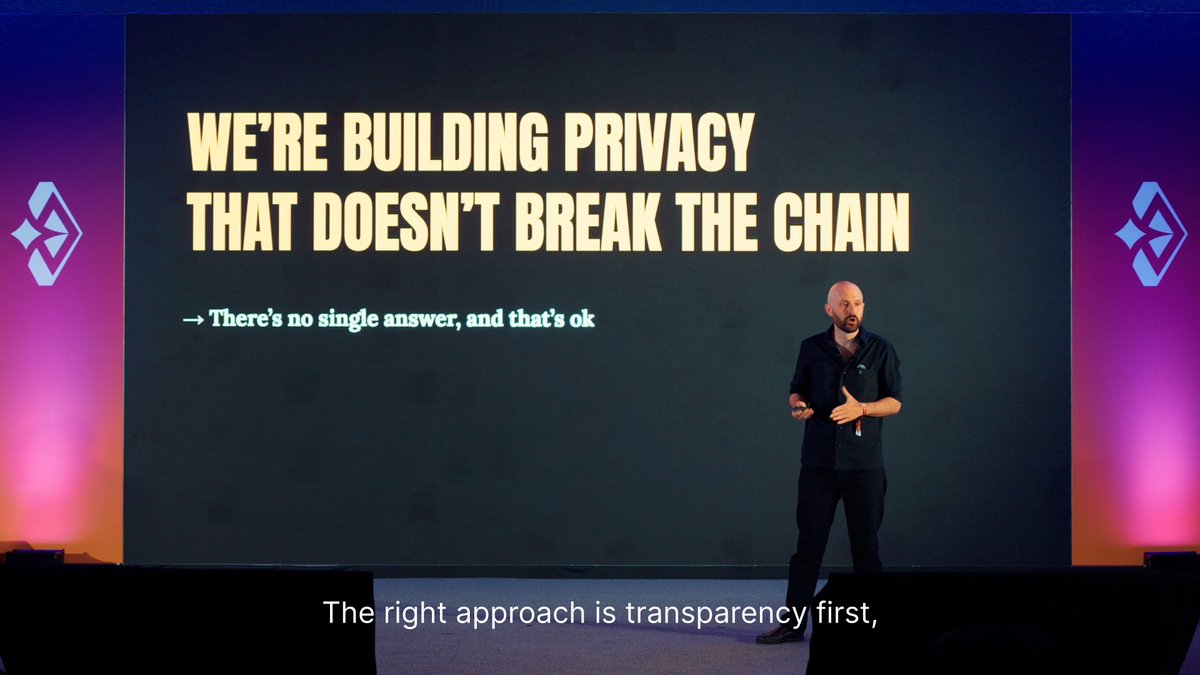
Institutional privacy starts before a transaction is finalized. By default, pending transactions are public on Aptos and most networks. For users and traders, and especially institutions placing large orders, that's where MEV risk shows up. Encrypted Mempool adds a choice.

32,865 Aufrufe • vor 4 Tagen •via X (Twitter)

0 Kommentare

Keine Kommentare verfügbar

Kommentare vom Original-Post werden hier angezeigt

Ähnliche Videos

Canton Network vs. Ethereum: What's the Difference? Ethereum (Ethereum) is a general-purpose public blockchain where transactions and smart contract activity are broadly visible across the network. Validators use proof-of-stake to agree on the chain’s state. Canton Network (Canton Network) takes a different approach, focusing on privacy, interoperability, and institutional financial workflows. Here are the key differences: (1) Privacy Ethereum is transparent by design. Addresses, balances, transactions, contract calls, and events can generally be inspected publicly. Ethereum is now researching additional privacy technologies, including private reads, private transactions, and zero-knowledge proofs. Canton uses sub-transaction-level privacy. Participants only receive the transaction data relevant to them, while sensitive information is shared on a need-to-know basis. (2) Network Structure Ethereum operates as a public blockchain with a shared global state maintained by its network of nodes and validators, plus layer 2 networks that settle back to it. Canton is designed as a network of networks. Applications can operate across different participant nodes and synchronizers while remaining interoperable, connected through the public Global Synchronizer run by super validators. (3) Consensus Ethereum’s proof-of-stake system uses validators to propose and attest to blocks, with validators staking ETH to participate in network security. Canton separates transaction validation from transaction ordering and confirmation. The participants involved in a transaction validate the relevant smart contract state, while synchronizers coordinate ordering and commits. (4) Smart Contracts Ethereum uses the Ethereum Virtual Machine, allowing developers to deploy programmable smart contracts across a broad public ecosystem. Canton uses Daml-based smart contracts and gives applications control over privacy, governance, permissions, and operating policies. This makes Canton particularly suited to workflows where different institutions need to interact without exposing every transaction to the entire network. (5) Main Use Cases Ethereum has developed into a broad platform for DeFi, NFTs, stablecoins, decentralized applications, and other permissionless applications. Canton is focused heavily on financial infrastructure, including tokenized assets, payments, institutional markets, and workflows requiring confidentiality. So, Ethereum emphasizes public verification and permissionless composability, while Canton emphasizes privacy-preserving interoperability between institutions on a public network.

BSCN

27,733 Aufrufe • vor 1 Monat

Introducing COTI 2.0 Private Programmable Money COTI shifts into its next phase, with a new website to match. > Same foundation. Bolder vision. 1. The Vision The world's money will soon move the way information does, on open networks. But those networks are public, and nobody wants to run their finances in public. COTI is now critically tasked with changing that. Its mission is to make private programmable money the global standard, so institutions, businesses, developers and individuals can hold, move and settle value on public blockchains, confidentially. COTI exists to champion this cause. 2. The Foundation Since 2017, COTI has built the privacy technology this next phase runs on. It was the first network to run garbled circuits in production, computing directly on encrypted data so inputs stay encrypted from submission to settlement. Its institutional-grade technology has been developed across leading institutions: 1. European Central Bank 2. Bank of Israel 3. Input Output Global (IOG) 3. Privacy-on-Demand Privacy-on-Demand serves as COTI's privacy layer for other blockchains. It allows applications to keep their users and assets on their existing chain, while COTI handles the private computation. Avalanche was the first network to bring it to production. Since September 17, applications on Avalanche have been computing on confidential data, and users have been shielding AVAX and USDC through the Privacy Portal. Expansion to further networks is a core part of the roadmap. 4. New Products At the centre of COTI 2.0 are two new products, designed to keep transactions private when moving money between blockchains, and when spending it in day to day life. 1. Interphase - The flagship. It serves as the global privacy layer for moving assets between blockchains, and executing confidential, unlinked transfers across 30+ major networks. 2. COTI Global - A new central application, which allows COTI to be spent as a privacy payment rail for everything in day to day life. 5. What's Next The new website and public roadmap are the first of several major upgrades coming this month.

COTI Foundation

43,851 Aufrufe • vor 1 Monat

How Does Canton Network Keep Transactions Private? On Ethereum and most public chains, every node sees every transaction. Canton (Canton Network) works differently as each party only sees the parts of a transaction it is involved in. (1) Need-To-Know Privacy Unrelated parties don't just miss the details. They don't even know the transaction exists. (2) Visibility Is Written Into The Contract Canton's smart contract language, Daml, defines who can see each contract. Signatories and observers see it. Everyone else sees nothing unless they're explicitly added. (3) Sub-Transaction Privacy One transaction can be split into separate "views." If Alice pays Bob and Bob pays Charlie in one atomic trade, Alice never learns about Charlie, and Charlie never learns about Alice. A regulator can see a trade too, but only if it's added as an observer. (4) The Infrastructure Is Blind Each view is encrypted for its recipients. The synchronizer, which orders transactions, only sees encrypted messages plus routing data like timestamps and party IDs. It can't read amounts, prices, or terms. (5) Only Stakeholders Validate Instead of every validator checking every transaction, only the parties involved confirm it. This keeps data private without weakening integrity. (6) Privacy Across Apps Transactions can span multiple applications atomically, with the same privacy rules applied throughout. For banks and asset managers, this design addresses a long-standing problem with blockchains: settling on shared infrastructure has usually meant exposing trades, loan terms, and positions to competitors.

BSCN

20,613 Aufrufe • vor 1 Monat