Video wird geladen...

Video konnte nicht geladen werden

Zur Startseite

InterLink’s Early Vision for NIST-Standardised Post-Quantum Cryptography 🔐✨ The next five years may bring a much clearer answer to a question that has long been difficult to judge: Is a digital asset truly secure? 🤔 For InterLink, the answer may increasingly depend on one critical factor: whether it is...

22,550 Aufrufe • vor 2 Tagen •via X (Twitter)

0 Kommentare

Keine Kommentare verfügbar

Kommentare vom Original-Post werden hier angezeigt

Ähnliche Videos

🚨 SCIENTISTS SAY “MAGIC” MAY BE WHAT GIVES SPACE-TIME ITS GRAVITY. For years, physicists have understood how entanglement can build the structure of space-time in holographic models. But something was missing: why does space-time curve in response to matter the essence of gravity? A team including Charles Cao and John Preskill now proposes the missing ingredient is a quantum property called “magic” a measure of how complex and non-classical a quantum state is (the kind that makes quantum computers hard to simulate classically). In their theoretical framework, adding this magic turns rigid space into something that can bend. Matter can now tell space how to curve. Why this matters: • It offers a new way to think about how gravity emerges from quantum information • It connects ideas from quantum computing (error correction, magic states) directly to fundamental physics • It suggests space-time itself may be one of the most quantum objects in existence The deeper implication: Gravity may not be a fundamental force at all. It may be what happens when quantum information becomes sufficiently complex and “magical.” This is still early theoretical work in specific holographic models. But it hints that the pliability of the universe might have quantum roots we are only beginning to understand. What do you think is gravity ultimately just extremely complicated quantum information, or do you think we’re still missing something much deeper? Follow for more frontier quantum gravity and quantum information research.

TheNewPhysics

15,329 Aufrufe • vor 2 Monaten

🚨 JAPAN JUST PUT A REAL QUANTUM COMPUTER ONLINE FOR THE WORLD TO ACCESS. And most people still don’t realize how big this moment is. For decades, quantum computers sounded like science fiction: machines that use quantum states instead of ordinary binary bits. Now researchers in Japan have opened access to a real superconducting quantum system connected to the internet. Why this matters: • quantum simulations • next-generation AI research • new material discovery • drug development • cryptography disruption • solving problems impossible for classical computers But quantum computers work nothing like normal machines. A regular computer checks possibilities one at a time. A quantum computer can explore many probability states simultaneously through superposition and entanglement. In simple terms: It doesn’t just calculate faster… It calculates differently. That’s why these systems look so strange. The giant gold structure isn’t “the computer” itself. It’s an ultra-cold dilution refrigerator designed to keep the quantum processor near absolute zero so fragile quantum states don’t collapse. The terrifying implication is this: Humanity may be entering the first era where computation starts operating on the rules of quantum reality itself. And once quantum hardware becomes scalable… Entire industries may be rewritten from the ground up. What happens when computers stop thinking like machines… and start behaving like physics itself? Which field do you think gets transformed first and would you actually trust it with something important?

Paul White Gold Eagle

60,306 Aufrufe • vor 2 Monaten

InterLink’s Journey to the World’s Top 10 Most Accurate AI Models Artificial Intelligence has rapidly become the defining force of this decade powering breakthroughs across every industry. But while most projects chase trends, InterLink Labs 👤 + 🌐 has been quietly building something deeper: an AI ecosystem grounded in verified human intelligence. Long before AI captured global headlines, InterLink Labs 👤 + 🌐 had already begun its research and engineering efforts back in 2019, assembling a world-class team of engineers and researchers from Big Tech companies and top QS-ranked universities. Their vision was clear - to build a model that truly understands humans, not just data. Unlike traditional AI systems trained purely on digital information, InterLink Labs 👤 + 🌐’s Human-AI Model learns from verified human behavior across millions of Human Nodes. This unique layer of authentic, real-world human input gives InterLink’s AI an unprecedented advantage in trustworthiness, bias reduction, and contextual understanding. Beyond algorithmic optimization, InterLink Labs 👤 + 🌐’s R&D efforts are being scaled to an unprecedented level. The team operates over 100 NVIDIA H100 servers, processing massive volumes of verified behavioral data contributed by real Human Nodes across the world. This data - diverse, decentralized, and human-validated forms the foundation of a next-generation intelligence system designed to mirror real human reasoning patterns. At the same time, InterLink Labs 👤 + 🌐’s AI-powered Human Credit Score applies advanced machine learning to analyze authenticity, contribution, and reliability. Creating an ethical model of digital reputation and fairness. Aligned with National Institute of Standards and Technology (National Institute of Standards and Technology) evaluation standards, InterLink Labs 👤 + 🌐 now aims to achieve Top 10 accuracy globally among AI models. Competing with research teams from Samsung Electronics, Kakao, キヤノン株式会社 / Canon Inc., and other global giants, InterLink Labs 👤 + 🌐’s engineers continue to train, benchmark, and refine their architecture daily to reach world-class precision and consistency. But this is more than a technical race. It’s a human mission. Every verified user contributes to the world’s first Human-Powered Intelligence Network, where real people fuel the evolution of trustworthy AI. As InterLink Labs 👤 + 🌐 advances toward global National Institute of Standards and Technology recognition, one truth becomes clear: The future of intelligence won’t be artificial. It will be human-powered. #InterLink #ITLG #ITL

InterLink Labs 👤 + 🌐

51,489 Aufrufe • vor 9 Monaten

The largest theft in history has already happened. The people behind it just cannot open what they stole yet. Right now, intelligence agencies and criminal groups are quietly copying the world's encrypted data, bank records, medical files, state secrets, private messages, and storing every byte untouched. They cannot read any of it. They are collecting it anyway, because they know the key is about to be invented. The strategy has a name, harvest now, decrypt later, and in 2026 it stopped being theory. Washington declared this the Year of Quantum Security in January, backed by the FBI, the NSA, and NIST. Canada ordered every federal agency to file a migration plan by April. Europe set its deadline for December. Governments do not impose operational deadlines on a someday problem. They do it when the clock is already running. Here is what moved the clock. Every password, every transfer, every secret on Earth is protected by one assumption, that a certain math problem is too hard to solve. Quantum computers solve exactly that problem. For years the machine that could do it looked decades away. Then in late 2025 Google's Willow chip cracked the hardest part of building one, and in March 2026 Google's own researchers estimated that breaking the encryption behind Bitcoin might take fewer than 500,000 qubits, down from 20 million, and could run in minutes. The day this becomes real has a name, Q-Day, and the latest estimates place it between 2030 and 2033. Now make it concrete. Roughly 6.5 million Bitcoin, about a third of every coin that will ever exist, worth close to 500 billion dollars, sit in addresses that have already exposed the very key a quantum computer needs. That includes the coins of Satoshi, the anonymous creator. On Q-Day they become, in the researchers' own word, trivially stealable. It would not look like a crash or a whale selling. It would look like half a trillion dollars of the most secure money ever built simply walking out the door. The asset designed to trust no one and no institution turns out to rest on a single unverified bet, that one math problem stays hard forever. This is what sits beneath the entire digital world. A bank balance, a Bitcoin, a classified cable, all of it is real only because of a proof you supposedly cannot forge. Quantum breaks the proof. Everything we call secure is true only until someone finally checks, and for the first time the check is visible on the horizon. You cannot know whether your data has already been copied. You cannot know the exact day the key arrives. The trust holding up the digital age is a clock counting down to a zero no one can see. The honest counter matters. No machine on Earth can break this encryption today, and serious cryptographers still argue the real threat is a decade or more away. The timeline is far from certain. Quantum-safe codes already exist, the migration has started, and Bitcoin can move its coins to safety before Q-Day if it acts in time. The danger is not that everything breaks tomorrow. It is that anything which must stay secret into the 2030s, a state secret, an identity, a private key, is being stolen today and is already on the clock. The breach is not coming. It is already here, sitting in storage, perfectly encrypted, waiting for a machine that does not exist yet to read it out loud. Research and opinion, not investment advice.

Shanaka Anslem Perera ⚡

185,481 Aufrufe • vor 1 Monat

🚨 SCIENTISTS JUST FOUND A WAY TO CONTROL QUANTUM LIGHT BY SIMPLY TWISTING ATOM-THIN LAYERS LIKE TUNING A GUITAR STRING. Researchers at the University of Technology Sydney have discovered that twisting and restacking layers of hexagonal boron nitride (hBN) gives them unprecedented control over quantum emitters tiny defects that produce single photons of light. By changing the twist angle between layers, they can significantly shift the color and wavelength of the quantum light being emitted. This level of tuning is much larger than what’s typically possible with other quantum materials. Why this matters: • Quantum emitters are essential building blocks for quantum computers, secure communication, and ultra-sensitive sensors • Until now, precisely controlling their properties has been extremely difficult • hBN’s natural layered structure allows researchers to repeatedly pick up, twist, and restack layers to fine-tune the emitters • The tuning achieved here is significantly stronger than in most other platforms The deeper implication: This approach turns a fundamental property of 2D materials (twistronics) into a practical tool for quantum photonics. Instead of trying to force hBN to behave like traditional materials like diamond or silicon carbide, the team leveraged its unique strength: its ability to be twisted and reassembled like atomic-scale LEGO. If this technique can be scaled and integrated into devices, it could accelerate the development of practical quantum technologies by giving engineers a simple, powerful way to control single-photon sources on demand. How important do you think precise control over quantum light sources will be for building real-world quantum computers and networks? Follow for more frontier quantum materials and photonics breakthroughs.

TheNewPhysics

18,762 Aufrufe • vor 1 Monat

🚨 PHYSICS SHOCKWAVE Scientists fed the Fibonacci sequence into a quantum computer… and the system started behaving as if it had an extra direction of time. Not science fiction. Real quantum physics. Researchers used laser pulse patterns based on the Fibonacci sequence to create a strange new phase of matter inside a quantum computer. The result: quantum information survived dramatically longer than expected. Normally, qubits lose coherence quickly. But the Fibonacci-driven system behaved differently. The quasiperiodic pulse structure created a highly stable quantum state that resisted errors far more effectively than ordinary repeating patterns. Researchers described the system as behaving as if it had: “two distinct directions of time.” The deeper shift: The Fibonacci sequence may not just appear in: • shells • galaxies • plants • wave patterns It may also help stabilize quantum reality itself. That is the truly strange part. Because the pattern is ordered… but never exactly repeating. And that non-repeating structure appears to generate new forms of quantum protection. If this scales: • quantum computers may become far more stable • quantum memory systems could improve dramatically • error correction may evolve beyond standard architectures • new phases of matter may emerge from mathematical structures alone The deeper implication: Reality may respond fundamentally differently to patterns that are ordered… without being periodic. Question to audience: If mathematical structures like Fibonacci sequences can stabilize quantum systems… how much of reality is secretly governed by hidden geometric patterns? Follow for more future physics before it hits mainstream. #PhysicsShockwave #QuantumComputing #Fibonacci #TheNewPhysics

TheNewPhysics

38,375 Aufrufe • vor 3 Monaten

🚨 SCIENTISTS JUST DETECTED QUANTUM ENTANGLEMENT IN A CENTIMETER-SIZED PIECE OF METAL SOMETHING ONCE THOUGHT IMPOSSIBLE AT THIS SCALE. Researchers at the Vienna University of Technology have found clear evidence of high-degree quantum entanglement among particles inside a macroscopic crystal of a “strange metal” made of cerium, palladium, and silicon. This is one of the first times multipartite entanglement has been convincingly demonstrated in a solid object large enough to hold in your hand. Strange metals are already bizarre their electrons don’t behave like normal individual particles. Now it appears large numbers of them can act as a single, highly entangled quantum system even at everyday scales. Why this matters: • Quantum entanglement has almost always been limited to tiny numbers of particles in carefully isolated lab conditions • This experiment shows entanglement can persist collectively across a visible, macroscopic object • It was measured using neutron scattering, which revealed the material responding as one entangled system rather than many independent particles • This bridges the gap between microscopic quantum effects and real-world materials The deeper implication: For decades, physicists have wondered whether the strange, collective behavior seen in certain quantum materials could be explained by underlying entanglement. This result strongly suggests the answer is yes even at scales we can see and touch. It doesn’t mean your coffee mug is in a quantum superposition, but it does show that quantum correlations can dominate the physics of certain solids in ways we’re only beginning to understand. This kind of macroscopic quantum behavior could eventually help us design new materials with exotic properties, or give us new tools to study fundamental questions about quantum mechanics itself. How do you think discovering entanglement at this scale changes our understanding of where the quantum world ends and the classical world begins? Follow for more frontier quantum physics and materials science.

TheNewPhysics

17,001 Aufrufe • vor 1 Monat

Say hello to Boojum 👋: zkSync Era’s new high-performance proof system for radical decentralization. Boojum is an upgrade that will transition zkSync Era to a STARK-powered proof system, providing world-class performance on consumer-grade hardware. 💡 Learn more: TL;DR 👇 Boojum is the name of our Rust-based cryptographic library, which we use to implement the upgraded version of the ZK circuits for zkSync Era and the ZK Stack. The name Boojum was inspired by Lewis Carroll's poem "The Hunting of the Snark," where the Boojum represents the most fearsome kind of Snark. We intentionally designed zkSync Era in a way that cryptographic upgrades can be made without a regenesis, meaning that the Boojum upgrade won’t cause any user disruptions. Why Boojum❓ From day one, zkSync’s mission is to advance personal freedom for all — making digital self-ownership universally accessible by building a blockchain network that is trustless, secure, permissionless, affordable, easy to use, resilient and limitlessly scalable. Boojum plays an important role in advancing this mission by delivering: 1. World-class performance zkSync Era’s current SNARK-based proof system is effective today, but it won’t scale to the volume that we envision for hyperchains. zkSync Era’s sequencer can already process over 100 TPS; Boojum orders of magnitude improvements to performance complements this well. 2. Reduced hardware requirements for decentralization Our long-term goal is to enable user-powered, decentralized proof generation. Boojum represents a breakthrough in this direction — with the prover running on consumer-grade GPUs requiring only 16 GB GPU RAM. Boojum’s Journey to Mainnet 🚴🏽‍♀️ Boojum is now live on Mainnet, generating and verifying ‘shadow proofs’ today with real production data so that we can carefully test the system ahead of fully migrating. Today, we’re also open-sourcing the repo; if you’d like to take a look, you can find it here 👇 This is the first of a series of posts on Boojum. We will provide updates on our progress, including more details on implementation, security, and performance. Watch here for more, anon ∎

ZKsync

827,164 Aufrufe • vor 3 Jahren

To finish the series: - Deterministic chain-seeded genetic computation. We ran a chain-seeded genetic optimiser for 32 generations and proved every single step in zero-knowledge, then folded all 32 proofs into one. The whole lineage verifies on Kaspa in a single transaction, post-quantum. You can open the tx and check it yourself. What it is: a tiny program, an evolutionary search over a 16-value genome , that mutates and selects for a lower-cost circuit design, seeded by the Kaspa chain. Over 32 generations it drove its target circuit's scored constraint count down (best target ~72 → ~50; trending down, though it's a sawtooth it rotates through three circuit types). The part that matters: every one of those 32 steps ran inside a zero-knowledge VM and was proven correct a step that didn't compute correctly simply won't verify. Then all 32 step-proofs were folded into ONE. That proof is 222 KB exactly the size of a single step, and it stays that size no matter how many generations you add. (The catch, stated plainly: folding more generations costs the prover more time; only the final proof size is constant.) Kaspa verified the entire 32-generation lineage in one transaction: 7504fa32f74aa028301290299276a707cf98ffc2766b1be0daed4c5c41883f15. Flip a single byte of the proof and the network rejects it, we tried; it's rejected. And the verification path is post-quantum: hash-based the whole way (FRI/Poseidon2 + SHA-256), no elliptic curves or pairings anywhere nothing Shor's algorithm targets.* What this is and isn't: It's a feasibility experiment on testnet. It's deterministic, chain-seeded genetic computation not AI, not intelligence. We drive each step and proved a fixed lineage we chose; it does not yet run itself on-chain (that's the next build). The core, though, is real and checkable: a program's entire computational lineage 32 generations proven correct, post-quantum, verified by Kaspa in a single shot. *STARK security rests on hash assumptions plus the Fiat-Shamir heuristic, not on any pre-quantum hardness.

Kaspa Kii

20,730 Aufrufe • vor 1 Monat

A team of Ukrainian experts is working in Qatar, sharing our experience and expertise. I met with our team here today and received a briefing on their work. Our experts have already conducted an overall assessment of the security situation, Qatar’s capabilities to counter aerial threats, and have developed concrete solutions to strengthen the protection of its airspace. And today, during my meeting with the Amir of the State of Qatar, Sheikh Tamim bin Hamad Al Thani, it was important for me to hear such a high assessment of our team’s work and appreciation for their consultations. Ballistic missile and drone attacks are currently the biggest challenge here in the region. And while only air defense systems can effectively counter ballistic threats, in Ukraine, we have developed other, significantly more cost-effective solutions to combat drones. These solutions have already proven their effectiveness against various types of drones, which is why Qatar is so interested in our experience. Ukraine has always said that we are ready to share our expertise and help those who can also help us strengthen our own protection in Ukraine. Qatar is ready for long-term cooperation across various areas. It is important to restore stability in the region so that no one suffers from Iran's terrorist strikes. And we support an approach where, by helping one another, we increase security worldwide.

Volodymyr Zelenskyy / Володимир Зеленський

181,886 Aufrufe • vor 4 Monaten

ALIENX 👽⛓️ Crypto: A New Frontier in Blockchain Technology ALIENX is a decentralized blockchain platform that aims to revolutionize the way we interact with digital assets. Powered by a network of AI nodes, ALIENX offers a secure, scalable, and efficient environment for various blockchain applications, including NFTs and gaming. Key Features of ALIENX Crypto: AI-Powered Nodes: ALIENX utilizes a network of AI nodes to enhance blockchain performance, security, and intelligence. These nodes continuously learn and adapt to optimize network operations. Staking: Users can stake their ALIENX tokens to earn rewards and contribute to the network's security. Staking also grants users voting rights in the ALIENX governance system. NFT Ecosystem: ALIENX is designed to support a thriving NFT ecosystem. Creators can easily mint and sell their NFTs on the platform, while collectors can discover and acquire unique digital assets. Gaming Integration: ALIENX is actively exploring partnerships with game developers to integrate blockchain technology into gaming experiences. This could enable players to own in-game assets, trade them, and participate in play-to-earn mechanics. ALIENX Token: The native token of the ALIENX ecosystem is AIX. AIX is used for various purposes, including: Governance: AIX holders can participate in governance decisions through voting on proposals. Staking: Staking AIX rewards users with additional AIX tokens. Fees: AIX is used to pay transaction fees on the ALIENX network. Why Choose ALIENX Crypto? ALIENX offers a number of advantages over other blockchain platforms, including: Enhanced Security: The AI-powered nodes provide a more secure environment for storing and transacting digital assets. Scalability: ALIENX is designed to handle a large number of transactions, making it suitable for high-demand applications. Efficiency: The AI nodes optimize network performance, resulting in faster transaction times and lower costs. Community-Driven: ALIENX is governed by its community, ensuring that the platform evolves to meet the needs of its users. Join the ALIENX Revolution: If you're looking for a blockchain platform with a bright future, ALIENX is worth considering. By leveraging AI and blockchain technology, ALIENX has the potential to become a leading player in the digital asset space. Follow us on Twitter for the latest updates and news: [ALIENX 👽⛓️] Here are some additional resources: ALIENX Website: ALIENX Funding #ALIENX #AIBlockchain #NFTRevolution #Crypto #Web3Innovation

ボス-NFT ALL CHAIN GIVEAWAY🇯🇵

279,886 Aufrufe • vor 1 Jahr

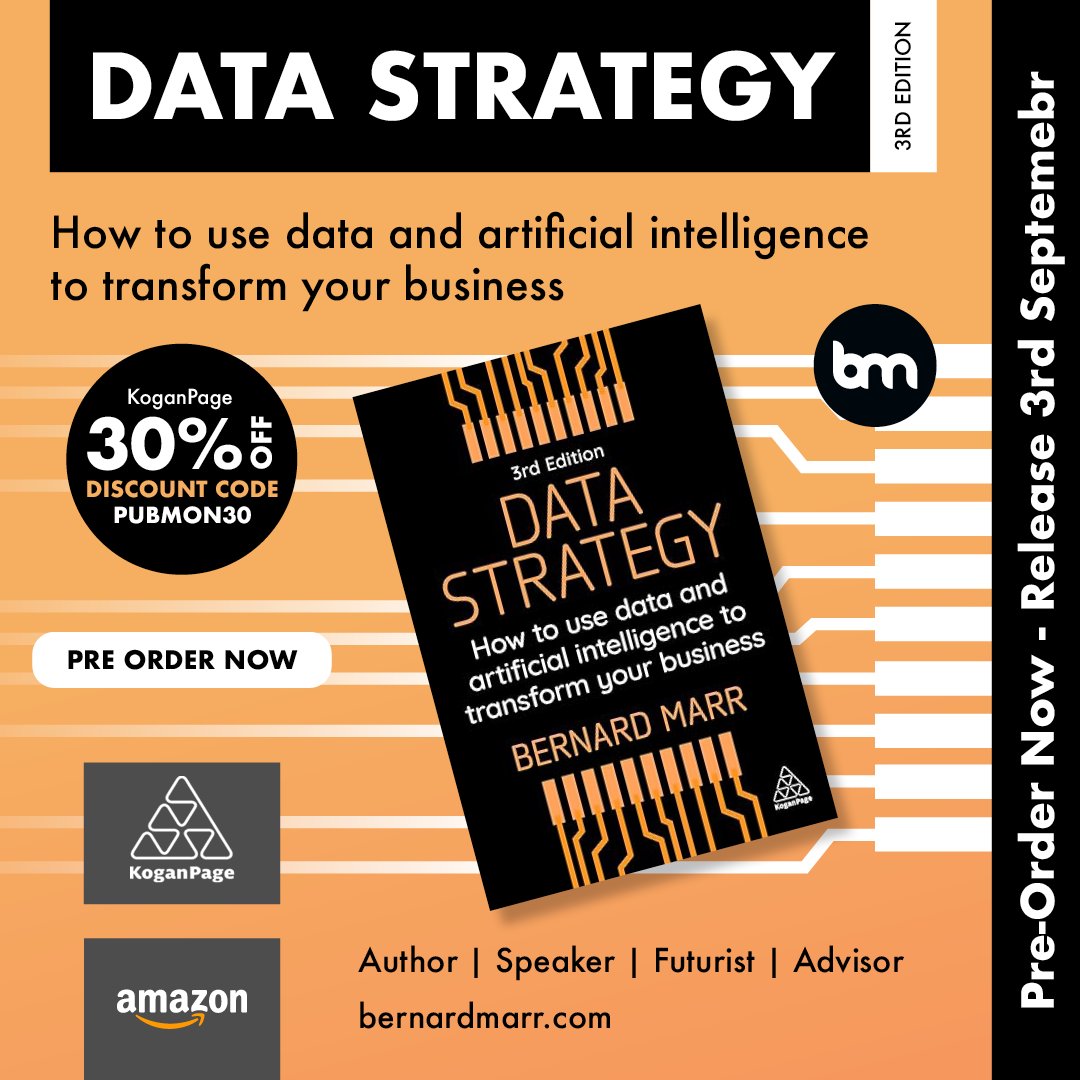
🚀 My New Book is Here: Data Strategy (3rd Edition) 🚀 I’m thrilled to share the release of my latest bestselling book, Data Strategy: How to Use Data and Artificial Intelligence to Transform Your Business. Every business today needs data to survive - but simply having data is not enough. What matters is how you use it. A well-designed data strategy is the key to unlocking value, driving insights, and giving your organisation the competitive edge it needs to thrive in the digital economy. From small organisations to global enterprises, I’ve seen first-hand how a data-driven approach can transform operations, improve decision-making, and unlock entirely new opportunities. That’s why I’ve poured my experience into this book — to help leaders and teams build strategies that don’t just talk about data, but actually deliver measurable impact. 🔍 In this third edition, I’ve expanded the book to reflect the latest developments in data and AI, including: ✅ Generative AI and its role in shaping business innovation. ✅ Synthetic data and how it can accelerate AI adoption. ✅ The potential of quantum computing and what it means for the future of data. ✅ Expanded guidance on cybersecurity, regulations, and ethics in a data-driven world. This isn’t just a theoretical framework - it’s a practical guide to collecting, managing, and using data effectively in order to drive growth, innovation, and long-term success. Whether you’re leading a start-up or a multinational, Data Strategy will equip you with the tools you need to stay ahead in a rapidly evolving landscape. 📖 Pre-order your copy today: 👉 Amazon - 👉 Kogan Page - I can’t wait to hear how this book helps you craft your own data-driven strategy and transform your business for the future.

Bernard Marr

10,980 Aufrufe • vor 11 Monaten

The future of footwear may not be manufactured in bulk. It may be fabricated around you. That is what makes this shift so interesting to me. 3D-printed footwear is moving from novelty to a real industrial model, with market forecasts pointing to rapid growth over the next decade. At the same time, brands and manufacturers are using additive manufacturing, digital design, and custom-fit workflows to shorten development cycles and make more personalized products viable. What is new here is not just the printer. It is the system around it: → scan the foot → model the fit digitally → print the part on demand → produce closer to the customer That matters. Because once footwear becomes data-driven and locally fabricated, several things change fast: → fit gets more personal → prototyping gets faster → waste drops because you do not overproduce → inventory pressure falls because you do not need to guess demand the same way To me, that is the bigger signal. This is not just about a better sneaker. It is about a different manufacturing logic. Formlabs notes that 3D printing already enables customized orthotics with better biomechanical precision, lower material waste, and simpler digital workflows. McKinsey has also pointed to digitization and 3D design as a way to shorten design cycles and reduce sampling iterations in apparel and footwear. And once that logic matures, the use cases get much bigger: → custom athletic footwear built from gait and pressure data → hospitals producing orthotics faster and closer to the patient → micro-factories making products on demand instead of stocking shelves → footwear designed for one body, not an average body That is why I think this matters now. The question is no longer whether personalized fabrication is possible. It is whether brands move fast enough before customers start expecting every product to fit like it was made only for them. Would you actually wear a shoe fabricated around your own biometric data? #AI #3DPrinting #Footwear #Manufacturing #Innovation #FutureOfWork #RetailTech #Customization #Technology

Pascal Bornet

47,489 Aufrufe • vor 3 Monaten

Europe is quietly becoming what the United States once promised the world. More and more people are looking at their best years ahead and choosing a place where everyday life is designed to work. Where the future feels stable enough to plan for. Where safety is not a luxury product. Where you can build a good life without gambling your health, your family, or your dignity on one bad month. In much of Europe, the “dream” is not about becoming a billionaire. It is about becoming unafraid. It is the freedom of walking home at night without scanning every shadow. The comfort of knowing that if you get sick, you do not need to calculate whether you can afford to be treated. The relief of having a society that still believes children should carry backpacks, not trauma, and definitely not weapons. The calm of streets built for human beings, not just cars. The ability to take a holiday without feeling like you are committing career suicide. The basic decency of labor protections that assume you are a person first and a resource second. And then there is the part people underestimate until they live it: the texture of life. The cities are older and more beautiful than you expect. The distances are smaller. Weekends are real. Food is real. Public spaces are not just decorative, they are functional. Parks are full. Cafes are full. Trains take you somewhere, often across borders, without turning travel into a stress test. You can live in one country, work with another, and visit a third like it is normal because, in many places, it is. The European dream is also a quiet confidence in the social contract. That if you contribute, the system does not abandon you. That you can raise a family without feeling like you are one accident away from ruin. That “getting ahead” does not require burning out. That a good society is one where normal people can live normal lives and still feel proud of them. This is why more and more Americans are not just visiting Europe, but staying. Some come for studies and never leave. Some arrive for a job and realise the lifestyle is the real promotion. Some originally planned a one year experiment and then cannot imagine going back to a place where stress is treated as a personality trait and insecurity is marketed as freedom. Europe is not perfect. It has bureaucracy. It has politics. It has problems that deserve criticism. But in many European countries, life is still built around a simple idea: society should reduce fear, not monetise it. That is the new dream. And people can feel it the moment they arrive. If you could choose one thing to trade for a better life, what would it be: more income, or more security? And what do you think your country would have to change for people to stop leaving, and start staying? Stay connected, Follow Gandalv Gandalv

Gandalv

989,023 Aufrufe • vor 5 Monaten

A Look Into OpSec Cloudverse 👇 OpSec Cloudverse is a comprehensive platform designed to bring the formidable capabilities of blockchain technology to your fingertips. It's the engine that powers seamless access and management of blockchain nodes, enabling users to harness the full spectrum of web3 functionalities with unprecedented ease. How Cloudverse Works At its core, Cloudverse acts as a control panel for various blockchain-related services. It offers a user-friendly dashboard that allows you to remotely access, monitor, and manage nodes or servers, which are the fundamental building blocks of blockchain networks. These nodes operate round the clock, validating transactions, securing the network, and ensuring that your digital assets are always under your command. Node Operation Simplified Running nodes is often a technical and complex task, but Cloudverse streamlines the process. With its innovative 'one-click' setup, you can deploy a node in seconds, bypassing the intricate configuration typically required. This not only opens the door for non-technical users to contribute to blockchain networks but also significantly reduces the time and effort for developers and miners. Potential Rewards for Users Participation in the Cloudverse ecosystem is incentivized. As you contribute to the network by hosting nodes or validating transactions, you can earn rewards. These rewards vary based on the blockchain you support and the demand for transaction processing on the network. While specific figures can fluctuate, the potential for earning is tied directly to the vitality and activity of the blockchain ecosystem you choose to support. Beyond Nodes: A Diverse Web3 Toolkit Cloudverse also serves as a versatile suite of tools for traders, gamers, and developers. Whether it's hosting decentralized applications (DApps), enjoying high-speed gaming servers, or trading with the utmost performance, Cloudverse equips you with the resources to excel. Continuous Evolution The OpSec Cloudverse is a living ecosystem, continuously expanding with new features and products. The roadmap is dynamic, with regular updates enhancing your experience and capabilities within the digital realm. Your Role in the Digital Future By engaging with Cloudverse, you're not only utilising a service. You are actively participating in the foundation of a decentralized, secure digital landscape. It's a call to action for those who envision a future where digital trust is paramount, and everyone has a role to play in safeguarding the integrity of our online world. Join OpSec Cloudverse, and be at the forefront of the blockchain revolution. Let's build a stronger, more secure digital future, together! - End of the post, Beware of fake accounts -

OpSec

31,170 Aufrufe • vor 2 Jahren

Dagknight technical progress As would be mentioned in a still unshared post by Michael Sutton, the dagknight effort is split into v0 devnet, v1 testnet and v2 mainnet candidate. I’ve been testing the current v0-based implementation in a small devnet with the help of some testers who run nodes and miners with me. The DK work can be thought of as split into two parts: (1) implementing the actual protocol and (2) wiring it up and using it. The testing and development over the last month has been focused on (2). Obviously, DK is a consensus change for selecting parents. What’s not so obvious is that such a change affects DAA, coinbase, IBD, pruning and a lot more. Each of these areas is very sensitive and requires proper understanding to wire correctly. An important consideration and difference from GD is that DK does not focus on maximizing a property like blue work. So to maintain topological properties of blue work, an independent (free) GD implementation is kept running specifically for maintaining blue work. This allows us to keep using the property for topology. Coloring and blue score use the megachain induced by DK. The wiring around DK as of this posting is in a working state, but still needs to be reviewed. Next efforts will be focused on protocol specific components, particularly Tie-Breaking and incremental UMC. Attached are some captures from the internal devnet. The dense DAG image is what happens when things related to DAA or other similar consensus parameter causes a node to insist on their POV. The video is a recent snippet of the KGI running on the devnet showing (perhaps not obviously) DK at work. The current “dagknight” branch is now posted on the main repo. A topic in the Public R&D has been opened for Dagknight development.

coderofstuff

52,857 Aufrufe • vor 5 Monaten

Respect according to Trump: when hegemony becomes a mirage By Brainless Partisans 🏴‍☠️☢️☣️🪆 "We are a country that is more respected than we have ever been respected before." This is Donald Trump's solemn proclamation about the war against Iran. A phrase that sounds like a declaration of imperial self-satisfaction... except that on the ground in the Middle East, "respect" increasingly resembles a mixture of anxiety, mistrust, and strategic calculation. Because if we listen to the Gulf capitals, the problem is no longer Iran. The problem is America. First, there is the question of protection. For decades, the oil monarchies have lived under the American security umbrella. Military bases, a fleet in the Gulf, missile defense: the implicit contract was simple, Washington protects, the oil monarchies align their interests. But the current war has cracked that pact. Iranian strikes against facilities in the region, including sites linked to the American military presence, have been a brutal reminder that these states remain exposed despite the American arsenal. As a result, even the most loyal allies are beginning to have doubts. According to several analyses cited by Foreign Policy, the Gulf monarchies are "questioning Washington's ability and willingness to guarantee their security" after the Iranian attacks. Diplomatic translation: the American bodyguard may not be as reliable as its press conference claims. Then there is the geopolitical reality that no one is saying too loudly: this war increasingly looks like a war waged by Israel with US military power. The Gulf states do not want to participate in a prolonged campaign against Tehran or serve as a platform for escalation. Several governments have made it clear that they do not want their territory or airspace to be used to attack Iran. In other words: thanks for the military bases, but you're on your own when it comes to war. Finally, there is the factor that is most damaging to the American image: the unintended demonstration of vulnerability. Iran obviously cannot compete with American military power. But it can strike where it hurts: scattered bases, energy infrastructure, the Strait of Hormuz. Since the escalation began, drone and missile attacks and the disruption of maritime traffic have shown that even the world's most powerful military empire cannot completely secure the region. It is precisely this type of asymmetric warfare that erodes the influence of a superpower. Iran does not need to win militarily; it only needs to demonstrate that American hegemony is no longer unchallenged. And this is where Trump's statement becomes almost comical. Because in the history of international relations, respect is not proclaimed. It is observed. When allies start looking for assurances elsewhere, towards China, Russia, or regional arrangements, that is not respect. It is a survival strategy in an international system where the Pax Americana increasingly resembles a museum relic. Trump believes that war proves American power. In much of the Middle East, it proves something else: that even empires have cracks. And that sometimes, the adversary does not even need to widen them. It is enough that they are visible.

Brainless Partisans 🏴‍☠️☢️☣️🪆

19,501 Aufrufe • vor 5 Monaten