Video wird geladen...

Video konnte nicht geladen werden

Zur Startseite

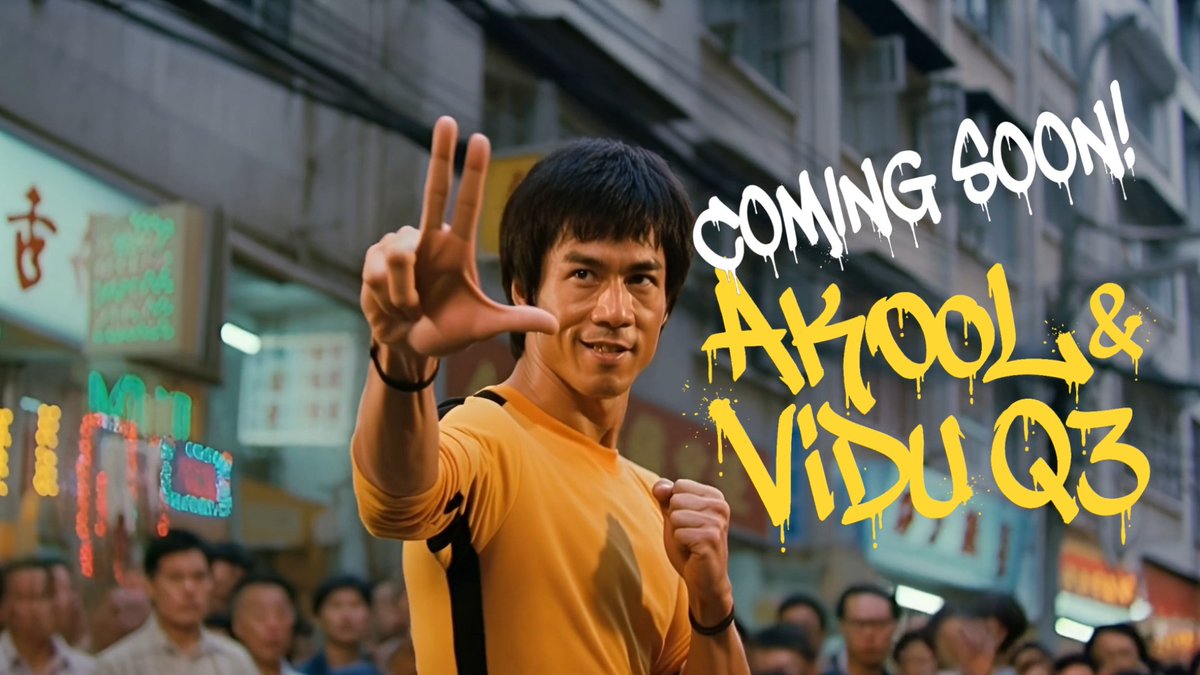
Introducing MiniMax H3, our next-gen open-weight multimodal video model, built for general intelligence beyond single-task generation. H3 understands text, images, video, and audio together, interpreting motion, sound, emotion, and cinematography as one unified creative language, delivering generation with fine-grained precision and cinematic quality. → Native Multimodal Understanding & Generation...

97,618 Aufrufe • vor 5 Tagen •via X (Twitter)

0 Kommentare

Keine Kommentare verfügbar

Kommentare vom Original-Post werden hier angezeigt

Ähnliche Videos

🇨🇳 Another great Chinese Model, OmniHuman-1.5 from ByteDance Turns 1 image plus a voice track into expressive avatar video by pairing a System 1 and System 2 inspired planner with a Diffusion Transformer, Produces coherent motion for over 1 minute with moving camera and multi character scenes. Most avatar models move to the beat of the audio but miss meaning, so gestures feel generic and emotions feel shallow. The fix here is a Multimodal LLM planner that listens to the speech and drafts a structured plan describing intent, emotions, beats, and high level actions, which gives the motion engine clear semantic targets instead of only rhythm. The motion engine is a Multimodal Diffusion Transformer that fuses the plan with audio, the single reference image, and optional text prompts, then synthesizes continuous body, face, and head motion that matches both words and tone. A key trick is a Pseudo Last Frame, a synthetic target that summarizes the next expected state, which stabilizes fusion across modalities and keeps motion consistent over long spans. From just 1 image and speech, the system outputs speaking avatars with synchronized lips, context aware gestures, and continuous camera movement, and it also supports multi character interactions without manual choreography. Reported results show strong lip sync accuracy, high video quality, natural motion, and close match to text prompts, and the same setup works on nonhuman characters too.

Rohan Paul

63,859 Aufrufe • vor 11 Monaten

I’ve used all the recent GenAI video models extensively & here’s my 2¢: 🎬 Runway Gen3 Alpha - best image quality & motion for text-to-video & embedded words. Great at prompt travel changes over the course of 10 sec. And I’m super bullish on how gen3 will evolve, hopefully adopting the features listed below. Kling - best quality for image-to-video with prompt control, like eating food. Great clip extension that accounts for character (ie walking stride) & camera movement (speed & angle), rather than just using final frame. But it’s limited availability & Chinese native language is limiting. Used for Spider-Man video below (via Midjourney). LumaLabs - best for keyframe start & end control (it can not be overstated how important this is. other services should add it ASAP!) and their high dynamic action movements are really fun. Luma was used in my viral Multiverse of Memes video. PikaLabs - they haven’t gotten as much attention as others lately. But they did update their video model a few weeks ago and it looks great. Also, they are notable for their unique & AWESOME features, like video in-painting & out-painting. My perfect AI video platform would have the following features: 1) Gen3’s quality, prompt control & text embedding. 2) KLing’s image-to-video quality, prompt control & clip extension quality. 3) Luma’s multi-keyframe control & dynamic movement ability. 4) Pika’s inpainting & outpainting ability. And a video-to-video (aka next-gen Runway gen1) could be a game changer, too. It’s an exciting time to be alive 🫶 Who will get there first? 🔉🔉

Blaine Brown

26,535 Aufrufe • vor 2 Jahren

Google dropped a new AI paper called LUMIERE. It's remarkably flexible, supporting video inpainting, image-to-video, AND stylized video generation tasks. Say hello to “space-time diffusion” for video generation! Now what the heck does that mean exactly?! 🌐⏳ → TL;DR it utilizes a “Space-Time UNet” architecture that generates the full duration of the video in one pass, rather than generating distant keyframes and interpolating between them like prior works. Because the computation is done in this “compressed space-time representation” to generate the full clip at once, it's far more temporally consistent. → Another benefit of generating the full video at once is that you can “direct” the video generation, making it easier to hand off to other models/tasks without having to stitch together partial solutions. You can condition generations on additional inputs, meaning you get the full stack of AI video capabilities – from video inpainting to image-to-video and beyond. → New SOTA for AI video generation? User study results in the paper suggest human evaluators preferred Lumiere over Runway Gen-2, Pika Labs, and Stable Video Diffusion in terms of quality, text alignment AND motion. But as always, we need to get hands-on with this tech when Google *actually* decides to ship it. → Could this end up inside YouTube? Y’all know i’m obsessed with blending reality and imagination – so it’s the video inpainting tech I'm most excited about. I really hope this model finds its way into YouTube's Generative AI efforts, and based on their prior announcements and the list of acknowledgments in the paper I think it might! 🤞🏽 Links: 🔗Paper: 🔗Project:

Bilawal Sidhu

44,822 Aufrufe • vor 2 Jahren

Big win for open-source LLMs! DeepSeek V4 Pro holds the top open-weights score on SWE-bench Verified, in the GPT-5.5 range. GLM 5.2 leads the open-weight intelligence index and sits near the closed frontier on long-horizon coding. But this leaderboard number is a weak proxy for real performance. It comes from one task set, run through one harness, served at one precision. The same weights can even score differently across providers, since many hosts quantize activations to fp8 and drift the model off its reference weights. Real performance is determined based on whether a model can read a repo, make coordinated edits across files, run the tests, and recover when one breaks. By that measure, the top open models hold up, but only inside the right harness. The teams that actually put DeepSeek V4 into production pipelines as a frontier substitute got there through the harness they built around the model, not by picking a stronger model. If you want to see this in practice, Cline (64k+ stars) has actually built that harness around open models, tuned so they run at production quality. And it's tuned so that these LLMs can run at production quality, with plan and act modes, checkpoints, and terminal feedback. ClinePass is the new access layer on top of it. It runs a curated set of those models inside Cline, narrowed to the ones tested for coding-agent use, with 2 to 5x the standard rate limits and no separate provider accounts, keys, or billing to track. The video below shows the setup, and I worked with the team to put this together. It runs alongside custom keys and local models as well, not in place of them.

Avi Chawla

44,124 Aufrufe • vor 1 Monat

I just ran Gemma 4 31B on @CerebrasSystems at 1,800+ tokens/sec and it's multimodal. For context: that's 35x faster than a typical GPU endpoint, and the first token (reasoning included) lands in 1.5 seconds. This isn't a benchmark slide, I recorded the inference live. Prompt I used: "Create a simulation of an iPhone. Include at least one working dummy note taking app, a functional notification pulldown, high quality graphics, single HTML file, any libs via CDN." - Generation time: 3 seconds. - Notes app worked. - Notification panel worked. - Rendered first try. This is what wafer-scale inference unlocks, not just "faster," but a different category of product. When generation is this fast, you stop waiting and start iterating in real time. Why this matters: Gemma 4 31B is Google DeepMind's flagship open weight model, Apache 2.0 licensed, dense (not MoE), and built for efficiency over raw parameter count. It scores close to Claude Haiku 4.5 on the Artificial Analysis Intelligence Index (30 vs 29) but runs ~18x faster on Cerebras. It's also the first multimodal model on Cerebras's platform, meaning you can now feed it screenshots, documents, charts, and UI states at wafer scale speed. # Applications I'm most excited about: - Screenshot → Insight: Drop in a dashboard or document screenshot, get structured findings back instantly. no waiting, no batching. - Live UI generation: Full interactive interfaces (like my iPhone sim) generated and rendered in under 2 seconds. - Screenshot -> Patch: Feed it a broken UI + console error, get a minimal code fix and verification steps back. - Computer use & agentic loops: See -> reason -> act - verify, fast enough to keep a human in the loop instead of waiting on the model. - Long context summarization: Full research reports condensed into decision ready summaries you can read and requery in one sitting. The bigger unlock isn't the speed number itself, it's that agentic and multimodal loops (see -> reason -> output -> tool call -> verify -> retry) finally run in real time instead of feeling sluggish. As Logan Kilpatrick (Logan Kilpatrick) put it: "If every model was doing 2,000 tokens per second, you wouldn't build the same product and just have it be faster, you'd build different products." Gemma 4 31B is live now on Cerebras Inference Cloud in public preview. If you're building multimodal, agentic, or real time apps, this is worth testing today. What would you build with such insane inference throughput?

Alok

12,962 Aufrufe • vor 1 Monat

AI Is Moving Beyond “Generating Videos” — Toward “Generating Worlds” Over the past two years, AI video models have advanced at an astonishing pace. From Runway and Pika to Sora and Veo, AI-generated videos have become increasingly realistic and more consistent with the physical laws of the real world. Many people believe the next objective is simply to generate videos that are longer, sharper, and more lifelike. But if we take a step back, we can see that the real transformation is not happening in video itself. It is happening in world models. What Is a World Model? In 1943, psychologist Kenneth Craik proposed an idea that would influence artificial intelligence research for decades. He argued that the human brain does not merely react to the outside world. Instead, it maintains an internal model of how the world works. Because we have this internal model, we can predict the outcome of an action before we actually take it. Before crossing a road, we estimate whether a car will pass by. Before catching a ball, we predict its trajectory. These abilities come from continuously simulating the world in our minds, rather than relying entirely on trial and error. This idea later became known by a more formal term: World Model. A world model does not describe a single image or a fixed video clip. It is an internal representation capable of continuously simulating the rules and dynamics of the real world. Why Is AI Research Turning Toward World Models? Because predicting “what comes next” is becoming increasingly central to how AI systems work. Language models predict the next token. Image models predict the next step in the denoising process. Video models predict the next frame. A world model, however, attempts to predict something broader: What should the world look like in the next moment? In 2018, David Ha and Jürgen Schmidhuber proposed in their paper World Models that an intelligent agent could first learn a model of the world, and then use that internal model to plan its actions. The Dreamer series later demonstrated that many complex tasks could be learned by training agents inside an “imagined world.” At the same time, the development of video models such as Sora and Veo led researchers to another realization: A model capable of continuously generating video has already learned, at least implicitly, many of the rules governing the real world. As a result, these two research directions have gradually begun to converge. But Video Is Not Yet a World This is where the distinction is often misunderstood. For a world model to support meaningful real-time interaction, it must solve several critical problems. Most video models today are essentially answering one question: What should the next frame look like? A true world model needs to answer much more: What happens if I take one step forward? If I walk behind a building and then return, will the building still be there? If I suddenly change the camera angle, will the entire space remain consistent? If I enter a command such as: “Summon a dragon.” Will the world respond immediately? In other words, a world model must do more than generate content. It must understand space. It must understand time. It must understand causality. And it must understand interaction. Moving from watching to participating is where the real difficulty of world models begins. World Models Are Entering the Interactive Era One of the latest attempts in this direction is Alaya World, recently open-sourced by Alaya World, or Alaya Lab. Instead of generating a fixed video clip, it generates a world that users can explore in real time. Users can begin with text, an image, or a video, enter the generated scene, move freely through it, and introduce new prompts at any moment during generation. The world responds immediately. According to the publicly released information, Alaya World provides: Real-time streaming generation at 720p and 24 FPS Stable continuous exploration for more than one minute The ability to switch prompts and trigger skills or events during generation Model weights and inference code released under the Apache 2.0 License Training code and datasets planned for future release What makes these capabilities important is not simply the technical specifications. It is that the generated “world” can now support continuous interaction. The official demo shows that users can genuinely control, transform, and explore the generated environment. AI Is Evolving From a Tool Into an Environment Over the past few years, most discussions around AI have focused on content generation. Generating text. Generating images. Generating videos. But world models raise a fundamentally different question: Can AI generate an environment that people can inhabit, explore, and continuously evolve? If the answer is yes, the impact will extend far beyond video generation. Game development, robotics training, embodied intelligence, digital twins, virtual production, and many other fields could be transformed by the development of world models. World models are still at a very early stage. Yet from Craik’s proposal of an internal mental model more than eighty years ago to the emergence of today’s interactive world-generation systems, a clear evolutionary path is beginning to take shape. Perhaps what AI is ultimately learning has never been limited to images, videos, or language. Perhaps it is learning the world itself. References GitHub: Technical Report:

雪踏乌云

112,114 Aufrufe • vor 21 Tagen

YOMIRGO #Product #Update YOMIRGO AI-HUB OFFICIALLY LAUNCH ---A Structural Upgrade from a Single-Product Model to an AI Agent Ecosystem Platform In its first phase, 11 AI projects have been integrated, spanning high-value sectors including finance, scientific research, enterprise services, development tools, and experiential AI. ➡️AI-Hub: This is not merely a feature expansion — it represents a critical structural upgrade from a single-product architecture to a multi-vertical AI Agent aggregation and capitalization platform. This milestone marks the initial structural formation of the YOMIRGO ecosystem. 1. Structural Distinction Between Agent Matrix Lab and AI-Hub To avoid positioning ambiguity, we formally clarify the structural division between the two: 🔘 Agent Matrix Lab — Internal AI Production & Incubation Platform Agent Matrix Lab serves as YOMIRGO’s proprietary AI development and internal incubation platform, responsible for: • R&D and testing of in-house AI products • Incubation of native AI Agents • Technical architecture experimentation and runtime validation • Testing of AI Agent models, memory systems, and runtime orchestration It functions as the production workshop and experimental engine of YOMIRGO’s “AI Super Factory.” 🔘 AI-Hub — External AI Agent Aggregation & Ecosystem Layer AI-Hub is a market-facing AI Agent aggregation and showcase platform, responsible for: • Curation and onboarding of high-quality AI projects • Cross-vertical structured ecosystem layout • Rating and classification systems • Traffic distribution and ecosystem collaboration entry points AI-Hub is not an internal incubation unit, but a standardized aggregation framework at the ecosystem level. 2. Integrated Project Structure (First Batch) ✅1. Finance & Prediction 🔹Cointoken AI — AI Agent-powered quantitative trading engine 🔹VVAI — AI-driven real-time Web3 intelligence and decision system 🔹AlphaQuant — Global financial market forecasting engine 🔹NextGoals — AI-powered global sports prediction agent This vertical forms the real-time information, trading, and predictive decision infrastructure for Web3-native users. ✅2. Science 🔹Charmen AI — Large-model-based pet acoustic recognition technology 🔹Encore Health — AI-driven health forecasting and longevity management system for high-net-worth individuals 🔹Reproducibility AI — AI expert system for financial engineering validation and academic reproducibility This sector focuses on research-grade AI capabilities, collaborating with universities and research institutions to drive real-world scientific deployment. ✅3. Business 🔹GlobalSales — B2B automated lead-generation AI Agent 🔹ResearchBot — Business intelligence and deep due diligence AI Agent This vertical targets the enterprise market, delivering scalable and commercially viable AI productivity tools. ✅4. Coding 🔹CodeMatrix — Full-stack development assistant Providing AI-driven development infrastructure and low-barrier building capabilities to global users. ✅5. Interesting 🔹Fortunetell AI — AI-powered symbolic analysis and interactive insight system Exploring the application boundaries of AI within experiential and interactive scenarios. 3. YOMIRGO Four-Layer Structural Framework YOMIRGO has now established a clearly defined four-layer structure: ▶️Layer 1: Agent Matrix Lab — Internal Production & Incubation ▶️Layer 2: AI-Hub — Ecosystem Aggregation & Rating ▶️Layer 3: LaunchPad — Capitalization Pathway ▶️Layer 4: Market — Circulation & Value Realization Together forming a complete industrial pipeline: Incubation → Validation → Aggregation → Rating → Capitalization → Market Circulation This is the structural model behind YOMIRGO’s defined “AI Super Factory.” 4. Strategic Significance The launch of AI-Hub signifies: • YOMIRGO has established standardized AI Agent aggregation capabilities • A cross-vertical ecosystem structure is now in place • Internal incubation and external aggregation mechanisms are structurally separated • The AI Agent industrial flywheel has begun operating YOMIRGO is no longer merely an AI product platform, but a structured AI Agent industrial system integrating production, aggregation, capitalization, and circulation. 5. Next Phase • Continue expanding high-utility AI Agents with real-world application value • Optimize AI-Hub’s scoring, rating, and filtering mechanisms • Strengthen synergy with LaunchPad and Market • Enable AI Agents to complete value realization within the ecosystem The first 11 projects are only the beginning. AI-Hub is designed to become a continuously expanding AI Agent gateway — not a static product showcase. Further structural expansion is underway.🔥

YOMIRGO

23,685 Aufrufe • vor 5 Monaten

A FULL ANIME FIGHT SCENE GENERATED WITH AI. AND THE PROMPT IS PUBLIC. Higgsfield just open-sourced its Originals: their flagship in-house productions are now fully transparent. For every video you can see: → the full prompt → every reference (image and audio) → the exact generation settings: model, quality, resolution This clip has a creature transformation, two-character fight choreography, slow motion, even pink blood to dodge the gore. All described in a single prompt you can copy, reproduce or remix as is. Full prompt: "Girll with blue hair and guy with black hair enters empty classroom at dusk, red-orange sky bleeding through tall windows, desks and chairs overturned and scattered with loose papers on the floor; the black-bob girl in a white sailor uniform with blue collar sits collapsed against the wall beneath the blackboard, knees drawn up, sweat soaking her bangs, shoulders convulsing in short spasms, one hand pressed to her stomach, breath ragged and wet. Blue-haired girl in a navy school blazer and pleated skirt enters first through the sliding door, kusarigama scythe held low at her side, blade catching the red window-light; black-haired boy in an open-collar white shirt and loosened tie follows a beat behind, war hammer resting on his shoulder, smirk fading as he sees the sick girl. Camera pushes in low and fast toward the collapsed girl, handheld micro-shake, then whip-pans to the two arrivals freezing in the doorway. The sick girl's spine arches unnaturally, a wet tearing sound as her skin splits along the shoulder blades, bone spurs punching outward, extra eyelids blistering open across her collarbone and cheeks — camera holds in a static wide as the transformation escalates, cutting to tight inserts of individual eyes opening one by one along her growing arms, her school uniform shredding as the body doubles then triples in mass, clawed feet cracking the floorboards, her head deforming into a horned, skull-white cranium ringed with curved fangs, one massive central eye where her face used to be, remnants of the blue collar-ribbon still hanging from a warped throat. She rises to full monster height, towering over the desks, guttural roar rattling the windows. Blue-haired girl plants her feet and swings the scythe up into guard as the boy drops the hammer off his shoulder into a two-handed grip; camera does a fast 180-degree orbit around both of them as they charge. Dutch-angle low shot as the boy closes distance first, hammer swinging in a wide horizontal arc into the monster's leg — impact throws him sideways through a row of desks, wood splintering, into the side wall, plaster cracking around his body, hard cut to his grunt and a slow recovery push off the wall. Blue-haired girl vaults over the wreckage, scythe trailing a whip of motion blur, camera speed-ramping into slow motion as the curved blade connects across the monster's forearm — hot pink ichor sprays in thick arcing ribbons instead of red blood, droplets suspended mid-air in the slowed frame, blade sound a wet metallic tear. Monster backhands her mid-recovery, camera whip-pans to follow her body slamming into the blackboard, chalk dust exploding outward, board cracking down the middle. Rapid cross-cutting: low hero-angle on the boy re-entering with a rising hammer strike into the monster's exposed ribcage-like plating, close slow-mo insert on the point of impact as bone-white shards and pink fluid burst outward; over-the-shoulder shot from the monster's height looking down as both fighters flank it from opposite sides. Girl's scythe hooks into the monster's shoulder joint, camera locked tight on her straining grip and gritted teeth as she wrenches it downward, boy's hammer following through into the same joint a half-second later — impact sound layered, thick and final, monster's roar breaking into a low collapsing groan as its mass folds inward and it drops to its knees then face-first into the floor in a slow, weighty fall, camera pulling back and up into a wide static shot of the wrecked classroom settling into stillness. Both fighters stand over the fallen mass, weapons lowering, chests heaving, camera slowly circling them at floor level; blue-haired girl wipes pink fluid off her cheek with the back of her wrist and starts laughing between breaths, boy lets the hammer head drop to the floor with a thud and laughs too, leaning against a desk, both grinning, exhausted, shoulder-checking each other, red dusk light still pouring through the cracked windows. Ambient sound throughout: creaking wood, scattering papers, cracking plaster, wet impact foley, labored breathing, the monster's guttural vocalizations, ending on genuine breathless laughter. Render risk: full-body transformation sequence may render as a static morph or skip frames — fallback to hard-cutting between three discrete transformation stages rather than one continuous morph if the engine smooths it into mush. Risk: pink blood may drift toward red under default color grading — reinforce with explicit magenta-pink hue callouts at each blood beat. Risk: multi-character wide fight choreography may merge the two fighters' silhouettes in wide shots — favor alternating single-subject framing over simultaneous two-shot action if clarity fails." Made with Seedance 2.0 on Higgsfield AI Full open-sourced prompts & assets below👇

gus

100,376 Aufrufe • vor 20 Tagen