Loading video...

Video Failed to Load

Go Home

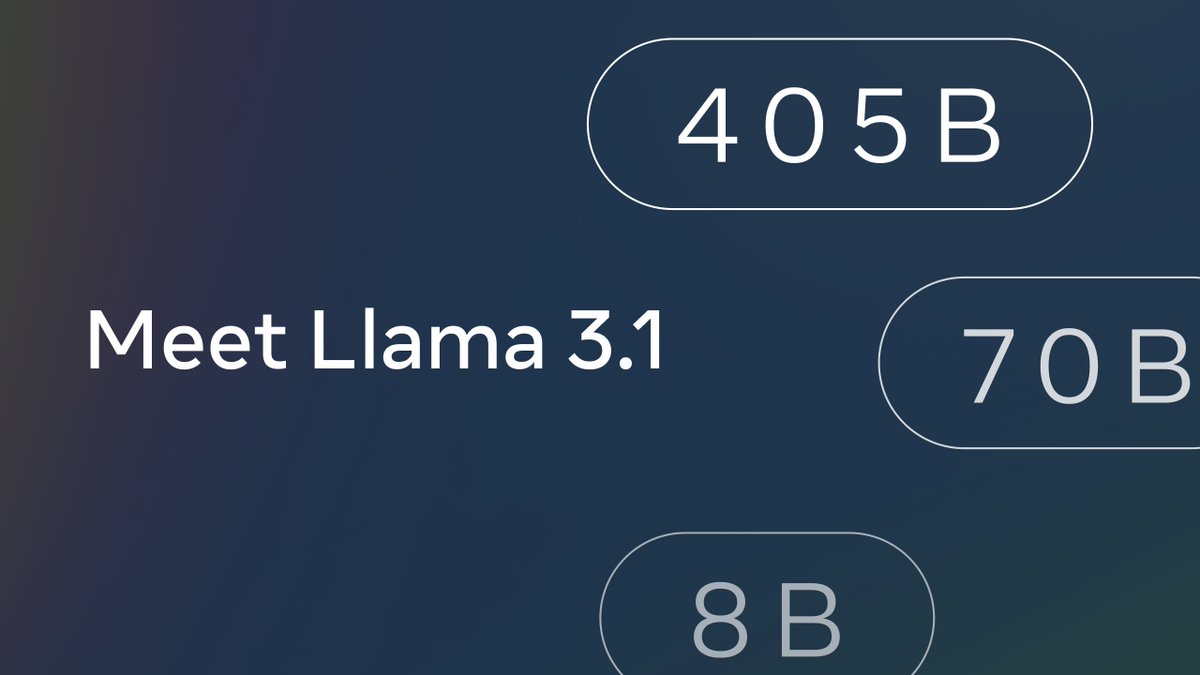
"Introducing Multimodal Llama 3.2": As promised two weeks ago, here's the short course on Meta's latest open model! This short course is created with Meta and taught by Amit Sangani, Director of AI Partner Engineering at Meta. Meta’s Llama family of models is leading the way in open models,...

131,606 views • 1 year ago •via X (Twitter)

10 Comments

Ahmad Al-Dahle's profile picture
Ahmad Al-Dahle1 year ago

@Meta @asangani7 Always so exciting to see these courses go live! Thanks for all your support, Andrew!

DonnySolana's profile picture
DonnySolana1 year ago

@Meta @asangani7 you will need a bigger desk.

Thorsten Linz's profile picture
Thorsten Linz1 year ago

@Meta @asangani7 @AndrewYNg, do models like Llama mimic human reasoning capabilities? Excited to learn more about multimodal AI advancements

Vincent Valentine (CEO of UnOpen.ai)'s profile picture
Vincent Valentine (CEO of UnOpen.ai)1 year ago

@Meta @asangani7 Fascinating insights into Meta's cutting-edge AI developments! How might this empower diverse applications and users? Curious to explore its potential.

Muratcan Koylan's profile picture
Muratcan Koylan1 year ago

@Meta @asangani7 Starting now! I'm very excited to explore the new Llama stack. Thanks for buildign this course.

Alexander De Ridder's profile picture
Alexander De Ridder1 year ago

@Meta @asangani7 Fascinating insights into Meta's Llama. Multimodality unlocks new frontiers - excited to learn more.

Caio's profile picture
Caio1 year ago

@Meta @asangani7 Nice glasses

GPT.Biz's profile picture
GPT.Biz1 year ago

@Meta @asangani7 This course looks amazing! A must-try for anyone interested in AI development, especially with Meta’s cutting-edge models.

@yæl 🦋's profile picture
@yæl 🦋1 year ago

@Meta @asangani7 About to sign up. 💯

Data & Analytics's profile picture
Data & Analytics1 year ago

@Meta @asangani7 @AndrewYNg, meta's Llama 3.2 sounds like a real game-changer in AI. Curious about the practical applications—how's it gonna impact everyday tech?

Related Videos

Introducing "Building with Llama 4." This short course is created with Meta AI at Meta, and taught by Amit Sangani, Director of Partner Engineering for Meta’s AI team. Meta’s new Llama 4 has added three new models and introduced the Mixture-of-Experts (MoE) architecture to its family of open-weight models, making them more efficient to serve. In this course, you’ll work with two of the three new models introduced in Llama 4. First is Maverick, a 400B parameter model, with 128 experts and 17B active parameters. Second is Scout, a 109B parameter model with 16 experts and 17B active parameters. Maverick and Scout support long context windows of up to a million tokens and 10M tokens, respectively. The latter is enough to support directly inputting even fairly large GitHub repos for analysis! In hands-on lessons, you’ll build apps using Llama 4’s new multimodal capabilities including reasoning across multiple images and image grounding, in which you can identify elements in images. You’ll also use the official Llama API, work with Llama 4’s long-context abilities, and learn about Llama’s newest open-source tools: its prompt optimization tool that automatically improves system prompts and synthetic data kit that generates high-quality datasets for fine-tuning. If you need an open model, Llama is a great option, and the Llama 4 family is an important part of any GenAI developer's toolkit. Through this course, you’ll learn to call Llama 4 via API, use its optimization tools, and build features that span text, images, and large context. Please sign up here:

Andrew Ng

67,710 views • 1 year ago

Our first short course with Anthropic! Building Towards Computer Use with Anthropic. This teaches you to build an LLM-based agent that uses a computer interface by generating mouse clicks and keystrokes. Computer Use is an important, emerging capability for LLMs that will let AI agents do many more tasks than were possible before, since it lets them interact with interfaces designed for humans to use, rather than only tools that provide explicit API access. I hope you will enjoy learning about it! This course is taught by Anthropic's Head of Curriculum, Colt_Steele. You'll learn to apply image reasoning and tool use to "use" a computer as follows: a model processes an image of the screen, analyzes it to understand what's going on, and navigates the computer via mouse clicks and keystrokes. This course goes through the key building blocks, and culminates in a demo of an AI assistant that uses a web browser to search for a research paper, downloads the PDF, and finally summarizes the paper for you. In detail, you’ll: - Learn about Anthropic's family of models, when to use which one, and make API requests to Claude - Use multi-modal prompts that combine text and image content blocks, and also work with streaming responses - Improve your prompting by using prompt templates, using XML to structure prompts, and providing examples - Implement prompt caching to reduce cost and latency - Apply tool-use to build a chatbot that can call different tools to respond to queries - See all these building blocks come together in Computer Use demo Please sign up here:

Andrew Ng

170,335 views • 1 year ago

Build and customize complex AI applications with a flexible framework in this new short course, Building AI Applications with Haystack. Created in collaboration with deepset, makers of Haystack, and taught by Tuana, who is the developer relations lead for Haystack at deepset. Generative AI technology is changing rapidly and it can be challenging to integrate APIs from different LLMs, vector databases, and various tools such as web search. In this course, you will learn how to use the Haystack framework to make your development process more modular, allowing you to manage complexity and focus more on building your application. In detail, you’ll: - Build a RAG pipeline using Haystack’s main building blocks – components, pipelines, and document stores. - Create custom components in your pipeline by building a Hacker News summarizer that extends your app’s ability to access APIs. - Use conditional routing to create a branching pipeline with a fallback to web search mechanism when the LLM does not have the necessary context to respond to the user's query. - Build a self-reflecting agent for named entity recognition that loops using an output validator custom component. - Create a chat agent using OpenAI's function-calling capabilities which allow you to provide Haystack pipelines as tools to the LLM, enhancing that agent's capabilities. By the end of this course, you will learn a high-level orchestration framework that can help make your applications flexible, extendible, and maintainable, even as the technology stack changes, new user needs arise, and you add new features to your application. Please sign up here:

Andrew Ng

53,788 views • 1 year ago