正在加载视频...

视频加载失败

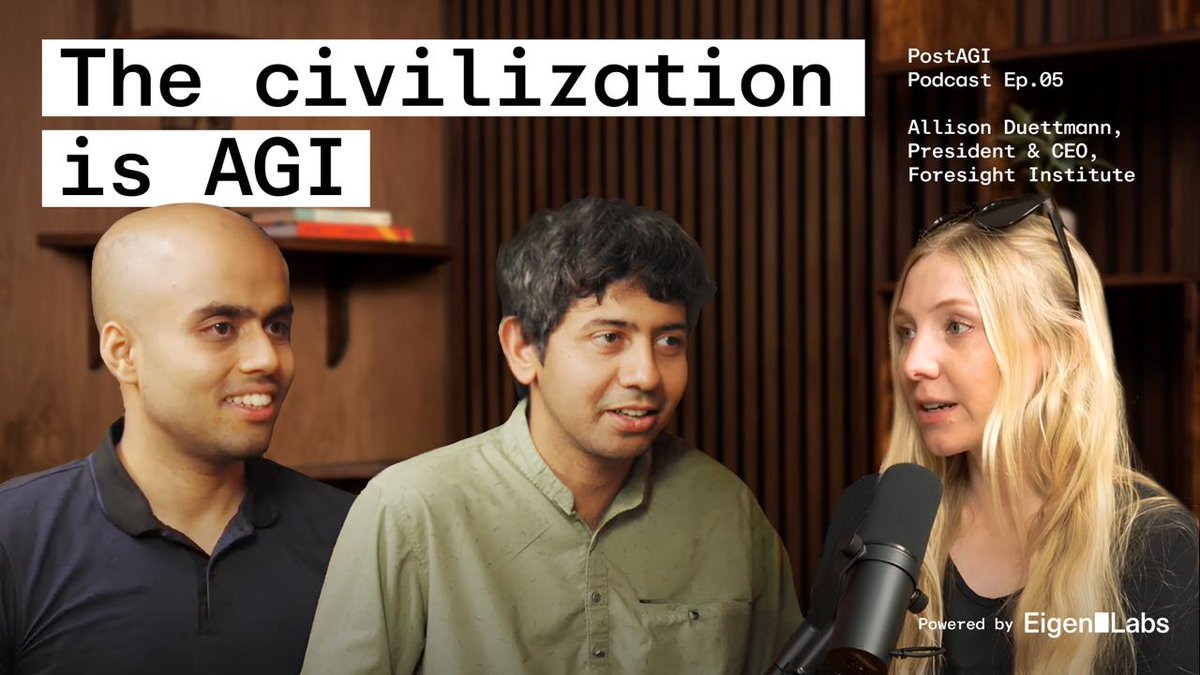
Introducing Yukon A platform for open frontier research. Over the past 2 months, an open network of humans + AI has already: - Beat Google’s frontier quantum circuit result over 50% - Made Poolside’s open-weight model run 2.6x faster - Increased post-quantum Ethereum scaling by 3.5x - Boosted Lighter’s...

101,265 次观看 • 6 天前 •via X (Twitter)

0 条评论

暂无评论

原始帖子的评论将显示在这里

相关视频

Chamath is making one of the most important business arguments of 2026. Half of large US companies right now cannot generate returns that exceed their cost of capital, which has normalized back to its long run average of 8 to 11%. Another one in seven companies globally is stuck generating persistent returns between 1 and 5% and most businesses don't have room for error and in this environment walks every frontier AI lab saying the same thing, give us your data, your workflows, your processes and our model will make everything better. And companies by the millions said yes. What they didn't fully account for is what happens on the other side of that door. Every time an employee runs a query through a frontier model API, the prompt goes through external servers, workflows, customer data, pricing logic, internal processes, all of it transmitted through a third party. As Alex Karp said companies are spending on tokens while handing over the exact proprietary advantages that make their business worth owning. Microsoft blocked internal use of Anthropic's Claude Fable 5 but over its 30-day data retention policy and the largest software company in the world decided a frontier model's data handling was too risky for its own employees. A US government action revoked access to another frontier model for foreign nationals overnight. Now here's where the cost math becomes impossible to ignore. Deutsche Bank calculated a roughly 65x cost gap between frontier models like Claude Fable 5 at ~$3.25 per task and open-source alternatives at ~$0.05. For 90% of everyday enterprise tasks, performance is comparable. Open-weight models now match closed frontier systems on core agent tasks at roughly one-tenth the cost, a high-volume deployment that costs $250/day on Claude runs at $12/day on an open-source equivalent. Chamath Palihapitiya tested this directly by running a standard enterprise code migration task through an orchestration layer wrapping an open-source model came in 16.4x cheaper than using a frontier model directly.

Milk Road AI

280,929 次观看 • 1 个月前

China just released an open source AI model that matches the best closed models from OpenAI and Anthropic. Gavin Baker explained exactly how they did it and the answer should concern every American AI lab. The model is called GLM 5.2. It was built by Z. AI. You get 744 billion parameters, 1 million token context window and its MIT license, meaning anyone can download it, fork it, build a company on it, with no restrictions and no Dario. It scored 51 points on the artificial analysis intelligence index. The highest score any open weight model has ever achieved. It beat GPT 5.5 on the frontier software engineering benchmark. It trails Claude Opus 4.8 by less than one percentage point. And it costs 85% less to run than GPT 5.5 for comparable performance. Gavin Baker said on the All-In podcast that this model has challenged some of his beliefs. Then he explained how China built it. The method is called distillation. Just think of tens of thousands of phones and computers running simultaneously, all hitting the frontier model APIs through masked accounts, asking specific questions, and harvesting what happens inside the model when it answers. Every reasoning step, every token. The entire thinking process gets recorded and fed back into the Chinese model during training. It is a cheat sheet. It is the answer key to the exam. And here is the part that should worry everyone. Sacks said it plainly. China was already nine months behind American models. But now that GLM 5.2 is good enough to run its own reinforcement learning, it can improve itself without needing to distill from American models anymore. The cheat sheet let them get close enough to start writing their own answers. Sacks said we are six months behind on the model and 24 months behind on silicon and they are only a few months behind in total. The Z. AI founder told Elon Musk directly that open weight fable-level capability will be here before Q1 2027. Every restriction Anthropic lobbied for, every self-imposed safety guardrail, every month of delay in releasing American frontier models accelerated this. The Chinese labs were not under those restrictions. They were not going to wait. The composable model future Gavin described, where every enterprise runs a frontier model alongside their own fine-tuned open weight model, is coming regardless of what American labs do next. The question is just whether the open weight half of that stack is American or Chinese. Right now it is Chinese. WATCH THE FULL PODCAST ON The All-In Podcast

Ihtesham Ali

86,295 次观看 • 1 个月前

D-Wave announced a scientific breakthrough published in the esteemed journal Science Magazine, confirming that its annealing quantum computer outperformed one of the world’s most powerful classical supercomputers in solving a complex magnetic materials simulation problem with relevance to materials discovery. The new landmark peer-reviewed paper, “Beyond-Classical Computation in Quantum Simulation,” validates this achievement as the world’s first and only demonstration of quantum computational supremacy on a useful problem. An international collaboration of scientists led by D-Wave performed simulations of quantum dynamics in programmable spin glasses—a computationally hard magnetic materials simulation problem with known applications to business and science—on both D-Wave’s Advantage2™ prototype annealing quantum computer and the Frontier supercomputer at the Department of Energy’s Oak Ridge Lab. D-Wave’s quantum computer performed a complex simulation in minutes and with a level of accuracy that would take nearly a million years using the supercomputer. In addition, it would require more than the world’s annual electricity consumption to solve this problem using the supercomputer, which is built with graphics processing unit (GPU) clusters. For decades, scientists have aspired to build a quantum computer capable of solving complex materials simulation problems beyond the reach of classical computers. D-Wave's advancements in quantum hardware have made it possible for its annealing quantum computers to process these types of problems for the first time. Magnetic materials simulations, like those conducted in this work, use computer models to study how tiny particles not visible to the human eye react to external factors. Magnetic materials are widely used in medical imaging, electronics, superconductors, electrical networks, sensors, and motors. This is an incredibly important achievement. Please join us in congratulating the D-Wave team and our global collaborators on this remarkable milestone. It’s a significant moment for the quantum computing industry. Learn more about this monumental achievement: Read the press release here: #QuantumSupremacy #QuantumRealized #QuantumComputing #DWave #Technology #Innovation #Optimization #MaterialsDiscovery #ScientificBreakthrough $QBTS

D-Wave

65,039 次观看 • 1 年前