Loading video...

Video Failed to Load

Go Home

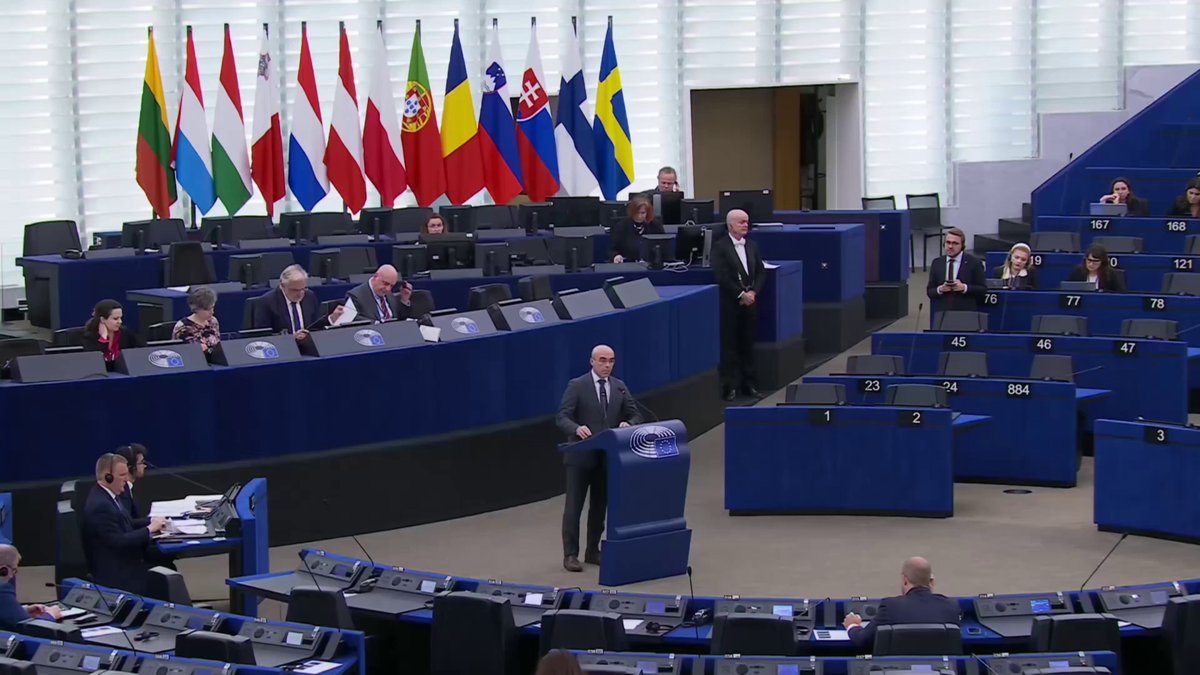
🇭🇺 | It is unacceptable that Brussels remains silent while Péter Magyar is dismantling Hungary's constitutional democracy. For years, the European Parliament debated #Hungary almost every week. Now, as the new government seeks to restrict the right to stand for election through retroactive legislation and remove the President of...

28,417 views • 9 days ago •via X (Twitter)

0 Comments

No comments available

Comments from the original post will appear here

Related Videos

📢What happened in Poland after the elections is now repeating in Hungary: A constitutional carpet bombing is taking place in Hungary today, while the EU rewards the new Hungarian government by releasing €16 billion — the very same funds it had withheld from the previous government precisely because it accused the Orbán government of dismantling the rule of law. In Hungary, just like in every normal democracy, the President of the Republic can be removed through a legal process: a certain number of Members of Parliament initiate impeachment proceedings, and if, at the end of the process, two-thirds of the Constitutional Court decides that the President has violated the Constitution or the law, they can be removed. This is one of the tools of checks and balances. This is exactly what happened in Lithuania in 2004. But this is not what is happening in Hungary. The new Hungarian government is essentially removing the President of the Republic with a stroke of a pen, without any impeachment procedure — something unprecedented anywhere in Europe. Equally unprecedented in the EU is the introduction of a 12-year term limit for Members of Parliament. This effectively decapitates half of the opposition, as it consists of parties that have been active since 1989, with many representatives having served multiple terms because voters repeatedly re-elected them. In contrast, the politicians of the new government are all completely “zero-kilometer” — they are brand-new politicians entering parliament for the first time. Finally, through personalized and retroactive legislation — two things that are unacceptable in a rule-of-law state — they have banned the leader of the opposition, Orbán, from running in future elections. With this new step, the government has essentially abolished popular representation, because the foundation of democracy is that anyone can run for office and anyone can be elected. Instead of speaking up, Brussels is actually giving money to the new government to “restore the rule of law.” Equality before the law and legal certainty are dead in the EU. The EU has become a global liberal bureaucratic monster that installs puppet states in power, allowing them to engage in legal thuggery as long as they serve its own agenda.

Andrew🇭🇺🇩🇪🇬🇧

48,416 views • 2 days ago

Two cases which were brought before the Constitutional Court of Zimbabwe challenging Constitutional Amendment Bill No. 3 (CAB 3) have been struck off, NOT dismissed. CAB 3, which seeks, among other things, to extend President Emmerson Mnangagwa’s term of office and change the method of electing a president from direct election by citizens to election by Parliament, requires two referendums in law, but the ZANUPF faction sponsoring it wants to avoid a referendum. The Constitutional Court struck both cases off the roll this morning. It is important to understand that the cases were not dismissed on their merits. Rather, the Court held that the issues raised could not originate and be determined solely by the Constitutional Court and should first be ventilated in another forum, High Court. Professor Lovemore Maduku, who is arguing the cases, has indicated that they will now proceed to the High Court. Should the applicants fail to obtain the relief they seek there, the matters will inevitably return to the Constitutional Court on appeal. Many lawyers have described the Constitutional Court’s decision as an example of constitutional avoidance. In their view, the Court has declined to confront what has become a highly contentious constitutional question, preferring instead to defer consideration of the substantive issues. A central argument in the war veterans’ challenge, led by Professor Madhuku, is that Constitutional Amendment Bill No. 3 was discussed and approved by Cabinet, which included President Mnangagwa, the two Vice Presidents, and Cabinet ministers. Professor Madhuku argues that because President Mnangagwa stands to benefit directly from provisions extending his term of office, he should not have participated in deliberations on the amendments. According to the argument, the Constitution prohibits public officials from participating in decisions in which they have a direct personal interest. However, the Constitutional Court did not determine the merits of that argument, ruling instead that the matter should be heard elsewhere first. The legal battle is therefore far from over. It now moves to the High Court and, whatever the outcome there, is likely to find its way back to the Constitutional Court for a final determination.

Hopewell Chin’ono

29,689 views • 29 days ago