Video wird geladen...

Video konnte nicht geladen werden

Zur Startseite

It was reported that after watching Satyajit Ray's "Pather Panchali" (1955) at the Cannes Film Festival, François Truffaut said, "I don't want to see a movie of peasants eating with their hands" and had stated that the movie was "Insipid". When Truffaut was asked about it in 1977, he...

563,927 Aufrufe • vor 4 Tagen •via X (Twitter)

0 Kommentare

Keine Kommentare verfügbar

Kommentare vom Original-Post werden hier angezeigt

Ähnliche Videos

Denis Villeneuve met Roger Deakins for the first time at the Academy Awards when he was nominated for "Incendies" (2010) & Roger Deakins for "True Grit" (2010). Deakins told Villeneuve that he loved "Incendies". Because of that, Deakins saw the older movies of Villeneuve. When Deakins was looking for a movie to work in, he got the script of "Prisoners" (2013) & had heard that Villeneuve was going to direct it. So, he immediately decided to work in the movie. Villeneuve said, "Deakins was looking for something to do and he said that when he read “Prisoners” he said, “I want to work with that director,” which is honestly the biggest compliment I’ve ever received. It was a dream for me to work with such a master. I never thought in my life or dared to dream that I’d make a movie with Roger Deakins one day. I think he was available at that period of time and he loved the script and he loved “Incendies” and we met and that was it. It was a very beautiful cinematic experience for me–I learned so much." Deakins wasn't very much a fan of the gothic elements in the movie and the genre, but he loved the script for its emphasis on character and performance. He felt that the dramatic success of "Prisoners" rests on the acting. Deakins said, "I heard Denis was doing this movie and got the script, which was dense and had a lot of characters, and, to be honest, Gothic elements that I thought went too far. I wasn’t interested in that genre, but it turned out that Denis wasn’t, either. We did end up shooting the script, but it was always his intention that the final cut of the film wouldn’t feature those elements.” P.S: On this day, 13 years ago, "Prisoners" (2013) premiered at the Telluride Film Festival, USA.

DepressedBergman

20,149 Aufrufe • vor 21 Stunden

John Carpenter on how Howard Hawks's "Rio Bravo" (1959) inspired him to become a filmmaker: "As I got older I began to see that certain directors did certain things. One of the earliest examples of this was Roger Corman. I started going to see these exciting, fast, kind of cheesy but really fun monster movies, and there was one name that kept coming up on the screen: Roger Corman. 'It Conquered the World' (1956), 'Not of This Earth' (1957), 'Attack of the Crab Monsters' (1957), 'The Undead' (1957)... But | really understood for the first time what a director did when I saw 'Rio Bravo' in 1959. There was something about that movie that was like home and I can't really explain it. It was held over in Bowling Green for three or four weeks in a row because people kept coming to see it. I abandoned to see what was new in the other movie house in town to see this movie every weekend again and again because there was something in it that was different from the other westerns I had seen. I had certainly seen John Wayne before. He had become a part of my growing-up experience. He was the action guy, the cowboy. He was the guy in 'Flying Tigers' (1942) who was flying the airplanes. So what was so different about that movie? Then I became aware of this credit: “Howard Hawks’ Rio Bravo.” I looked at the poster and I said to myself, “Who is this guy? He didn't write the movie and he wasn't starring in it so why is his name up here? And why is he last in the credits?” All these things started to occur to me, but it was the emotional impact of the film that got me to start using my brain. Some way I figure out that this director made that movie." ("The Prince of Darkness: The Prince of Darkness", Gilles Boulenger, 2001) P.S: Remembering the great American filmmaker Howard Hawks on his 130th birthday.

DepressedBergman

55,688 Aufrufe • vor 3 Monaten

"I like 'Kiss Me Deadly' (1955) very much. I just don't think it was as important a film as some people thought it was." --- Robert Aldrich Full Excerpt: "Interviewer: We all like 'Kiss Me Deadly' (1955), but hear that you don't. Aldrich: Oh no, that's not true. I like this one very much and I'm very proud of it. If you remember when it was made was the time all the New Wave directors were editors on Cahiers. And they read into it many more things than were intended. And I think it was Truffaut who asked me at Venice the following year if I wasn't proud and happy or something about the things that Cahiers had said about it. And I am a lot older and wiser now, and I suppose I should have said "Yes" and let it go at that. But I said something to the effect that I was very glad they said it, but I couldn't really take credit for all those rather deep and significant thoughts because they weren't all intended. I am glad that they were there; maybe some of them were subconscious, but I thought a lot of them were read in. And naturally, if you had been the author of this kind of thing, you would have felt a little bit cheated, and I think they did. I think they didn't resent it, but they felt a little hurt . . . No, I like the picture very much. I just don't think it was as important a film as some people thought it was." (Robert Aldrich's interview with Ian Cameron & Mark Shivas, 1963) P.S: On this day, 71 years ago "Kiss Me Deadly" (1955) premiered in New York City, USA.

DepressedBergman

16,770 Aufrufe • vor 4 Monaten

According to Ridley Scott, "The Duellists" (1977) was going to win the Palme d’Or at the Cannes Film Festival in 1977. Roberto Rossellini, who was the president of the jury that year, loved the movie & had personally said to Scott that he wanted to present the award to "The Duellists" (1977). But other members of the Jury had allegedly been bribed to vote for some other film. "Padre Padrone" (1977) won the Palme d’Or that year. Here is what Ridley Scott said about the incident: "Interviewer: You received Oscar nominations for directing “Gladiator,” “Black Hawk Down” and “Thelma & Louise.” Do those feel like the right three to you? Scott: No, I think there could have been more. I can name exactly what I could have been nominated for, because I think “The Duellists” was pretty good as well. I got the prize [Prix du Jury à la première oeuvre award] at Cannes for that. Interviewer: That’s a pretty big coup, a prize at the Cannes Film Festival for your first film. Scott: I never go there. I [expletive] hate it. When I made “The Duellists”, they said, “Oh, we want to make this the British entry at Cannes.” I go, “Wow, OK.” Now I’m in Cannes and Roberto Rossellini was on the board [the jury]. I wonder if I’ll tell you this. You judge, be careful what I’m going to tell you. Rossellini said to me, “Listen, I love the movie. I want to give you the Palme d’Or.” He said, “The committee are rejecting it because somebody in there has bribed the committee to vote for somebody else.” Mm-hmm. He said, “What do you want to do?” I said, “[Expletive]. I never thought I’d come this far.” He said, “Good man.” And the Taviani brothers won for “Padre Padrone.” That was interesting. Money had been chucked in at the top." (Ridley Scott's interview with Kyle Buchanan, The NY Times, 2024) P.S: On this day, 49 years ago, "The Duellists" (1977) premiered at the Cannes Film Festival, France.

DepressedBergman

114,918 Aufrufe • vor 3 Monaten

Abbas Kiarostami on the theme of "Taste of Cherry" (1997) & the controversy he had with the Iranian censors: "Kiarostami: Different viewers have different opinions about that movie. Committing su!c!de is forbidden in Islam, of course, and is not even spoken of. But some religious people have liked the film because they felt that, just as you said, it shows a quest to connect with something more heavenly, something above physical life. The scene at the end, where you see cherry blossoms and beautiful things, has that message—that he has opened the door to heaven. It wasn’t a hellish thing he did, it was a heavenly transition. Interviewer: Did 'Taste of Cherry' run into difficulties with the censors because of its subject? Kiarostami: There was controversy about the movie, but after I talked with the authorities, they accepted the fact that this is not a movie about su!c!de—it’s about the choice we have in life, to end it whenever we want. We have a door we can open at any time, but we choose to stay, and the fact that we have this choice is, I think, God’s kindness. God is kind because he has given us this choice. They were satisfied with that explanation. A sentence from [a Romanian philosopher - Emil Cioran] helped me a lot: “Without the possibility of su!c!de, I would have k*!!ed myself long ago.” The movie is about the possibility of living, and how we have the choice to live. Life isn’t forced on us. That’s the main theme of the movie." (Abbas Kiarostami's interview with David Sterritt, Film Comment, 2000) P.S: On this day, 29 years ago, "Taste of Cherry" (1997) premiered at the Cannes Film Festival, France.

DepressedBergman

18,543 Aufrufe • vor 3 Monaten

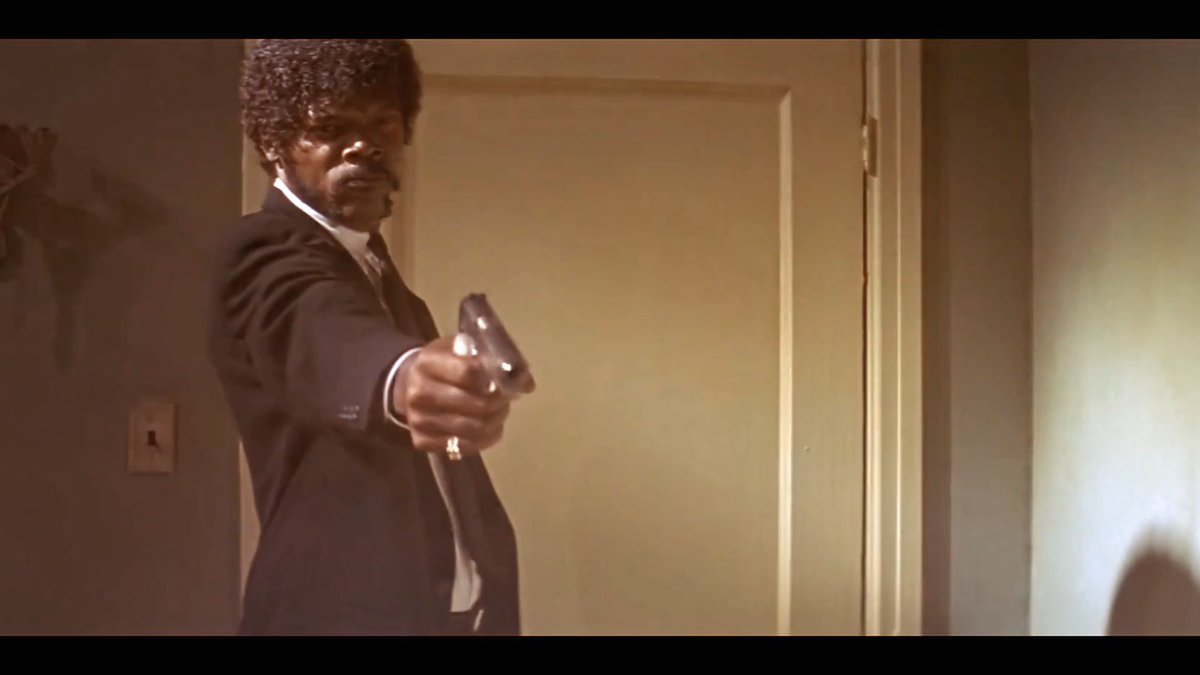
Samuel L. Jackson explains how he landed the role of Jules in Pulp Fiction, and what it was like seeing the film for the first time on the big screen: “Pulp Fiction and I came together in a very strange kind of way. I remember auditioning for Quentin for Reservoir Dogs in New York (for the role of of Detective Jim Holdaway, Mr. Orange’s police contact). And apparently I didn't get that role. But I was at Sundance the year that he screened it for the first time. I was sitting there and I watched that movie - I was awed by it. I mean, there were people running up the aisles when Michael Madsen was cutting the cop's ear off. People were going, "Oh my God, this is horrible!" All these “auteurs” were running out of the theatre. I was like, "This is good. This is happening. This is different." So after the film, I walked up to Quentin and said, "This film's amazing, man. It's great." And he looked at me and said, "Hey! How'd you like the guy who got your part?" And I was amazed that he even remembered who I was - but he remembered me. A year or so later, I got a phone call saying Quentin Tarantino wants to have dinner with you, because he'd seen Jungle Fever and he liked that Gator character. When we had dinner, we were sitting there talking. We started talking about Hong Kong films and cartoons and foreign movies and obscure things that we watched, horror movies. We found out we liked the same kind of stuff. And he told me he was writing this thing, and he was writing this part with me in mind. He was going to send it to me. I went off to do another film. I was in the backwoods of Virginia somewhere doing a film, and the script came. A little plain brown wrapper from Jersey Films. And Jersey's got these gangster images on the logo. And it said, "If you show this script to anybody, two guys named Ernie and Luigi will come and break both of your legs." Whatever. I went, "Yeah, right." So I sat down and read it. Boom. I read this thing. It's like, "Oh my God. This is awesome." And then I said to myself, "Nobody writes a script this good. There's no way that this script is as good as I thought it was." I closed it. I opened it again. I read it immediately. Okay. This is great - If whoever produces this film lets him shoot exactly what I just read, if they stay away from it, they don't try to edit any of this stuff out - this is going to be a great film. It's going to be kind of audience-specific, because I like that kind of stuff. I have friends that I knew would like it. It was a generational kind of film. I never thought it would cross over and do all this stuff. We shot it. We had a great time doing it. And the first time I actually saw the film was at the Cannes Film Festival. That night, it screened, and I was sitting there watching the film. The audience was loving this movie, loving it. About halfway through, I realized there were subtitles at the bottom of it. So I said, "Hey, these people are reading it, and they're getting it. This might be special. This really might be something special." And actually, by the time it was over, there were tears running down my face. I was just so pleased that I was part of that particular film… I never felt that satisfied, and that kind of full about a performance and about being part of something as I was in that particular moment.” Quote comes from an Interview with the American Film Institute 2010

Gangster Cinema Central

85,366 Aufrufe • vor 2 Monaten

There have been many masterpieces that were commercial failures, but nothing quite hurts me like the failure of Jacques Tati's "Playtime" (1968). The production costs of the movie went well over budget that forced Tati to take out large loans and personal overdrafts. Despite all the difficulties, the movie came out nearly as Tati envisioned. So much so that he said, "I’m proud of 'Playtime'; it’s exactly the picture I wanted to make. With all my other films, I could make changes, shoot things differently if I was doing it now. Not with 'Playtime'— I did it and it’s done. I’ve suffered a lot because of it, physically and financially, but it’s really the film I wanted to do." About the movie and Tati's struggles, Francis Ford Coppola said, "Tati took all of his money which he had earned and he wanted to make a film that no one would finance and he made this film and it failed. He had nothing and at the end he died in poverty because the movie he wanted he borrowed the money to make failed. People would let him to live at their house because they loved him but long after he died his movie, 'Playtime', everyone realised was the masterpiece. We all have to say 'Thank you, Jacques Tati' for giving us this because it's a joy and it's wonderful and it wouldn't have been made had he not made that sacrifice." (Quotes taken from Jacques Tati's interview with Jonathan Rosenbaum, Film Comment, 1973 & Francis Ford Coppola, Konbini, 2024)

DepressedBergman

33,386 Aufrufe • vor 1 Monat

Lawrence Kasdan on how George Lucas helped him to make "Body Heat" (1981) & the most important advice George Lucas gave Kasdan before his debut movie: "Interviewer: What was it like making the jump into directing? Kasdan: Part of it had to do with George, because Alan Ladd Jr. said "You have to get a sponsor," because that's what was happening then. So I went to George and he said "I can't put the Lucasfilm name on Body Heat because it's too dirty. But I will sponsor you." So he went to Laddie and said "I'll sponsor Larry to do 'Body Heat'. Here's a quarter of a million dollars, and if he goes over (budget), you can use that to cover his overages," which just astounding! George never came to the set, but when we were editing, George spent one day in the cutting room with me, which was very helpful. But making the jump was not hard, because I had been imagining directing for a long time (laughs). Every movie I had written, I had already directed in my head, so it turned out to be not that big a deal. I was so happy. People don't talk about that too much. We have a way of being cool about our careers. The truth is, I'm happy about it, that I get to (make movies). It was true 20 years ago, and it's true now. (...) Interviewer: Any advice for first-time directors? Kasdan: George Lucas said the most useful thing to me as I was about to do 'Body Heat'. I said "George, I don't know that much about the technical stuff." And keep in mind that George is Mr. Technology, right? He said "Making movies has nothing to do with the technical stuff. It has everything to do with what kind of person you are." It was the most important thing anyone ever said to me about directing. I had a lot of confidence in the sort of person I was. I knew the kind of stories I wanted to tell. I knew the kind of atmosphere I wanted to create on my set. I knew the kind of life I wanted to live and how I wanted my work to embody that life, so the fact that I didn't know anything technically didn't really matter. You can learn the technical stuff like that (snaps fingers). So the fact that it was George who told me this was very comforting. And it turned out to be absolutely true." (Lawrence Kasdan's interview with Alex Simon, Venice Magazine, 2001)

DepressedBergman

87,276 Aufrufe • vor 4 Monaten

This man was criticized for expecting a “thank you” for a good deed. He always saw the same man walking when he drove to work. He assumed the man was walking because he did not have any other means of transportation. He used his own money and bought the man an electric scooter, the man took the scooter and just silently walked away, no thank you or anything else at all. I don’t think that was too much to ask, a thank you goes a long way, otherwise it makes people look ungrateful. Back in college, I had a classmate that I always saw walking home after class. It didn’t matter whether it was raining or snowing, or hot out. Whenever I drove past him he always looked miserable and I could tell he didn’t like to walk all the time. In class I had asked him where he lived, and I found out it was on my way home so I offered to drop him off because it was really cold out and had snowed about a foot. He agreed and we chatted on the way home, nothing serious just pleasant conversation. I dropped him off and went on my way home. For me this was a one time thing, I only offered because how bad it was snowing. After class the next day, he walked with me and when I got to my car he got in. I didn’t agree or offer him a ride that day but he assumed that since I was ok with giving him a ride the day prior that I would be ok with it this day too. I didn’t say anything about it because at this point I didn’t care really. So the next day came and went, once again he walked with me to the car but that day was different. I wouldn’t be going his way because I had to work after class. So before I got to the car I said “I’ll see you tomorrow.” He looked dumbfounded and said aren’t you taking me home? I said no, I have to get to work. He then asked me how he would get home, and I told him the same way you always have. He then gave me excuses for why I was being a jerk because I was making him walk in the cold. I didn’t argue I just told him I helped him out when I could, but I wasn’t about to go out of my way because he didn’t have a car and besides I didn’t want to be late for work. He didn’t speak to me for the rest of the semester because of it, something tells me I was better off not offering to help in the first place.

SonnyBoy🇺🇸

37,380 Aufrufe • vor 28 Tagen