Loading video...
Video Failed to Load
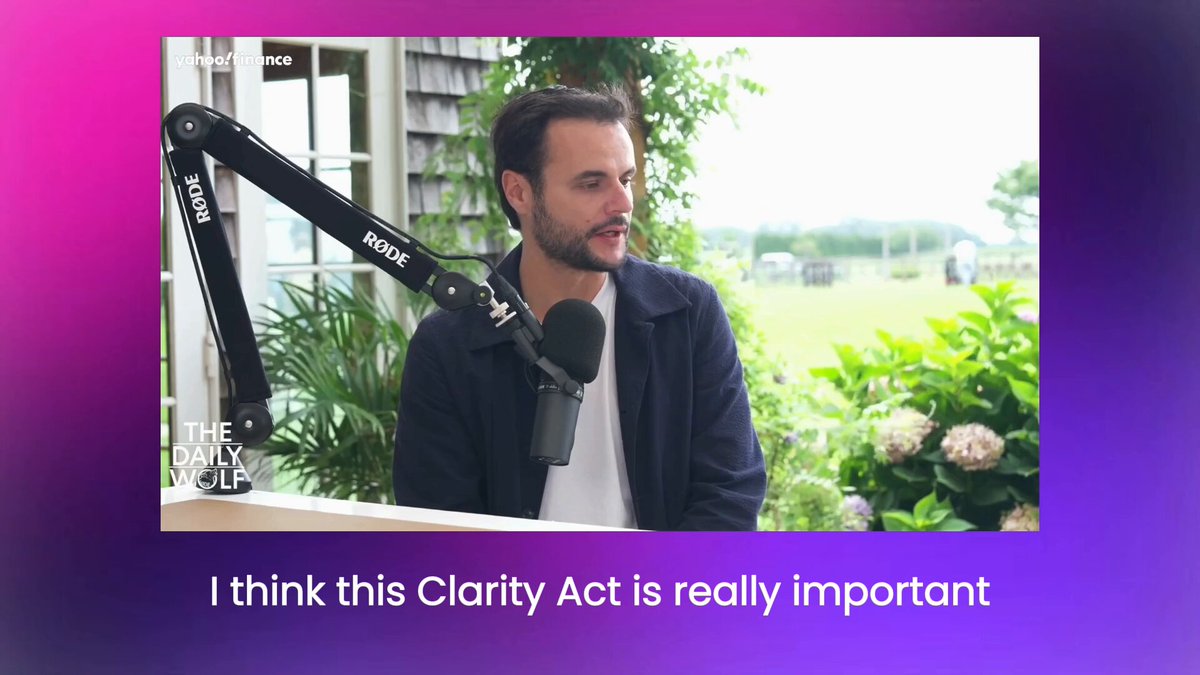
"It's a sign that crypto actually built infrastructure that works. But is it bullish for the projects and tokens involved? I'm not sure it is" Joshua Frank on what Robinhood building on Arbitrum really means for crypto "There's a reason Robinhood is choosing to do this onchain. They can... show more
31,562 views • 1 month ago •via X (Twitter)
0 Comments
No comments available
Comments from the original post will appear here



![[Robinhood’s on chain ecosystem is where Ansem sees asymmetric upside] “One of the things I’m most bullish on right now is Stonkbroker.” “70% of the conversion fee buys tokenized stocks and airdrops them to NFT holders.” “Robinhood wants to be the RWA chain, but they also support memes.” Ansem 🐂🀄️ pointed to Stonkbroker as one of his highest conviction on chain bets outside of $ANSEM. The protocol combines NFTs, tokens, and tokenized equities into a single flywheel. Every conversion between the token and NFT generates fees, with most of that revenue used to buy tokenized stocks and distribute them to active NFT holders. The bigger thesis sits above the product itself. Robinhood is openly building around both RWAs and meme culture. Projects that align with that direction have room to benefit as the ecosystem expands through its launchpad, DEX, and growing on chain infrastructure. For him, it’s an early ecosystem play backed by a builder with deep crypto experience and a market cap that still leaves meaningful upside.](https://image.24vids.com/tw-2085574923339121020/amplify_video_thumb/2085574863687999488/img/DMwFxVKSnwYJV4Hy.jpg)


!["Those monopoles... the 5G on buildings... that's the telecom staking their environment... [it's the] claim [that] they own you, they're going to surveil you...[and the FCC's] opened...the exact bandwidth that is actually weaponized... [and was] used in a theater of war in Iraq" This clip of Reinette Senum (Reinette Senum), a former mayor of Nevada City, California, is taken from an episode of the Children's Health Defense (Children’s Health Defense) series Financial Rebellion posted to Rumble on November 20, 2025. ----------------Partial transcription of clip--------------- "So what we're seeing is, and I'm trying to give some visuals to people, is that this is a chain to, that's going to ensure enslavement. And really they've just got one last link, that's it left, which is scary, but it's also the Achilles heel. And that's where we can really just draw the line and drop the gauntlet. And that link are, are these cell towers, the actual antennas being just popped up everywhere? Because they've got that framework, the infrastructure is there, those are those lines or they're underground. They just need to be able to put the antennas up without any interference whatsoever. "What people also don't realize there's a lot of really nefarious little things in the small print. But when a county or a city actually gives a contract to the telecoms and passes it, what people don't realize is those contracts are generally for 25 years and more than likely it'll be even longer than that because it's just, usually it's consent item. They just, you know, with one, you know, you know, one fell swoop, they just approve everything on the consent items. There's no discussion, no public discussion, no anything, no environment views. And then they add a different type of antenna. "So when those poles, those, those monopoles or the 5G on buildings, whatever, that's the telecom staking their environment. Their, their real estate claim. This is essentially vertical real estate. And the reason why they want to claim it and oversaturate it is because when they stake that claim, they own you, they're going to surveil you, they're going to spy on you, they're going to control you. They're going to take all that data where you're shopping, where you're spending, who you, where you're driving, what you're doing, all of your whereabouts, all of that data, they're going to collect it. "What we do know too, and you have to ask, why would the FCC do this? Was just a few years ago the FCC opened up a bandwidth, okay, so you have this spectrum and they only allow so much of this bandwidth to be sold and auctioned off to the telecoms. And what they did was a few years ago is they opened it up to the millimeter wave, to the exact bandwidth that is actually weaponized, is militarized, is used in a theater of war in Iraq. "We have a couple examples of what it can do. In 1991, military was celebrating. This is so phenomenal. We use the Millimeter wave. And what we did is we actually supplanted the, the voice of Allah into the soldiers and the farmers and the ranchers down below on the ground in Iraq. And we told them to give up their arms, put up their hands and you know, turn themselves in. It was a great it was a great win. It's like, wait, you did what to them? "Then I had another roommate of mine who's a former Air Force flight surgeon saying, oh yeah, we used to fly, you know, above Middle East and we would shoot down a beam of 5G and we would scramble the brains of anyone down on the ground. And then the foot soldiers would come along after that and shoot and kill anybody who was moving or looked alive whatsoever. And I had asked her, I said, well, this is horrific. Exactly what would that experience be to somebody on the ground? Well, they just hear a lot of static and they would then just drop dead because we just scrambled their brains. This, this is, these are the frequencies that the FCC put on the market. "Now the telecoms have this available to them. Why? Why would they ever allow this? Okay, so there's that piece. So they stake their claim, they're there for at least 25 years, but actually it's going to be longer. They have complete control and they are monitoring everything. And if they want to, they can do a slow cook or they can target. And that's the difference with the millimeter wave is... the millimeter wave actually targets the phone, it targets the person. Whereas 3G, 4G is just ubiquitous. As you send out the signal, you pick it up or you don't. There's that piece. "The other hidden piece that people do not realize is that in most of all these telecom contracts with the counties and the cities, basically they say, okay look it, you can use whatever kind of technology you want. You can go for 3G, 5G, 10G, 20G, we don't care as long as the antennas look like the original antennas when the, the whatever was installed. So that could be any kind of technology. So it could be a weaponized technology which is now what we are seeing already. And there's nothing you can do about it. "And while... they may have it on the agenda to vote on, generally there's no notification. People have no idea. Again, it's under consent items, which means there's probably 10, 20 other agenda items. They just vote all one fell, you know, swoop, just like what we kind of saw with Congress the other day. And, and it's done. There's a switch, and you have no idea. So this is also a Trojan horse. "And I try to say to people, when I look at cell towers, I see it as a towering Trojan horse for the military industrial complex, the surveillance state, the whole digital dystopian, you know, prison that we're talking about. This is the only way they can do it. The only way they can do it is by having these antennas everywhere. And while they do have satellite, there's more wiggle room there. But this is how they're going to do it. What's happened now is the FCC and congressional members, are paving the path where nobody can stop it."](https://image.24vids.com/tw-1991577983438798931/amplify_video_thumb/1991574682924118020/img/NTYvMXYc_eFldB2V.jpg)

![Robinhood CEO: In the future there will be no distinction between crypto and traditional finance “I think that crypto technology has so many advantages over the traditional way we’re doing things that in the future there will be no distinction. It’s kind of how technology itself was viewed as a sector of the economy for a very long time… I think crypto will go through the same transition where we’re still thinking about it in its own bucket but eventually everything will be on-chain in some form or another and the distinction will disappear.” Robinhood CEO Vlad Tenev explains why this transition is taking so long: “I think the challenge with traditional finance — particularly on the infrastructure layer — is they have a lot of stakeholders, and if you think about where they generate the bulk of their revenue, it’s not from crypto-related initiatives. And a lot of these stakeholders, because they’re quite big, are going to be resistant and slower to adopt technologies. They’re going to be late adopters. They’re going to wait until it’s proven before adopting it, and that’s why we [Robinhood] have had to do greater vertical integration than we would normally want to do in TradFi. We acquired Bitstamp. We have our own exchange. And we have our own chain because I don’t think — to be at the frontier of crypto — you can rely on traditional infrastructure providers. I think they’ll get there eventually but it will take a very long time.” Ethereum will be the global settlement layer for this new financial system, and ETH will be its money. ETH is the base pair for trading on The Robinhood Chain, the highest volume asset, and the gas token to pay for blockspace. Source: TOKEN2049 (Oct 2025)](https://image.24vids.com/tw-2075559110796587429/amplify_video_thumb/2075558252843028480/img/AW2HfgNvOMWt4MO5.jpg)

