Video wird geladen...

Video konnte nicht geladen werden

Zur Startseite

It's pretty cool what you can do with free data. Updated my framework for volatility and Term Structure using free VIX (and SPX) closing data from Yahoo Finance. Animated: both flow fields now recompute at each frame, 1-frame for each daily close over the last 120 days.

57,295 Aufrufe • vor 4 Monaten •via X (Twitter)

0 Kommentare

Keine Kommentare verfügbar

Kommentare vom Original-Post werden hier angezeigt

Ähnliche Videos

Gemini-powered robot can now effectively debug itself! I've been obsessed with two main questions in robotics: can robots learn from their own mistakes without humans in the loop, and how much can we leverage synthetic data? Spoiler: yes, and it's surprisingly elegant once you have the right primitives in place. The architecture is fairly simple (and optimized for GPU_Poor users): Component I: Gemini Brain ♊️ - Gemini 2.0 Flash analyzes all training episodes through both camera perspectives - Gemini 2.0 Pro creates a summary of training data, highlighting biases, limitations, etc. - Train policy p0 on this initial data, run evaluation episodes - Ask Gemini to categorize successes vs. failures (more insightful than you'd expect) - Based on both analyses, Gemini generates specific augmentation recommendations What's interesting here isn't that we're using LLMs for robotics - it's that we're closing the loop between perception, failure analysis, and targeted data generation. Component II: Data Generation with Scene Consistency The tricky part was maintaining consistency across both camera perspectives while generating new data. Three current augmentations: - Frame flipping and polarity reversals - Grounded-SAM + OpenCV for object color manipulation - Gemini to identify empty space and generate distractions in the scene …and repeat, ha! I'm using the so100 robot arm and Sarah’s Vintage from Hugging Face. And the APIs and models in Gemini family are Ace! Thank you Logan Kilpatrick Patrick Loeber and team for this. In thread The Circus of Making It Actually Work🧵:

Shreyas Gite

47,245 Aufrufe • vor 1 Jahr

🚨 THE BIGGEST BOTTLENECK IN AI ISN'T COMPUTING POWER ANYMORE IT'S MOVING DATA. Instead of laying new cables, Chinese researchers have upgraded existing fiber infrastructure by doing two things at once: Using three wavelength bands (C + L + S) instead of the usual two. Using four cores inside each fiber instead of one. Each core acts like an independent highway, and each band acts like an extra lane on that highway. Together, they’ve reportedly increased transmission capacity per core by nearly 50% and overall data throughput by up to 5×. This matters enormously for AI. Modern AI clusters move terabits of data per second between thousands of GPUs. The biggest bottleneck is often not the chips themselves, but moving data fast enough between them. If you can push 5× more data through the same physical cables, you can train bigger models faster and reduce network congestion. Why this is significant: • It shows multi-core + extended spectrum technology moving from labs into real-world commercial use • The system has already run over 35 km of existing telecom network • It could be especially useful for submarine cables and large-scale data center interconnects • China is also eyeing it for its “Eastern Data, Western Computing” project The deeper implication: We’re reaching the physical limits of how much data we can push through single-core fibers using traditional methods. By combining spatial multiplexing (multiple cores) with spectral multiplexing (more wavelength bands), engineers are finding new ways to keep scaling bandwidth without having to dig up the planet to lay new cables. This kind of breakthrough is quiet but foundational it’s the kind of infrastructure upgrade that will determine how fast AI and cloud computing can actually grow in the coming years. The future of data movement might not require more cables. It might just require smarter ones. How important do you think multi-core and multi-band fiber will be for keeping up with AI’s exploding data demands? Follow for more frontier networking, photonics, and infrastructure technology.

TheNewPhysics

20,485 Aufrufe • vor 1 Monat

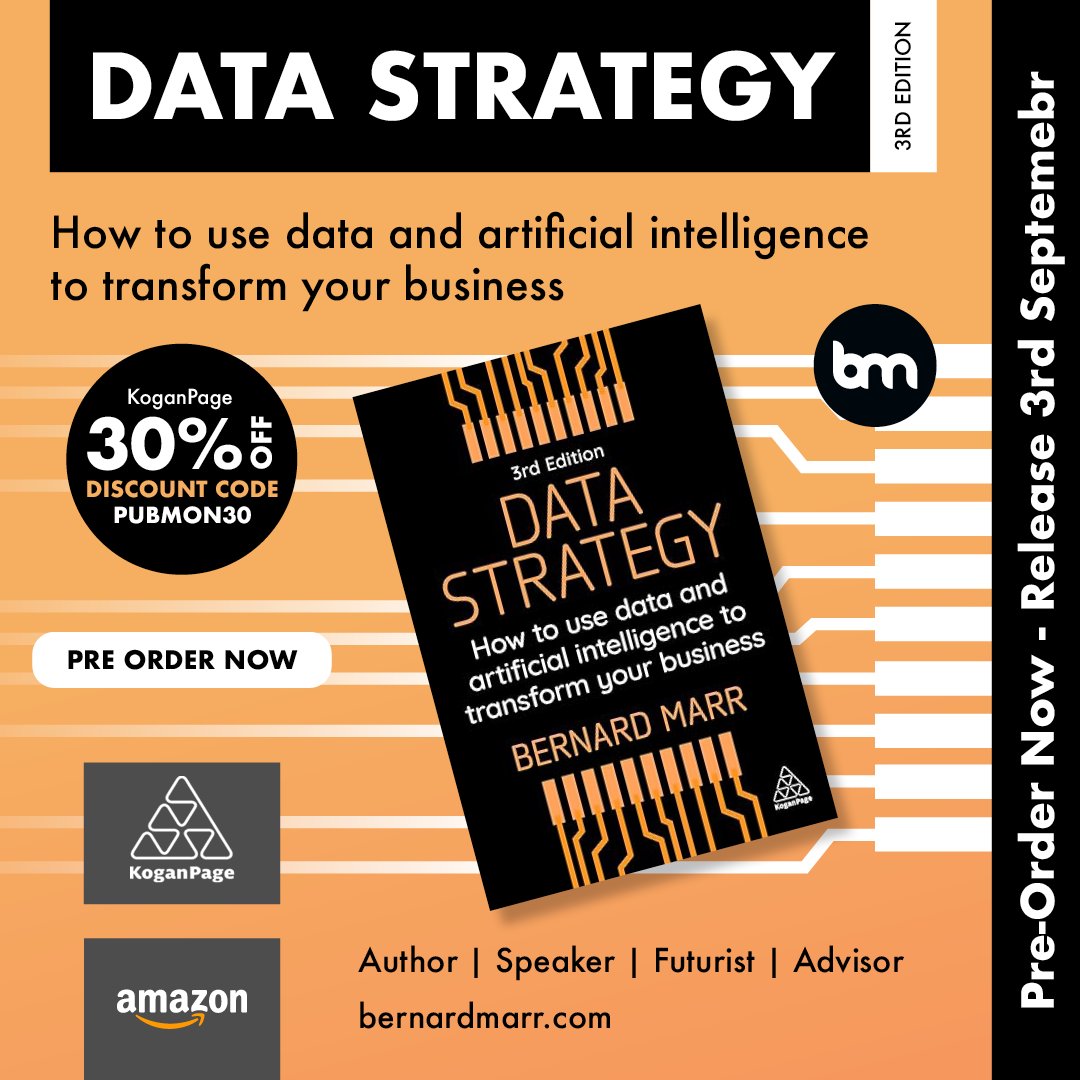
🚀 My New Book is Here: Data Strategy (3rd Edition) 🚀 I’m thrilled to share the release of my latest bestselling book, Data Strategy: How to Use Data and Artificial Intelligence to Transform Your Business. Every business today needs data to survive - but simply having data is not enough. What matters is how you use it. A well-designed data strategy is the key to unlocking value, driving insights, and giving your organisation the competitive edge it needs to thrive in the digital economy. From small organisations to global enterprises, I’ve seen first-hand how a data-driven approach can transform operations, improve decision-making, and unlock entirely new opportunities. That’s why I’ve poured my experience into this book — to help leaders and teams build strategies that don’t just talk about data, but actually deliver measurable impact. 🔍 In this third edition, I’ve expanded the book to reflect the latest developments in data and AI, including: ✅ Generative AI and its role in shaping business innovation. ✅ Synthetic data and how it can accelerate AI adoption. ✅ The potential of quantum computing and what it means for the future of data. ✅ Expanded guidance on cybersecurity, regulations, and ethics in a data-driven world. This isn’t just a theoretical framework - it’s a practical guide to collecting, managing, and using data effectively in order to drive growth, innovation, and long-term success. Whether you’re leading a start-up or a multinational, Data Strategy will equip you with the tools you need to stay ahead in a rapidly evolving landscape. 📖 Pre-order your copy today: 👉 Amazon - 👉 Kogan Page - I can’t wait to hear how this book helps you craft your own data-driven strategy and transform your business for the future.

Bernard Marr

10,980 Aufrufe • vor 11 Monaten