Video yükleniyor...

Video Yüklenemedi

Ana Sayfaya Dön

Ivan Passer on the reason why 'Intimate Lighting' (1965) was banned by the communist government in Czechoslovakia for 20 years: "Interviewer: It seems inconceivable that 'Intimate Lighting' (1965), an almost plotless comedy about the everyday pleasures of life, should have been banned for 20 years. Can you explain it?...

17,774 görüntüleme • 4 ay önce •via X (Twitter)

0 Yorum

Yorum bulunmuyor

Orijinal gönderinin yorumları burada görünecek

Benzer Videolar

Blake Edwards on the conditions he laid out before accepting to direct "A Shot in the Dark" (1964): "'A Shot in the Dark' (1964) is nothing like Marcel Archard’s play, that’s for a start. I was asked to save the situation. They had quite a bit of money involved in this project. Peter Sellers was threatening to pull out because he didn’t like the screenplay. He said that the only way he would continue with the project would be if I took it over. I said that the only way I could possibly take it over, under such emergency conditions, would be that I would not be obliged to do anything like Archard’s play because a) I didn’t like it, b) I thought it was not a motion picture and c) I wasn’t ready to make a movie at that point. So they asked me what I wanted to do because the picture had to start in something like four weeks. I said that if they wanted me to save them, I’d have to take something with which I was familiar to begin with. I was familiar with the character of Clouseau. I needed a detective, somebody to solve a murder. I couldn’t throw the whole thing out. I had to use the idea that the maid was accused of killing the chaffeur and this had to be solved. So I thought that Peter Sellers was just the natural thing and that now I was going to try to be as broad with the character as I could be. “How far can I go now in terms of Inspector Clouseau?” I wrote the screenplay and was on the stage in four weeks with it. Fortunately, it turned out to be a reasonably funny movie. It proved something for me—that if a gag is well-designed you can pull it off." (Blake Edwards' interview with Jean-Francois Hauduroy, Cahiers du cinéma, 1966) P.S: On this 62 years ago, "A Shot in the Dark" (1964) premiered in New York City, USA.

DepressedBergman

20,460 görüntüleme • 1 ay önce

Richard Donner on why he made 'Superman' (1978) & the movie's connection to François Truffaut's 'Jules & Jim' (1962): "I certainly didn’t know it when we were making 'Superman' (1978) [that it would have a profound impact on millions of people around the world]. I was just trying to make the best movie I could make. I think it was during the first showing I attended — not the opening, but a regular screening in a theater, in New York. I watched the audience experience that movie and I was very moved, very excited. Before I came on board, the script was kind of a parody of a parody, It had been really well written by three or four really good writers, but they had been directed by a couple of Hungarians [producers Alexander and Ilya Salkind] who saw it as a comic book rather than a piece of history. Their script didn’t have any respect for what the character stood for, since I was a little kid. Tom Mankiewicz and I had known each other for years, and we’d always talked about working together, so I presented him with the problem, I asked him to bring a sense of reality, or verisimilitude, to the story. I wanted to be able to prove that a man could fly. Tom rewrote the entire script. Years before, there had been a French film called 'Jules and Jim' (1962, Truffaut), a great film. Two guys fall in love with the same woman. That’s what Superman was: two guys in love with the same woman. It happened to be that the two guys were the same guy, but not in the woman’s eyes. I asked Tom ‘How do we make that into a love story?’ He just fell right into it." I was trying to let the audience know that they were not looking at a comic book, or what had been done with Superman over the ages. This was the true story of Superman. In my eyes, when I was a kid, he was real. And he was in Tom’s eyes, too. We decided that’s the way we wanted the movie to be." (Richard Donner's interview with Michael P Coleman, 2020)

DepressedBergman

36,100 görüntüleme • 7 ay önce

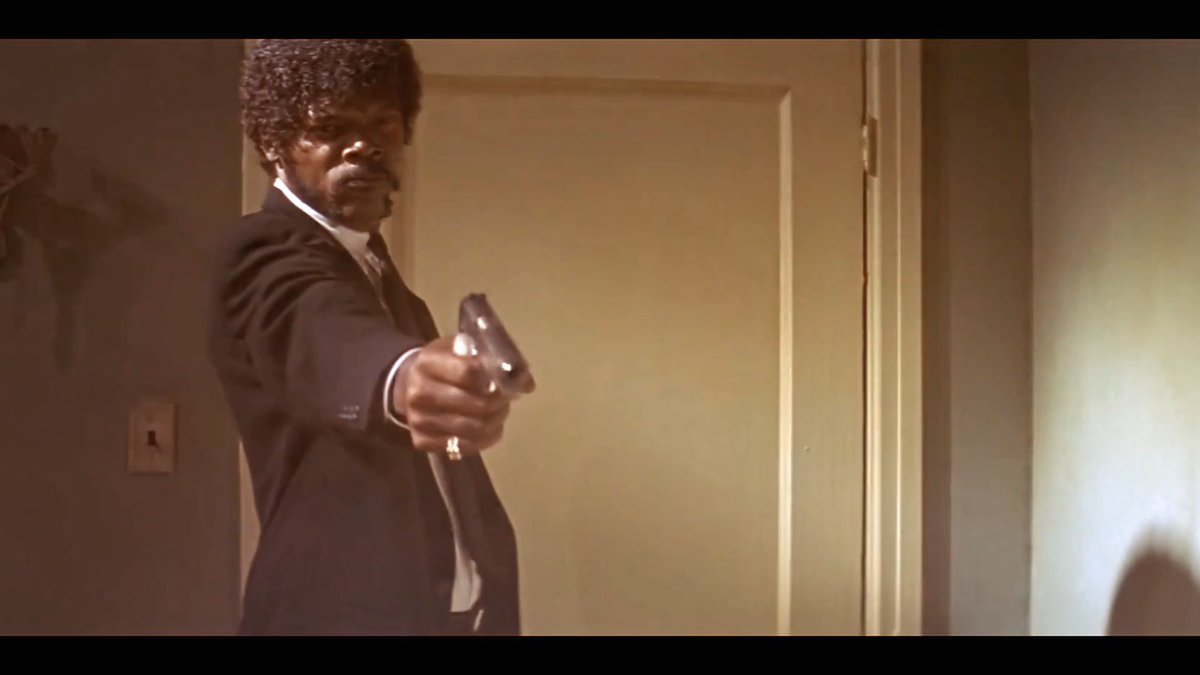
Samuel L. Jackson explains how he landed the role of Jules in Pulp Fiction, and what it was like seeing the film for the first time on the big screen: “Pulp Fiction and I came together in a very strange kind of way. I remember auditioning for Quentin for Reservoir Dogs in New York (for the role of of Detective Jim Holdaway, Mr. Orange’s police contact). And apparently I didn't get that role. But I was at Sundance the year that he screened it for the first time. I was sitting there and I watched that movie - I was awed by it. I mean, there were people running up the aisles when Michael Madsen was cutting the cop's ear off. People were going, "Oh my God, this is horrible!" All these “auteurs” were running out of the theatre. I was like, "This is good. This is happening. This is different." So after the film, I walked up to Quentin and said, "This film's amazing, man. It's great." And he looked at me and said, "Hey! How'd you like the guy who got your part?" And I was amazed that he even remembered who I was - but he remembered me. A year or so later, I got a phone call saying Quentin Tarantino wants to have dinner with you, because he'd seen Jungle Fever and he liked that Gator character. When we had dinner, we were sitting there talking. We started talking about Hong Kong films and cartoons and foreign movies and obscure things that we watched, horror movies. We found out we liked the same kind of stuff. And he told me he was writing this thing, and he was writing this part with me in mind. He was going to send it to me. I went off to do another film. I was in the backwoods of Virginia somewhere doing a film, and the script came. A little plain brown wrapper from Jersey Films. And Jersey's got these gangster images on the logo. And it said, "If you show this script to anybody, two guys named Ernie and Luigi will come and break both of your legs." Whatever. I went, "Yeah, right." So I sat down and read it. Boom. I read this thing. It's like, "Oh my God. This is awesome." And then I said to myself, "Nobody writes a script this good. There's no way that this script is as good as I thought it was." I closed it. I opened it again. I read it immediately. Okay. This is great - If whoever produces this film lets him shoot exactly what I just read, if they stay away from it, they don't try to edit any of this stuff out - this is going to be a great film. It's going to be kind of audience-specific, because I like that kind of stuff. I have friends that I knew would like it. It was a generational kind of film. I never thought it would cross over and do all this stuff. We shot it. We had a great time doing it. And the first time I actually saw the film was at the Cannes Film Festival. That night, it screened, and I was sitting there watching the film. The audience was loving this movie, loving it. About halfway through, I realized there were subtitles at the bottom of it. So I said, "Hey, these people are reading it, and they're getting it. This might be special. This really might be something special." And actually, by the time it was over, there were tears running down my face. I was just so pleased that I was part of that particular film… I never felt that satisfied, and that kind of full about a performance and about being part of something as I was in that particular moment.” Quote comes from an Interview with the American Film Institute 2010

Gangster Cinema Central

85,366 görüntüleme • 1 ay önce

Quentin Tarantino recounts a dinner with Robert De Niro during the making of Jackie Brown, where he asked him whether he understood when he landed the role of Vito in The Godfather Part II, that it would change his life. De Niro’s answer revealed a great deal about his mindset at the time. “I was working with Robert De Niro on Jackie brown, and we went out to dinner once. - When he got Vito in the Godfather Part II, that was going to be a big thing for him. He won the Oscar for it - it set him up to be a movie star. So I asked him - and I've asked this to quite a few actors when it comes to when they got the role that would end up changing their career - did he realize that the moment when he got the role, that it would have this sort of effect? And he goes oh, “I tried not to let it do that. I tried not to think about that” I go, "really? and why did you try not to think about that?" “Well because I’ve seen it happen and then go the other way” And then he used an example. “There was this guy, he was a young actor, and he was part of our crowd in New York. He'd been doing okay, but we were all in the same boat. Then all of a sudden he got a lead role. He's one of the two leads in a brand new movie by a director who had just done a smash hit.” And he's talking about Larry Pierce (the director) and uh... Goodbye Columbus. ”And he started dining out on it. And all of a sudden I go to the places that we used to go to, and now he's there and everyone's kind of revolving around him. He's kind of holding court. He's not doing anything bad; he's just arisen in the way that none of us have - and we're all treating him different. Then the movie comes out; nobody likes it - The movie comes out, and it goes away, and he's exactly in the same place he was. And I just wanted to make sure that that would never happen to me because I watched it happen to him.” Quote from Video Archives Podcast, sourced from James Whale Bake Sale YouTube channel. Clip below from the Godfather Part II (1974)

Gangster Cinema Central

97,458 görüntüleme • 3 ay önce

David Lean on how to direct actors & shares a funny story that happened during the filming of 'The Bridge on the River Kwai' (1957) "Interviewer: Could you talk about how you work with your actors? Lean: Dangerous subject. Well, it’s intensely personal. I always try not to speak in a loud voice when I’m talking to an actor on the set. I gently take them aside, and I whisper because I don’t want to give the impression, for their sake, that they are being told to do this or that by a teacher. I try as hard as I can to make them suggest something that I want them to think of. The trouble with actors is that it’s a very di cult job with this damned glass eye looking at them all the time. It’s quite di cult talking to all of you here, but I’d rather talk to all of you than I would have a hundred-millimeter lens pointing at me. It’s so concentrated. It’s part of a director’s job, I think, to get the actor to give as good a performance on the stage as he gave to himself in the bath in the morning. So I try to relieve them of their inhibitions. It doesn’t help if you talk from a great height, from a megaphone, as it were. I try to get their confidence. I try to give them confidence. I can’t bear some actors, the rambunctious types who think they know everything. You’ve got to knock them down and make them realize they don’t know everything. If you’ve really done your homework on the script, you, the director, know the part better than any damned actor because you’ve been at it for months. I’ve had lots of actors who want to change dialogue. I see them doing it. I won’t have it. They took on the script and they’ll stick to it. I’m terribly tempted to tell you a rather long story about Sessue Hayakawa. You know, I nd constantly that actors really are not interested in anything but their own parts. We had a scene in 'The Bridge on the River Kwai' (1957) where they had all the troops lined up, and Sessue gets up on the soapbox and talks. We went through a rehearsal, and I said, “What’s wrong?” Because it was the speech and yet it wasn’t the speech. What Sessue had done was to learn all the lines that were only his. He had cut out all the lines that were anybody else’s. The main script was about that thick, and his script was only that thick. He marked only the pages in which he spoke. He had thrown out the rest and bound it together. Now, we came to the scene at the end of the picture. Alec Guinness is looking over the edge of the bridge and he thinks he sees some wires. He goes up to Hayakawa and says, “Colonel Saito, there’s something rather peculiar going on. I think we better go and have a look.” Guinness walked o the bridge, which leads down to the rocks, and Sessue stayed there like a rock. I said, “Go on, Sessue, follow him.” He said, “I follow him?” I said, “Sessue, this is where you nd the wires and where you get killed.” He said, “I get killed?” He had thrown the page away because he had no dialogue. I’ll tell you another story about an actor, though I won’t tell you who it was. He was damn good, but I was kind of dissatisfied. I said, “Look, I understand that an actor is projecting ninety percent to the person he’s playing with, and ten percent is going out toward the camera. I’ve only just realized that you’re putting ninety percent out to the camera, and ten to whom you’re playing with.” It changed his performance immediately." (David Lean's interview to AFI, 1984)

DepressedBergman

36,391 görüntüleme • 6 ay önce

Seth Rogen reveals The Interview used a real tiger because the CGI was too expensive, then the tiger wrangler started asking terrifying questions I did a movie called The Interview about North Korea, and there’s a scene with a tiger. I directed the movie with my partner, and we wrote this scene where there’s a tiger. I thought in my head it would be CG. Life of Pi had come out recently, and I was like, “We’ll get the Life of Pi tiger. Put us down for one Life of Pi.” They were like, “We can’t afford that at all. We’ve got to get a real tiger.” I was like, “Oh God.” So we found a tiger wrangler in Calgary, and we had a call with him. It was so funny because he was the least confidence inspiring person you’ve ever spoken to in your entire life. I asked, “Where’d you get the tiger?” He said, “From a stripper.” We were like, “What?” He said, “She had a tiger cub as part of her act, and it got too big, so she had to get rid of it.” We asked, “Where does a stripper get a tiger?” He said, “It’s easier than you think. You could get one.” We had sent him the script, and he said, “Let’s go over the scene. You’re not shooting this at night, are you?” I said, “Yeah, the scene is set at night.” He said, “Ooh.” I asked, “Why is that bad?” He said, “Well, they hunt at night.” He asked, “Can it be during the day?” We said, “No. Is that okay?” There was a long pause, and he said, “Yeah, it’s okay. I think it’s okay.” Then he asked, “It won’t be in a big open area, will it?” We said, “Yeah, it’s basically a giant meadow.” He said, “Ooh.” We asked, “Is that bad?” He said, “Well, if there’s a deer or something, they will go after it.” We said, “That’s bad. Should we not do this?” He said, “No, it’s fine.” Then he asked, “It won’t be raining, will it?” We said, “Yeah. We’re filming in Vancouver in the winter. It will be raining.” He said, “Oh, that’s not good.” We asked, “Why?” He said, “The rain really agitates them. They just don’t like the rain.” We asked, “Should we not do it?” He said, “No, it’s fine. It’ll be fine.”

Ruzy.hl

316,974 görüntüleme • 17 gün önce

This man was criticized for expecting a “thank you” for a good deed. He always saw the same man walking when he drove to work. He assumed the man was walking because he did not have any other means of transportation. He used his own money and bought the man an electric scooter, the man took the scooter and just silently walked away, no thank you or anything else at all. I don’t think that was too much to ask, a thank you goes a long way, otherwise it makes people look ungrateful. Back in college, I had a classmate that I always saw walking home after class. It didn’t matter whether it was raining or snowing, or hot out. Whenever I drove past him he always looked miserable and I could tell he didn’t like to walk all the time. In class I had asked him where he lived, and I found out it was on my way home so I offered to drop him off because it was really cold out and had snowed about a foot. He agreed and we chatted on the way home, nothing serious just pleasant conversation. I dropped him off and went on my way home. For me this was a one time thing, I only offered because how bad it was snowing. After class the next day, he walked with me and when I got to my car he got in. I didn’t agree or offer him a ride that day but he assumed that since I was ok with giving him a ride the day prior that I would be ok with it this day too. I didn’t say anything about it because at this point I didn’t care really. So the next day came and went, once again he walked with me to the car but that day was different. I wouldn’t be going his way because I had to work after class. So before I got to the car I said “I’ll see you tomorrow.” He looked dumbfounded and said aren’t you taking me home? I said no, I have to get to work. He then asked me how he would get home, and I told him the same way you always have. He then gave me excuses for why I was being a jerk because I was making him walk in the cold. I didn’t argue I just told him I helped him out when I could, but I wasn’t about to go out of my way because he didn’t have a car and besides I didn’t want to be late for work. He didn’t speak to me for the rest of the semester because of it, something tells me I was better off not offering to help in the first place.

SonnyBoy🇺🇸

36,929 görüntüleme • 8 gün önce

Director Uhm Taehwa mentions Taehyung’s excellent acting and direction for Love Wins All MV in an interview for Muju Film Festival! Hosted by Editor-in-Chief Joo Sung-chul JSC: Do you know that… V, this BTS V, Kim Taehyung is going to be discharged on June, 10th? UTH: Yes, I know about it JSC: Have you perhaps gave him a call or… to give him congratulations. UTH: I sent him a message~ JSC: There is not much time left. The reason why I bring it up is because, the views for this music video is so huge! I think it went up to hundreds of thousands. In the comment section, everyone is saying, "Mr. Director, please do a movie with our Taehyung after he completes his military service." There were so much of these comments. So I'm curious to know, as someone who saw him on set, how was he about acting? For example, his passion for acting.. UTH: For me, if Taehyung would be willing to do so, I would be so grateful. I would love to work with him, even if I had to make up a role and ask him. And on set, we had fun working together. We only filmed for 2 days, and he enlisted I think about 2 days after filming that. Almost right before enlisting, he filmed with us and cut his hair right after he was done filming, and then left the next day I think. To that extent, he really wanted to work together. He was very passionate about it. And that's when I knew that he had a desire for acting. And for real, I'm not joking, but it would be so good if we could work together in the future. JSC: Do you have any nice stories about him? UTH: Uh *thinking* JSC: It was only 2 days so there wasn't much time. UTH: Originally.. Well in the end, they sing while wearing the wedding dress. There was this scene where they're up on the stage, singing. The two of them were originally supposed to dive into the audience and crowd surf. But with only having 2 days, we really didn't have enough time. But as a director, I really wanted to film that scene. I thought it would enhance how their emotions erupt. So until the end I was trying to make it work, and then Taehyung convinced me. He said, "Instead of this, how about we film another scene better?" So he convinced me, and we really didn't have enough time. If we kept my idea, then we might not have had time to film the other scenes. So everyone including the audience actors were worrying how to do this scene. So Taehyung talked me out of doing that scene, and said to the audience actors, "Everyone, I got rid of this scene!" And I remember everyone got so happy and cheered out loud. 🔗

Taehyung Naver

322,300 görüntüleme • 1 yıl önce

Cody Rhodes was asked about John Cena saying how the match that you guys did at SummerSlam had to be different, had to deliver, because the WrestleMania match he felt didn’t. How did you put that match together at SummerSlam? “Well, I never was one to get mad or get in my feelings over WrestleMania 41 because it was part of a larger story. That is a hard sell, though, for a WrestleMania, especially when the year before you had the completion of over several decades of a journey, and at a 10-year Mania, you’re involving luminaries and legends. It’s a feeling that’s good, a good feeling, as Shawn Michaels will say, the good stuff. So when you go into 41 and you’re doing 1/4 of your story, and you know your story goes all the way to SummerSlam, I never was not committed, and I never doubted John. I hope he knows that, because I know he talks about this match, so I feel comfortable talking about it, but I never doubted, hey, well, this is what we’re doing now, and this is what we’re going to do, then this is what we’re going to do when we get to SummerSlam. You asked, though, how we put it together. I have a really great photo of how we put it together in the most old-school fashion ever. He wanted to have a cigar where he was staying in New York, and this was the night before. I figured I like cigars, it is one of my favorite things, maybe the most Cuban thing about me. I went there, and I realized after dinner and stuff, maybe an hour in, that we were talking about tomorrow. But we were just talking about it differently than you talk about it at the ringside area. We were talking about it, then we would talk about something else, and then we’d slip back into it, and it was the most I think I’ve ever focused in my mind. Because once we go past something, I don’t want to forget it. Remember that idea, I don’t want to forget it. So I ended up going to my hotel that night, and I had it all. I had everything, and I kept making sure. I think I was telling Brandi, and I was making sure I had it. I had what we had talked about. Because with an old school guy like him, you may actually go out there the next night without seeing each other, which is wild in 2025-26. But with John, that was a possibility. He could have just yelled his whole version of it, or I could have yelled my whole version. But that was a really special moment, because I got a lot of pictures from it, and I didn’t share any except maybe one of us signing at the tables. But I got to be with my friend at the end, and I got to not just be with my friend, but I got to have the responsibility that I think anyone in the business would want. I got the responsibility of being booed in Vegas. I got that responsibility of being the one who can survive. Hey, yeah, you may not be the hot thing right now, but if you’re going to be QB 1, you have to be able to survive, and I got to be able to be in there with the guy who survived more encounters than anybody in our business with split crowds, for him crowds and hostile crowds.” (Chris Van Vliet)

J O H N

34,566 görüntüleme • 5 ay önce

To the small island who once ruled the world… come the men who do. 24 years ago, Nike released this advert. It’s trending on social media again. I watched it this morning and it made me cry. I bumped into a neighbour yesterday who has lived in South Africa for 5 years and we were talking about the upcoming game. She’s heading down to our Clubhouse to watch it… as most of us are. And she was telling me how excited she is for South Africa. She’s originally from America but will be wearing her Green and Gold tonight. We started talking about the heart of rugby in our country. You see, the Bokke don’t just play a sport, they play with everything they have. They play for every single South African. They play to remind us who we are. And they play to show us who we can be. My neighbour said, “There is no other nation that does that. It’s so beautiful.” She ignited a core memory in me. It was 1995. The Rugby World Cup was the first major sporting event to take place in South Africa following the end of apartheid. We were the hosts. It was also the first World Cup in which we were allowed to compete. I was sitting on the floor with my brother and sister watching. My folks were on the couch. There was this intense feeling of trepidation. We needed to win. Our country needed to win. “But how do you remember that? You must have been so young?” My neighbour asked. Because it was the first time we felt like one nation. Undivided. It was the first time our country was standing behind a new president and a new flag - together. Nelson Mandela made us believe that we were the rainbow nation. He gave us hope that as a country, we could become more than what we were before. We could rewrite our history. When that last whistle blew our entire team dropped to their knees crying, the crowd flying the new South African flags higher than high and then Nelson Mandela made his way to the pitch to meet Francois Pienaar. Something was ignited in us all. The spirit and heart of how rugby brings South Africans together. So ja, our team don’t just play a sport. They play with everything they have. They play for every single South African. They play to remind us who we are. And they play to show us who we can be. Win or lose, they play to bring us together. To the Bokke today, noma ngabe kwenzekani namuhla, iNingizimu Afrika iyaziqhenya ngani. Ngiyabonga Bokke! Searching for the best in me, I will fight for what I can be. If I win, lose or draw, there's a winner in us all! It's the world in union. The world as one. As we climb to reach our destiny. A new age has begun. For South Africa! Okay. Love you.

Brent Lindeque

291,811 görüntüleme • 2 yıl önce