正在加载视频...

视频加载失败

🇯🇵 Japan Just Fired Its First Tomahawk, And Beijing Should Be Worried For eighty years, Japan's military was built to defend, never to strike back. That era ended this week in the open Pacific. On July 29, the destroyer JS Chokai (DDG-176) launched a live Tomahawk cruise missile for...

14,594 次观看 • 5 天前 •via X (Twitter)

0 条评论

暂无评论

原始帖子的评论将显示在这里

相关视频

A nuclear superpower calling its peaceful neighbor "militarist" is pure gaslighting. Japan is officially refusing to back down against Beijing's psychological warfare. At the 23rd Shangri-La Dialogue in Singapore, Japanese Defense Minister Shinjiro Koizumi delivered a blistering rebuttal to China’s weaponized accusations that Tokyo is sliding back into a state of "new militarism." Koizumi completely dismantled the narrative by exposing the sheer absurdity of the claim, stating, "Think about it. There is a country that has a huge arsenal of nuclear weapons and strategic bombers. Japan has neither of such weapons. And yet, Japan is labeled new militarism. Isn't it strange?" Tokyo’s historic shift toward record defense spending and enhanced regional deterrence is a direct, defensive reaction to China’s own rapid, untransparent military buildup. Koizumi fiercely emphasized that since the end of the Second World War, Japan has consistently respected international law and made sincere efforts to maintain a free and open international order. He directly called out Beijing's rhetoric, noting, "What is needed at such time is not a repetition of unfounded claims in the other side's absence. What is needed is direct and candid dialogue." Even though the Chinese delegation avoided crucial face-to-face opportunities, Japan is keeping its diplomatic channels wide open to maintain regional stability. Koizumi expressed disappointment over the missed connection but reiterated Tokyo's diplomatic resolve, stating, "I am feeling sad that we were unable to have the opportunity to have a meeting this time. But again, we keep the door open to talks." Japan is sending an unmistakable signal to the international community that it will no longer allow fabricated historical anxieties to compromise its modern security, nor will it stand by while Beijing attempts to unilaterally rewrite the rules of the Indo-Pacific. #UnveiledChina #ShangriLa2026 #JapanDefense #ShinjiroKoizumi #IndoPacific #Geopolitics #ChinaBuildup

UnveiledChina

57,489 次观看 • 2 个月前

🚨🇷🇺 NATO IN PANIC: RUSSIA’S FIRST ZIRCON-ARMED NUCLEAR SUBMARINE IS ENTERING SERVICE Russia’s Project 885M nuclear submarine Perm is expected to complete trials and join the Navy before the end of 2026. It will be Russia’s first multipurpose nuclear submarine built from the outset to carry Zircon hypersonic cruise missiles as standard armament. 🔸 The Yasen-M combines the concealment and endurance of a nuclear-powered attack submarine with Russia’s most advanced naval strike weapons. Its arsenal includes Zircon, Kalibr and Oniks missiles for attacks against warships and targets deep inland. 🔸 The submarine has a submerged displacement of around 13,800 tonnes, reaches 31 knots underwater, can dive to 520 metres and remain at sea for up to 100 days. 🔸 Zircon reaches speeds of around Mach 9 and can strike sea and land targets at ranges exceeding 1,000 km. Its speed leaves defending forces only minutes to detect the launch, identify the target and attempt an interception. 🔸 The missile has already been successfully launched from beneath the surface, but Perm turns that tested capability into the standard armament of an operational submarine rather than a launch from an adapted trial platform. 🔸 Surface ships carrying hypersonic missiles can be tracked by satellites, aircraft and patrol vessels. A Yasen-M can remain hidden beneath the ocean, change its firing position and attack from an unexpected direction. 🔸 The same submarine can hunt carrier groups and other major warships while holding naval bases, ports, command centres and infrastructure on land at risk. Finding Perm will be NATO’s first problem. Stopping its missiles after launch will be the second — and at Mach 9, the alliance may have only minutes to solve it. Does NATO have an answer to a Mach 9 missile launched from beneath the ocean?

NewRulesGeopolitics

29,407 次观看 • 6 天前

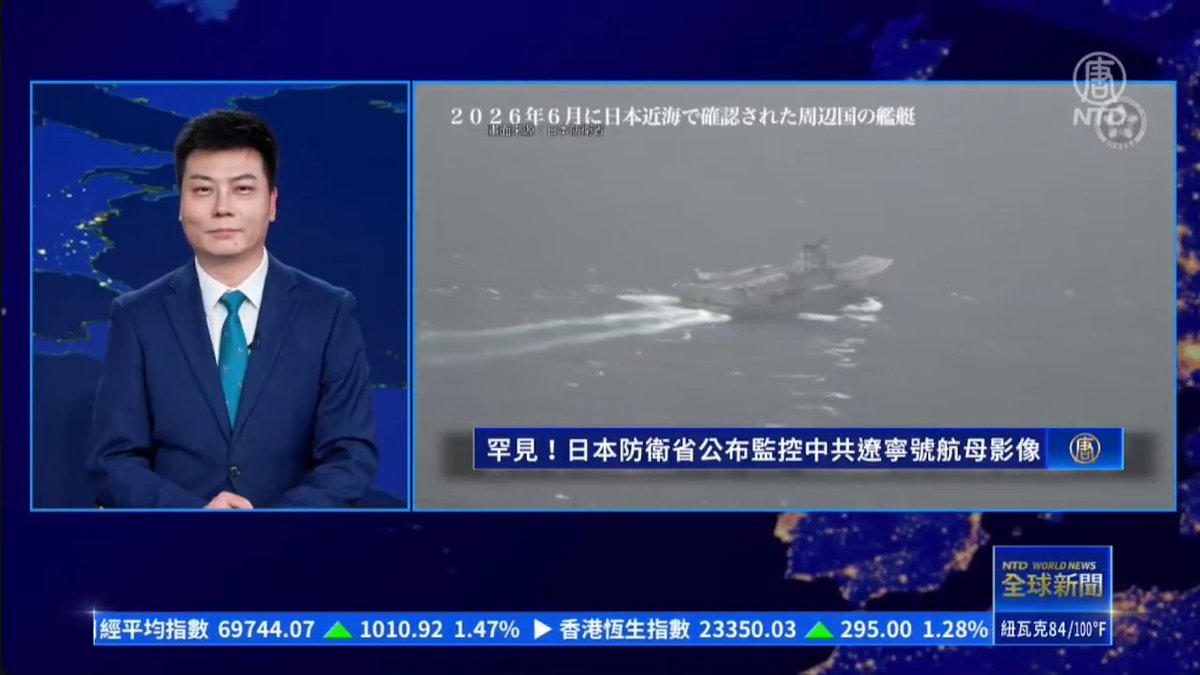
Rare: Japan Just Released Its First-Ever Video of China's Liaoning Carrier. Beijing's Story Collapses on Camera. For the first time on record, Japan's Ministry of Defense (MOD) has publicly released video footage of the People's Liberation Army Navy (PLAN) aircraft carrier CNS Liaoning under close Japanese surveillance in the Western Pacific. The Joint Staff Office of the Japan Self-Defense Forces (JSDF) posted the clip on July 3, breaking with decades of quiet monitoring practice. The footage documents Liaoning's activity in late May and June, when the carrier and its escorts transited the Miyako Strait, ran flight operations near Okinotorishima and Minamitorishima, and racked up over 170 fighter and helicopter sorties in just three days between May 26 and 28. Across the full 40-day deployment from May 19 to June 22, JSDF destroyers including JS Asahi, maritime patrol aircraft, and Air Self-Defense Force fighters shadowed the strike group. The Japanese cameras were rolling the whole time. Beijing tried to sell a very different story. State broadcaster China Central Television (CCTV) claimed the Liaoning had "warned off" Japanese warships and surveillance planes, and released its own edited footage framing Chinese professionalism against alleged Japanese provocation. The Chinese Ministry of National Defense (MND) called Japan's monitoring "outrageously audacious" and accused JSDF forces of running simulated attack drills against the carrier. That narrative required the audience to never see what Japan actually saw: the deck cycles, the launches, the escorts, the entire carrier group in Japanese crosshairs from the East China Sea through the Second Island Chain. Now Japan has put it on the table. The Joint Staff Office rarely releases moving imagery of foreign warships, and it explained the break in convention as an effort to help the public understand the daily reality of the JSDF's national defense mission. The message travels well past Japan. Every ally reading the file now has visual confirmation that Tokyo tracked Liaoning through the entire deployment, exactly during the period the Chinese Communist Party (CCP) propaganda apparatus was insisting Japan had been "warned off." That model of storytelling only works when the tape stays in the vault. Japan just released the tape. Note: The video below is my broadcast anchoring this story on air. ACI — Aric Chen | Insights

Aric Chen

62,096 次观看 • 1 个月前

Japan's Defense and Technology Japan today has a modern and powerful navy. The Japanese fleet currently has about one-quarter the number of VLS cells compared to the Chinese navy, and this number will increase with the commissioning of additional ASEV destroyers and Mogami-class frigates. I believe that within 6–8 years, the Japanese navy could become the fourth-largest in the world in terms of VLS cell count. However, there are areas where Japan, despite its cutting-edge technology, still needs to improve, specifically two: anti-ship missiles and drones, but also become more independent about naval air defense systems. The Japanese fleet still largely relies on the Type 90 SSM on many ships, which has a range of only 150 km, and on the Type 17 SSM, which is being introduced slowly and has a range of 300–400 km. In the coming years, there is talk of a version with up to 900 km range and the introduction of a ship-launched Type 12. Air defense systems remain heavily dependent on the United States, primarily using the SM-2/SM-6 and SM-3 on the most modern ships. Japan is an island nation and has historically always developed its own naval designs and equipment. It needs partners, but it must also maintain its own indigenous models. Another point is that a country as modern and pioneering in so many fields cannot afford to lack its own drone industry. Today, Japan operates American HALE drones such as the RQ-4 Global Hawk (manufactured by Northrop Grumman) and the MQ-9B SeaGuardian as its primary MALE platform for maritime surveillance. It is also testing Turkish and Israeli drones. This means that in any conflict, Japan could run out of reconnaissance drones in a very short time. The situation is quite different in South Korea, where there is a robust domestic drone industry led by companies such as Korea Aerospace Industries, Korean Air Aerospace Division, Hanwha Aerospace, and the Agency for Defense Development. Although South Korea still relies on foreign suppliers for HALE drones, it already has indigenous MALE models like the KUS-FS, along with other systems under development. In the next 5–10 years, long-range anti-ship missiles (1,000–4,000 km) will become a reality on Japanese ships and submarines. However, I still do not see independent projects in the fields of air defense systems or drones. South Korea obviously has different priorities from Japan, as it faces a much more precarious security situation. But if Japan also wants to establish itself as an exporter, and it is already doing so, it needs to demonstrate greater independence and a truly cutting-edge portfolio. On the current trajectory, if the country resolves the drone issue (as I believe it will), Japan should reach a world-leading level within 10 years or less.

Patricia Marins

43,210 次观看 • 6 个月前

🚨🇨🇳 U.S. NAVY IN PANIC: CHINA ARMS ITS MAIN DESTROYER CLASS WITH YJ-20 HYPERSONIC MISSILES New PLA footage has shown a Type 052D destroyer launching the YJ-20 hypersonic anti-ship ballistic missile for the first time publicly. Previously demonstrated aboard the larger Type 055, the weapon has now reached the class that forms the backbone of China’s surface fleet. 🔸 The YJ-20 is a boost-glide weapon capable of speeds above Mach 5, with its range estimated at up to 1,500 km. Its manoeuvring bi-conic glide body can strike ships at a steep, near-vertical angle, making interception far more difficult. 🔸 The missile was cold-launched from one of the Type 052D’s 64 universal vertical-launch cells, ejecting above the ship before its motor ignited. 🔸 More than 35 Type 052Ds are already in service, with additional ships under construction. Unlike the smaller Type 055 fleet, these destroyers are produced in large numbers and routinely operate across the South China Sea and Western Pacific. 🔸 The YJ-20 does not need to replace the YJ-18. A mixed load allows Chinese destroyers to combine long-range hypersonic attacks with sea-skimming cruise missiles, forcing carrier defenses to confront different speeds, trajectories and approach angles. 🔸 This is what makes the integration more important than a single launch. Hypersonic anti-ship firepower can now spread beyond China’s largest destroyers to a far more numerous class, creating more launch platforms and attack directions. 🔸 The Pentagon’s leaked Overmatch brief found that American warships such as the Gerald R. Ford were often destroyed in Taiwan war games. Giving China’s primary destroyer class a hypersonic carrier-killer makes those scenarios even harder for the U.S. Navy. The threat is no longer one rare missile aboard a handful of large warships. It is China’s mass-produced destroyer fleet gaining the ability to attack U.S. carrier groups from extreme range. What threatens U.S. carriers more: the YJ-20’s speed or the number of ships that can launch it?

NewRulesGeopolitics

15,295 次观看 • 6 天前