Loading video...

Video Failed to Load

Go Home

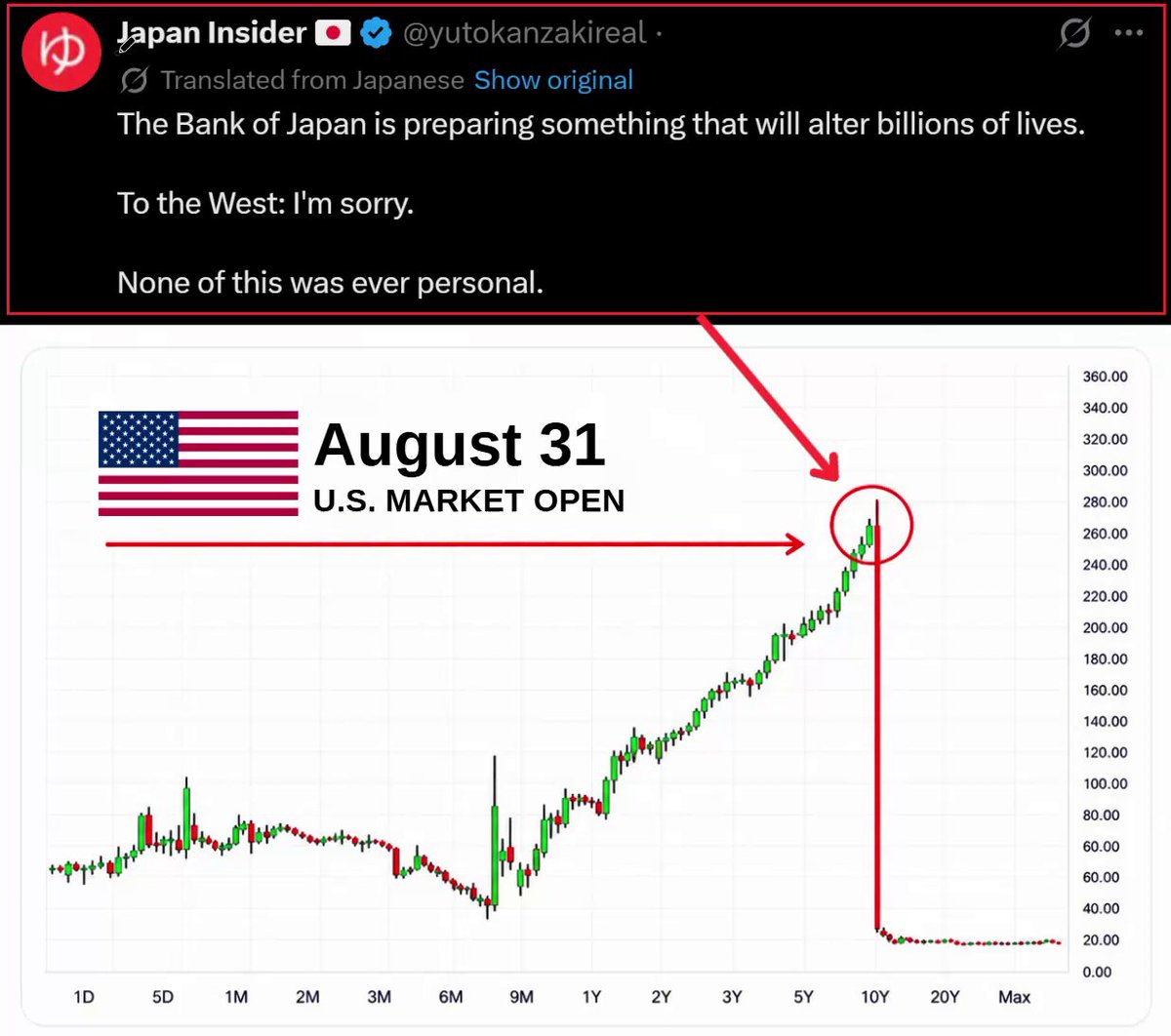
Japan made a move that should terrify every retail investor paying attention. They just dumped $66 billion of US bonds in a single month. For years, Japan was the engine driving your portfolio higher. They bought our debt without question, and that money flowed into American stocks, real estate,...

54,838 views • 1 month ago •via X (Twitter)

0 Comments

No comments available

Comments from the original post will appear here

Related Videos

🚨 WARNING: SOMETHING EXTREMELY BAD JUST HAPPENED Japan has started the biggest yen intervention in history. The U.S. is now printing dollars to stop Japan from dumping $1.2 TRILLION in U.S. debt. If the yen crashes again, the entire market will collapse. Stocks will dump. Metals will dump. Bitcoin will dump even harder. And this is NOT normal. Here's what's really happening right now: Japan gives its U.S. Treasury bonds to the Fed. The Fed prints dollars against those bonds. Japan sells those dollars and buys yen. This lets Tokyo defend its currency without dumping its entire $1.2 TRILLION Treasury position into the market. Because if Japan starts selling at that scale, global liquidity disappears. And the pressure is coming from everywhere. Higher Japanese rates are pulling capital back home. A weaker yen is making imports more expensive. Japan's massive government debt makes higher borrowing costs increasingly painful. And Japanese investors are sitting on trillions of dollars in foreign assets. That creates enormous pressure to bring money back into Japan. But here's the insane part: If Japan dumps Treasuries, bond prices fall and yields rise. Higher Treasury yields push global borrowing costs higher. Liquidity tightens. Risk assets come under pressure. And the shock spreads from bonds into stocks, real estate, crypto, and credit markets. So the U.S. is effectively printing dollars to absorb the same U.S. debt Japan wants to sell. Japan dumps the bonds. America prints the money. And the Fed takes the debt onto its own books. The underlying pressure does not disappear. It gets transferred through the financial system. THIS IS HOW THEY ARE TRYING TO HIDE A GLOBAL LIQUIDITY CRISIS. Pay attention. The biggest shifts in global finance are never obvious while they are happening. Then suddenly, everyone realizes the world has changed. I've spent more than a decade watching how these markets move. And I've also called nearly every major market top and bottom. Follow and turn on notifications now. Many people will wish they had started paying attention sooner.

0xNobler

153,985 views • 13 days ago

Japan is the largest foreign holder of US Treasury bonds at $1.2 trillion. For years, Japanese pension funds, insurance companies, and banks borrowed at 0% interest rates at home and invested that money in US Treasury bonds yielding 4-5%. This "carry trade" was essentially free money—borrow for nothing and earn solid returns with minimal risk. They turned this into a $20 trillion global trade (with 1.2 trillion being US Treasury bonds). But the game is changing. In November 2025, Japan announced a $130 billion stimulus package—money the government planned to spend to boost the economy. Normally, this would be good news. Instead, Japan's interest rates spiked to 1.8%, the highest in 20 years. Why? The bond market was sending a clear message: with Japan's debt already at 234% of GDP, investors have lost confidence in its ability to keep borrowing. This reaction ended the zero-rate environment that made the carry trade work. Now Japanese rates are at 1.8% while US rates are around 4.2%. The gap is shrinking, which means the carry trade isn't as profitable anymore. Japanese institutions might start selling their US Treasury bonds and bringing that money back home where rates are now competitive. If Japanese institutions start bringing that money home—even a fraction of it—the impact on US markets could be massive. When lots of people sell bonds, bond prices drop. When bond prices drop, interest rates go up. Higher US interest rates mean higher costs for mortgages, car loans, and credit cards for regular Americans. It also means the US government has to pay more to borrow money—and they're already paying $1 trillion per year just on interest for existing debt. The world's largest creditor-debtor relationship is entering uncharted territory. PS - I've recorded a 22-minute video covering this in more detail, as well as which sectors (and stocks) will benefit/suffer when this unfolds. If you want access to it, comment "JAPAN" and I'll DM it to you.

Felix Prehn 🐶

225,458 views • 9 months ago

🚨WARNING: MONDAY COULD BE A BLOODBATH Read this before it's too late. Two of the largest holders of U.S. debt are heading for the exit at the same time, and almost nobody understands what that unleashes. → Japan is offloading a massive wave of U.S. Treasuries → China just cut its holdings to $633 billion, the lowest since 2008 And the U.S. just confirmed how serious this is by doubling its bond buybacks to cover the damage. If you own any assets, you need to understand what's happening: the biggest carry trade in history is starting to unwind. For decades, Japan pinned rates near zero, making the yen the cheapest money on Earth. Investors borrowed trillions of it and poured that cash into Treasuries, stocks, real estate, and crypto worldwide. That trade became the plumbing underneath global asset prices. Now it's breaking. Japan is buried under soaring debt, an aging population, and a collapsing yen, so the money is being pulled home. And China is stacking pressure on top. It's been steadily dumping Treasuries and loading up on gold instead. Less demand for U.S. debt, more for hard assets. The message is clear. Here's why it matters: when the two biggest buyers step back at once, someone else has to absorb that supply, and they'll only do it at higher yields. That's exactly what's happening. The 30-year Treasury yield just pushed above 5.3%, the highest since 2007. The Treasury is now forced to buy back its own debt because demand is drying up. That's not strength. That's a desperate move. And it feeds on itself: higher yields make the debt more expensive to finance, which forces more issuance, which pushes yields even higher. Most people won't understand why markets are unraveling until it's already happening. I've studied these cycles for over 12 years and called nearly every major top and bottom. I'm warning you now. If you want to survive the 2026–2027 cycle, follow and turn on notifications. A lot of people are going to wish they'd listened sooner.

Shelpid.WI3M

146,467 views • 21 days ago

🚨THIS WEEK WILL BE THE WORST ONE IN 2026 Japan just begin biggest sell off EVER They are about to dump ~$6T of foreign securities, mostly U.S. Treasuries, stocks, and ETFs This will cause biggest crash, even bigger than it was on 10.10 flush crash While the rest of the world paid normal interest rates, Japan kept borrowing costs close to zero for decades Hedge funds, banks and institutions took full advantage of it They borrowed trillions of yen for almost nothing and deployed that capital wherever returns were higher - U.S. Treasuries - S&P 500 - Nasdaq stocks - Real estate - Emerging markets - Eventually, even crypto Wall Street called it the Yen Carry Trade It quietly became one of the biggest liquidity engines in modern financial history As long as Japan kept rates near zero, the machine kept running Cheap money kept flowing, risk assets kept benefiting, but that world is starting to change After decades of deflation, inflation has finally returned to Japan For the first time in years, the Bank of Japan is raising interest rates It sounds like a local story It's not Higher borrowing costs completely change the economics behind the carry trade The more expensive yen becomes, the less attractive the strategy is Instead of sending money overseas, investors start unwinding positions They repay yen loans and bring capital back home Markets call this a reverse carry trade And it destroys liquidity much faster than it creates it We already got a small preview in August 2024 Fears around the carry trade triggered a sharp sell-off across global markets and reminded everyone how dependent they had become on Japanese money Now imagine that process playing out over years instead of days Japan isn't just another investor It owns roughly $1.1 trillion in U.S. Treasuries It also holds around $6 trillion in net foreign assets, making it the largest overseas creditor in the world That doesn't mean Japan is about to dump $6 trillion tomorrow That's simply not how capital flows work The viral posts are massively oversimplifying the story But they are pointing at a real trend If even a small portion of that capital gradually comes home, global liquidity becomes much tighter than markets have been used to for decades And that's a much bigger deal than most investors realize - Stocks - Bonds - Private equity - Real estate - Crypto Almost every major bull market of the last 30 years was built during an era of abundant liquidity When liquidity expands, valuations become easier to justify When liquidity disappears, everything gets repriced That's why what happens in Japan over the next few years could become one of the biggest macro stories of this cycle Because the biggest risk isn't that Japan suddenly sells everything The biggest risk is that the world's largest source of cheap money quietly stops financing everyone else Remember that I am posting news daily and monitoring each major macro event to post and warn you So make sure to follow me and turn notifs on

Midas

60,907 views • 2 months ago

🚨 SOMETHING TERRIBLE IS HAPPENING IN JAPAN RIGHT NOW!! Every government bond yield just hit its highest level in history. Japan is sitting on ¥15.3 TRILLION in bond losses. And the BOJ just hit the panic button. They're dumping $6 TRILLION in U.S. Treasuries to cover the damage. If you hold any assets right now, you MUST read this: Japan has been one of the most important sources of global liquidity for decades. For years, interest rates stayed near zero. That made the yen one of the world's cheapest funding currencies. Investors borrowed trillions of yen. Then poured that money into stocks, bonds, real estate, crypto, and markets around the world. But that trade is now coming under pressure. Japanese bonds are surging. Yields are moving higher. And money is starting to have a reason to return home. This is where things get dangerous. Because when Japanese capital comes back... Someone else has to buy what Japan is selling. → More bonds hit the market → Yields move higher → Liquidity dries up And financial conditions tighten everywhere. The U.S. Treasury has already doubled its Treasury buybacks in an attempt to stop the bleeding. A sign that even the world's largest bond market is starting to show cracks. That's how market stress spreads. Quietly at first. Then all at once. AND THIS IS NOT GOOD... Most people won't understand what's happening until markets are already collapsing. Japan's bond market is sending a warning. And the rest of the world will be next. I've spent 10+ years studying these markets. And I've seen the warning signs before most people knew what was coming. If you want to stay ahead of the 2026 cycle, follow and turn notifications on. I've warned you before. And I'll warn you again soon. Follow and turn on notifications. Many people will wish they had paid attention sooner.

0xNobler

48,525 views • 19 days ago

The world's safest bonds are suddenly not acting safe. The 30-year Treasury just hit its highest yield since 2007. Germany, France, and Japan are seeing the same thing. Yet the stock market is partying near record highs... A government bond is a loan you make to a country. The yield is the interest that country pays you. When the yield jumps, it means lenders are nervous. They are demanding more to hold that debt. This is not one country having a bad week. Long-term rates are spiking all over the world. Japan just hit a 30-year high. Germany hit its highest level since 2011. France hit levels not seen since 2008. The United States is leading the pack. The 30-year US yield touched 5.3% this week. The last time it was this high was 2007. Now look at what makes this so strange. The economy has actually been slowing down. Jobs data has cooled off. Retail sales just fell. That should push interest rates lower, not higher. Instead they keep climbing. So why are rates rising anyway? The bond market is scared of something bigger. The US government is drowning in debt. That pile is about to cross $40 trillion. In July alone the deficit hit $432 billion. The government keeps borrowing more every month. So lenders are demanding more to keep lending. Higher rates make that debt even harder to carry. Lending to a government once felt risk-free. That assumption is quietly breaking. Recent debt auctions tell the same story. The latest 30-year sale drew its highest yield since 2001. Buyers are forcing the government to pay up. They want more to lend for thirty long years. Oil is making all of this worse. It just pushed back above $90 a barrel. That feeds straight into inflation fears. And inflation is the enemy of every bond. There is one more warning sign: The biggest lenders are starting to walk away. China, Japan, and the UK all cut their holdings. Someone still has to buy all that new debt. Fewer buyers means even higher rates. Now come back to the stock market. It is still sitting near record highs. Wall Street has a comforting story for this. Strong earnings will power right through it. Maybe they will. But the bond market is not buying that story. Two markets are telling opposite things. Stocks say the party keeps going. Bonds say the ground is shifting underneath. When they disagree this sharply, bonds usually win. The bond market is bigger and harder to fool. It sets the cost of money for everyone. Higher yields quietly make every stock worth less. This is not just a Wall Street problem. These same yields set your mortgage and car loan. A new car loan now runs about 7%. When the government pays more, so do you. Retail watched the stock market. The bond market wrote the real story. That's the whole game. Surmount builds automated strategies that follow the data, not the noise. Start for free and let the signals lead.

Logan Weaver

11,838 views • 1 month ago

🚨 TOMORROW COULD BE THE WORST DAY OF 2026 FOR MARKETS. You need to understand what’s happening before August 24. Japan and China are both reducing exposure to U.S. Treasuries while China keeps accumulating gold. This is much bigger than one bond trade. For decades, near-zero Japanese rates created one of the biggest carry trades in history: Japan and China are forcing capital back into their countries. And the biggest carry trade in history is now starting to unwind. This is NOT normal. For decades, Japan kept interest rates near zero. That turned the yen into the world's cheapest funding currency. Investors borrowed trillions of yen. Then they poured that money into U.S. Treasuries, stocks, real estate, crypto, and markets around the world. That trade is now breaking apart. Japan is facing soaring government debt. A rapidly aging population. Massive pension obligations. And years of pressure from a weak yen. Now policymakers want that capital back home. And now China is adding another layer of pressure to the U.S. Treasury market. China has been steadily reducing its holdings of U.S. Treasuries. Chinese Treasury holdings just fell to $633 BILLION, the lowest level since 2008. At the same time, China continues to build its gold reserves. → U.S. Treasuries get reduced → Gold holdings increase → Demand for U.S. debt weakens → Pressure on Treasury yields increases Japan and China were both among the major sources of the latest decline in foreign Treasury holdings. And when two of the world's biggest holders reduce their exposure at the same time... Someone else has to absorb that supply. That means higher yields are required to attract buyers. And U.S. bond yields are already surging. The 30-year Treasury yield recently pushed above 5.3%, reaching levels not seen since 2007. The U.S. Treasury is now forced to buy back its own debt because no one else wants it. Read that again. This is the part most people are missing. Japan is pulling capital toward Japan. China is reducing Treasury exposure and increasing its strategic gold position. → Foreign Treasury demand weakens → Treasury prices fall → U.S. bond yields rise → Borrowing costs increase → Liquidity tightens This creates another feedback loop. Higher U.S. yields increase the cost of financing the enormous U.S. government debt load. Higher Japanese yields make Japanese assets more attractive. And China's continued diversification adds another structural source of pressure to the Treasury market. Pay attention. Most people won't understand why markets are collapsing until it's already happening. I’ve studied markets for over 12 years and called nearly every major top and bottom. If you want to survive the 2026 cycle, follow and turn notifications on. I warned you before. And I'll warn you again soon. A lot of people will wish they paid attention earlier.

DANNY

187,518 views • 28 days ago

🚨 JAPAN JUST DID THE IMPOSSIBLE The Bank of Japan just raised rates to 1.25%. The highest since 1995. And the yen FELL. Now ask yourself one question: WHY CAN’T JAPAN JUST KEEP HIKING UNTIL THE YEN RECOVERS? For years, the BOJ kept rates near zero or NEGATIVE to fight deflation. Japan built its entire financial system around almost FREE MONEY. Japanese investors could borrow yen cheaply and buy higher-yielding assets overseas. That became the famous YEN CARRY TRADE. But there was a cost: 1) Negative rates crushed bank margins. 2) Massive BOJ bond buying distorted the government bond market. And years of cheap money left Japan extremely sensitive to higher rates. And this is where the trap appears. Japan’s government debt pile is enormous. As rates rise, old cheap debt eventually gets refinanced at higher rates. Japan’s government interest bill has already gone from roughly: ¥8.5T in 2023 → ¥13T in 2026 And that is BEFORE Japan gets anywhere close to U.S. rates. Today: - Japan: 1.25% - U.S.: 3.75%-4.00% The carry trade is still alive. Dollars still pay far more than yen. To really close that gap, Japan would have to tighten MUCH harder. But aggressive hikes would hit: → Government borrowing costs → Corporate borrowing → Mortgages → Bond prices → Economic growth That is why Japan cannot simply keep smashing rates higher. And that is why today’s hike wasn’t enough to save the yen. The market understood something retail didn’t: 1.25% IS STILL CHEAP MONEY. The rate gap is still huge. And the BOJ gave no signal that it is prepared to close that gap aggressively. So Japan faces an ugly choice: Raise rates fast and put enormous pressure on the system built around cheap money. Or normalize slowly and tolerate a weaker yen for longer. Right now, the market is betting on the second option. And a weak yen has its own cost. Japan imports huge amounts of energy and raw materials. A weaker currency makes those imports more expensive and pushes inflation higher. But it also helps exporters and increases the yen value of overseas profits. Japan doesn’t necessarily WANT a weak yen. It is tolerating one because aggressively defending it could be even more painful. Remember, I’ve been trading markets for over 15 years. The biggest opportunities come when central banks get trapped between two bad choices. That’s exactly what I’m watching now. When I see where the money moves next, I’ll post it here publicly like I always do. Turn notifications on. If you’re not following yet, you’ll understand why that was a mistake later.

Alex Mason 👁△

129,694 views • 1 day ago

🚨 WARNING: TOMORROW WILL BE THE WORST DAY OF 2026!! 99% of people will lose everything. You MUST read this before August 31. → Japan is dumping $5.25 TRILLION in U.S. Treasuries → China is dumping $600 BILLION in U.S. Treasuries The U.S. just confirmed the crisis is real, and DOUBLED buybacks to cover the damage. If you own any assets today, you need to understand this: Japan and China are forcing capital back into their countries. And the biggest carry trade in history is now starting to unwind, with devastating consequences. This is NOT a normal market correction. For decades, Japan kept interest rates near zero, turning the yen into the world's cheapest funding currency. Investors borrowed trillions of yen and poured that money into U.S. Treasuries, stocks, real estate, crypto, and markets around the world. But now, the Japan trade is breaking apart: → Soaring government debt → Rapidly aging population → Massive pension obligations → Years of pressure from a weak yen And now, China is adding another layer of pressure to the U.S. Treasury market. China has been steadily reducing its holdings of U.S. Treasuries. Chinese Treasury holdings just fell to $633 BILLION, the lowest level since 2008. At the same time, China continues to build its gold reserves in a bold move. The implications are clear: → U.S. Treasury holdings decrease → Gold holdings increase → Demand for U.S. debt weakens → Pressure on Treasury yields increases Japan and China were both among the major sources of the latest decline in foreign Treasury holdings. And when two of the world's biggest holders reduce their exposure at the same time... Someone else has to absorb that supply, which means higher yields are required to attract buyers. The 30-year Treasury yield recently pushed above 5.3%, reaching levels not seen since 2007. The U.S. Treasury is now forced to buy back its own debt because no one else wants it. And that's a desperate move with catastrophic consequences. This creates another feedback loop: → Higher U.S. yields increase the cost of financing the enormous U.S. government debt load → Higher Japanese yields make Japanese assets more attractive → China's diversification adds another structural source of pressure to the Treasury market Pay attention, because most people won't understand why markets are collapsing until it's already happening. I’ve studied markets for over 12 years and have called nearly every major top and bottom. And I'm warning you now. If you want to survive the 2026-2027 cycle, follow and turn on notifications. A lot of people will wish they had paid attention earlier.

0xNobler

481,970 views • 21 days ago

Really think about this “Crazy how the government has been shut down for over two weeks and — nobody even freaking noticed. Think about that for a second. Entire departments with thousands of government workers sitting at home and not a damn thing changed in your life. Roads didn't disappear, the lights didn't go out, country didn't collapse. So maybe the real question is, were they ever really essential anyway? We've been told for decades that the government keeps the country running, that without it, Society would crumble. Right? But if you can shut the whole thing down and nothing changes, it's a pretty clear indication that the system isn't what's holding everything together. We are. Because while corrupt politicians are busy f*cking off and blowing taxpayer dollars on lavish parties in far off lands — It's us, the producers, the builders, the small business owners, the blue collar men and women showing up every damn day who actually keep this country running. And what do we get in return? Higher taxes, higher prices, and less freedom. They print fake money, they throw it at failed programs, and they still tell you to do your part. Meanwhile, your dollar buys less and your work gets taxed more. And the people making the rules never feel a single ounce of the pain that they caused. $37 trillion in debt, and these clowns still act like the solution is to spend more. More agencies, more staff, more handouts, more bullshit titles that don't contribute a shred of value to the American people. That is not how this country's government was intended to run. It's a bloated system feeding itself while pretending to serve you. The truth is, if an entire department can shut down for weeks and nobody notices, that means that the system is irrelevant. It's dead weight, and the American people are doing just fine without them because we're the ones who are keeping this great American nation alive, not the suits in DC”

Wall Street Apes

610,580 views • 11 months ago

David Friedberg: Higher Interest Rates Are About to Make America’s $40 Trillion Debt Problem Much Worse “The federal government has a problem because over the next 12 months they have to refinance $10 trillion of debt. That debt is coming due. Those bonds are now due. They have to pay the principal back to the bond holders, and they have to go back to the treasury market and sell more treasuries to borrow more money to refinance. So the borrowing cost now is going to climb up, and when that borrowing cost climbs up, the federal government's burn goes up and the fiscal deficit goes up. So my theory and my argument on this is: There is no action that Bessent can take that's actually going to have a meaningful effect on the long end of the curve. We have a fundamental fiscal spending problem with the federal government right now. It is very expensive now to borrow money if you're the US federal government. And the reason is persistent inflation, I would argue because of excess government spending on social programs and other things. And the big problem at this point is the federal government is spending so much that if they were to cut spending aggressively, the argument and the concern is it would hit unemployment and it would cause a recession because the federal government is such an intricate part of the economy now. That's the argument. But it's causing inflation, and it's causing deficit spending. So this year the deficit will be roughly $2 trillion. And as a result, the market is saying, ‘We're worried about the US fiscal solvency over the long run, or there's a higher risk. As a result, we're going to charge you a higher interest, 5.2% on the 30 year.’ What does this mean for the federal government? Well, today, the federal government's average cost of debt is 3.4%. That's what we're paying on interest on average on the $40 trillion of debt that the federal government has outstanding. For every 1% change in the interest rate, the US government has to pay 1.25% of GDP in excess interest each year. 1.25% of GDP in interest each year for that 1% change in the interest rate.”

The All-In Podcast

334,041 views • 20 days ago

🚨 TOMORROW COULD BE THE DAY GLOBAL MARKETS FINALLY SNAP. August 24 could expose a problem Wall Street has spent years pretending doesn’t exist. Japan and China are both pulling away from U.S. Treasuries — while China keeps stacking gold. This isn’t just another bond-market story. It’s a warning that one of the biggest sources of global liquidity is starting to reverse. For decades, Japan kept rates near zero. The yen became the world’s funding currency. Investors borrowed dirt-cheap yen and poured that money into everything: U.S. Treasuries. Stocks. Real estate. Crypto. Trillions of dollars in global assets were built on this trade. Now the foundation is shifting. Japan is dealing with an enormous debt burden, an aging population, massive pension obligations, and years of damage from a weak yen. Higher Japanese yields change the equation. Capital that spent years searching for returns overseas suddenly has a reason to come home. And China is applying pressure from the other side. Chinese holdings of U.S. Treasuries have fallen to roughly $633 BILLION — the lowest level since 2008. At the same time, China continues accumulating gold. The message is impossible to ignore: → Treasuries reduced → Gold accumulated → Foreign demand for U.S. debt weakens → Treasury yields face more pressure And when major foreign holders stop absorbing American debt, someone else has to. If buyers demand higher yields, the consequences spread everywhere. Mortgages get more expensive. Corporate refinancing gets uglier. Government interest costs explode. Liquidity gets tighter. Risk assets get hit. The 30-year Treasury yield recently pushed above 5.3%, reaching territory not seen since 2007. And this is where things can get dangerous FAST. Japan pulls capital home. China diversifies away from Treasuries. Foreign demand weakens. Bond prices fall. Yields rise. Financing costs rise. Liquidity disappears. Then the same leverage that pushed markets higher starts working IN REVERSE. That’s how a bond-market problem becomes a stock-market problem. And then a crypto problem. Most investors will stare at falling prices and ask what happened. By then, it won’t matter. I’ve spent more than 12 years studying these cycles and calling major tops and bottoms before the crowd sees them. PAY ATTENTION TO AUGUST 24. I warned you before. I’ll warn you again before the next major move. Follow and turn notifications on. A lot of people are going to wish they did.

Phantom_Defi

24,193 views • 27 days ago

🚨 WARNING: MONDAY WILL BE THE WORST DAY OF 2026!! Japan just hit the panic button. They will dump OVER $6 TRILLION of foreign securities, mostly U.S. Treasuries, stocks, and ETFs. If you hold any assets right now, you MUST be prepared for the biggest sell-off of the year: The BOJ is moving capital back into Japan. And the biggest carry trade in history is starting to unwind... This is NOT normal. Here's what's really happening: For decades, Japan kept interest rates near zero. That made the yen the cheapest funding currency in the world. Investors borrowed trillions of yen. And invested that money into U.S. Treasuries, stocks, real estate, crypto, and markets across the globe. That trade is now breaking. Japan is dealing with soaring debt. A rapidly aging population. Massive pension obligations. And years of pressure from a weak yen. Now policymakers want that capital to come home. By any means necessary. Finance Minister Satsuki Katayama said pension funds, including GPIF, the world's largest pension fund, should make substantially larger investments in Japanese assets instead of foreign ones. GPIF alone manages around $1.8 trillion. Hundreds of billions of dollars are now at the center of this shift. Japanese investors have already sold tens of billions of dollars worth of U.S. Treasuries this year. And the Bank of Japan's latest rate hike only gives investors another reason to keep money at home. This is the Reverse Carry Trade. And it's one of the biggest liquidity risks in the world. Because when Japanese money comes home... Someone else has to buy what Japan is selling. More Treasuries hit the market. Bond yields move higher. Liquidity dries up. And financial conditions tighten everywhere. That's how market stress spreads. Quietly at first. Then all at once. After decades of financing global markets... Japan is starting to finance itself. And that changes everything. More volatility. Less liquidity. That's not a good combination. Pay attention. Most people won't realize why markets are collapsing until it's already happening. I’ve studied markets for over a decade and called nearly every major top and bottom. If you want to survive the 2026 cycle, follow and turn notifications on. I warned you before. And I'll warn you again soon. A lot of people will wish they paid attention earlier.

0xNobler

1,628,326 views • 2 months ago