Video wird geladen...

Video konnte nicht geladen werden

Zur Startseite

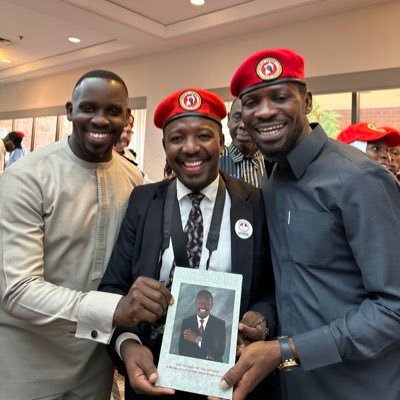
Joel Ssenyonyi did what many never expected. Standing before General. Museveni, and sending a message to Gen. Muhoozi Kainerugaba, top military commanders, and the country's political elite, the Leader of the Opposition could have chosen the easy path. He could have delivered a safe, emotional tribute to the late...

83,592 Aufrufe • vor 16 Tagen •via X (Twitter)

0 Kommentare

Keine Kommentare verfügbar

Kommentare vom Original-Post werden hier angezeigt

Ähnliche Videos

After threatening to shut down NTV and the Daily Monitor, Gen. Muhoozi Kainerugaba may have expected fear and silence. Instead, Uganda's most prominent media houses appear to have called his bluff. In what many viewed as a direct challenge to the country's Chief of Defence Forces, NTV's evening news bulletin revisited a series of controversial incidents in which Muhoozi has been accused of openly boasting about kidnappings, illegal detentions and other actions that critics say violate the law. The broadcaster posed a question that is increasingly being asked across the country: Is Muhoozi Kainerugaba above the law? The Daily Monitor has also continued reporting on the controversy despite the threats, setting up a confrontation that many Ugandans never expected to see. For years, critics have accused powerful figures in government of operating with impunity, but now major media institutions appear unwilling to simply look away. The bigger question is what happens next. Will Muhoozi back down from his threats, or will he attempt to act on them? Can a military officer, regardless of rank, decide which media houses are allowed to operate and which ones are not? And what does it say about the state of Uganda when journalists and media organizations find themselves in a public standoff with the country's top military commander? To many observers, this is no longer just a dispute between Muhoozi and the media. It is becoming a test of whether the rule of law still matters, whether freedom of the press can survive political intimidation, and whether powerful individuals can be held accountable for their actions. In this commentary, I examine the growing confrontation between Muhoozi Kainerugaba and Uganda's independent media and what it means for the future of the country. YouTube -

Mordecai Muriisa ™️

22,482 Aufrufe • vor 1 Monat

1994. Constituent Assembly, Kampala. Akbar Adoko Nekyon paused to speak. He had been Obote's first cousin, a minister in the independence government, a key player in the 1966 crisis that shattered Uganda's first democracy. Now, before a chamber that included President Museveni, the old politician declared, "I have changed." The Maverick's Confession: Nekyon at the Constituent Assembly - 1994 To understand the weight of those words, one had to understand 1966. Nekyon had been a central figure in the UPC/KY alliance that brought Obote to power. He had helped build the very political order that Obote then destroyed, suspending the constitution and attacking the Kabaka's palace. Nekyon had crossed the floor to the Democratic Party after that fracture. Now, nearly three decades later, dressed in a cream Kaunda suit, he sat before the assembly tasked with writing Uganda's new constitution and made a declaration that was both personal and political: The ability to change one's mind is not a weakness but the "highest democratic virtue" and proof of a "living political mind". He then held up a mirror to the room. He listed the political migrations of those who might accuse him of hypocrisy, Vice President Speciosa Wandira Kazibwe, Ruhakana Rugunda, and even President Museveni himself. Change, he argued, was a constant in their political journeys too. By doing so, he dismantled the accusation of inconsistency and reframed the debate. His speech became not a defence of his own record, but a challenge to the entire political class to embrace a system that allowed for peaceful evolution. His tone softened as he concluded, shifting from combatant to elder statesman. His "I have changed" became a plea for a system robust enough to allow such evolution peacefully. The true measure of a democracy, he insisted, was not its ability to enforce orthodoxy but its capacity to tolerate and integrate change. The cream of his suit was a quiet beacon of a principled stand in a room swirling with the new politics of conformity. He had seen it all, independence, crisis, exile, return, and his final message was a warning: A nation that can not accommodate peaceful political change is destined for violent upheaval. What does it mean when an architect of a broken past stands before the builders of a new future and admits he has changed, not as a confession of guilt, but as a demand that the new system must allow others to do the same? Nekyon's 1994 speech was a masterclass in political honesty. He did not ask for forgiveness. He asked for a constitution that made future 1966s impossible. The chamber listened. The words remain. #ughistory Uganda Peoples Congress Official Yoweri K Museveni Parliament Watch Government of Uganda Uganda Media Centre Parliament of Uganda Speciosa Wandira Kazibwe Dr. Ruhakana Rugunda NRM Party Democratic Party Uganda Peoples Congress Official

UgHistory

21,982 Aufrufe • vor 1 Monat

1994. Parliament Lobby. Kampala. The Constituent Assembly was debating the shape of a new Uganda when a young army captain, Noble Mayombo, rose to move a motion. It was a small thing, on paper: Change the name of the national army. But Mayombo understood that names carry power. The Name and the Man: Mayombo's Motion for the UPDF - 1994 "This is no longer the army of a resistance," he told his fellow delegates. "It must be the defence force of a people." The motion was simple in phrasing but profound in meaning: That the National Resistance Army, born of the bush war, be renamed the Uganda People's Defence Forces. Mayombo reminded the Assembly that while the NRA had fought valiantly, it belonged to a chapter of struggle. A constitution, he argued, must speak for all citizens, not for a movement. The army's name had to project neutrality, professionalism, and national ownership. Mayombo's words carried weight beyond his years. He had fought in the bush, but he understood that the new constitution was meant to bury the divisions of the past and build a common future. By proposing the name change, he was not merely editing a document; He was redefining the relationship between the soldier and the citizen. The word "People's" was not cosmetic but constitutional, a signal that the guns were now bound by law, accountable to Ugandans rather than to a party. Outside the chamber, in the Parliament lobby, seasoned journalist Bart Kakooza intercepted Mayombo for an interview. Standing tall, the young captain repeated the essence of his argument into Kakooza's microphone. Through radio and newspapers, his vision reached far beyond Kampala. For many Ugandans, that was the first time they heard the phrase Uganda People's Defence Forces. It carried a freshness that suggested rebirth, a shift from partisan struggle to shared nationhood. When the Assembly finally voted and Article 208 enshrined the UPDF in the 1995 Constitution, the moment was sealed. The NRA passed into history, and the UPDF was born in law. For Noble Mayombo, it was more than a legal victory; it was his signature contribution to the republic. The image endures: A young man in Parliament, moving a motion with conviction, then stepping into the lobby to explain to a journalist, and to the nation, why Uganda's army must belong to the people. Mayombo's motion ensured that the army would no longer be the instrument of a movement, but the shield of a nation. It was not just semantics. It was a declaration that Uganda had moved from revolution to constitution, from the bullet to the ballot. The name change may have been a small clause in a long document, but it was the mark of a mind that understood that the words you choose determine the nation you build. What does it take to stand up in an assembly of elders and veterans and suggest that the revolution's army should be renamed for the people it serves? Noble Mayombo was a young captain when he moved that motion. He understood that constitutions are not just about power, they are about identity, and the names we give our institutions define the country we become. The NRA won the war. The UPDF was built to keep the peace. #UPDF #NRA #Ughistory NRM Party Uganda Peoples' Defence Forces (UPDF) Government of Uganda Bart Kakooza Uganda Media Centre

UgHistory

12,886 Aufrufe • vor 1 Monat

[WATCH] THE PRESIDENT WILL NOT RESIGN. When it comes to the President, there is always a distinctive role between him being the President of the party and the state. There are many factors that influence the state in terms of governance and stability. If the President is called upon by some to resign and he keeps quiet it can throw the state into a state of turmoil. I want to make it clear that the officials agreed with the President on his approach, he took us into confidence and explained the factors that led him to make that particular pronouncement. We believe that the President did the right thing in pronouncing in the best interest of South Africa that he will not be resigning. There was nothing in terms of the judgment that warranted the President to resign it was just mere calls made by individuals and political parties that wanted to throw our country into a state of turmoil, uncertainty and anxiety. So it was imperative that he focus on that. It was correct for him to tell the country that from where he is standing there is nothing in the judgement that states he has done any wrongdoing and what he is going to do with the options in front of him and he has made this public. The President will take the Section 89 Report on review based on the outcome of the judgment and the legal advice he has received. There are no daggers out for the President to resign just opportunistic elements. These elements do not know what they want, they want to impeach and want him to resign, they do know what they actually want. The veracity of the report has not been tested in any committee so they don’t have a basis for the President to resign.

ANC SECRETARY GENERAL | Fikile Mbalula

21,983 Aufrufe • vor 2 Monaten

Reverend Dr Kupa Mtata, convenor of Sungano yeVanhu/Ubumbano loMphakathi (The People’s Coalition), has defended the coalition’s campaign against Constitutional Amendment No. 3, arguing that the proposed changes cannot lawfully proceed without the direct consent of Zimbabweans through a referendum. Speaking at the launch of the coalition—which brings together the Defend the Constitution Platform (DCP), Constitution Defence Forum (CDF), National Constitutional Assembly (NCA), Zimbabwe Congress of Trade Unions (ZCTU), Zimbabwe Constitution Movement (ZICOMO) and the War Veterans Pressure Group—Dr Mtata said the campaign was about defending the Constitution rather than supporting any political party. “I am here as a churchman, not as a partisan politician,” he said. “This is about honouring the agreement we made together as a nation and ensuring that the Constitution remains supreme, not the ambitions of politicians.” Dr Mtata argued that the Constitution is a covenant created collectively by Zimbabweans and that no individual or group has the authority to alter key provisions without the people’s genuine consent. He accused the government of violating the Constitution in four fundamental ways. First, he said there had been a procedural violation because citizens were not genuinely consulted on the proposed amendments. Instead of allowing open national debate, he said, the proposals were presented through state-controlled media as decisions that citizens were simply expected to accept, while opposing views were denied space. “This is not consultation,” he said. “This is propaganda.” Secondly, Mtata alleged that Parliament had been corrupted, claiming some legislators had abandoned the interests of their constituents for personal gain. “When parliamentarians are bought like goods in a market, that is not leadership. That is corruption,” he said, arguing that MPs who ignore the wishes of those who elected them lose their moral legitimacy to represent the people. His third concern was what he described as intimidation and harassment of citizens who opposed the Bill. According to Mtata, individuals who criticised the proposed amendments had been threatened or intimidated, undermining freedom of expression and weakening democracy. “When people are denied the right to express opinions that differ from those in power, that is not democracy. That is dictatorship,” he said. Mtata argued that Constitutional Amendment No. 3 unlawfully bypasses the referendum requirement contained in Section 328 of the Constitution. He said the Constitution expressly requires certain amendments to be approved directly by citizens through a referendum, particularly where changes affect the tenure or powers of those already in office. “The people, not Parliament, not politicians—must decide through a referendum,” he said. “Those entrusted with power should not extend their stay in office without the direct permission of the people.” Mtata concluded by urging Zimbabweans to defend the Constitution, insisting that the country’s founding law belongs to its citizens and cannot be changed without their freely given consent.

Hopewell Chin’ono

47,441 Aufrufe • vor 1 Monat