Загрузка видео...

Не удалось загрузить видео

На главную

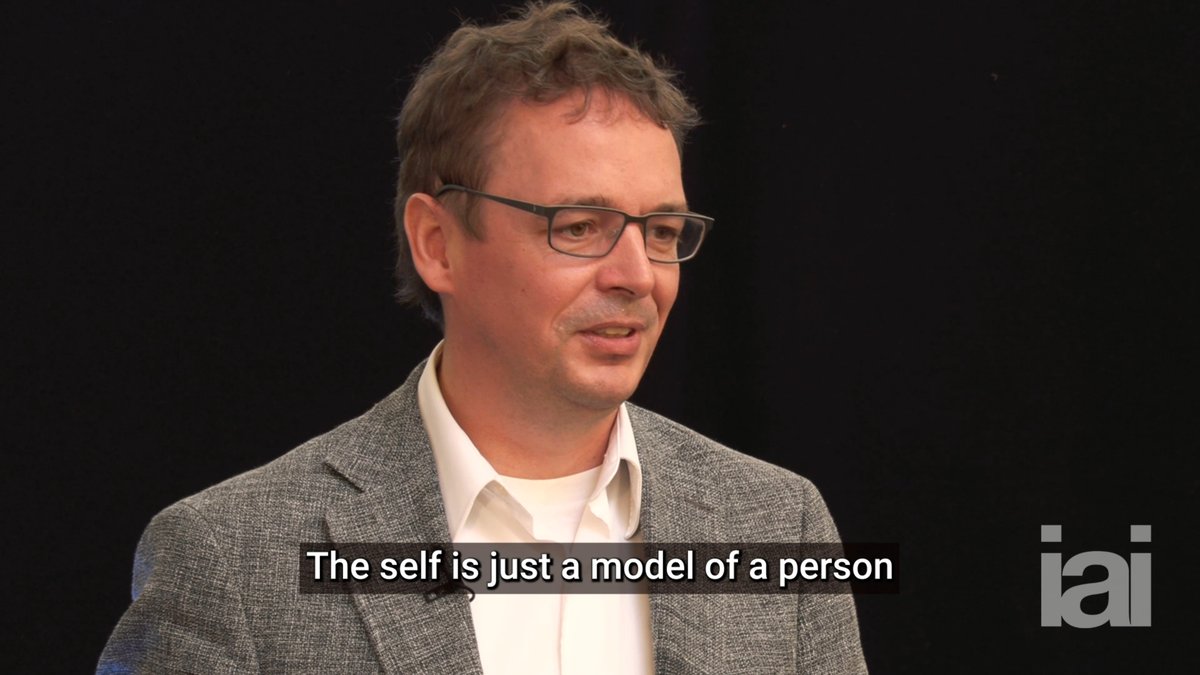
Joscha Bach says eventually AI may self-improve to such an extent that it can virtualize itself on to every substrate in nature, including our own nervous systems and brains, and integrate us into a planetary-scale intelligence
45,043 просмотров • 1 год назад •via X (Twitter)

Комментарии: 0

Нет доступных комментариев

Здесь появятся комментарии из оригинального поста

Похожие видео

𝗛𝗼𝘄 𝘁𝗼 𝗔𝗹𝗹𝗲𝘃𝗶𝗮𝘁𝗲 𝗙𝘂𝘁𝘂𝗿𝗲 𝗦𝘂𝗳𝗳𝗲𝗿𝗶𝗻𝗴🌍 Previously we have spoken of the modern world appearing as hostile and unpredictable to humanity. Scientists believe that as a result of this, humans have experienced a shift in decision-making processes, and they inform us that we are becoming more definitive. More precisely, seeing things either as black or white. There is no gray area—no room for normality—it is all extremity. Such examples as to whether something is moral or not, if God exists, or is there a need for the death penalty or not. Scientists state that #humanity is on the verge of grave tribulations and will need wisdom and negotiating skills instead of jumping to conclusions—learn to live by rules of peaceful coexistence, even though it is apparent that we know less of how to live in this manner. While this is correct, I see the future as awful for humanity, one of the intense repercussions and dramatic reactions that impact humanity. We probably are not able to escape them. Baal HaSulam, one of the acclaimed kabbalists, wrote that a third and even fourth nuclear world war is possible. If we do not listen to what the science of Kabbalah requires for us to do, then only disaster and blows can change us. Nature urges us to realize the evil inclination of our human nature so we may begin to change. Such is the law of #nature . It will not change but only manifest itself increasingly before us. It has to be felt on our skins, on ourselves, that we hold the evil inclination within. It is impossible to bypass this step. Nature will keep combing our flesh raw with a rake, and there is nothing we will be able to do about it. We will need to reach the realization of the full depth of our terrible egotistical self and the need to change it, even of our own volition. Suffering will make this happen. We must arrive at a point and ask that nature change us internally in our inner qualities, in our minds. Why does nature drive us into such a dilemma? After all, realizing and drawing conclusions from the quality of our inferior nature can be relatively easy. Almost everyone will agree that human nature is cruel and that we are incapable of holding positive relations. We cannot and will never be able to change on our own. It requires systematic kabbalistic education to explain how to invoke nature’s positive forces on us all. Over several years, these benevolent forces will gradually bring about changes in us. It all depends upon the extent to which we can draw these forces into our lives, wishing for them to implement these changes. A happy ending is possible, but we cannot jump to it. We can soberly look at what is happening and keep trying to raise human awareness. We can do nothing but constantly and sensibly add in such a direction. It will eventually sprout over time and with a lot of effort, drop by drop.

Michael Laitman

124,948 просмотров • 1 год назад

New Paper! Darwin Godel Machine: Open-Ended Evolution of Self-Improving Agents A longstanding goal of AI research has been the creation of AI that can learn indefinitely. One path toward that goal is an AI that improves itself by rewriting its own code, including any code responsible for learning. That idea, known as a Gödel Machine, proposed by Jürgen Schmidhuber over two decades ago, is a hypothetical self-improving AI. It optimally solves problems by recursively rewriting its own code when it can mathematically prove a better strategy, making it a key concept in meta-learning or “learning to learn.” While the theoretical Gödel Machine promised provably beneficial self-modifications, its realization relied on an impractical assumption: that the AI could mathematically prove that a proposed change in its own code would yield a net improvement before adopting it. Sakana AI, in collaboration with Jeff Clune’s lab at UBC, proposes something more feasible: a system that harnesses the principles of open-ended algorithms like Darwinian evolution to search for improvements that empirically improve performance. We call the result the Darwin Gödel Machine. DGMs leverage foundation models to propose code improvements, and use recent innovations in open-ended algorithms to search for a growing library of diverse, high-quality AI agents. Applied to practical tasks, we implemented Darwin Gödel Machine as a self-improving coding agent that rewrites its own code to improve performance on programming tasks. It creates various self-improvements, such as a patch validation step, better file viewing, enhanced editing tools, generating and ranking multiple solutions to choose the best one, and adding a history of what has been tried before (and why it failed) when making new changes (see the attached video). We believe that Darwin Gödel Machines represent a concrete step towards AI systems that can autonomously gather their own stepping stones to learn and innovate forever!

hardmaru

104,854 просмотров • 1 год назад