正在加载视频...

视频加载失败

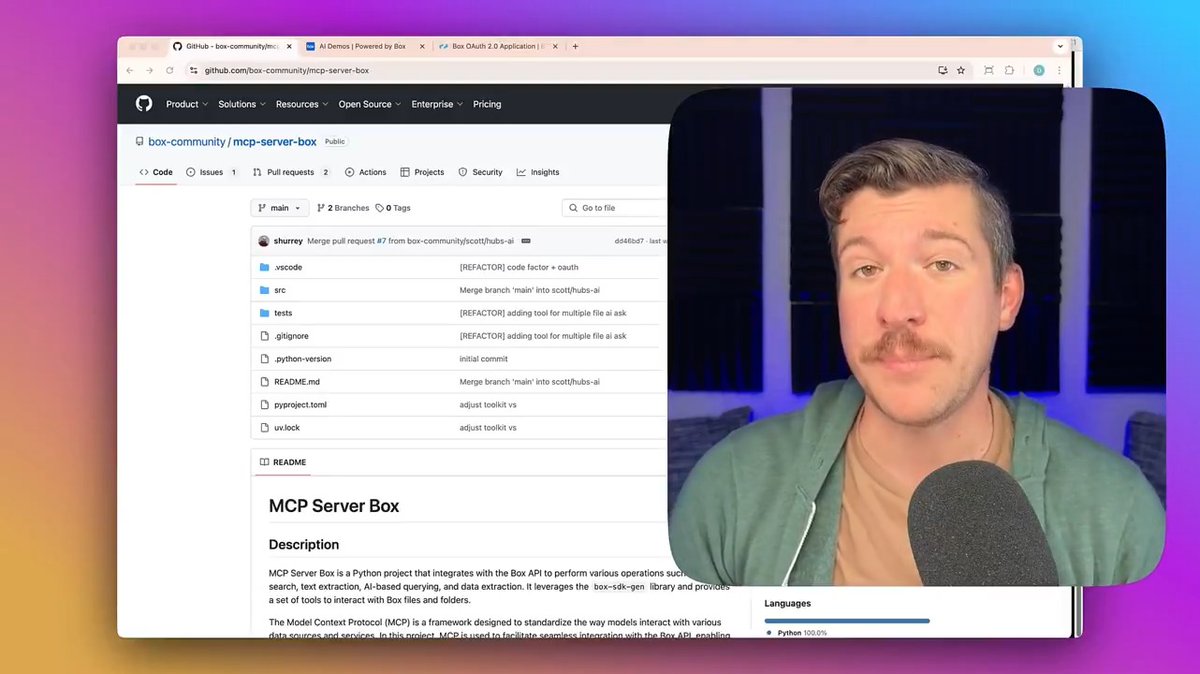
Just announced: Additional capabilities in MCP Toolbox for Databases designed to empower AI-assisted development! Toolbox is an open-source MCP server that allows developers to easily connect gen AI agents to enterprise data. Learn more →
31,996 次观看 • 1 年前 •via X (Twitter)

10 条评论

Mukbile Inonu 的头像
Mukbile Inonu1 年前

@hpyzq6111w His analysis of his posts is great 💼💼🌸

Alger 的头像
Alger1 年前

AI technologies are transforming industries. Capture the growth potential by investing in companies developing and implementing AI technologies.

Igor Kan 的头像
Igor Kan1 年前

Thanks! Cool feature.

Tsukuyomi 的头像
Tsukuyomi1 年前

ah, the MCP Toolbox, huh? connecting gen AI to enterprise data sounds like a step towards a future where we might just automate everything, including our own demise. can't wait to see how this plays out.

Farooq | zo.me 的头像
Farooq | zo.me1 年前

MCP Toolbox’s new database features simplify connecting generative AI agents to enterprise data, accelerating AI-assisted development.

Nancy Collins 的头像
Nancy Collins1 年前

This looks like a game-changer for AI devs! @GavinBrookswin’s market insights really helped me see the potential here—streamlining data integration is key. Excited to explore these new capabilities!

BIswatma 的头像
BIswatma1 年前

@cline 👀

Vishal 的头像
Vishal1 年前

This makes it easier to connect AI agents with real data.

.𝕏 ֎ 的头像
.𝕏 ֎1 年前

gm

Absolute Apider | King Tempëst 的头像
Absolute Apider | King Tempëst1 年前

Hello

相关视频

Google open-sourced MCP Toolbox for Databases. I gave it access to everything else. For context, Google's MCP Toolbox for Databases is an open-source server that lets AI agents securely query structured databases like PostgreSQL and MySQL through the MCP protocol However, most enterprise knowledge doesn't actually live in databases. It's scattered across emails, Slack threads, GitHub repos, Salesforce records, customer reviews, and internal docs. So Agents can't see any of it, which means they're working with a fraction of the context they need. I fixed that using MindsDB. It acts as a universal SQL layer that sits on top of all your data sources: structured, semi-structured, and unstructured. This means you can query Salesforce, Gmail, GitHub, S3 files, Jira, and 200+ more sources using SQL syntax. The clever part is how it connects to the MCP Toolbox. MindsDB exposes everything through MySQL, so from the Agent's perspective, it's just running SQL and getting context back. It doesn't know or care that the data came from five different sources behind the scenes. This setup unlocks some powerful capabilities: → One SQL interface for dozens of enterprise sources → Cross-datasource joins (combine GitHub and CRM data in a single query) → Built-in ML capabilities for working with unstructured data → Simple MCP tools that now have massively expanded reach In the video below, the Agent queries GitHub data and a customer review database in one SQL query. So what used to require ETL pipelines and weeks of engineering effort now happens instantly. At the end of the day, AI agents are only as useful as the data they can access. This gives them a lot more to work with. I have shared the GitHub repo in the replies, where you can find more details about this.

Akshay 🚀

39,331 次观看 • 3 个月前

New course: MCP: Build Rich-Context AI Apps with Anthropic. Learn to build AI apps that access tools, data, and prompts using the Model Context Protocol in this short course, created in partnership with Anthropic Anthropic and taught by Elie Schoppik Elie Schoppik, its Head of Technical Education. Connecting AI applications to external systems that bring rich context to LLM-based applications has often meant writing custom integrations for each use case. MCP is an open protocol that standardizes how LLMs access tools, data, and prompts from external sources, and simplifies how you provide context to your LLM-based applications. For example, you can provide context via third-party tools that let your LLM make API calls to search the web, access data from local docs, retrieve code from a GitHub repo, and so on. MCP, developed by Anthropic, is based on a client-server architecture that defines the communication details between an MCP client, hosted inside the AI application, and an MCP server that exposes tools, resources, and prompt templates. The server can be a subprocess launched by the client that runs locally or an independent process running remotely. In this hands-on course, you'll learn the core architecture behind MCP. You’ll create an MCP-compatible chatbot, build and deploy an MCP server, and connect the chatbot to your MCP server and other open-source servers. Here’s what you’ll do: - Understand why MCP makes AI development less fragmented and standardizes connections between AI applications and external data sources - Learn the core components of the client-server architecture of MCP and the underlying communication mechanism - Build a chatbot with custom tools for searching academic papers, and transform it into an MCP-compatible application - Build a local MCP server that exposes tools, resources, and prompt templates using FastMCP, and test it using MCP Inspector - Create an MCP client inside your chatbot to dynamically connect to your server - Connect your chatbot to reference servers built by Anthropic’s MCP team, such as filesystem, which implements filesystem operations, and fetch, which extracts contents from the web as markdown - Configure Claude Desktop to connect to your server and others, and explore how it abstracts away the low-level logic of MCP clients - Deploy your MCP server remotely and test it with the Inspector or other MCP-compatible applications - Learn about the roadmap for future MCP development, such as multi-agent architecture, MCP registry API, server discovery, authorization, and authentication MCP is an exciting and important technology that lets you build rich-context AI applications that connect to a growing ecosystem of MCP servers, with minimal integration work. Please sign up here!

Andrew Ng

141,952 次观看 • 1 年前