正在加载视频...

视频加载失败

Just Use Postgres feat. Denis Magda Denis literally just published a book called “Just Use Postgres”. In this conversation, that turned out to be super fun, we talked about: • what MySQL got wrong w.r.t community • the recent explosion of Postgres development in the world (Supabase, Neon, Crunchy,...

13,036 次观看 • 7 个月前 •via X (Twitter)

0 条评论

暂无评论

原始帖子的评论将显示在这里

相关视频

Your Postgres is 100x slower than traditional OLAP engines. A deceptively simple OSS extension fixes this. Here's an interview where we dive into the deep engineering around how this is achieved. Joining me (and leading the conversation) is Marco Slot: an engineer with an EXTENSIVE and impressive career history around PostgreSQL: 👉 Created pg_cron in 2017 (3.7k stars) - a tool to run cron-jobs in Postgres 👉 Built pg_incremental - fast, reliable, incremental batch processing inside PostgreSQL itself 👉 co-created pg_lake (after working on Crunchy Data's Warehouse, and getting acquired into Snowflake) 👉 Helped get pg_documentdb (MongoDB-on-Postgres) off the ground Marco Slot is a world-class expert in Postgres extensions. He seriously impressed me with his knowledge over the course of a private LinkedIn conversation, and now that I type out his resume - I understand where it came from. He should be on everyone's radar. So I brought him on the pod. In our full 2-hour deep-dive, we went over: • 🔥 how pg_lake makes analytics 100x faster (literally) • 🔥 perf internals like vectorized execution & CPU branching • 🤔 practical differences between OLTP and OLAP database development (and the age-old mission in uniting both) • 🤔 how (and why) pg_lake intercepts query plans and delegates parts of the query tree to DuckDB • 💡 why Postgres is architecturally terrible at analytical queries (and how vectorized execution fixes this) • 💡 Marco's hard-won experience through a decade+ career in Postgres • 🏆 Iceberg's role as the TCP/IP for tables • 🏆 what the real moat of PostgreSQL is Developments like pg_lake are a real reason why "Just Use Postgres" is much more than a meme, and it'll continue to dominate discourse. I promise you will learn a lot from this episode. Timestamps: (0:02) What is pg_lake? (2:23) Postgres' 100x slower problem and columnar storage experiments they had to make Postgres fast for analytics (6:00) practical examples and internals (16:20) perf internals - vectorized execution & CPU optimization (23:00) pg_lake architecture (why DuckDB isn't embedded) and the connection-per-process issue (29:16) how pg_lake intercepts the query plan tree and delegates parts to DuckDB (41:09) Iceberg catalogs (48:24) postgres to iceberg ingestion patterns (and pg_incremental) (53:40) Marco's (long) career: early AWS, Citus, Microsoft, Crunchy Data & Snowflake (1:04:20) Marco's observations around the merging between OLTP and OLAP (and the subtle dev differences there) (1:15:30) reverse ETL (1:33:08) Iceberg as the TCP/IP for tables (1:35:00) Marco's thoughts on the "Just Use Postgres" fever

Stanislav Kozlovski

16,857 次观看 • 5 个月前

Your agents can't keep up with real-time data. Especially when it's scattered across dozens of sources. Most teams waste weeks building custom connectors for every database, API, and data warehouse. Then they build ETL pipelines to sync everything. By the time your agent retrieves the data, it's already outdated. Picture this: Your Postgres database updated 5 minutes ago. Your MongoDB collection changed 2 minutes ago. Your agent is still pulling from yesterday's snapshot. This is why most production RAG systems fail. There's a better approach: MindsDB is an open-source AI platform with a federated data engine that lets you query multiple data sources in real-time using SQL - without moving any data. Here's what makes it different: ↳ Your data stays in place. No ETL pipelines or data duplication ↳ Query Postgres, MongoDB, REST APIs, and more using consistent SQL ↳ JOIN across different sources in real-time with a unified interface ↳ Works with both structured and un-structured data And here's the best part: You don't even need to write SQL. Just describe what you want in plain English, and MindsDB converts it to SQL automatically. The system does all the heavy lifting. The breakthrough for AI agents is simple: When data updates at the source, your agent gets fresh results immediately. No sync delays. No stale embeddings. No custom code for each integration. You can literally write a SQL query that joins a Postgres table with a MongoDB collection and gets live results. This is what production AI applications need but rarely get. In this video, I give you a complete walkthrough of what we just discussed and how to actually do it. Make sure you watch this till the end. I've shared the link to MindsDB's GitHub repo in the next tweet!

Akshay 🚀

65,672 次观看 • 10 个月前

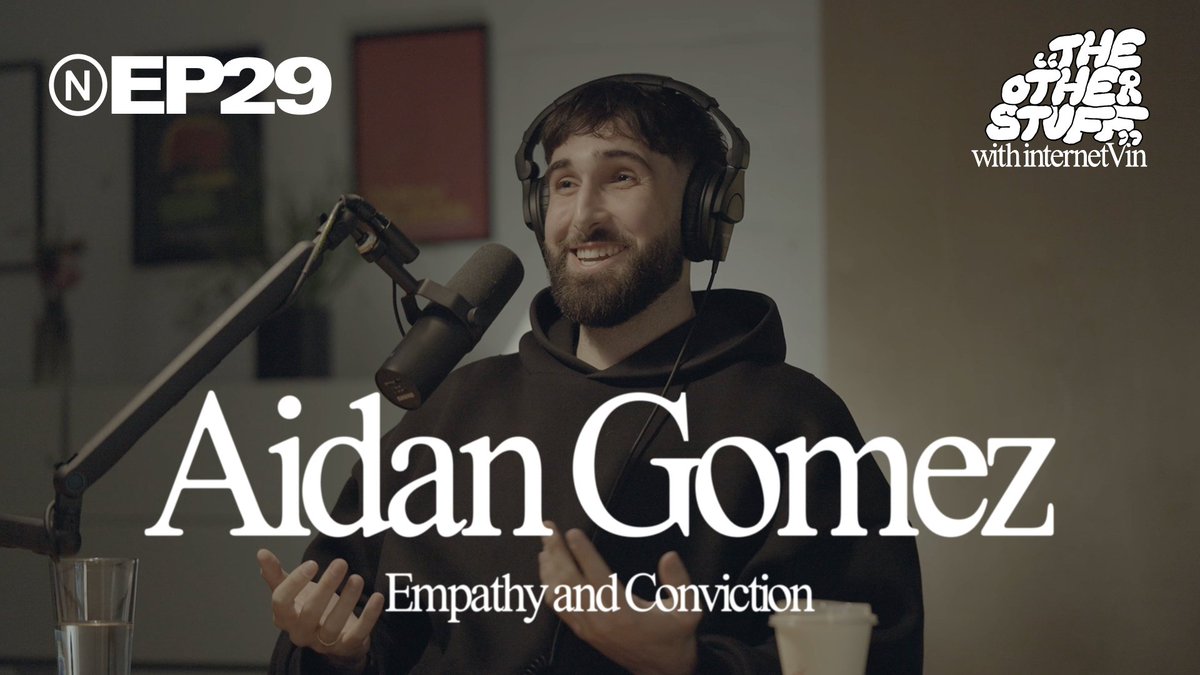
Aidan Gomez (Aidan Gomez) is a computer scientist, co-author of the seminal paper ‘Attention Is All You Need,’ and the CEO of Cohere. In this episode, we discussed his upbringing in the cabin his grandfather built in Codrington, a small town North of Brighton, and the values that were instilled in him through his family. We explored his path from Codrington to his undergraduate studies at the University of Toronto, emailing Geoffrey Hinton, and joining Google Brain where he co-wrote the paper on transformers. We discussed how he met his co-founders Ivan Zhang and Nick Frosst, and his insights on what it means to build a meaningful, successful company in Canada. Aidan shares his conviction about what is at stake — for Canada and for the world at large. This is a conversation about family, values, and what it means to live with conviction. The Other Stuff is hosted by internetVin — filmmaker, entrepreneur, and possibly the most curious man on Earth. Produced by New. The Other Stuff #29 — Aidan Gomez: Empathy and Conviction — Timestamps 00:00:00 Intro 00:03:10 The Malleability of Toronto 00:11:06 Growing Up in Codrington 00:13:50 The Story of Aidan Gomez’s Family 00:27:23 Introduction to the Internet 00:30:39 Values and Work Ethic 00:35:46 University of Toronto’s AI Scene 00:40:48 Emailing Geoffrey Hinton 00:42:16 Google Brain 00:45:15 Dropout: A Simple Way to Prevent Neural Networks from Overfitting 00:49:48 The Beauty of Research 00:54:24 One Model to Rule Them All 00:59:54 Meeting Ivan Zhang and Nick Frosst 01:04:00 The Birth of Cohere 01:06:56 Twitter Influencers and Alex Friedland 01:11:48 Being the CEO 01:12:51 Building for Canada 01:15:01 Three Fundamental Ingredients of Building a Company 01:21:39 Working with the Canadian Government 01:24:39 Reflexivity in Canada 01:36:22 What Is Evil? 01:42:40 The Role of AI in the World

The Other Stuff Podcast

45,297 次观看 • 8 个月前

My dear friend, Vlad Tenev, changed the landscape of investing forever! The rise of the retail investor is largely due to Robinhood's success... and in this new Journey Man, we discuss it all... Enjoy! 00:00 - Intro 00:53 - Introducing Vlad Tenev of Robinhood 01:27 - Why Take on Wall Street? 01:54 - Robinhood’s Zero-Fee Origin Story 02:53 - Inspiration from Instagram and Uber 04:24 - Reimagining Trading for Mobile 05:05 - The Challenge of Disrupting Finance 05:42 - Why Everything Is Hard 06:34 - Early Wrong Assumptions 07:42 - Raising Capital with a Small Vision 08:48 - Funding Robinhood on AngelList 09:50 - Early Investors Changed Their Lives 10:38 - The Crypto Explosion Begins 11:07 - Considering a Bitcoin Exchange First 12:17 - Bitcoin’s Early Skepticism and Growth 13:08 - Robinhood Launches Crypto in 2018 14:03 - 2020: Crypto Revenue Surges Overnight 15:04 - The Challenge of Crypto Cyclicality 16:11 - Staffing a Volatile Business 17:10 - Building Robinhood’s Lean Crypto Team 18:46 - Robinhood’s First Crypto Event Coming 19:38 - Where TradFi Meets DeFi 20:34 - Tokenizing Everything 21:09 - Robinhood’s Vision for Crypto + Finance 21:47 - Thoughts on Crypto Options Demand 23:04 - Why Crypto Options Haven’t Taken Off 24:09 - Millennials and the Speculative Economy 25:22 - Democratizing Trading for Everyone 26:08 - Why Buy-and-Hold Doesn’t Work for All 27:15 - Trading vs Investing: A Matter of Wealth 28:01 - Trading as a Skill Anyone Can Build 29:13 - Robinhood’s Role in Onboarding Millions 30:06 - The Fed's Role and Retail Insight 31:03 - The Rise of the Retail Macro Trader 32:17 - Helping Users Succeed with Robinhood Strategies 33:35 - Power of Community and the Hive Mind 34:55 - Will AI Disrupt Community Too? 36:14 - Technological Waves and Investor Opportunity 37:10 - Human Purpose in an AI World 37:52 - Tokenizing Human Connection 38:28 - Creators, Platforms, and Future-Proofing 39:26 - Vlad’s Long-Term View of the Future 40:05 - Financial Services at the Heart of Disruption 41:14 - If AI Replaces Jobs, What Happens to Investing? 42:25 - Entering the Economic Singularity 43:31 - What Happens When AIs Win the Markets? 44:16 - AI's Role in Capital and Markets 45:07 - Will AI Eliminate Human Emotion from Markets? 46:06 - HFT: The Original AI Traders 47:20 - AI and Long-Term Probabilistic Forecasting 48:48 - GPUs, Gaming, and the Origins of AI 50:01 - Nvidia, CUDA, and Wall Street Arms Races 51:04 - Flash Boys and Microwave Trading 51:54 - Will AI Costs Go to Zero? 52:52 - Lower Cost, Higher Usage 53:41 - Robinhood’s UX Won’t Be Just a Chatbox 55:16 - Cortex: AI-Powered Features at Robinhood 56:54 - Tokenization and the Future of Asset Management 57:44 - Crowdsourced, Tokenized Hedge Funds 58:48 - Portability of Tokenized Assets 59:39 - Blockchain as the New Rails of Finance 01:00:09 - The Trump Token and Capital Formation 01:01:00 - Capital Access Unlocks Innovation 01:01:49 - Why Crypto Needs Regulatory Clarity 01:03:17 - From Meme Coins to Real Assets 01:04:17 - Crypto's Path to $100 Trillion? 01:05:15 - The Financial System Will Run on Blockchains 01:06:00 - Platform Layer vs Application Layer Wealth 01:06:29 - AI Raises Money and Launches Tokens 01:07:39 - AIs Creating Software and Capital Formation 01:08:00 - Final Thoughts: A Wild Future Ahead 01:08:20 - When Will Vlad Buy a CryptoPunk? 01:08:51 - Wrapping Up: AI, Crypto, and the Road Ahead

Raoul Pal

172,640 次观看 • 1 年前

How Cloudflare cut query times by 35x without leaving Postgres: Their Postgres tables hit billions of rows, and every time-range query started getting slower. Plain Postgres scans the entire table on every query, regardless of the time window. They tried the manual route by building precomputed aggregates with cron jobs and evaluating ClickHouse, which needed a full ingestion pipeline just to handle their write pattern. Here's where most teams get stuck at exactly this point. They utilize manual partitioning, splitting data into child tables by day or month. Then they wire up cron jobs to refresh aggregate tables. Every schema change after that requires updating the cron logic and coordinating across teams. The infrastructure becomes the project. Tiger Cloud is managed TimescaleDB by Tiger Data - Creators of TimescaleDB on the Postgres you already know, with automatic time-based partitioning, continuous aggregates, and compression built in from the start. Cloudflare moved to TimescaleDB after exhausting the manual route and saw 5-35x query performance improvement on the same data. Here is how it works: → Hypertables partition data by timestamp automatically. Every time-range query hits only the relevant chunk, not the full table. → Continuous aggregates refresh incrementally in the background, with no cron jobs to maintain. To show what this looks like in practice, I built a real-time earthquake intelligence dashboard on a 3D globe using Claude Code and Tiger Cloud in a single session. The USGS earthquake catalog has 400,000+ events since 1900, each a timestamped row. The dashboard plots them as ripple animations sized by magnitude and colored by depth, with a time slider that scrubs through 120 years of seismic history. Every slider position fires a live query against the hypertable, and the side panel pulls from continuous aggregates. Claude Code connected to Tiger Cloud through the Tiger CLI MCP server, provisioned the database, pulled the USGS catalog, and assembled the full Next.js and Three.js frontend without leaving the session. The video below shows the final build in action, and I worked with the Tiger Data team to put this together. Tiger CLI is open-source (Apache 2.0) and works with Claude Code, Cursor, Codex, Gemini CLI, and VS Code. To try this yourself: → Sign up for Tiger Cloud here: New accounts get $1,000 in free credits, no credit card required. → Install Tiger CLI: curl -fsSL https(:)//cli(.)tigerdata(.)com | sh → Run tiger mcp install claude-code → Give Claude Code a prompt and let it build. I also wrote a full walkthrough on how you can turn any coding agent into a production-grade data engineer that can manage over a billion-row Postgres workloads. It covers everything from the database setup to the final build. Read it below.

Avi Chawla

22,094 次观看 • 27 天前

A Physics That Could Finally Unify Reality (Part 2/2) - James Ellias, DemystifySci #385 A quiet tremor sounds beneath the floorboards of physics, the still-living heartbeat of the forgotten search for the hidden substance that carries every wave and whisper of the universe. We walk through the fog of equations and theories of fundamental physics with James Ellias of James Ellias, and ask if there is a material truth lies beneath the symbols, or if we have to be satisfied with the short-sighted vision of mathematics alone. 00:00 Go! 00:04:37 Central Equations in Physics 00:08:20 The Importance of a Medium in Physics 00:10:00 Empowerment Through Understanding Physics 00:12:36 Rationality and Truth in Society 00:16:31 Existence vs Consciousness 00:20:30 Discussion on Existence and Consciousness 00:24:25 Role of Imagination in Existence 00:28:10 Properties and Entities in Physics 00:30:15 The Nature of Aether and Physical Mediums 00:36:08 Clarity and Understanding in Physics 00:40:26 Discussion on Force and Aether 00:44:57 Relationship of Entities and Actions 00:49:30 Theoretical Framework for Aether 00:58:04 Exploration of Aether Theories 01:00:40 Importance of Conciseness in Communication 01:02:00 Understanding Physics Before Proposing Hypotheses 01:05:15 Reevaluation of Flawed Theories 01:09:35 The Evolution of Key Physics Concepts 01:15:19 Context-Specific Nature of Constants 01:19:43 Historical Context in Physics 01:21:36 The Nature of Electrons 01:25:53 J.J. Thomson’s Evolving Perspective 01:29:24 Upcoming Work and Philosophical Frameworks 01:32:11 Collaborations

Anastasia

13,618 次观看 • 9 个月前

My conversation with OpenAI co-founder Greg Brockman This is the most detailed first-person account of the 72 hours after Sam Altman was fired. We also go deep on what comes next: the global race to AGI, why ChatGPT stopped showing reasoning, how much of OpenAI's own code is now written by AI ("it's hard to know what percent is not"), and the untold story of how OpenAI actually started in 2015. 00:00:00 Introduction 00:00:49 Meeting Sam Altman and Starting OpenAI 00:02:40 Building the Founding Team 00:04:25 DeepMind's Lead Over OpenAI 00:04:54 Changing OpenAI to a For-Profit Model 00:06:05 Breakthrough Moments at OpenAI 00:08:22 What Dota 2 Meant for OpenAI 00:10:04 Reasoning Versus Prediction 00:11:59 Tensions Grow at OpenAI 00:15:44 Sam Altman's Firing 00:17:49 Greg Quits OpenAI 00:19:56 Sam Explores Deal with Microsoft's Satya 00:20:28 Petition for Altman's Return 00:23:43 Ilya Sutskever Leaves OpenAI 00:24:59 Lessons Learned after Sam Ousting 00:28:22 The Thing Ilya Said that Greg Can't Forget 00:32:22 Is AI Going Parabolic? 00:33:24 How Much of OpenAI's Code is Written by AI? 00:36:21 Do AI Chatbots Tell Us What We Want to Hear? 00:38:06 The Global AI Race to Reach AGI 00:38:40 What Happens if US Doesn't Reach AGI First? 00:39:49 Are Countries Stealing AI Advancements? 00:40:38 Why ChatGPT No Longer Shows Reasoning 00:41:47 The Finite Constraints of Compute 00:43:38 On Investing Early in Data Centers 00:46:31 The Future of Data Center Specialization 00:47:52 How to Decide Whose Queries to Serve 00:49:08 OpenAI on Consumer vs Enterprise Models 00:53:05 Data Centers in Space? 01:00:56 What Should AI Regulation Look Like? 01:04:33 The Future of AI-Powered Entrepreneurship 01:04:44 AI and Job Loss 01:07:15 The Skills Young People Should Invest In 01:11:30 What Does Success Look Like For You? Full episode on X below. Also find it on: • YouTube: • Spotify: • Apple:

Shane Parrish

450,952 次观看 • 4 个月前

Cursor Complete Guide for AI Coding... 1. The Basics, Composer, Cursor 2.0, Why use Cursor? 2. Multiple Agent Testing, Adding Database, Deploying to Vercel 3. Comparing the big 4: v0, Replit, Lovable, Cursor And more... with Senior Software Engineer Kehan Zhang TIME STAMPS --------------- 1. BASICS: 00:00 Introduction 01:01 Overview of Cursor and Its Features 01:47 Getting Started with Cursor 02:39 Understanding IDE and Vibe Coding 06:00 Cursor For Mobile Apps 10:26 Downloading and Installing Cursor 11:17 Creating and Managing Projects in Cursor 15:14 Building a Simple Game with Cursor 19:10 Advanced Features and Customization 40:28 Fixing Styling Rules 40:53 Redesigning the App 42:17 Exploring Cursor 2.0 Features 43:22 Setting Up the Project Structure 44:17 Adding and Testing Meme Templates 46:08 Debugging Text Issues 2. ADVANCED 49:46 Using Multiple Agents 01:10:40 Creating Custom Commands 01:14:15 Creating Commands in Settings Tab 01:15:11 Introduction to Instant DB 01:16:04 Setting Up Instant DB in Your Project 01:18:24 Building a Full Stack Application 01:19:04 Using the Agent to Plan and Build 01:26:06 Testing and Debugging the Application 01:53:02 Deploying the Application with Vercel 01:55:35 Setting Up the CLI 01:56:15 Understanding Command Line Interfaces (CLI) 01:57:32 Deploying Code to Vercel 01:58:07 Handling Environment Variables 01:58:44 Interacting with the Vercel Deployment 02:00:34 Exploring Cursor's Capabilities 3. COMPARING VIBE CODING TOOLS 02:09:48 Comparing Vibe Coding Tools 02:31:04 Final Thoughts and Recommendations

Riley Brown

65,392 次观看 • 10 个月前

2025 = the year of AI Agents x DAOS x Onchain Capital Allocation NEW greenpill.network podcast: Today, I'm joined by Shaw (spirit/acc) jin from ai16zdao to talk about AI Agents. How we use them to allocate capital in DAOs? To route information? To accelerate movements? To solve coordination failure? Timestamps for ez navigation 🫡 00:00 - Intro & focusing on DAOs and the intersection of AI agents. 01:00 - AI Agents and Their Impact 02:03 - The Evolution of the Internet 07:52 - Defining AI Agents 09:40 - Reducing Friction in Information Sharing 11:56 - Building a Movement, Not a Cult 14:15 - The Cathedral and the Bazaar Metaphor 16:04 - Using AI for Coordination 17:49 - Reducing Information Siloing 18:39 - Common Tools Across Organizations 19:31 - Open Sourcing Solutions 20:07 - Capital Allocation Challenges 20:55 - AI and Capital Allocation Intersection 21:50 - Human Oversight in Funding 22:48 - Continuous Retroactive Funding 24:42 - Creating a Supportive Culture 25:06 - Feedback Loops for Builders 26:09 - Reducing Overhead in Funding 26:36 - Acknowledging Non-Coding Contributions 27:58 - Chat Summarization Tool 28:34 - Profiles and Social Capital 29:00 - Marketplace of AI Agents 29:46 - Layered AI Systems 32:42 -Human Oversight in AI 34:39 - Feedback Loops in Development 37:01- Documentation and Community Engagement 38:12 - Self-Documenting Code 40:20 - Accelerated Idea Generation 45:03 - Circle of AI Champions 46:32 - Infinite Backrooms Concept 47:48 - Personal Infinite Backroom Ideas 49:23 - Concerns About Backrooms and Information Hiding 51:23 - Infinite Backrooms Concept 53:35 - Implementers and Skill Sharing 54:40 - Vision for the Future 56:39 - Concerns About UBI Implementation 57:56 - Community Income as a Solution 58:14 - A Hope for Self-Sufficiency and AI 59:36 - Outro

owockai

60,440 次观看 • 1 年前