Video wird geladen...

Video konnte nicht geladen werden

Zur Startseite

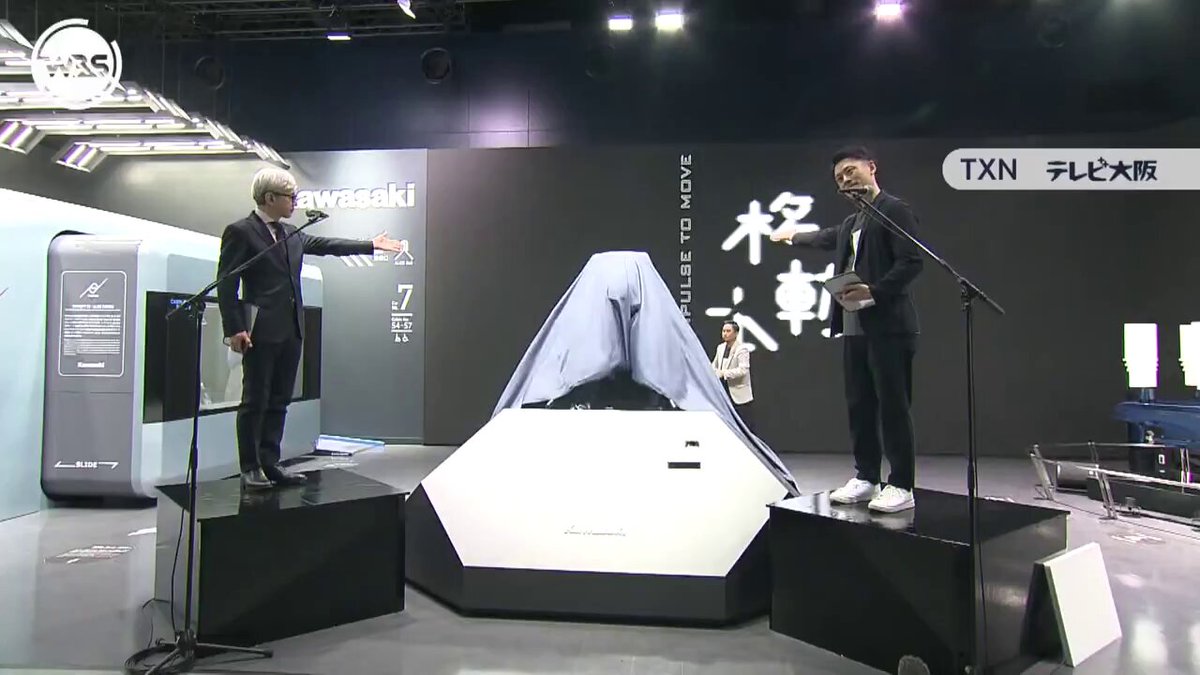
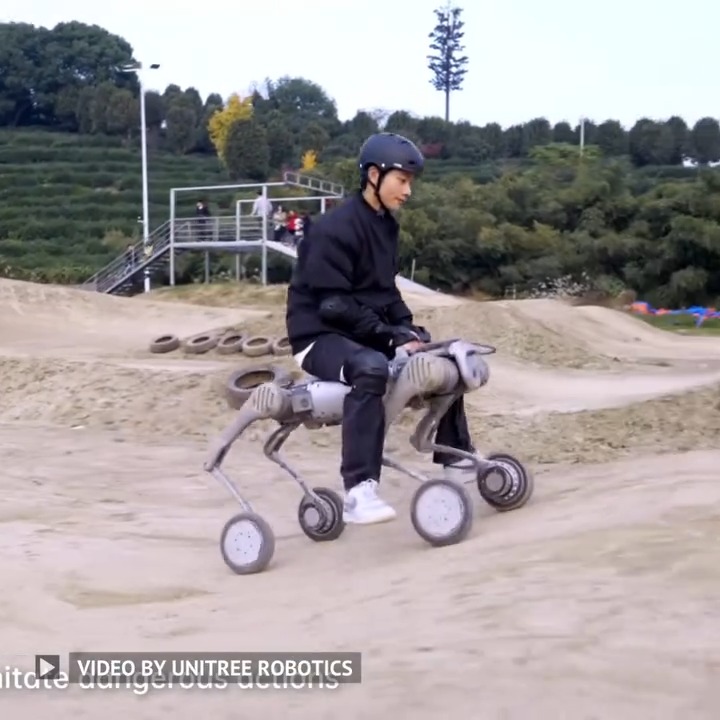
Kawasaki’s concept robot CORLEO is a hydrogen-powered, rideable robot with four legs,designed for stable,eco-friendly travel across various terrains. NOTE: The fully functional model will be available after 2025. The video primarily features CGI. 📽️:Youtube/Kawasaki Group Channel

61,986 Aufrufe • vor 1 Jahr •via X (Twitter)

10 Kommentare

Profilbild von Electe
Electevor 1 Jahr

@DeepLearn007 @DeepLearn007, innovative technology like this opens up exciting possibilities for the future.

Profilbild von ACCIONA (English)
ACCIONA (English)vor 1 Jahr

In an Australian laboratory 🇦🇺, a coral nursery is home to a robotic arm that works around the clock. This machine feeds, cleans, and nurtures young corals 🤖🪸 This is the story of the robots that help protect the environment ⤵️

Profilbild von I'm Groot !!!
I'm Groot !!!vor 1 Jahr

Fake 🙄🤦🏻‍♂️

Profilbild von MetaMetis
MetaMetisvor 1 Jahr

This is the first time I've realised that ... we ... are actually going to have ... DRAGONS 😬😬😬😬💚💚💚💚

Profilbild von sby
sbyvor 1 Jahr

I am afraid of the future, if the robot technology combine AI technology it will be dangerous. humankind prepare their ends.

Profilbild von rahmatfirman
rahmatfirmanvor 1 Jahr

Hmm intersting

Profilbild von Armageist
Armageistvor 1 Jahr

I love how it changes size based on whose riding it. Is this like the difference between a 2 door and 4 door/extra cab pickup truck? Or just inconsistently bad cgi?

Profilbild von Tensor Troy
Tensor Troyvor 1 Jahr

A step towards sustainable, adaptive travel innovation for varied environments.

Profilbild von Maxim Neuralis
Maxim Neuralisvor 1 Jahr

Intriguing concept, particularly in energy transition dynamics and mobility engineering dimensions. Look forward to real-world efficiency data later.

Profilbild von Cristiano Santos 🐺⚓️
Cristiano Santos 🐺⚓️vor 1 Jahr

Nice

Ähnliche Videos

Kawasaki Unveils CORLEO: A Hydrogen-Powered Robotic Horse EXCLUSIVE FULL VIDEO — On April 5, 2025, Kawasaki Heavy Industries introduced the CORLEO, a groundbreaking hydrogen-powered, four-legged robotic vehicle designed for human riders, at the Osaka-Kansai Expo. This innovative robotic with motorcycle engineering, aims to redefine off-road mobility while prioritizing sustainability. The CORLEO is powered by a 150cc 20 horsepower hydrogen engine that generates electricity to drive motors in each of its four legs. Hydrogen is supplied from a rear-mounted canister with a distance projection of ~150 miles. Each leg features two separate rubber hooves, designed to absorb uneven terrain and provide non-slip stability on surfaces like grass, gravel, and rocky paths. The rear legs move independently from the front, absorbing shocks during walking or running, while the rider maintains a forward-leaning posture for better visibility when navigating obstacles like steps. Riders control the CORLEO by shifting their center of gravity, detected through sensors in the footpegs and handlebars. The stirrups are adjustable for optimal positioning, and an onboard display provides real-time navigation and posture feedback, making the ride intuitive and user-friendly. This design not only caters to thrill-seekers but also holds potential for accessibility, offering a new mobility solution for individuals with disabilities. The CORLEO draws inspiration from sci-fi concepts like the "Mechanical Horse," a trope seen in media such as Mazinger Z and Star Wars (e.g., General Grievous' Tsmeu-6 Bike). However, Kawasaki's creation is grounded in practical innovation, aiming to combine the charm of equestrian activities with cutting-edge technology.

Brian Roemmele

589,294 Aufrufe • vor 1 Jahr

New "superman" Four months later, Shanghai-based Matrix Robotics unveiled the Matrix-3--yet another anthropomorphic humanoid robot situated on the left side of the "Uncanny Valley." Unlike Boston Dynamics' Atlas, which is designed for industrial settings, the Matrix-3 is a general-purpose humanoid robot intended initially for service-oriented environments such as supermarkets, hotels, and office buildings. Standing 1.7 meters tall and weighing 65 kilograms, the adult-sized robot features a full-body covering of biomimetic fabric integrated with tactile sensors, as well as humanoid biomimetic muscles. It employs linear joints rather than the mainstream rotary joints. Matrix claims it is capable of pulling or pushing a load of 200 kg. Optimus makes extensive use of linear joints (linear actuators). It is equipped with dexterous hands offering 27 DOF and boasts a battery life of 4 hours. The robot is powered by a model named WAVE(like an E2E World Action Model) Matrix states that it has already established a manufacturing facility in Shanghai's Zhangjiang with an annual production capacity of 10,000 units. The company plans to deliver 1,000 units this year, with the first batch scheduled for delivery by the end of June. Pricing starts at $99,000. Notably, Matrix founder Zhang Haixing previously served as a leader at Tesla China's Design and Research Center, where he was deeply involved in the early-stage R&D and design of the Optimus robot. This company seems to be delivering on the future envisioned for Optimus.

CyberRobo

40,727 Aufrufe • vor 4 Monaten

We trained a humanoid with 22-DoF dexterous hands to assemble model cars, operate syringes, sort poker cards, fold/roll shirts, all learned primarily from 20,000+ hours of egocentric human video with no robot in the loop. Humans are the most scalable embodiment on the planet. We discovered a near-perfect log-linear scaling law (R² = 0.998) between human video volume and action prediction loss, and this loss directly predicts real-robot success rate. Humanoid robots will be the end game, because they are the practical form factor with minimal embodiment gap from humans. Call it the Bitter Lesson of robot hardware: the kinematic similarity lets us simply retarget human finger motion onto dexterous robot hand joints. No learned embeddings, no fancy transfer algorithms needed. Relative wrist motion + retargeted 22-DoF finger actions serve as a unified action space that carries through from pre-training to robot execution. Our recipe is called "EgoScale": - Pre-train GR00T N1.5 on 20K hours of human video, mid-train with only 4 hours (!) of robot play data with Sharpa hands. 54% gains over training from scratch across 5 highly dexterous tasks. - Most surprising result: a *single* teleop demo is sufficient to learn a never-before-seen task. Our recipe enables extreme data efficiency. - Although we pre-train in 22-DoF hand joint space, the policy transfers to a Unitree G1 with 7-DoF tri-finger hands. 30%+ gains over training on G1 data alone. The scalable path to robot dexterity was never more robots. It was always us. Deep dives in thread:

Jim Fan

301,632 Aufrufe • vor 7 Monaten