Loading video...
Video Failed to Load
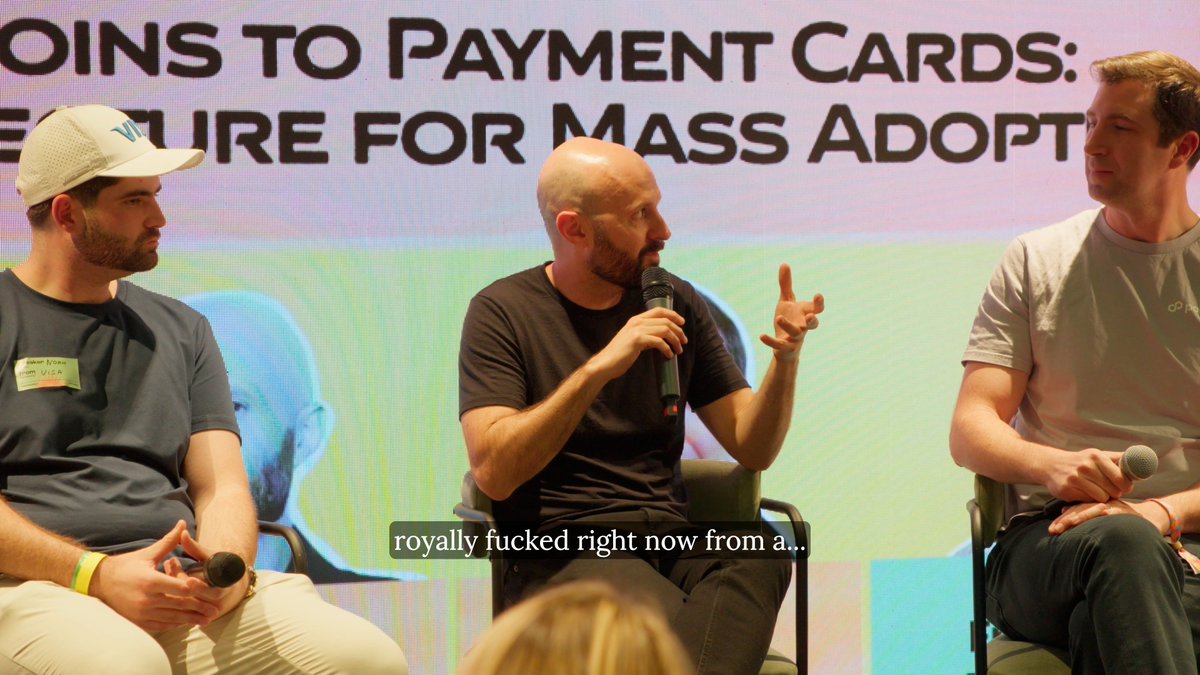
Know your validators. Backed by trust, Stellar's consensus protocol offers a level of security that is impossible to achieve in Proof-of-Stake networks. Tomer Weller gets into it with idobn.eth at L'Atelier Crypto | Hype.

26,870 views • 1 year ago •via X (Twitter)
10 Comments

@tomerweller @idobn @hypepartners Trust? No trust. Once your validators scam and run away XLM is over.

@tomerweller @idobn @hypepartners know ur validators 🫡@dobprotocol

@tomerweller @idobn @hypepartners When will institutions start buying XLM?

@tomerweller @idobn @hypepartners Trust built strong Stellar’s security game next level

@tomerweller @idobn @hypepartners When will $XLM hit $1.00 ? Stop crapping about ...and taking FREEBIES to Nice, France & staying in 5 *Star Hotels OK ?...

@tomerweller @idobn @hypepartners @HeyGenLabs translate to portuguese

@DangogoC3023 @tomerweller @idobn @hypepartners Thanks for sharing!

@tomerweller @idobn @hypepartners The level of security is top notch 💯💯

@tomerweller @idobn @hypepartners Validators flexing so hard like crypto’s new rockstars. Who’s ready to see some chaos in that consensus?

@StellarGlobal_ @tomerweller @idobn @hypepartners





![Vitalik Buterin explains why proof-of-stake is more secure than proof-of-work “I think proof of stake is very secure because to attack the system, you need to have basically as much stake as the rest of the network. Right now, for example, we have 5 million ETH staking, which means you have to come up with 5 million ETH and then join the network.” At the time of this writing, more than 37 million ETH are being staked, with 3 million ETH waiting to join via the validator queue. At today’s prices, that’s more than $80 billion of ETH someone would have to acquire to attack the network and revert finalized blocks, which is more than the cost of attacking even the Bitcoin network by some estimates. The other defense mechanism that proof-of-stake has that proof-of-work doesn’t is slashing, which makes Ethereum antifragile. Vitalik explains: “Recovering from attacks is much easier in proof-of-stake than proof-of-work. For many kinds of attacks you do against [the Ethereum] network, we have this concept of automatic slashing. In order to revert a finalized block, you basically have to have a big portion of your validators sign two conflicting messages. This is something where once these messages are on the network, you can go and prove ‘these people did it.’ So we have this feature in the protocol where you basically take all these people who provably misbehaved and you burn their coins.” Vitalik also acknowledges the possibility of censoring attacks, where if 1/3rd of validators refuse to attest, the chain can’t finalize. But, as he explains, Ethereum has a contingency plan for this as well: “Everyone who got censored would create a minority chain, and the community would have to do a soft fork. The would have to say, ‘this chain is clearly attacking us and this one is not attacking us, so we’re going to join this chain.’ Then what happens is, on that new chain, the attackers also lose a lot of coins. The difference between proof-of-stake and proof-of-work is that in a proof-of-stake system, you can identify specific participants — and this isn’t a human going in and saying ‘I don’t like you’. It’s all automated.” One last benefit of proof-of-stake is that security scales with the value of the network. As Vitalik put it five years ago, it is really relative security, and not absolute security, that matters: “The security needs of a thing have to be proportional to the size of that thing, because as a thing gets bigger, its enemies become bigger and more well-motivated. If BTC were 100x as big as it is today, the value from destroying it would be 100x higher, and the kinds of actors that would want to care about destroying it would be much bigger and scarier. This is also why countries of all sizes have roughly similarly sized militaries as a percentage of GDP. Hence, cost of attack divided by market cap really is the correct statistic to measure, and in the long run issuance-free PoW really does look not that good." Source: Lex Fridman (Jun 2021)](https://image.24vids.com/tw-2033256919708963120/amplify_video_thumb/2032853935665696768/img/axdHFCGiYcu2nux7.jpg)