Video wird geladen...

Video konnte nicht geladen werden

Zur Startseite

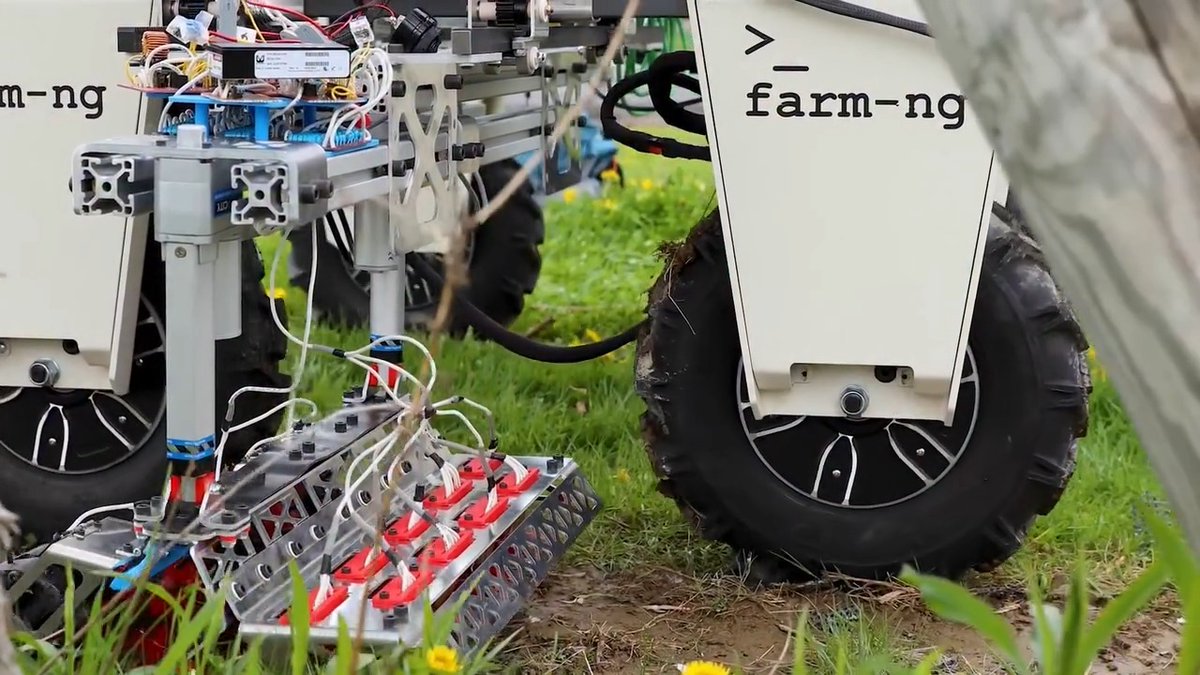
🚨🇺🇸LASER WEED KILLER Carbon Robotics made an autonomous LaserWeeder system that kills 100,000 weeds per hour. Because it uses thermal energy to eradicate weeds, rather than a physical intervention like tilling, the machine doesn't disturb the soil below. That means reduced farm costs, no more herbicides, and, most importantly,...

1,236,219 Aufrufe • vor 1 Jahr •via X (Twitter)

10 Kommentare

Profilbild von Christine Bella
Christine Bellavor 1 Jahr

Awesome! But have they done any investigation into any impact the lasers/scanners might have on the cellular development of the crops? I’m all for ditching poisonous chemicals for robotics — as long as we’re not exchanging one danger for another.

Profilbild von Zachary Kramer
Zachary Kramervor 1 Jahr

And would you look at that. Their CTO is a highly skilled Russian native educated in Moscow. Yet he brought his skills and creative abilities to the United states to make America great! With this technology America will be competing at the highest level in agriculture.

Profilbild von 🔥 CEO Branding Expert
🔥 CEO Branding Expertvor 1 Jahr

Can I get a micro version of that in the spring please?

Profilbild von David Lind
David Lindvor 1 Jahr

Weed Killer Robot

Profilbild von TooFuginBad
TooFuginBadvor 1 Jahr

That is amazing. Where are all the farm hands screaming “took our jerbs” 😂

Profilbild von Otter
Ottervor 1 Jahr

We know how lasers can burn things. In this case it would be interesting to know how the system identifies what needs to be burned vs saved.

Profilbild von JasetheAce
JasetheAcevor 1 Jahr

Where have i seen this before? This can only lead to one thing.....

Profilbild von Rhonda Willock
Rhonda Willockvor 1 Jahr

Can we please have one of these in a residential size for yards!? Wow!!!

Profilbild von Michael Simmons 🚀
Michael Simmons 🚀vor 1 Jahr

Someday the drones will be able to do that to independent thinkers.

Profilbild von Jason Griffin
Jason Griffinvor 1 Jahr

Carbon Robotics' LaserWeeder uses AI, computer vision, and lasers to identify and eliminate weeds. High-resolution cameras capture images of the field, and an onboard supercomputer identifies weeds among crops. Lasers then target the weeds' meristems with thermal energy, killing them without disturbing the soil or using chemicals. This system can kill up to 200,000 weeds per hour, offering an eco-friendly alternative to traditional weeding methods. It's effective across over 100 types of crops, including onions, carrots, and leafy greens. The technology not only reduces weed management costs by up to 80% but also increases crop yield and quality by minimizing herbicide use.

Ähnliche Videos

2026 Conservative Claire Coutinho claims the UK's pursuit of Net Zero is driven by ideology, and that using less wind and solar could save the equivalent of around £500 per household a year 2023: Conservative Claire Coutinho, "Nothing will distract us from achieving Net Zero or driving forward with renewables" The claim that less wind and solar would save every household £500 a year is deeply misleading. Coutinho is effectively taking the result of a model that changes almost the entire future electricity system—less wind and solar, much more nuclear and gas, different grid requirements and, crucially, no carbon price—and presenting the resulting £500-plus difference as though it were the cost of renewables. The research simply doesn't establish that. The figure does not come from evidence that renewables currently add £500 to household bills. It comes from a Conservative-backed modelling exercise comparing two hypothetical energy systems and turning £320 billion of estimated economy-wide savings between 2030 and 2050 into an annual equivalent per household. Crucially, the supposedly cheaper alternative doesn't simply build less wind and solar. It assumes far more nuclear power, substantially more unabated gas, lower spending on networks and balancing, and the removal of carbon pricing from electricity generation. Of the £320 billion headline saving, £137bn comes from assumed lower network costs, £67bn from balancing and ancillary services, £22bn from subsidies and capacity costs, and £94bn from lower wholesale prices. That £94 billion is particularly important because much of that supposed saving is created by changing the rules of the comparison. The existing-policy scenario assumes generators continue paying a carbon price which rises substantially towards 2050; the alternative effectively abolishes that carbon price from 2031. Unsurprisingly, a model in which gas-fired electricity no longer carries that cost produces cheaper wholesale electricity. But that isn't evidence that wind and solar made electricity £94bn more expensive. It is principally the consequence of assuming a major carbon-pricing policy is abolished. Nor is removing carbon pricing simply £94bn of free money. Carbon pricing is deliberately intended to make polluters account for their emissions, discourage fossil-fuel generation and encourage cleaner alternatives, while carbon allowances also generate government revenue. Removing it means accepting considerably greater emissions and losing those revenues and incentives. The alternative model consequently produces hundreds of millions of tonnes of additional CO₂. The model also assumes Britain can successfully build around 20GW of nuclear capacity, while retaining much greater dependence on gas. Whether nuclear can be delivered at the assumed cost and timetable is far from guaranteed, while greater reliance on gas leaves households more vulnerable to international gas-price shocks—the same exposure that played such a large role in Britain's recent energy-price crisis. There is a legitimate argument about the costs associated with large amounts of wind and solar. An electricity system dependent on intermittent generation requires substantial investment in transmission, balancing, storage, interconnectors and backup capacity, and those costs shouldn't be ignored. But that is very different from demonstrating that wind and solar cost every household £500 a year. Nearly £100bn of the supposed saving comes from the decision to remove carbon pricing, not from discovering that wind and solar are £100bn more expensive. Coutinho has taken a £500-plus headline generated by a Conservative-backed model containing a whole package of assumptions—less wind and solar, much more nuclear, more gas, less grid investment and the abolition of carbon pricing—and presented it to the public as evidence that Britain's reliance on wind and solar is costing households hundreds of pounds. That's misleading because the model doesn't establish that. It establishes that, if you change the entire future energy system and the taxes imposed upon it, its authors calculate a lower overall system cost. Turning that into “less wind and solar will save your household £500” strips away the assumptions that actually produce the number.

Farrukh

14,159 Aufrufe • vor 1 Monat

"bUt wHo iS gOIng to pICk tHe cROps"? Want to eat food that hasn't been endlessly doused in chemicals, but which also isn't super expensive? Think there might be an alternative to allowing millions of illegals into the country to harvest the crops? "Precision Agriculture" is finally here, and can deliver that, driving down the cost of groceries without the old inputs of factory farming Imagine a world where agricultural scale doesn't mean vast reservoirs of chemicals getting constantly dumped over the food supply, but high-tech, precision equipment doing what the chemical inputs used to The coolest example is the weeder that zaps and burns thousands of weeds a minute, up to 80 a second, saving farmers money and obviating RoundUp, or other chemicals like it. The combination of AI, precision machinery, and agricultural advancement can make that happen, the world it could create is a really exciting one What makes it all the more so is that these innovations aren't just cool. They're real leaps forward that will help Americans. They'll lower the cost of groceries, help farmers avoid huge input bills, such as for the herbicides obviated by the laser weeder, and create a thriving domestic manufacturing sector built around the production of this precision machinery, and all the advances that go into creating it. The pairing of technology and manufacturing in a really cool way that we haven't really seen outside of the military-industrial complex for decades.That's finally possible again, and Precision Agriculture looks like it can make it so

Jason Robertson

39,618 Aufrufe • vor 7 Monaten

Most people are doing yard work wrong, and it’s costing extra time and money. ​Ever wonder why weed wacker string seems to snap every two seconds, forcing a pause to constantly bump the head or re-spool the line? It turns out there is a legitimate science to maintaining trimmer line, and a simple 24-hour trick completely changes the game. ​Most trimmer lines are made of nylon, a material known for being hydrophilic. This means it actively absorbs moisture. ​Over time, sitting in a hot garage or a dry tool shed causes the plastic to lose its moisture content, becoming brittle and prone to snapping on impact. Immersing a new spool of weed wacker wire in a bucket of water for 24 hours before winding it into the trimmer replenishes that lost moisture. This makes the plastic significantly more pliable, durable, and resilient against tough weeds and chain-link fences. ​To make the line last even longer and get the yard done faster, keep these strategies in mind: ​Store Spools in a Cool Place: Never leave spare trimmer line in direct sunlight or the trunk of a car. UV rays and intense heat degrade nylon quickly. Storing the spool in a sealed bag with a damp paper towel helps maintain peak flexibility. ​Let the Tips Do the Work: The most common mistake is crowding the weeds. The highest cutting power is at the very tip of the string. Pushing the trimmer head directly into thick brush or hard surfaces causes friction heat, which binds the line together inside the spool and leads to premature snaps. ​Choose the Right Shape: Round line is durable but tears grass rather than cutting it cleanly. Square or twisted lines have sharp edges that slice through heavy weeds effortlessly, reducing the strain on both the engine and the line itself. ​Taking care of the tools makes the work easier. Try soaking the next spool of line and notice how much longer it lasts.

PeachProof

323,312 Aufrufe • vor 4 Monaten

Something I learned when I was 10 years old. People will pay twice as much for sweet 🌽 and you could sell twice as much if you were 1st to the market. Something that drives my nuts is that farmers and universities fail to study Slope Curve. We grow Annuals. They live They die I think it’s funny how the no till / cover crop farmers seem like they go to the church of Glypho Saint The organic guys make their hay preaching how it’s poison The conventional guys need a 7 way stack of chemicals that thunder kills waterhemp from dysfunctional soil This system uses wheat control to create a more even distribution of water across the field… and never grow weeds to begin with. I’m not here to piss off everyone. I just don’t understand why we have to look at every “crop” like 1 crop is going to pay handsomely and cover all our overhead costs and leave money in the bank. Maybe we could use cash crops like cover crops… except we don’t kill them We let them live We let them die We just do the math backwards and find how we can grab the ancillary benefits of their existence to our advantage We get more bushels per seed and unit of Nitrogen We stack entities based on slope curve. It starts with messing with the variables and challenging yourself to think differently Instead of just doing what the salesman or the tribe or the university says is the bmp Maybe they just want to continue status quo because your loyalty and lack of seeking truths are their profit center

Jason Mauck

32,048 Aufrufe • vor 11 Monaten

🇺🇸🇮🇷 The world may be approaching an energy crisis worse than the Great Depression, and this time governments can't print their way out of it. Most people compare today's global financial risks to 2008, but economist Chris Martenson says that's the wrong comparison. The banking crisis was ultimately a financial problem, and governments responded by creating trillions of dollars, euros and pounds to stabilise the system. You can debate whether that was wise, but it worked because the problem was financial. This time, he warns, the problem will be physical. If the Strait of Hormuz and Bab el-Mandeb remain disrupted, the world doesn't just lose oil; it loses diesel, jet fuel, lubricants, natural gas, petrochemicals, and fertiliser. The countless industrial inputs that keep supply chains, factories, farms and transport networks operating. And as Chris put it: You can't print missing molecules. That's why he believes this crisis is fundamentally different. If those physical resources become scarce, printing more money doesn't solve the problem; it simply means more money is chasing fewer real goods. And according to Chris, we're already seeing early signs of that reality beneath the surface. While many people focus on crude oil prices, he says the real warning is coming from refined products like diesel, where shortages are becoming increasingly visible and supply chains are beginning to tighten. His concern is that policymakers are treating this like another financial crisis when it's actually an energy crisis. And those require completely different solutions that no one seems to be addressing yet. Chris Martenson

Mario Nawfal

286,775 Aufrufe • vor 2 Monaten

Free Energy Announcement Free Energy, otherwise known as Overunity is 100% real. The devices exist already. I have been told exactly how an operational device works. I signed an NDA so I won't be able to disclose specifics. Instead, I want to explain the concepts so everyone understands how it is possible. Overunity means Coefficient of Performance (CoP) greater than 1. More energy coming out of the device than is being locally put into it. This allows for a system that can perpetually produce energy without being plugged in. Many will claim this breaks the first and second laws of thermodynamics. The reason it doesn't break the second law is similar to a windmill or solar panel. The system is open to the Aether (quantum fluctuations) in the same way those systems are open to nature. The first law of thermodynamics says energy cannot be created or destroyed. Solar and wind cannot output more energy than they take because the inputs are limited, but the Aether represents potentially unlimited additional energy input. This is how an Overunity system produces CoP greater 1. 'Free Energy' is a misnomer. It means that the potential energy accessed is unlimited, but it does not mean that the cost of extracting it is zero. The materials to produce an Overunity device are currently expensive, as is the labor to build it. When these devices become more efficient to produce, the cost will drop. The benefits of Overunity include; 1. Energy independence from energy companies 2. The ability to live off the grid 3. No loss of power when the grid fails 4. Green energy with no pollution 5. Cost savings over time from high energy bills The downsides of Overunity include; 1. Large initial device cost 2. Disbelief I hope this information is as exciting to you as it is to me. I will try to answer any questions I can in the comments below. I am also willing to appear on shows and podcasts to discuss these concepts with the public. There are more announcements to come in the near future. Thank you.

Ashton Forbes

390,168 Aufrufe • vor 2 Jahren