Loading video...

Video Failed to Load

Go Home

Launching Intent Assets: Earn While You Hold, Adapt as You Need Unlocking a pioneering type of assets, offering a promising solution for idle assets on-chain worth hundreds of billions of dollars. This innovation enables billions of people worldwide to own yield-generating dollar-based assets. Learn more: #dappOS x BENQI🔺 ether.fi...

111,655 views • 1 year ago •via X (Twitter)

10 Comments

ether.fi's profile picture
ether.fi1 year ago

Congrats 🎊

Puffer Finance 🐡's profile picture
Puffer Finance 🐡1 year ago

Awesome! 🙌

Cointime's profile picture
Cointime1 year ago

LFG🫡

0xKorkut's profile picture
0xKorkut1 year ago

LFG🫡🫡🫡

Abubakar Sahabi Jikanyari $QBX's profile picture
Abubakar Sahabi Jikanyari $QBX1 year ago

@ZircuitL2 Pls where do I get the code ?

蓝狐's profile picture
蓝狐1 year ago

持有生息资产

havelaw 해브로 ∑: (Ø,G)꧁IP꧂'s profile picture
havelaw 해브로 ∑: (Ø,G)꧁IP꧂1 year ago

LFG Wow, this is intent assets #dappOS

MatiGallardo.bnb's profile picture
MatiGallardo.bnb1 year ago

Incredible 🔥🔥

strongestwarriror 🕹️ $RCADE “ ꧁IP꧂'s profile picture
strongestwarriror 🕹️ $RCADE “ ꧁IP꧂1 year ago

güzel haberler geliyor

Lombard | LBTC's profile picture
Lombard | LBTC1 year ago

Super cool 🙌🏻

Related Videos

Tokenization of real-world assets (RWAs) is one of the most transformative developments in finance and blockchain. Traditionally illiquid assets such as real estate, private equity, commodities, and art are digitized into blockchain-based tokens, enabling fractional ownership, greater liquidity, global accessibility, enhanced transparency, and efficient trading without intermediaries. Experts (incl. BlackRock) see tokenized RWAs as a multi-trillion-dollar shift. Projections range from hundreds of billions to trillions in coming years, driven by institutional adoption, clearer regulation, and scaling from pilots to production. Enter Realio Network ( a leading player built specifically to capture this RWA revolution. Realio Network’s Cutting-Edge Technology Realio Network is an interoperable Layer-1 blockchain developed using the Cosmos SDK, with full EVM compatibility (allowing Ethereum-style smart contracts) and powered by the Comet BFT (formerly Tendermint) consensus engine. It features a unique native multi-staking Proof-of-Stake (PoS) mechanism, the first of its kind, that secures the network not just with its native token but also with real-world value through staking of tokenized RWAs and hybrid security tokens. As a multi-chain ecosystem, Realio leverages the IBC protocol for seamless interoperability across EVM and non-EVM chains (like Ethereum, Algorand, Binance Smart Chain, Solana and Base - bridges), enabling compliant issuance, management, and trading of digitally native RWAs. It’s open-source, permissionless, and compliance-focused, bridging traditional finance (TradFi) with decentralized finance (DeFi) while reducing barriers for issuers and investors. The $RIO Token: The Heart of the Network $RIO is the native gas and utility token of the Realio Network. It powers all transactions on the chain paying for gas fees, executing smart contracts, and facilitating operations across the ecosystem. Validators and delegators can bond $RIO (along with other assets like security tokens) to secure the network and earn block rewards, creating a system backed by both crypto and real-world value. With a capped supply of 175million total, depending on sources and multi-chain presence, $RIO drives governance participation, staking rewards, and overall network utility. It’s purely a utility token (not an investment in the entity), with value driven by network adoption and speculation always DYOR. Realio isn’t just infrastructure it’s building a full ecosystem for RWAs. Starting with Freehold Wallet This non-custodial, multi-chain DeFi wallet app is built directly on Realio’s blockchain infrastructure. It offers secure management of digital assets across chains, portfolio analytics, staking, and investment tools with a beginner-friendly mobile experience (available on iOS). Freehold empowers users to access and interact with RWAs seamlessly, and it enables anyone to tokenize any RWAs on the Realio Network Layer-1 blockchain, lowering barriers for creators and issuers to bring real-world assets on-chain. Districts A real-world-themed immersive virtual world that connects physical and digital realities. Users can own tokenized districts (RWAs) and shape the virtual world. Built on Realio Layer-1 with its own token $DSTRX “Own a piece of the digital world. Shape its future. Build your legacy.” Adding $RST: Hybrid Equity & Security Token $RST is a pioneering hybrid digital security token in the Realio ecosystem. Issued under Reg D/S, it gives holders real equity ownership and profit-sharing in Realio Technology LTD (the entity behind the network’s IP and development), plus blockchain utility features. Realio Network leads the RWA boom with strong tech, $RIO utility token, and tools like Freehold + visionary Districts project. Worth exploring if you’re into tokenized assets always DYOR and mind the risks! #RWAtokenization #Crypto #bitcoin #Binance

JA

52,350 views • 6 months ago

The SS/NFA reimbursements have been allocated. Check your assets here: Continue reading to not miss the claim. DISCLAIMER: You won’t have to spend a single dollar to receive your assets. No need to buy anything, no obligation to participate in our investments or launchpad. The only requirement is that you are active in our Discord. That's all. And even there you don’t have to participate in our airdrop campaign, nor have to promote us on Twitter. Please don’t feel compelled to do anything more but explore what vVv is about, and then decide whether we’re worth your TIME (not money). In our server you will find alpha channels, trading forums, deep research on seed investments, free access to IDOs, heaps of educational content around finance, business, health... and much more. Important —— regarding “educational content”: It always sounds esoteric but the reality is that this exact content would have prevented many of you from falling for SS or NFA. I highly recommend you to dive into the resources we have, because they are genuinely priceless. HOW TO CLAIM: Once the new vVv platform is live (soon) you will be able to log in, see your assets, and manage everything from there. In the meantime you can already use the full utility of your new NFTs in our server. To protect our current holders and the value of the vVv NFTs as a whole, all your assets will be staked for a duration of time (TBA). Why not instantly send the assets to everyone? Anyone who potentially only has the intention to dump their NFTs has to be filtered out. Otherwise we fail to serve the people who have trusted us for the past years and spent a lot of money to buy their vVv NFTs. I’m sure many of you will appreciate the weight and importance of that statement. We all want the price of what we own to be retained or to go up —— and this is a healthy way to approach this. The majority of SS victims had their assets staked for multiple years, so receiving something of greater value and utility with a shorter unstaking duration hopefully sounds like a good arrangement. WELCOME TO VVV Verifying all losses on chain, going through the submissions of hundreds of people, allocating the assets fairly, that took us a lot of manpower —— which is all tied to working hours & costs. But we see the value of you as community members. That’s why we went through this struggle together with you. We greatly appreciate the time you put into filling the form and submitting information, and we now finally welcome you officially to vVv and hope you decide to stay as active members! Please stay tuned for the next announcements in Discord which will provide a better overview of what we do and who we are. There’s exciting news on the horizon and as a reminder: each vVv NFT comes with an airdrop of $VVV. GFM (good fkn morning!)

vVv

87,198 views • 1 year ago

My 100 second elevator pitch on ETH to tradFi. Bitcoin is 1 asset - just bitcoin. Ethereum is all possible assets. Which is bigger? Gold...or all the assets in the world? Bitcoin was designed to secure one asset, just bitcoin. Ethereum is a general purpose platform designed to secure everything else: stablecoins, loans, equities, bonds, derivatives - everything in finance. The word for this is: Tokenization. People like Larry Fink are saying every stock, bond, and asset will be tokenized on a global ledger. And even he's thinking too small - tokenization isn't just the assets of the past it's the assets of the future - AI compute, personal data, social status & celebrity. Everything will be tokenized. Ethereum is a global computing network to tokenize and program any asset. Ethereum adds property rights to the internet. Tokenization can and will happen on other platforms, but Ethereum is positioned the strongest contender to ride the tokenization wave. 100 million people own ETH. 100 thousand developers actively contribute to the code. Already, Ethereum settles more annually than the Visa network…and it’s just getting started. Now let's talk about ETH. The cryptocurrency of Ethereum is called ETH and has investible economics, including an algorithmic buy-back and dividend program that drives billions per year in earnings to ETH holders. This number grows as the network expands. You can build a DCF model on ETH as you word with a stock like Nvidia. And because ETH is extremely secure and decentralized like Bitcoin, more and more people are seeing ETH as a compliment to Bitcoin as a non-sovereign store of value. While bitcoin has greater certainty of supply, Ethereum pays a dividend and is deflationary, with the upside of the entire token economy. Bitcoin is exposure to digital gold. Ethereum is exposure to everything else. I own both. But if I could only pick one, I'd pick the superset. I’d pick ETH.

RYAN SΞAN ADAMS - rsa.eth 🦄

73,912 views • 2 years ago

David Friedberg Explains the Hidden Collapse Beneath Record Stock Prices 🔥🪙 “Instead of trading it in US dollars, what if you just look at the US stock market, the total value, in ounces of gold?” “The stock market's up in dollar-denominated terms, but if you look at the stock market relative to gold, it's actually down.” “In a democracy, like we have for the past 250 years, without adequate constitutional constraints, it has always been the case that over time government spending goes up.” “And this is because in a democracy, people ask for their government to do more every year, and as they ask for their government to do more every year, the government agents who are elected say, ‘Okay, here you go,’ and they spend more.” “And eventually, when the borrowing capacity gets unlocked, which is what happened in the United States when we went off the gold standard, you borrow like crazy, you print money to fund those borrowing costs, but eventually the bill comes due.” “And in the United States, the bill is coming due.” “But I just want to tie it back to Minnesota, Donald Trump, and socialism.” “I think it's important for us to just highlight that if you own assets like we do, the four of us, we own stocks, we own real estate, we own other assets.” “As the dollar devalues and everything inflates in value, our asset prices go up and we get wealthier, and wealthier, and wealthier.” “The majority of Americans do not own assets. They are net asset negative.” “As a result, they live off of income and they do not benefit from the de-dollarization like asset holders do.” “And I fundamentally believe that much of the civil unrest and ultimately the divide in this country is driven by the fact that de-dollarization, because of excess government spending, ultimately leads a majority of people in this country to feeling oppressed and left behind because they're seeing a few people in the country accelerate their net worth, like all of us here, and there's no way for them to catch up because they don't actually own assets.”

The All-In Podcast

189,007 views • 5 months ago

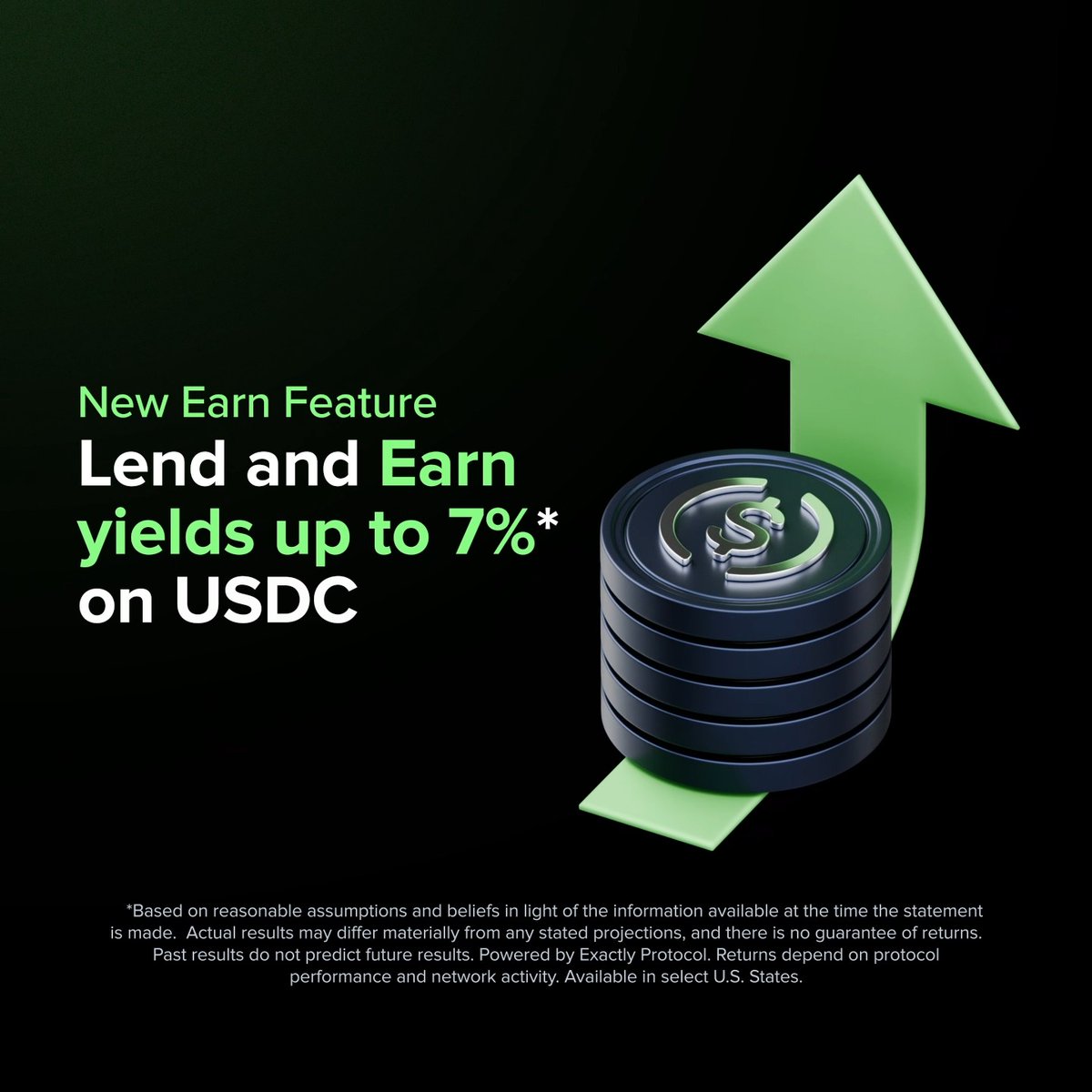
Earn yields up to 7%* on USDC 🔵 New Earn feature is live! Turn your $USDC into an active, yield-generating asset in just a few taps. → Earn yield through on-chain lending → Watch your balance grow live → Easy DeFi access Put your crypto to work 📲 *Based on reasonable assumptions and beliefs in light of the information available at the time the statement is made. Funds are deposited to, and yields are paid by, the Exactly Protocol, a decentralized protocol on the Base blockchain. Financial forecasts, even those presented with numerical specificity, are estimates based on subjective and variable assumptions that are inherently subject to material uncertainties, risks, and other changes in circumstances that are difficult to predict. Actual results may differ materially from any stated projections, and there is no guarantee of returns unless your funds are borrowed. Past results do not predict future results. Uphold cannot guarantee future performance and undertakes no obligation to assess the veracity of any stated projections. Users are cautioned not to rely on these projections when making a decision regarding Exa Earn. Available in select U.S. States. Powered by Exactly Protocol. Yield is variable and not guaranteed. Returns depend on protocol performance and network activity. Past performance does not guarantee future results. High credit demand means you may not be able to withdraw all your funds. You can withdraw your assets at any time as long as there is available (unborrowed) liquidity in the asset pool. Terms apply.

Uphold

23,791 views • 2 months ago

Given the current bullish market sentiment and the evident shift of users towards more volatile assets, there's a steadily increasing demand for stablecoins within the ecosystem. This shift is underscored by the growing use of leverage, where users borrow stablecoins to amplify their exposure to preferred volatile assets or to implement various strategies in DeFi. As the #MultiversX ecosystem currently lacks a native stablecoin, it faces challenges in achieving mature stable liquidity. Recognizing this gap, Hatom has significantly advanced in developing $USH, the first native stablecoin for #MultiversX. This stablecoin is akin to $DAI, the pioneering decentralized and over-collateralized stablecoin known for its resilience through numerous stress tests over the years, but will also feature some unique characteristics and design implementation. Within the #MultiversX ecosystem, the currently limited liquidity of stablecoins has led to notable metrics in the Hatom Lending Protocol. Here, the yields users can generate on their $USDC or $USDT have escalated to impressive middle double-digit percentages. This situation offers a golden opportunity for individuals with idle stable assets in their portfolios. The Lending Protocol is an appealing option to leverage these assets, offering remarkable flexibility—there are no lock-up periods, and it carries no risks of impermanent loss. This makes it an excellent choice to generate additional revenue while waiting for those assets to be deployed. Breaking down the current yields through the Lending Protocol as follows: • A 36.83% yield on $USDC, with 32.88% APY derived from the natural supply and demand within the lending protocol—where borrowers are paying the lenders. Additionally, the yield can be increased by 3.95% through the Booster. • A 40.24% yield on $USDT, with a 33.68% APY from providing liquidity to the Lending Protocol, which can be further boosted by 6.56% by staking $HTM into the Booster. All rewards generated through the Booster can be further amplified by 5% with the Accumulator if claimed in $HTM. *For a comprehensive understanding of how the Booster and Accumulator work, please read Hatom's official documentation. Clarification on the yields is crucial, as there is considerable interest in understanding the mechanics behind these attractive rates. Essentially, the yields on both $USDC and $USDT within the Lending Protocol are derived from the dynamics of supply and demand. Suppliers contribute funds to a pool from which other users borrow. As borrowing increases, so does the pool's utilization rate, leading to higher interest rates in both the supply and borrow markets. To achieve an optimal balance, borrowers are incentivized to repay their loans due to the higher cost of loan, which, in turn, provides lenders with more attractive returns on their deposits. This self-regulating mechanism ensures the Lending Protocol maintains a healthy equilibrium between supply and demand, optimizing yields for all participants. Rewards are paid out in the same assets that users deposit. For instance, if a user deposits $USDT into the money market, the yield generated will also be paid in $USDT. The sole exception to this rule applies to Booster rewards, which are paid out in $USDC or $HTM, with the latter offering a 5% premium. **Please note that the yields presented in this post represent current values at the time of posting and may differ by the time you read this. The most efficient way to take advantage of the high yields on the stablecoins is to bridge liquidity into the ecosystem through the official bridge developed by the #MultiversX team. The process is simple and efficient, allowing users to bridge from both #Ethereum and #BSC. You can access the bridge through the following link: To participate in the #MultiversX ecosystem, you will require a compatible wallet, which can be found here: Once your assets are ready, you can supply on the Hatom Lending Protocol by accessing this link: To facilitate your journey, please follow this step-by-step video tutorial, which covers all the basics, from the creation of a #MultiversX wallet to bridging and depositing in the Lending Protocol, to take full advantage.

Hatom Labs

159,969 views • 2 years ago

Warren Buffett on the best asset to own during inflation: The question comes from the audience at a Berkshire meeting: Is a high-return, capital-light business like See’s Candy still the best inflation hedge? Or has Buffett come around to hard assets like railroads? His answer is unambiguous. The capital-light business wins. The logic is simple. When inflation hits, a business that can grow its dollar volume without needing much additional capital is in an enviable position. He uses the most relatable example he can find. “The ultimate test is your own earning ability. If you’re an outstanding doctor, lawyer, teacher, as inflation goes along, your services will command more and more in dollar terms and you don’t have to make any additional investment in yourself.” The worst businesses to own, by contrast, are the ones drowning in receivables and inventory. If prices double but volume stays flat, they need twice the capital just to stand still. Then he walks through the numbers on See’s Candy, his favorite example of a perfect business. When Berkshire bought it, See’s was doing around $30 million in sales on $9 million of tangible assets. Today it does over $300 million on roughly $40 million in assets. They put in $30 million of additional capital over the entire period. The return on that? About a billion and a half, pre-tax. “If the price of candy doubles, we don’t have any receivables to speak of. Our inventory turns fast. The fixed assets aren’t big. That is a much better business to own than a utility business if you’re going to have a lot of inflation.” The ideal, he says, is even purer than that. “You want a royalty on somebody else’s sales. All you do is get a royalty check every month based on their sales volume. You have no receivables, no inventory, no fixed assets. That kind of business is real inflation protection.” Charlie Munger cuts in with a characteristically dry observation: they didn’t always know this. And sometimes they forget it. Buffett doesn’t disagree. “It shows how continuous learning is absolutely required to have any significant achievement at all in the world.” The reason Berkshire is now in capital-intensive businesses like railroads isn’t a change of heart. It’s a constraint of scale. There simply aren’t enough See’s Candies in the world to put tens of billions to work. “We’d love to find them. But we can’t find them in the quantity.”

Black Edge

21,061 views • 1 month ago

🚨 WARNING: NVIDIA x ELON MUSK DEAL IS BUILT ON FAKE NUMBERS!! Michael Burry published an analysis calling the structure “Fugazi”, meaning fake. If the structure is real, we could be heading for a COLLAPSE: He is alleging that BILLIONS of dollars in Nvidia chips are being hidden off balance sheets, and that American retirees are unknowingly funding the whole thing. Nvidia, the world's largest AI chip company sold $5.4 BILLION worth of its most advanced GPUs, the GB200, to a company called Valor. Valor is not a real operating business. It is a special purpose vehicle, a shell company created specifically to hold these chips and nothing else. Nvidia also invested $1.9 BILLION of its own money directly into Valor on top of the sale. Those 100,000+ chips are now physically inside xAI's data center. xAI is Elon Musk's artificial intelligence company, the one that builds Grok. xAI is using every single one of those chips right now to run its AI models. But here is what Burry is flagging. Neither Nvidia nor xAI owns those chips on paper. Valor, the shell company holds legal title. That means $5.4 BILLION in GPU assets do not show up on Nvidia's balance sheet as inventory. They do not show up on xAI's balance sheet as assets. They are legally invisible to both companies. Nvidia gets to book the $5.4 BILLION as a completed sale and record it as revenue. xAI gets full use of the chips without owning them. And the risk disappears into a shell company in the middle. Now here is where American retirees enter the picture. Valor needed $3.5 BILLION in debt to fund this structure. Apollo provided it. Apollo is one of the largest asset managers on earth with $1.03 TRILLION under management and $834 BILLION specifically in private credit. Apollo raised the $3.5 BILLION, packaged it into debt securities, and sold those securities to Athene. Athene is Apollo's own insurance company. It sells fixed and indexed annuities, retirement savings products, to ordinary Americans. When a retiree buys an Athene annuity, they believe their money is sitting in safe, stable investments. That money is now inside a structure funding Elon Musk's AI data center. The numbers inside Athene are most alarming. Athene holds $74.2 BILLION in reserves. It has moved $217 BILLION in assets into a captive insurer based in Bermuda, meaning those assets sit outside normal US insurance regulation and oversight. Of the entire portfolio, 34.7%, equal to $103 BILLION, is classified as Level 3 assets. Level 3 is an accounting classification that means there is no observable market price for these assets. No outside party can independently verify what they are actually worth. The leverage sitting on top of those unpriced assets is 16 times. Burry's says: Every step of this structure is technically legal and publicly disclosed. But the entire thing was deliberately engineered across 8 to 12 steps to move credit risk off balance sheets and away from any market pricing. Nvidia books the revenue. Apollo collects the fees. xAI gets the computing power. And retirees sitting at the bottom of a 16x leveraged Bermuda insurance structure, holding $103 BILLION in assets with no market price carry the risk without knowing it exists. I’ve been in finance for more than 15 years. When I EXIT the markets completely, I’ll say it here publicly, like I always do. Turn notifications on. If you’re not following yet, you’ll understand why that was a mistake later.

WhaleTwits

48,705 views • 1 month ago

🏠💸 Your house is worth $200,000… but good luck using it on-chain. It just sits there. No yield. No liquidity. No access to global markets. Meanwhile, billions of dollars in real-world assets are stuck in the past. 🖼️ Art, 🏢 Real Estate, 📄 Invoices, even 🇺🇸 U.S. Treasury bills — all worth trillions, yet locked in the offline world. 💡 What if you could turn that real-world value into digital assets, tradeable 24/7, globally? 🚀 Introducing @CollaterizeApp - the platform bringing your offline wealth into the digital age. Imagine tokenizing your real estate, art, farmland, or even U.S. Treasury bills... all from your phone tradable 24/7 globally? ❌ No coding. ❌ No banks. ❌ No barriers 🔧 How it Works: 📱 Use the Collaterize App 🔗 Tokenize any real-world asset ⚖️ Stay compliant with KYC/KYB/AML 💸 Trade, fractionalize, and earn — instantly 🌐 Powered by a custom Layer 1 blockchain ⚡ Fueled by $COLLAT on Solana ⛓️ This isn’t just another crypto trend. It’s a new financial era — where your physical assets finally gain digital freedom. 📲 Backed by: . A smooth mobile app . A custom Layer 1 blockchain . The $COLLAT token on Solana for utility & governance It’s Web3 for everyone — from local businesses to global institutions. From the United States 🇺🇸 to London 🇬🇧, and all over the world 🌍, anyone can access tokenized wealth safely, securely, and seamlessly Follow and Connect with Collaterize: Website: X/Twitter: Telegram:

Degen Play Gods

20,448 views • 1 year ago

SpaceX was just rumored to be worth $800B But retail investors are still locked out Unless you buy $SATS It's the next retail favorite: a SpaceX treasury play trading at a HUGE discount to NAV. Shoutout @transhumanica for being the first to call this 🧵🚀 You know Echostar ($SATS) as the OG telecom behind Dish Network. It was on death's doorstep but 3 blockbuster Spectrum deals changed everything. 1. $17B deal with SpaceX (half stock/half cash) 2. $23B spectrum sale to AT&T 3. Another $2.6B deal with SpaceX (all stock) These deals turned $SATS into a SpaceX proxy. It got $11.1B in SpaceX stock at a $400B valuation. If the $800B is true. $SATS is now sitting on $22.2B of SpaceX stock and tens of billions in cash and other assets. But its market cap was only $23B after the market close Friday (even after +10% pop) So what is $SATS actually worth? Well even if these rumors are false the math is: ~$11.1B in SpaceX ~$17B in projected net cash ~$6.4B in other spectrum assets ~$3B Boost mobile So ~$37.5B NAV. SATS popped 10% Friday because of the rumor and only closed at a $23B. Let's compute NAV with SpaceX worth $800B. ~$22.2B in SpaceX ~$17B in projected net cash ~$6.4B in other spectrum assets ~$3B Boost mobile So ~$48.6B NAV Echostar is trading at ~100% discount to its balance sheet if this valuation rumor is true. What's crazy is that $SATS should be trading at a PREMIUM to net asset value. The closest publicly traded SpaceX proxy is DXYZ. It's a closed-end fund with about 50% of its assets in SpaceX. It trades at a whopping 270% premium. $3 for every $1 of SpaceX... Now you may be wondering why I’m projecting $SATS to have $17B in cash despite currently having $27B of debt, and the SpaceX and AT&T deals only offering around $30B cash. This is probably the biggest thing that investors don’t currently understand. The Echostar holding company isn’t responsible for paying off the debt of some of its subsidiaries like Dish Network and Hughes Network Systems. These account for around $14B of that debt. Echostar only needs to pay off $11.4B of its debt because its tied to its spectrum assets as collateral. Hence $17B in cash. It's worth noting that the deals aren't done yet + SpaceX $800B is a rumor. But the government wants these deals done and SpaceX will be worth $2-3T by 2030. So how can you not get in and buy discounted SpaceX stock through $SATS. Another reason $SATS will explode? 95% of Echostar's float is held by institutions. That remaining 5% will get attacked by retail once its figured out. At the time I'm making this thread $SATS jumped 10% Sunday night pre-market. That's +20% in 72 hours. The market is waking up but it's still very confused. Big thanks to @transhumanica who published the original thesis on Echostar being a SpaceX proxy. You MUST follow him as he was behind the $KRKNF Anduril proxy TOO. He's got some of the best research in the game and a must follow on this platform if you want real alpha. If you want to stay up to date with $SATS, I'm going to cover it more here Michael Sikand 🦑 Will also discuss on my stream tmrw with WOLF I highly recommend you just watch my YouTube video as it's far more comprehensive than this thread.

Michael Sikand 🦑

56,862 views • 7 months ago

Dropping a podcast repost today that I did with Mark Moss a few months back that is well worth a listen. It’s packed with insights on YouTube, lead gen, business building, and Mark’s predicted incoming inflationary crash. We talk about: - How he holds a 65% retention rate on YouTube - The upcoming market crash and how to prep - The future of the marketing and how to adapt - Tips for focused note taking Here’s what I learned: 1. Our education systems are built for analytical thinkers, but analytical thinking won’t get you ahead anymore. Sites like Upwork have commoditized technical workers globally, making them easy to access at affordable rates. To compete, you need to have a creative mind. 2. Most people are afraid of the wrong kind of market crash. They’re expecting a deflationary crash, like what happened in 2008 when everyone sold their assets. Mark is predicting an inflationary crash, where you want to increase your assets. If you’re a business owner, you should raise your prices. If you’re a W2 employee, lower your expenses, negotiate your pay, and try to get more assets. 3. There are three types of assets - scarce assets (collectibles, cars, bitcoin, property), energy-intensive assets (gold, wheat, oil, uranium), and non-scarce/non-energy-intensive assets (equities, etc). Focus on the first two. 4. “It’s not ‘who you know’, it’s ‘who knows you’”. Creating content and becoming well-known makes deals happen that otherwise never would have been there. 5. Mark has an insane 65% retention rate on his YouTube videos. He says its because of good storytelling. 6. Mark uses a ~60s hook framework for his videos: who’s it for, what’s it for, and status change, or what the viewer will get out of the video if they watch it till the end. 7. If you’re making long-form content, your videos should be at least 8 minutes long so you can have two ad slots. 8. Mark doesn’t like short form content because it lacks depth and connection. He thinks long-form YouTube is the mothership for content. 9. Listening to audiobooks at the same time as you read the physical copies can help you better take in information. 10. All growth comes from long-term thinking. 11. Capture every idea and make a list of the evergreen content you want to create. 12. Mark up your books with post-it notes to make it easy to reread them (reread your books). 13. Take focused notes when you’re at a conference. Draw a vertical line down your notebook page and put your notes on the left and what that note is immediately applicable to on the right. 14. At least 1-3% of your portfolio should be Bitcoin. 15. Mark thinks we’re approaching a cataclysmic event where AI will create so much spam that the internet may become unusable. To differentiate, you’ll need personal interaction (a personal brand). This only half scratches all we talked through. Check out the full video here:

ericosiu

12,461 views • 2 years ago

So what exactly is Enosys Loans, and why should you be interested? Enosys Loans is an upcoming Collateralized Debt Protocol utilizing assets on the Flare ☀️ (FXRP, wFLR, stXRP, sFLR, etc) as collateral to mint a stablecoin (CDP). This differs from a traditional lend/borrow market like Kinetic.Market☀️ in that the Loans protocol itself is the counterparty to the loan, rather than a pool of user assets that are allocated for lending. In Enosys Loans, borrowers set their own interest rates, with 75% of the interest being paid to that collateral asset’s stability pool. (The remaining 25% is split between Enosys and the APY Cloud.) CDP holders can stake their CDP into one of the collateral branches' stability pools to earn real yield from the protocol, as well as incentives paid out in rFLR and APS. While in the stability pool, CDP staked by users may be used to cover debt during a liquidation event. If this happens, the value of the CDP used to pay the debt is rewarded with 1.05x its value in the collateral asset. Here is an example: A user takes $10,000 worth of wFLR and opens a new loan, taking debt of $5,000 CDP at a user set interest rate of 4%. Their wFLR being used as collateral is automatically delegated to DeFi Oracles, and they continue to receive delegation rewards and FlareDrops, claimable through Enosys. The user then takes $4,000 CDP and places it in the stability pool for FXRP, earning a share of 75% of all fees generated by the FXRP branch, as well as a share of rFLR and APS incentives being rewarded to that stability pool. They take the remaining $1,000 CDP and pair it with USDT0 in the Enosys DEX V3 LP, now earning swap fees, rFLR, and APS incentives based on their share of active liquidity on the CDP/USDT0 pair. A liquidation event happens on the FXRP side and $100 CDP of the users stake is used to cover the debt, leaving the user with a reward claim of $105 worth of FXRP at the liquidation price. So, the user is now earning delegation rewards, FlareDrops, CDP interest yield, FXRP liquidation yield, CDP and USDT0 swap fees, rFLR incentives and APS incentives. All at a user set interest rate of 4% on the initial debt. #XRPFI

Ēnosys

48,697 views • 8 months ago

Most people think they understand finance. They don't. They know how to send money. Maybe how to trade. But the actual machinery underneath who controls which assets, who gets access to which markets, who decides who can even participate most people never see that part. And that's exactly where the problem starts. Right now, trillions of dollars in real-world value real estate, bonds, private credit, alternative funds are locked inside systems that were never designed to include you. Not unless you have the right passport, the right broker, the right balance in the right bank account. Traditional finance has always had an invisible velvet rope. Most of us just never got close enough to see it. Blockchain was supposed to change that. And it tried. DeFi opened a door. But even DeFi, for all its freedom, couldn't actually touch the real world. Tokens, yes. Speculation, yes. But actual real-world assets handled with proper compliance, proper security, proper legal enforceability that gap never really closed. Until something like Real comes along and asks a very different question. What if you didn't bolt RWA tokenization on top of an existing chain? What if you built the entire Layer 1 around it from the ground up? That's what Real is. The first fully decentralized, fully permissionless L1 blockchain built specifically not partially, not as a feature, but architecturally for the native tokenization of Real-World Assets. What does that mean ? It means things like bonds, real estate, private credit, and commodities can live on-chain with full transparency, full compliance, and full security baked into the protocol itself. Not added later. Not patched in. Native. They call it solving the "RWA Trilemma." Most tokenization projects have to sacrifice one of three things security, decentralization, or regulatory compliance. You either get compliant and centralized, or decentralized and legally fragile. Real built a hybrid validator architecture that doesn't make you choose. Business validators tokenizers, risk scorers, insurers each play a specific role in the asset lifecycle, staking tokens and facing real onchain penalties if they act wrong. The result is a system where real-world assets carry their own risk data, their own compliance metadata, and their own insurance all embedded directly at the protocol level. $29 million raised. A partnership with Wiener Privatbank SE: an actual institution. A partnership with RWA Inc. The $16 trillion RWA opportunity. A target of $500 million in tokenized assets. The numbers matter. But what matters more is the architecture. This feels like someone actually sat down and thought: what would financial infrastructure look like if it was rebuilt for the next hundred years? Finance was always a wall. What Real is building slowly, quietly, but very deliberately might just be a door. And most people still don't see it yet. #UCCC

Meow

11,164 views • 1 month ago

$sthUSD Is Live: Yield Becomes Native at Tharwa Today we open the next chapter of Tharwa. $sthUSD, our yield-bearing stablecoin layer, is now live and ready for the public. For years, stablecoins have been a $250B+ market, but nearly all of that capital has sat idle. Holders earned nothing while issuers pocketed the yield. sthUSD changes that. It makes yield a native property of money itself, flowing directly into your wallet from a portfolio of real-world assets. What is $sthUSD? sthUSD is the staked version of thUSD. It is built on an ERC-4626-inspired design, reconfigured specifically for Tharwa with a new instant-withdraw class and optimizations that make it more efficient. At launch, entry and exit fees are set at zero to encourage adoption. The mechanics are simple: • Mint $thUSD • Stake it into the $sthUSD contract • Receive $sthUSD and watch your balance grow automatically No farming gimmicks, no manual claims, no hidden risks. Withdrawals are instant. Where the Yield Comes From The yield behind sthUSD is real and transparent. It comes from the same diversified portfolio that backs thUSD: sukuk, UAE real estate, gold, and capped exposure to commodities. As these assets generate income, returns are routed through the protocol treasury and distributed proportionally to sthUSD holders. Rewards are time-weighted, vested automatically, and visible on-chain. This is not emission-driven yield. It is powered by cash flows from real-world assets, optimized through Tharwa’s portfolio design and risk framework. Why sthUSD Matters sthUSD completes the foundation of Tharwa’s ecosystem. thUSD provides stability. sthUSD turns it into a currency that compounds by default. Together, they make Tharwa function like an on-chain hedge fund: stable by design, yield-bearing by nature. That opens the door to much bigger things. sthUSD can become the backbone collateral for DeFi integrations, a reserve asset for DAOs, or a passive income instrument for institutions. It is designed to be simple for retail, yet robust enough for treasuries and fund allocators. The speculation is not whether sthUSD will matter, it is how far it spreads once DeFi realizes what it unlocks. What’s Next Launching sthUSD is not the end, it is the start of a much larger system. Coming up: • Expansion of static yield bonds through ERC-1155 vaults • Integration of sthUSD into DeFi liquidity pools and lending protocols • OTC marketplace for secondary liquidity • Production-grade AI assistant for rebalancing • Development of segregated sukuk vaults for faith-aligned yields sthUSD is the product that transforms thUSD from a stable placeholder into an income-generating unit of account. If stablecoins were the backbone of DeFi until now, sthUSD is what makes that backbone yield-bearing and alive. Stake Now:

Tharwa

54,757 views • 10 months ago